The location where it started, 677 Third Avenue, isn't that far from Grand Central Station in midtown Manhattan. There, thousands of commuters pass each day, most unaware of the terrible historical events that occurred over four days. The start was 150 years ago yesterday.
One year ago yesterday, July 13, 1863, was a hot, muggy day, much like the day New York City (and where I live in upstate New York) is having today.
The pay system of the Union and the Confederate States was somewhat complex and beyond the scope of this layperson's blog.
The Union Army had suffered great losses in its effort to keep states
that had seceded from the Union from breaking away, and they needed more
soldiers. In March of 1863, a National Conscription Act was passed. But, men could buy their way out by hiring a substitute for
$300. $300, in 1863, was a sum only a rich man could afford.
Working people were, to put it mildly, upset at the prospect of being
drafted into the Civil War, and they were ready to demonstrate their
opposition to the National Conscription Act.
Working people, knowing the rich were buying substitutions, were ready to protest when the drafts were implemented in July of 1863.
July 13 was the second day of the draft lottery.
What started out as a draft protest quickly went out of control (with others, not quite interested in protesting the draft but more interested in racial violence, joining in) and turned into the largest civil insurrection in the history of our nation, and a race riot. Whites were the aggressors, and blacks were the victims.
One of the "highlights" (or low lights, as you will) was the burning of the Colored Orphan Asylum
a few blocks from the draft lottery office. Amazingly, over 200 black orphans escaped due the heroics of staff and several New York City firemen, and the Asylum was eventually reestablished elsewhere.
Finally, Federal troops, some fresh from fighting at Gettysburg, PA at the beginning of July, suppressed the "draft riots". There are a lot of recent resources online to read more about these riots.
An especially eye opening website shows European reaction to the riots in New York City.
And, a New York Times blog post is a good source of information regarding the life of blacks in New York City in that time era.
Again, history is never clean. It is always more complicated than we want to think, and sometimes goes in directions never expected.
Another episode in the epic story of the war that tore our nation apart from 1861-1865.
Sunday, July 14, 2013


Saturday, July 13, 2013
Sustainable Saturday - Pictures at a Community Garden
Today is an almost-wordless Saturday. I am going to let some pictures from my spouse's community garden plot do the blogging today, as I have fun with some out of town visitors.
 Our first zucchini (taken July 7) - the stony soil we garden in is visible here.
 Not all flowers in a garden belong to ornamentals. Here are white bean flowers.
 And finally, produce we got today from that garden, including - our first tomatoes (Juliet) of the year! July tomatoes are a big thing in upstate New York. (Not shown: our first green and purple beans.)
 We are so fortunate to be able to have a community garden plot as there isn't much room to grow at our house.
Is it gardening season where you live? If so, and you have a garden, what's ready to pick?
Monday: Garden Bloggers Bloom Day, and you'll see what's blooming at my upstate New York house.


Is it gardening season where you live? If so, and you have a garden, what's ready to pick?
Monday: Garden Bloggers Bloom Day, and you'll see what's blooming at my upstate New York house.
Friday, July 12, 2013
The Story of Jessie
Interesting things happen on the elevated New York City park called the High Line.
Does this remind you of a woman who has, perhaps, doused herself in water to escape the July heat?
 No. This isn't a woman who decided to drench herself in water to escape the heat.
It is public art. Here's the biography of "Jessie":
 And now, look what happens when another artist, Jeff Greenspan, puts a tip jar in front of this statue. The video lasts only a little more than a minute, and has gathered over 1,277,000 views on You Tube.
Poor Jessie. The subject of a psychological experiment? A trick played on tourists? A public art performance?
It makes me wonder, though - what happened to the money the artist collected? I hope, at least, that he donated it to the High Line.
If you had been there, what do you think you would have done?
Does this remind you of a woman who has, perhaps, doused herself in water to escape the July heat?

It is public art. Here's the biography of "Jessie":

It makes me wonder, though - what happened to the money the artist collected? I hope, at least, that he donated it to the High Line.
If you had been there, what do you think you would have done?
Thursday, July 11, 2013
Busted! on the High Line
Well, that should get my blog fans and friends to talking.
No, dear friends, I was not arrested on the High Line, an elevated park located on the West Side of Manhattan, which was formerly used by freight trains. Note the "!" in the title.
After I got past the initial rush of being surrounded by flowers and trees on the West Side of Manhattan, I noticed something was looking at me.
 A bust.
"Busted" is an exhibition of pieces of public art, which will run into next year. Not all of them, technically, are busts. But, they are there until next April, for our enjoyment.
This is a bust of Colin Powell, former four-star general and Secretary of State of the United States. (He was even offered the chance of running for President but declined.) He was born in Harlem but raised in my native Bronx.
 Yes, Colin Powell has been Busted!
Here's one called "Untitled-Top Gates Mask".
 And its sign.
 One empty pedestal was left empty on purpose, so people could vote on a 10th "bust". It would be made of the winner of the vote.
The people have spoken. And, alas, it wasn't me. Just as well - I'm sure the pigeons would have loved the opportunity.
Would you want to have a piece of public art created in your image?
No, dear friends, I was not arrested on the High Line, an elevated park located on the West Side of Manhattan, which was formerly used by freight trains. Note the "!" in the title.
After I got past the initial rush of being surrounded by flowers and trees on the West Side of Manhattan, I noticed something was looking at me.

"Busted" is an exhibition of pieces of public art, which will run into next year. Not all of them, technically, are busts. But, they are there until next April, for our enjoyment.
This is a bust of Colin Powell, former four-star general and Secretary of State of the United States. (He was even offered the chance of running for President but declined.) He was born in Harlem but raised in my native Bronx.

Here's one called "Untitled-Top Gates Mask".


The people have spoken. And, alas, it wasn't me. Just as well - I'm sure the pigeons would have loved the opportunity.
Would you want to have a piece of public art created in your image?
Wednesday, July 10, 2013
Simply Summer - Six Cups of Water
Radiation treatment is not fun, not at any season of the year, but especially not in summer.
When a member of a local community chorus in the New York City borough of Brooklyn was diagnosed with cancer, he didn't take it lying down. OK, he did have to take it lying down, but his voice wasn't going to be stilled.
Partially out of boredom and partially to entertain his fellow patients undergoing radiation treatment, this man, my friend of many years, decided to write and sing songs while undergoing his treatments.
Hence, something we can call Six Cups of Water in Three Variations. Why six cups of water? My friend must drink six cups of water before the treatment begins. And, then, hold it in until the treatment ends.
He's passed his halfway point and "only has 20 more treatments to go."
The video above came out the best, probably because I finally figured out that the lighting was all wrong in the first two. Remember, I am just starting out in my video career.
So without further ado...Six Cups of Water.
My friend graciously (OK, eagerly) sang all three songs in the series. The third video (the first one I shot) didn't come out that well (don't ask why part of it is sideways-you really don't want to know), but the audio is fine - I just don't have the knowledge or software to fix the video portion up. So VERTIGO WARNING close your eyes and just listen to the music on this third one.
And remember, you might have to pay good money one day to hear him sing! Just think if these take off and go viral....probably not but we can dream.
If you like what you heard please show my friend some blog love, and tell him so in the comments!
Tuesday, July 9, 2013
Signs above Manhattan
Last Friday, my spouse and I walked the High Line, the elevated New York park that was formerly freight train tracks, for the first time. Although it was our first time, it won't be our last.
One thing you can say about New York City weather in July - it is hot. And humid. But despite that, crowds walked the High Line.
With a head half spinning from the heat, and totally disoriented with the joy of being surrounded by trees and flowers in Manhattan, I started taking pictures.
Something that struck me right away were the signs on nearby buildings. After all, when you have four million visitors to a place each year, you want to have your sign out there.

For example, Patagonia asks us to take an "environmental pledge". (I don't buy their clothing, so this is not an endorsement.) Why not, near a park dedicated to the environment?

Then, I saw this sign above 10th Avenue in Chelsea. Apparently, this sign is a favorite of people on Flickr. It's one of my favorites, too. This was our first view and the sign was so perfect against the Manhattan building backdrop.

And then, we got a little closer. It really was for a parking lot! Considering that it really does take a miracle to find parking in most of Manhattan - I think the Almighty would really rather have residents and tourists take the subway (we did) and let Him concentrate on the really important stuff.

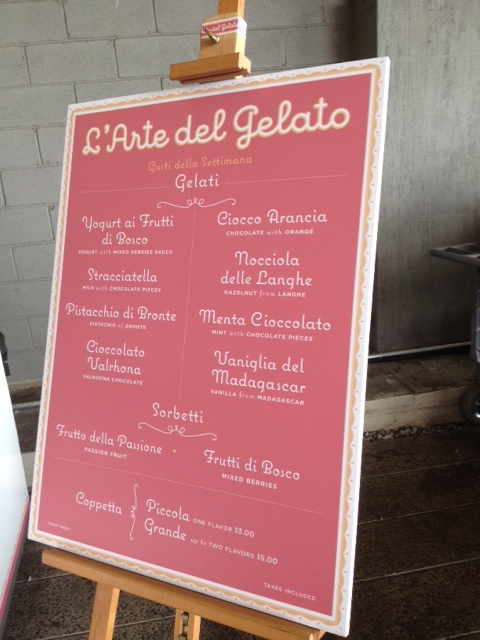
Finally, I am going to be mean and make your mouth water. Here are signs by a couple of the food vendors on the High Line.
 In New York City, foods blend together. There was also a "taco truck" and a gourmet "soda works".
Tomorrow, a special Simply Summer post. I'll resume blogging about the High Line- its flowers and its arts - later this week or next.
One thing you can say about New York City weather in July - it is hot. And humid. But despite that, crowds walked the High Line.
With a head half spinning from the heat, and totally disoriented with the joy of being surrounded by trees and flowers in Manhattan, I started taking pictures.
Something that struck me right away were the signs on nearby buildings. After all, when you have four million visitors to a place each year, you want to have your sign out there.

For example, Patagonia asks us to take an "environmental pledge". (I don't buy their clothing, so this is not an endorsement.) Why not, near a park dedicated to the environment?

Then, I saw this sign above 10th Avenue in Chelsea. Apparently, this sign is a favorite of people on Flickr. It's one of my favorites, too. This was our first view and the sign was so perfect against the Manhattan building backdrop.

And then, we got a little closer. It really was for a parking lot! Considering that it really does take a miracle to find parking in most of Manhattan - I think the Almighty would really rather have residents and tourists take the subway (we did) and let Him concentrate on the really important stuff.

Finally, I am going to be mean and make your mouth water. Here are signs by a couple of the food vendors on the High Line.
Tomorrow, a special Simply Summer post. I'll resume blogging about the High Line- its flowers and its arts - later this week or next.
Monday, July 8, 2013
Welcome to the High Line
On a hot summer day in Manhattan, we visited a park. It was 93 degrees and humid, but nothing was going to stop us.
This is what the park looks like from street level as you walk on the cobblestones of Gansevoort Street in the Meatpacking District.
Once upon a time, this park was a "spur" of the New York Central Railroad. Freight trains ran on this from 1934 to 1980. Then, for years, it sat there, abandoned. Eventually, CSX Transportation, Inc. donated the abandoned line to the City of New York.
 Some of the original track is still there, planted in flowers, grasses and trees.
 Climb these stairs (or take the elevator) and prepare to be amazed. You are about to walk on the High Line.
What is the High Line? It is trees, plants, wildflowers, domestic flowers, grasses, food vendors, young people, old people. Four million people a year visit it. It even has a blog. One mile of the 1.45 miles is now open. The park won't be complete until 2014, but there is so much to see now.
If you aren't into plants, look at the public art (more on that in another post). If you aren't into art, look at the signs, and the city scenery around you. No matter how many times you have seen Manhattan (I am a native New Yorker, by the way, and lived there for some 21 years) you haven't seen the biggest city in our country like this.
Come with me on my High Line walk. I'll be posting photos (and details) from time to time in the coming weeks.
What is your favorite public park?
 | ||
| Echinacea purpurea "Vintage Wine" |
 .
This is what the park looks like from street level as you walk on the cobblestones of Gansevoort Street in the Meatpacking District.
Once upon a time, this park was a "spur" of the New York Central Railroad. Freight trains ran on this from 1934 to 1980. Then, for years, it sat there, abandoned. Eventually, CSX Transportation, Inc. donated the abandoned line to the City of New York.


What is the High Line? It is trees, plants, wildflowers, domestic flowers, grasses, food vendors, young people, old people. Four million people a year visit it. It even has a blog. One mile of the 1.45 miles is now open. The park won't be complete until 2014, but there is so much to see now.
If you aren't into plants, look at the public art (more on that in another post). If you aren't into art, look at the signs, and the city scenery around you. No matter how many times you have seen Manhattan (I am a native New Yorker, by the way, and lived there for some 21 years) you haven't seen the biggest city in our country like this.
Come with me on my High Line walk. I'll be posting photos (and details) from time to time in the coming weeks.
What is your favorite public park?
Sunday, July 7, 2013
Civil War Sunday - Paula Deen and the Civil War
Next week we mark the 150th anniversary of the start of a terrible riot in New York City. On July 13, 1863, an event related to the Civil War...well, you'll have to come back to read more about it.
But something that is happening now, in our United States, has echoes of the event now called the New York Draft Riots. It won't be commemorated next week in the same way that famous battles, such as Gettysburg, were, which is why I need to blog about it.
But first, back to the present.
By now, if you are an American, you have heard of a woman by the name of Paula Dean. Many of us are probably sick of hearing about her, and I don't intend to add any fuel (to to speak) to the fires that are already burning. But the fact that this fire is burning at all is proof, as I have said too many times, that we are still fighting the Civil War (just less physically) here in the United States.
Just go on any of the thousands of web sites carrying coverage (of any sort) of the Paula Dean controversy and read the comments. The articles themselves may be of some interest but it's the comments that will really interest you.
I have a number of fans abroad (thank you!), so let me briefly explain who Paula Dean is. She is a celebrity chef, restaurant owner, creator of various lines of cooking equipment that, until recently, were sold in major department stores, and is basically a one woman industry. Paula has (or, actually, had) several cooking shows on a cable network called The Food Network.
She has an awful lot of fans in this country who love her decadent, butter-heavy recipes. I may not eat in that style, but I also believe in personal responsibility, so if you want to check out her recipes, "go for it".
She and her family are responsible for a lot of tourism to Savannah, Georgia, a city I last visited in March of this year, and a city that I love.
Paula being in the news started with a former restaurant manager suing Paula and her brother for racial harassment and another kind of harassment I can not mention in a "G" rated blogging competition. In a deposition for the lawsuit, Ms. Deen admitted to using a word I would have been severely punished for using in my childhood, but also a word that is still way too commonly used in this nation. As a result, Paula Deen has lost her contract with the Food Network and is quickly losing endorsements and other contracts.
She has kept a lot of her fan base, and I can say that she has a lot of fans in upstate New York, where I live. A lot of people feel for her plight. But, by now, you are asking "what does Paula Dean have to do with the Civil War?"
Paula Dean had ancestral relatives who were slave owners. Don't be shocked by this; most people who lived between the founding of our country (and prior!) and the Civil War era (1861-1865) benefited either directly or indirectly by slavery. And then there were the slaves - let's not forget about them.
With that in mind, listen to portions of the interview.
Paula Deen's great grandfather committed suicide after the Civil War. He was despondent. His life was ruined. And, his "30 workers" ran away.
Those 30 workers weren't workers except in the loosest definition of the word. They were SLAVES, human chattel, to use and abuse however the owner wished. Perhaps Paula Deen's great grandfather didn't abuse his slaves (if you ignore the fact that enslaving people is abuse), but the truth is, they weren't "workers". So, Paula seriously can not utter that word that describes what those workers were.
No, I don't mean the N word.
Instead, she can't utter the S word. You know, Slave. As in "yes, my family owned other human beings at one time". 30 were a lot? How about one? Many descendents of slave owners have faced that part of their geneology. Many others haven't. I can't speak for the descendents of said slaves but they can speak just fine for themselves.
Don't tell me those workers were like family, Paula. Yes, humans thrown into circumstances shared with other humans form bonds. But, what does that tell you, that those 30 workers ran away after the war. You're surprised? They were slaves and now they were free. Free like you and me, to make something of the rest of their lives. And they obviously (to use another cliche) voted with their feet.
Our country has a long way to go. Race relations are a delicate topic. It remains delicate. Will the Paula Deen episode allow us to finally lance that boil upon the skin of our nation? I doubt it.
Next week: the New York Draft riots.
Saturday, July 6, 2013
Sustainable Saturday - Up on the Roof and the Fire Escape
It's July and summer is already a couple of weeks old. New York gardening season is in full swing.
Especially in New York City.
New York City? The land of the "concrete canyon"? Well, yes. Wherever you find a spare piece of ground near where people live, you may well find green sights like these:
 Photographed from the High Line elevated park, Manhattan, New York City (see low building on left side, with trees. Yes, this is a rooftop garden - and they may well have edibles planted there, too.) (And yes, I am going to do a feature on my visit to the High Line next week.)

I think this plant may be a luffa plant - but whatever it is, it is climbing up a fire escape ladder in Brooklyn.

A Brooklyn zucchini, growing in a narrow strip between an apartment building and the sidewalk. And here are some more plants in that garden:
 Swiss chard and tomatoes.
 Eggplant in back, tomato in front.

No dirt? No problem! Here's a tomato plant in a container. Doesn't need to be a fancy container, either. (Apartment dwellers do have other challenges - which I am well aware of as I lived in an apartment without a balcony or access to the roof for some 21 years.)
 And dill.

Finally, in a small backyard - a fig tree. (Wish we could have good fig trees by where I live in upstate New York.) See the small trunk next to the pole.
Have you seen gardens in large cities? Does your city have any special program to encourage them?
Especially in New York City.
New York City? The land of the "concrete canyon"? Well, yes. Wherever you find a spare piece of ground near where people live, you may well find green sights like these:


I think this plant may be a luffa plant - but whatever it is, it is climbing up a fire escape ladder in Brooklyn.

A Brooklyn zucchini, growing in a narrow strip between an apartment building and the sidewalk. And here are some more plants in that garden:


No dirt? No problem! Here's a tomato plant in a container. Doesn't need to be a fancy container, either. (Apartment dwellers do have other challenges - which I am well aware of as I lived in an apartment without a balcony or access to the roof for some 21 years.)


Finally, in a small backyard - a fig tree. (Wish we could have good fig trees by where I live in upstate New York.) See the small trunk next to the pole.
Have you seen gardens in large cities? Does your city have any special program to encourage them?
Friday, July 5, 2013
Lemonade Crocheting and Knitting
The spouse of my friend in Brooklyn has to spend a lot of time in doctor's offices to be treated for a medical condition. My friend normally comes with him and waits for him while he has his treatment - sometimes waiting an hour (or even more).
Out of boredom, she started to do her needlework while waiting.
She does beautiful crocheting and knitting work - and, recently, has been working on projects for pediatric oncology patients.
I crochet but I do not knit, and I wanted to show off her work because I know quality work when I see it. I think the work, and the cause, is fantastic.

A crocheted blanket and some knit hats.
 Another crocheted blanket.
 And finally, some hats and scarves.
Aren't these beautiful? (Lately, she has had some yarn donated to her but I suspect enough of these projects were done using her own money.) We have the cliche "lemons out of lemonade" - this is about as lemony as you can get.
I've done a handful of crocheting for charity but never anything like this.
Have you ever done crocheting or knitting for charity?
Out of boredom, she started to do her needlework while waiting.
She does beautiful crocheting and knitting work - and, recently, has been working on projects for pediatric oncology patients.
I crochet but I do not knit, and I wanted to show off her work because I know quality work when I see it. I think the work, and the cause, is fantastic.

A crocheted blanket and some knit hats.


Aren't these beautiful? (Lately, she has had some yarn donated to her but I suspect enough of these projects were done using her own money.) We have the cliche "lemons out of lemonade" - this is about as lemony as you can get.
I've done a handful of crocheting for charity but never anything like this.
Have you ever done crocheting or knitting for charity?
Thursday, July 4, 2013
The 150th Anniversary of the Fall of Vicksburg
(A partial rewriting of a post from July 3, 2011).
Today is July 4, Independence Day for the United States.
I first found this story out on Ken Burn's classic TV mini series on the United States Civil War. (As I write, keep in mind that I am a native of New York State.)
Vicksburg, Mississippi, in a former Confederate state, has an online listing of community events. Listed in here, along with the Farmers Market, Faith Fest and the Old Court House Flea Market, is the "Red, White and Blue" Fourth of July weekend, and the 4th of July fireworks. Nothing special, here. Nothing different than what thousands of other cities and towns in the United States offer in celebrating our nation's Independence Day.
Or is it different?
Several generations of citizens of Vicksburg, Mississippi didn't know what a hometown 4th of July celebration was like-because they didn't have one. Stores remained open. People went about their business. And stories were told, dark stories, about the Siege of Vicksburg and its surrender to the Union Army on July 4, 1863. It is said that General Pemberton, the commanding general of the Confederate States of America forces at Vicksburg, chose to surrender Vicksburg to the Union army on Independence Day as he thought they would get more favorable terms of surrender.
After that surrender, Vicksburg did not celebrate Independence Day until 1945.
Even in 1997, they still had a problem with it.
We must try to understand why Vicksburg felt that way. Vicksburg is located on the Mississippi River, one of the most important waterways in our nation. It was just as important, if not more so, in the 1860's. It was vital for the Federals to take control of the Mississippi in order to win the war.
Vicksburg stood in the way. So, it was put under siege by Union forces commanded by General Grant and starved into submission. As a young girl growing up in the Bronx, I remember drawings in a textbook showing how the residents ended up taking refuge in caves dug into hillsides, and what they used for food as the siege progressed. Rats would have been a gourmet treat.
Towards the end, they were printing their newspaper on wallpaper because they had run out of paper.
For Vicksburg, July 4th didn't stand for our country's birthday but rather was symbolic of what its fellow citizens did to it back in 1863. I can only think that its citizens going overseas and fighting World War II side by side with the descendents of its former enemies of 80 years before, to fight a strong evil threatening to overtake the world, is what finally started to heal those wounds.
As William Tecumseh Sherman said, "War is Hell". Especially for civilians caught in the crossfire.
In another twist of history, the same Union General Sherman, the day after Vicksburg's surrender, started practicing for what would become his infamous "March to the Sea" by marching through Central Mississippi and burning Jackson.
The descendents of those people still remember, too.
Indeed, the wounds of the Civil War are still there, right underneath our collective skin, both North and South, not fully healed. This was true when I first wrote about Vicksburg in 2011, and is still true today. The wounds may not fully heal even in my lifetime.
Tomorrow, back to my regular blogging schedule.
If you are in the United States, have a wonderful Independence Day.
Wednesday, July 3, 2013
The Sentinals and the Heroes
When I visited Gettysburg, as I did at the dawn of the 21st century, I was immediately struck by one thing on the preserved battlefield.
The stone sentinels. The bronze sentinels.
On the battlefield, there are statues. Monuments. Monument after monument. In a way, you can consider Gettysburg as a huge outdoor art gallery. It's overwhelming, and, if you don't know the history behind them, even a bit puzzling.
Battalion monuments. Individual monuments. State monuments. Union monuments. Confederate monuments. Monuments and markers where people fought, and people died. Monuments in meadows and hills. I wish I had my pictures in electronic form from that trip, but I don't.
According to battlefield historians, people actually ask how those monuments were protected during the battle and how all the bullet holes were repaired afterwards. (They also ask questions such as "how did they direct traffic during the battles?" and "why were all the battles fought in national parks?")
I don't think I would last long as a public historian, not that I am even a historian.
But I digress - just a little. I had promised to blog about Confederate heroes at Gettysburg today.
Day three of the Battle of Gettysburg dawns. Actually, the fighting started at 4am, before dawn.
Both sides basically occupied the same ground as they had at the end of the second day's fighting. In the morning, the Confederates would try (and fail) to take Culp's Hill. The rebels then made a deadly gamble.
First, there would be a massive bombardment of the Union center under General Longstreet, lasting nearly two hours. Then, 12,000 Confederate troops were ordered to attack the heart of the Union lines.
Divisions headed by Major General Isaac R. Trimble, Major General George Pickett and the other headed by Brigadier General General James Johnston Pettigrew, participated.
The "charge" (which it wasn't for those soldiers; it was a walk across a mile of hell and over a stone fence, as bullets mowed them down) is, today, commonly called "Pickett's Charge" after General George Pickett. I am not a military historian, and I am not going to debate the details of who ordered it, who didn't want to do it, and so forth. One thing, though, is certain. People have been trying to blame one participant or the other for the defeat for the past 150 years.
Today, you can find "the high water mark of the Confederacy" on the Gettysburg battlefield. This is as far as the Confederates got in their invasion of the North, during Pickett's Charge. They would never get that far again.
Except for one small instance, the Confederates were not able to break through the Federal lines. Pickett lost over half of his division. He lost every one of his 15 regimental commanders.
So, could you say, that those 12,000 Confederates were heroes? Perhaps. They were certainly brave, as they continued to charge while their fellow soldiers died all around them. I do not agree with their cause but I can't argue against their bravery.
If we look for a one true hero of Gettysburg, we will probably never find that person.
So, the battle finally ended, but at what a cost - 51,000 dead, injured, captured. There were some skirmishes on July 4, but the battle is considered to have ended on July 3.
Are you related to anyone who fought in the Civil War, and may have been at Gettysburg?
The stone sentinels. The bronze sentinels.
On the battlefield, there are statues. Monuments. Monument after monument. In a way, you can consider Gettysburg as a huge outdoor art gallery. It's overwhelming, and, if you don't know the history behind them, even a bit puzzling.
Battalion monuments. Individual monuments. State monuments. Union monuments. Confederate monuments. Monuments and markers where people fought, and people died. Monuments in meadows and hills. I wish I had my pictures in electronic form from that trip, but I don't.
According to battlefield historians, people actually ask how those monuments were protected during the battle and how all the bullet holes were repaired afterwards. (They also ask questions such as "how did they direct traffic during the battles?" and "why were all the battles fought in national parks?")
I don't think I would last long as a public historian, not that I am even a historian.
But I digress - just a little. I had promised to blog about Confederate heroes at Gettysburg today.
Day three of the Battle of Gettysburg dawns. Actually, the fighting started at 4am, before dawn.
Both sides basically occupied the same ground as they had at the end of the second day's fighting. In the morning, the Confederates would try (and fail) to take Culp's Hill. The rebels then made a deadly gamble.
First, there would be a massive bombardment of the Union center under General Longstreet, lasting nearly two hours. Then, 12,000 Confederate troops were ordered to attack the heart of the Union lines.
Divisions headed by Major General Isaac R. Trimble, Major General George Pickett and the other headed by Brigadier General General James Johnston Pettigrew, participated.
The "charge" (which it wasn't for those soldiers; it was a walk across a mile of hell and over a stone fence, as bullets mowed them down) is, today, commonly called "Pickett's Charge" after General George Pickett. I am not a military historian, and I am not going to debate the details of who ordered it, who didn't want to do it, and so forth. One thing, though, is certain. People have been trying to blame one participant or the other for the defeat for the past 150 years.
Today, you can find "the high water mark of the Confederacy" on the Gettysburg battlefield. This is as far as the Confederates got in their invasion of the North, during Pickett's Charge. They would never get that far again.
Except for one small instance, the Confederates were not able to break through the Federal lines. Pickett lost over half of his division. He lost every one of his 15 regimental commanders.
So, could you say, that those 12,000 Confederates were heroes? Perhaps. They were certainly brave, as they continued to charge while their fellow soldiers died all around them. I do not agree with their cause but I can't argue against their bravery.
If we look for a one true hero of Gettysburg, we will probably never find that person.
 |
| Confederate reenactors |
So, the battle finally ended, but at what a cost - 51,000 dead, injured, captured. There were some skirmishes on July 4, but the battle is considered to have ended on July 3.
Are you related to anyone who fought in the Civil War, and may have been at Gettysburg?
Tuesday, July 2, 2013
Hold the High Ground
150 years ago yesterday, near a small town in southeast Pennsylvania, Confederate skirmishers and four Union soldiers ran into each other. Few men were expecting a fight. No one would have chosen what happened next.
The rebels, it is said, were on the march to try to find shoes, a clothing item that enough of their men had to do without because provisions, and funds, were inadequate. They hoped to find shoes in that small town of Gettysburg, Pennsylvania. What they found was a fight. As the day progressed, more and more soldiers joined the fight and the day ended with the Confederates in possession of Gettysburg and some 16,000 casualties dead, injured or captured.
Day two dawned with the promise of another hot southeastern Pennsylvania day. The cause of the Confederate States of America lay in the balance, as both sides realized by now. There would be so many stories to tell after that day was over. Today I concentrate on a couple of men on the Union side of the battle.
And the Confederates? Their turn comes tomorrow (weather permitting, as our county is under a flood warning.)
One of the heroes of the day was a man "unsung", a man who died in 1864 from dysentery and was unable to promote his cause after the war. Little is known about his early life, and most people have never even heard of him.
Colonel David Ireland and his 137th New York Volunteer Infantry regiment played a key role in maintaining control of Culp's Hill, suffering many casualties. If this hill had been captured by the Confederates, the battle may well have been lost. The high ground had to be held at all cost.
A month after the battle, he married the daughter of a prominent man in Binghamton, New York and then went off to war. He never saw his bride again, and had no children.
His tomb is not a tourist attraction. He is buried in a cemetery which can be seen from the eastbound lane of U.S. 17 as you go through Binghamton, New York.
Much more is known about another colonel, a man from Maine, a man who had made a living as a college professor and ended up winning the Medal of Honor for his actions at Little Roundtop that day. Thomas Desjardin, an expert on this man, Joshua Chamberlain, gave a talk at the Gettysburg Battlefield on Sunday and painted a picture of - well, an unpromising child.
Chamberlain stuttered -he couldn't get past the letters P B and L. He became quiet and reserved, afraid of social interaction. (As an adult, he would utter sentences such as "The time has come when we are to determine whether we are a nation or a - or a - or a basket of chips")
He had to learn German to be admitted to Bowdoin College. He locked himself into the attic of his home and practiced until he learned German. He subsequently learned six other foreign languages and spoke them all fluently.
In 1852, as a senior in Bowdoin College, he witnessed a private reading of Uncle Tom's Cabin by Harriet Beecher Stowe. He never forgot it.
This stutterer had to make a commencement speech and almost panicked when he saw famous alumni in the audience - novelist Nathaniel Hawthorne, poet Henry Wadsworth Longfellow and politician/future President Franklin Pierce. But he held it together. He ended up becoming a professor of rhetoric at Bowdoin College.
He changed from a mild mannered professor to an ardent soldier after the Civil War broke out, remembering that private reading of Uncle Tom's Cabin, and believing in the cause of abolition.
Chamberlain had never commanded a regiment in battle before Gettysburg. He had never been in a real "stand up battle" (one where the two sides line up staring at each other and fire at each other). And he was charged to hold a hill, Little Round Top, "at all hazard" - meaning, unto death. The high ground had to be held by the Union. The Confederates knew that to win the battle, they would have to take Little Round Top.
Chamberlain was suffering from an attack of malaria on July 2, 1863. Many of his men were suffering from dysentery. Chamberlain was shot twice during the battle, once in each leg. His men didn't have enough ammunition - and then, after wave after wave of Confederates were rebuffed - they ran out of bullets.
And, dreaming up a maneuver that is still taught today in military colleges, Chamberlain ordered his men to fix bayonets and commanded his Union troops to move in a particular way and against overwhelming odds his men held the hill.
Later in the war, in another battle, he suffered grievous wounds that he survived, but caused him tremendous pain for the last fifty years of his life. He went on to a distinguished career as Governor of Maine and President of Bowdoin College. Chamberlain, like David Ireland, has no direct descendents - he (in a colloquial term used in those days) "daughtered out".
His tombstone reads simply:
Joshua L. Chamberlain
1828 ----- 1914
There were other Union heroes that day - such as cavalry officer John Buford.
My plans for the 150th anniversary of day 3 will be telling a story or two of the Confederates at Gettysburg. Or perhaps, it will be the turn of our local weather to dominate the news again. Let's hope not.
The rebels, it is said, were on the march to try to find shoes, a clothing item that enough of their men had to do without because provisions, and funds, were inadequate. They hoped to find shoes in that small town of Gettysburg, Pennsylvania. What they found was a fight. As the day progressed, more and more soldiers joined the fight and the day ended with the Confederates in possession of Gettysburg and some 16,000 casualties dead, injured or captured.
Day two dawned with the promise of another hot southeastern Pennsylvania day. The cause of the Confederate States of America lay in the balance, as both sides realized by now. There would be so many stories to tell after that day was over. Today I concentrate on a couple of men on the Union side of the battle.
And the Confederates? Their turn comes tomorrow (weather permitting, as our county is under a flood warning.)
 |
| Flag of 137th NYVI |
One of the heroes of the day was a man "unsung", a man who died in 1864 from dysentery and was unable to promote his cause after the war. Little is known about his early life, and most people have never even heard of him.
Colonel David Ireland and his 137th New York Volunteer Infantry regiment played a key role in maintaining control of Culp's Hill, suffering many casualties. If this hill had been captured by the Confederates, the battle may well have been lost. The high ground had to be held at all cost.
A month after the battle, he married the daughter of a prominent man in Binghamton, New York and then went off to war. He never saw his bride again, and had no children.
His tomb is not a tourist attraction. He is buried in a cemetery which can be seen from the eastbound lane of U.S. 17 as you go through Binghamton, New York.
Much more is known about another colonel, a man from Maine, a man who had made a living as a college professor and ended up winning the Medal of Honor for his actions at Little Roundtop that day. Thomas Desjardin, an expert on this man, Joshua Chamberlain, gave a talk at the Gettysburg Battlefield on Sunday and painted a picture of - well, an unpromising child.
Chamberlain stuttered -he couldn't get past the letters P B and L. He became quiet and reserved, afraid of social interaction. (As an adult, he would utter sentences such as "The time has come when we are to determine whether we are a nation or a - or a - or a basket of chips")
He had to learn German to be admitted to Bowdoin College. He locked himself into the attic of his home and practiced until he learned German. He subsequently learned six other foreign languages and spoke them all fluently.
In 1852, as a senior in Bowdoin College, he witnessed a private reading of Uncle Tom's Cabin by Harriet Beecher Stowe. He never forgot it.
This stutterer had to make a commencement speech and almost panicked when he saw famous alumni in the audience - novelist Nathaniel Hawthorne, poet Henry Wadsworth Longfellow and politician/future President Franklin Pierce. But he held it together. He ended up becoming a professor of rhetoric at Bowdoin College.
He changed from a mild mannered professor to an ardent soldier after the Civil War broke out, remembering that private reading of Uncle Tom's Cabin, and believing in the cause of abolition.
 |
| Federal reenactors fire volley at Owego, New York |
Chamberlain had never commanded a regiment in battle before Gettysburg. He had never been in a real "stand up battle" (one where the two sides line up staring at each other and fire at each other). And he was charged to hold a hill, Little Round Top, "at all hazard" - meaning, unto death. The high ground had to be held by the Union. The Confederates knew that to win the battle, they would have to take Little Round Top.
Chamberlain was suffering from an attack of malaria on July 2, 1863. Many of his men were suffering from dysentery. Chamberlain was shot twice during the battle, once in each leg. His men didn't have enough ammunition - and then, after wave after wave of Confederates were rebuffed - they ran out of bullets.
And, dreaming up a maneuver that is still taught today in military colleges, Chamberlain ordered his men to fix bayonets and commanded his Union troops to move in a particular way and against overwhelming odds his men held the hill.
Later in the war, in another battle, he suffered grievous wounds that he survived, but caused him tremendous pain for the last fifty years of his life. He went on to a distinguished career as Governor of Maine and President of Bowdoin College. Chamberlain, like David Ireland, has no direct descendents - he (in a colloquial term used in those days) "daughtered out".
His tombstone reads simply:
Joshua L. Chamberlain
1828 ----- 1914
There were other Union heroes that day - such as cavalry officer John Buford.
My plans for the 150th anniversary of day 3 will be telling a story or two of the Confederates at Gettysburg. Or perhaps, it will be the turn of our local weather to dominate the news again. Let's hope not.
Monday, July 1, 2013
On A Warm July 1 Morning
On a warm summer morning one July 1, birds sang. Perhaps children were out picking raspberries on the edge of a small town in Southeast Pennsylvania.
Perhaps some of them were picking wild strawberries.

And other picked the abundant wildflowers, perhaps to put in a bouquet for their mothers.
 None of these people knew what would happen in the next three days. At the end of July 1, 1863, 16,000. soldiers would lie dead, wounded or captured. All together, from July 1 to July 3, 1863, 51,000 casualties....and the Confederates turned back from their aim to
capture Harrisburg, Pennsylvania and force the Union to recognize the
Confederate States of America. But at what a cost.
Today, Tuesday and Wednesday are the 150th anniversary of the Civil War Battle of Gettysburg, the pivotal battle in Pennsylvania which changed the course of American history. This battle was the bloodiest battle in the Civil War/American history.
Thursday, July 4, will be the 150th anniversary of the fall of Vicksburg, in Mississippi, a siege which also shaped the course of American history.
In recognition of these watershed events in the Civil War, I will be devoting the next four days on my blog to the Civil War. This won't be "just any" coverage - if you were bored to tears in school by your history classes, I promise this will not be your school's dreaded dead or dying on arrival history instruction. I hate dead history myself. I know not all of my blog readers are into the Civil War, so you may want to come back on Friday for some nice wildflowers.
For today, I'd like to have Senator Angus King of Maine provide the "video" for my blog. (If you don't want to listen to the video, a transcript of the speech is included - but I do recommend the video. You'll see why.) It's almost 13 minutes, but it is time well spent, and will give you an overview of some of the events of this battle, including the actions of one man - Joshua Chamberlain - a man who had been a professor in a Maine college the year before.
So what else is interesting about Senator King? He was born, not in Maine (a Union state) but in Virginia (a former Confederate state). And he is an Independent (not a Republican or a Democrat) - "his own man".
In the next couple of days, I'd like to tell you some stories about the battle of Gettysburg, perhaps some you have never heard of before, including two with a local, upstate New York slant. You'll learn things many people do not know about Joshua Chamberlain, the hero of Little Roundtop, who spent a lot of his life in Brunswick, Maine,. You'll also find out about the role my home area of upstate New York played in the Battle of Gettysburg - one you, and many others, probably have never heard of.
And, you'll read a story about Vicksburg, Mississippi, the city with a long memory which refused to...no, I'm not going to tell you. You'll have to come back July 4th and see.
For those joining me today in either Camp NaNoWriMo or the Ultimate Blog Challenge, welcome!
Perhaps some of them were picking wild strawberries.

And other picked the abundant wildflowers, perhaps to put in a bouquet for their mothers.

Today, Tuesday and Wednesday are the 150th anniversary of the Civil War Battle of Gettysburg, the pivotal battle in Pennsylvania which changed the course of American history. This battle was the bloodiest battle in the Civil War/American history.
Thursday, July 4, will be the 150th anniversary of the fall of Vicksburg, in Mississippi, a siege which also shaped the course of American history.
In recognition of these watershed events in the Civil War, I will be devoting the next four days on my blog to the Civil War. This won't be "just any" coverage - if you were bored to tears in school by your history classes, I promise this will not be your school's dreaded dead or dying on arrival history instruction. I hate dead history myself. I know not all of my blog readers are into the Civil War, so you may want to come back on Friday for some nice wildflowers.
For today, I'd like to have Senator Angus King of Maine provide the "video" for my blog. (If you don't want to listen to the video, a transcript of the speech is included - but I do recommend the video. You'll see why.) It's almost 13 minutes, but it is time well spent, and will give you an overview of some of the events of this battle, including the actions of one man - Joshua Chamberlain - a man who had been a professor in a Maine college the year before.
So what else is interesting about Senator King? He was born, not in Maine (a Union state) but in Virginia (a former Confederate state). And he is an Independent (not a Republican or a Democrat) - "his own man".
In the next couple of days, I'd like to tell you some stories about the battle of Gettysburg, perhaps some you have never heard of before, including two with a local, upstate New York slant. You'll learn things many people do not know about Joshua Chamberlain, the hero of Little Roundtop, who spent a lot of his life in Brunswick, Maine,. You'll also find out about the role my home area of upstate New York played in the Battle of Gettysburg - one you, and many others, probably have never heard of.
And, you'll read a story about Vicksburg, Mississippi, the city with a long memory which refused to...no, I'm not going to tell you. You'll have to come back July 4th and see.
For those joining me today in either Camp NaNoWriMo or the Ultimate Blog Challenge, welcome!
Sunday, June 30, 2013
Civil War Sunday - The Reunions
Today, we are on the eve of the 150th anniversary of the Battle of Gettysburg, in southeast Pennsylvania.
On C-SPAN 3 (a non profit cable channel initially created by the cable industry here in the United Stats) I've been watching live coverage of various Civil War historians giving talks about various aspects of the battle and the people who were part of it.
Earlier this evening, I watched a live interview with writer Jeff Shaara. He is not a historian, but a writer of historical fiction. When he writes a novel (Civil War oriented or otherwise) he goes directly to source documents, and, for him, "it's all about the characters". He tells history through the story of the people who were involved.
Jeff Shaara also talked about the Gettysburg reunions - the 50th and 75th reunions, to be exact.
Shaara told us that, in the 50th reunion (in 1913) sicknesses ran rampant as the veterans, mostly in their 70's, camped on the battlefield. The bodies of the veterans had been weakened by malaria and dysentery suffered during the war. Now, climbing hills and hiking across land they had fought on as young men, they became sick once again.
But, they wanted so much to be there. Federal and Confederate veterans shook hands and ate together. Confederate veterans once again voiced the "rebel yell". The Civil War shaped these men - for good or bad, it followed them all their lives.
The last verified veteran of the Battle of Gettysburg died in 1950 at the age of 102.
Now it is up to future generations to remember the Civil War, the story of America's past. Part of the history of the human race.
Word!
Today is "Word Cloud" day and the final day of the Word Count 2013 Blogathon. Later today, I will post my Civil War Sunday post.
To create a Wordle "word cloud" go to the Wordle website and enter the URL of your blog's main page. You can choose different fonts, sizes, colors and even layouts. Then, in order to save it, you must do a screen shot and save it in Paint (if you are using a PC, which I am) and edit out your computer's taskbar and whatever else doesn't belong. And voilà! (I can't get rid of some of the spaces, though so it saved a bit strange. If I make it bigger, the image is too big for the screen.
Mine shows what's been on my mind: Farmers Markets. Am I surprised?

My wrap up of the 2013 WordCount Blogathon will come later this week. Tomorrow I start the Ultimate Blog Challenge and Camp NaNoWriMo. In the meantime: celebration! I have survived my third Blogathon!
Do you enjoy making word clouds? Have you ever made one as a tool to analyze your blog?
Saturday, June 29, 2013
Sustainable Saturday - Saturday Otsiningo Market and Community Garden
After blogging yesterday about a failing downtown Binghamton, New York farmer's market, I had a much difference experience today at the Otsiningo Park Saturday market on the edge of Binghamton, New York in a county park.
 An overcast sky did not stop shoppers from coming out.
It's almost July, and we are hitting the main part of our growing season. Items in season include lettuce, snap and sugar peas, zucchini, and fresh herbs. Fruits include strawberries and sweet bing cherries.

One booth even had broccoli and cauliflower.

These lettuces were from earlier in June. We are more into the main, full grown lettuces now.
 I bought some cherries and some strawberries. At one time, you couldn't even get local sweet cherries - the times (and climate) are a'changin. One local orchard even offers u-pick cherries.
I noticed that a number of vendors had signs indicating where in New York or Pennsylvania (we are near the Pennsylvania border so Northern Tier Pennsylvania growers in our Southern Tier New York market are considered local) their fruit came from. A far cry from downtown Binghamton's Friday market and the suspect produce I blogged about yesterday.

Later, we spent some much needed time in our community garden plots, which are a few hundred feet from the market. Rain and soggy soil has kept us out. While spouse planted swiss chard and yellow beets for the fall, I weeded and weeded and surveyed the garden. Our beans are flowering, our summer squashes don't have squash bugs (yet), and the Godzilla sunflowers (photo above) are doing just fine.

And what about Bob, the heirloom paste tomato we bought on a whim after our main tomatoes were already planted? It's growing nicely, and flowering although the plant still isn't as big as those tomatoes planted before it. If we get good seed from it, a blogger from Nebraska has offered to swap tomato seeds with me. We'll have to see. Unfortunately, our spring and summer rains don't bode well for late blight, which ruined our entire tomato crop in 2009. (My spouse even got into the newspaper with a picture of him standing by some of the dead tomato plants before he ripped them up).
What local foods are selling in your markets this weekend?

It's almost July, and we are hitting the main part of our growing season. Items in season include lettuce, snap and sugar peas, zucchini, and fresh herbs. Fruits include strawberries and sweet bing cherries.

One booth even had broccoli and cauliflower.

These lettuces were from earlier in June. We are more into the main, full grown lettuces now.

I noticed that a number of vendors had signs indicating where in New York or Pennsylvania (we are near the Pennsylvania border so Northern Tier Pennsylvania growers in our Southern Tier New York market are considered local) their fruit came from. A far cry from downtown Binghamton's Friday market and the suspect produce I blogged about yesterday.

Later, we spent some much needed time in our community garden plots, which are a few hundred feet from the market. Rain and soggy soil has kept us out. While spouse planted swiss chard and yellow beets for the fall, I weeded and weeded and surveyed the garden. Our beans are flowering, our summer squashes don't have squash bugs (yet), and the Godzilla sunflowers (photo above) are doing just fine.

And what about Bob, the heirloom paste tomato we bought on a whim after our main tomatoes were already planted? It's growing nicely, and flowering although the plant still isn't as big as those tomatoes planted before it. If we get good seed from it, a blogger from Nebraska has offered to swap tomato seeds with me. We'll have to see. Unfortunately, our spring and summer rains don't bode well for late blight, which ruined our entire tomato crop in 2009. (My spouse even got into the newspaper with a picture of him standing by some of the dead tomato plants before he ripped them up).
What local foods are selling in your markets this weekend?
Friday, June 28, 2013
The Decline and Fall of the Binghamton Farmers Market?
Alas, poor Binghamton, New York Farmers Market, I knew thee well. I fear I will be writing your eulogy before long.
I believe a downtown farmer's market has become essential to the well being of any American downtown. One example? In the early 1980's I lived in Northwest Arkansas and, for a while, worked in downtown Fayetteville, Arkansas. Their downtown was vibrant and had a vibrant farmer's market. Cause and effect? I don't know but I hear that Fayetteville's market is better than ever. (I hope I can see it again this fall for the first time in almost 30 years).
In 2012, the farmers market in Fayetteville was voted the best in the "large farmer's market" category.
Meanwhile, there is the farmers market in downtown Binghamton, New York, also known as the Incredible Shrinking Farmers Market. It's been a struggle for years. For a while looked like things were improving. For a year or two, booths were increasing.
Now, the market is now down to two or three booths on Friday, their busier day. On Tuesday, the less busy day, it is even worse.
One of the regular booths obviously is not selling local produce. They sell tomatoes out of season (but could have been greenhouse grown). But they were recently selling plums. In June? In upstate New York? Seriously?
Is there a reason this grower posts pictures of their "fields"? I don't doubt they grow some of their own produce, but I will not buy from them because I can't depend on them selling local. If I want supermarket produce I go to a supermarket. I don't trust the Binghamton farmer's market.
Binghamton, New York (population about 47,000.) has a downtown with no nearby supermarkets, and is trying to attract more and more Binghamton University students to rebuild. That can happen (Raleigh, North Carolina) successfully. There are a lot of office workers, in addition to the students and the other people who live in walking distance of downtown, who would love a good farmer's market. This is a downtown trying to come back to life despite the odds. It needs all the help it can get.
I once talked to a vendor who had sold at the downtown market, and left. He told me that the narrow street the market is located on could not accommodate his trailer. That complaint is valid. Has the City thought about relocating the market to another part of downtown that would be more user friendly to vendors?
So, it's time, perhaps for something new. How about local craftspeople like the Ithaca market (an hour away) has? What about offering free parking with purchase? Theme days? Events that would interest students when the university is in session? Soon, there will be two downtown microbreweries. Will they be able to sample their wares?
Has the market thought of changing the Friday hours to something like 3-5:30 so that office workers can pick up produce on the way home? Perhaps "take out" food vendors could be brought into the Friday market so office workers could pick up a cooked entree for dinner. Evening markets are rare in this area. I've seen them succeed in other places, such as Asheville, North Carolina.
Vibrant farmers markets are possible. For downtown Binghamton's survival, one is essential.
I'd love to hear from someone who knows more about why the downtown Binghamton farmer's market is failing. I know getting a good market up and running is difficult, and I don't mean this post to be critical - but, rather, an attempt to see what is wrong and have the opportunity to blog about what could be done to fix it.
Did your area have a struggling farmers market that managed to turn itself around?
Thursday, June 27, 2013
Food Nostalgia Isn't All It's Cracked Up to Be
I was a child of the 50's and 60's and I remember the "bad old days" of American cooking, before "ethnic" (as it was called back then) ingredients became every day staples in our supermarkets.
No mangoes. No jicama. No fresh water chestnuts. No salsa. At least, none in our local Bronx markets.
Back then, someone could publish directions for a "Honorable Chinese Dinner" and feel they weren't insulting one of the oldest cuisines in the world. (In all fairness, the article did compare the "art" of Chinese cooking to the "art" of carving fine jade.) Meanwhile, my introduction to "Chinese cooking" was the double decker cans of LaChoy Chow Mein - one can with the chow mein, and a can of crispy "chow mein" noodles that I sometimes made for dinner as a teen - before I discovered the joys of baking my own bread and cooking in a wok.
I love to look at old cookbooks - but the "Better Homes and Gardens Meals with a Foreign Flair" cookbook from 1963 a blogger recently wrote about shows just how much cooking in the United States has progressed.
In fact, there's a blog devoted to horrible cookbooks of the 40's, 50's and 60's. (You must read this blog, even if you weren't alive back in "those days" - you owe it to yourself). No wonder the residents of the United States didn't have a weight problem!
I don't want to insult the "home cooks" of the 50's and 60's who made genuine, "down home" food - including, in this area, spiedies and "hot pies" - just the commercial versions of what someone out there thought we should be eating.
So, my readers, it is true confession time. 'Fess up in the comments:
Did you eat Swanson's TV Dinners?
Did you make molded food with Knox Gelatin?
Or, worst of all - did your Mom serve you Miracle Margarine? (mine did)
Or, are you nostalgic for those days, perhaps because you never lived through them?
Wednesday, June 26, 2013
Simply Summer - Fruits Blooms and Berries
It's summertime, the living is somewhat easy (at least more relaxed), and I have renamed my Wednesday feature "Simply Summer".
Take a walk with me through some parks and neighborhoods in the Binghamton, New York area to see what is blooming and what is berrying.
 My thanks to a certain reader who is an expert on plants and will be helping me out from time to time.
First up, rhus glabra - smooth sumac. I found this in Otsiningo Park near Binghamton, New York.
When I lived in rural Arkansas we experimented with making a tea from the berries of sumac. It was too tart for my taste. I've now found the leaves and roots of this particular sumac were used medicinally by Native Americans.
 Second - mulberry. This tree was dropping black berries all over the sidewalk in front of a house on the West Side of Binghamton.

Third- elderberry. These were in bloom last week on the Vestal Rail Trail.

This is a closeup of the flower, which is edible, as is the fruit. Years ago, again in Arkansas, we used to make fritters with the flowers (which can also be used medicinally) and jam with the fruits. (needless to say, you can make wine,too.) Elderberries are a member of the honeysuckle family.
I want to close with a couple of fruits of non-native invasive honeysuckles. Beautiful the flowers are, beautiful the fruits are - but these plants do not belong in our ecosystem-period.
 This nonnative honeysuckle could be Lonicera Morrowii or L. maackii, and to me (and her) it looks more like the latter.
 And, finally, another nonnative honeysuckle, Lonicera Tatarica, Tatarian honeysuckle.
Next Wednesday, I may be blogging about the Civil War (due to the 150th anniversary of the battle of Gettysburg) so the next Simply Summer feature may be in two weeks.
Do you like summer? If you do, what is your favorite part?
Take a walk with me through some parks and neighborhoods in the Binghamton, New York area to see what is blooming and what is berrying.

First up, rhus glabra - smooth sumac. I found this in Otsiningo Park near Binghamton, New York.
When I lived in rural Arkansas we experimented with making a tea from the berries of sumac. It was too tart for my taste. I've now found the leaves and roots of this particular sumac were used medicinally by Native Americans.


Third- elderberry. These were in bloom last week on the Vestal Rail Trail.

This is a closeup of the flower, which is edible, as is the fruit. Years ago, again in Arkansas, we used to make fritters with the flowers (which can also be used medicinally) and jam with the fruits. (needless to say, you can make wine,too.) Elderberries are a member of the honeysuckle family.
I want to close with a couple of fruits of non-native invasive honeysuckles. Beautiful the flowers are, beautiful the fruits are - but these plants do not belong in our ecosystem-period.


Next Wednesday, I may be blogging about the Civil War (due to the 150th anniversary of the battle of Gettysburg) so the next Simply Summer feature may be in two weeks.
Do you like summer? If you do, what is your favorite part?
Subscribe to:
Posts (Atom)