Showing posts with label sustainable agriculture. Show all posts

Saturday, January 7, 2017

Sustainable Saturday - Tasting New York

The weather outside was frightful (no, not really - it was 10 degrees F but no snow falling and little wind) but indoors, it was so delightful.

In the Binghamton, New York area, for the first time, we have a weekly winter farmer's market in a permanent indoor market.
What can you sell in an indoor winter market, besides the usual honey, meat, eggs, baked goods and crafts (not that there is anything wrong with that!)?   How about (not pictured) tomato/basil saison (a type of ale, and it was good.)  How about local Portobello mushrooms?


Farmed trout from Bainbridge, New York?
The last of the late fall veggies are still available - here, golden beets and carrots.
Garlic, onions and potatoes.
Parsnips, daikon radishes, and turnips.
Taste New York was out there, too, featuring various New York commercial products.  (I want my spelt chips - just sayin'....)

An overview of the market.

So, what does New York taste like?  Well,  spouse bought some yellow potatoes and a parsnip for some delicious potato latkes.  Yes, Hanukkah is over but this market put me in the mood.   There were apples for sale, too, but we have homemade applesauce in the freezer.  If you want the recipe for potato/parsnip latkes, I'll post it.

Day seven of the #UltimateBlogChallenge #blogboost.

Saturday, March 26, 2016

Local Saturday - How Sweet It Was

In the last two weeks of March, upstate New York hosts a couple of Maple Weekends, where we can visit local farmers who produce maple syrup.  You get to see the process and have some maple samples.

Normally, the maple syrup process is in full swing, or nearly so.

Not this year. 

We went to a maple syrup producer in Harpursville, New York, Bush's Syrup House, on March 19.  One of the owners greeted us and other visitors.

The equipment laid quiet. And empty.

After a record strange winter, the maple syrup season shut off in mid-February after a mild, near 80 degree day.  It's been happening more and more, this truncating of the season.

Maple syrup can only be made during a small window of opportunity.

So, without the delectable boiling or bottling in progress, we looked at equipment.

We sampled (and bought) some dark syrup - to me, the best there is.  (Here are the grades).

I can only hope the maple syrup industry is not something that will go away with continued global warming.   We continue to find out more and more about the health benefits of maple syrup.

There may even be surprising health benefits to come.

Has the weather affected food production in your area of the world?

Saturday, September 13, 2014

Sustainable Saturday - I'm Not the Only One

There was an amazing aurora borealis visible over the northeastern United States last night but we had a cloudy evening in the Binghammton, New York area. (Surprise!) By 11pm it was breaking up but I was too tired to want to travel somewhere without city lights to see it.

But today, at the Vestal, New York farmers market, I saw another natural color display.
I pulled my iPhone (still a 4S) out as I passed display after display.  One farm in particular, Bloodnick Farms in Appalachin, provided the raw materials for some (not all) of these photos.
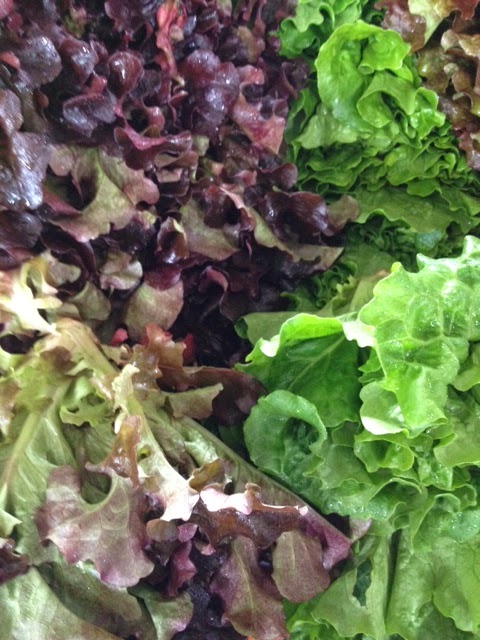
Bloodnick Farms- Local Fresh Picked Lettuce

Lettuce.
Beans, beets, and a little carrot.
Laughing Crow Farms, Nanticoke, NY

Kale and cabbage

And heirloom cherry tomatoes.

As I snapped pictures, Lisa Bloodnick from Bloodnick Farms smiled at me.  She struck up a conversation, saying "I saw you take a picture of my lettuce." and we quickly found out we had something in common.

Our phones were both stuffed full of pictures of plants, flowers, vegetables and other natural things.  Laughing, she got out her phone and showed me her personal Facebook page.

Her cover photo was a picture of her lettuce field.

I'm not the only one who uses veggies and fruits as their cover photos!

If you check out my blog's fan page on Facebook, Ramblin' with AM, you'll see some of my past posts and cover photos.  Give me a "like" and leave a comment if you like what you see.

What do you like to take pictures of?

Saturday, August 30, 2014

Sustainable Saturday - Strawberry Fields Forever

Don't these strawberries look luscious?

They aren't just any strawberries.  These are cutting edge strawberries, grown in a special way that may become more mainstream one day.

We picked those on Wednesday - fresh, at a farm in upstate New York about 30 miles from Syracuse, New York, where (for "normal" strawberries, the season would have been over in late June).

These strawberries are not your normal strawberries.  They were grown, outdoors, hydroponically, on a U Pick farm near Skaneateles, New York called Strawberry Fields.
These are grown in vertical towers.  They are everbearing strawberries, which bloom throughout the season.  The berries we saw had both flowers, small berries, and ripe berries, all on the same plant.

The berries are not officially organic, but are grown as naturally as possible.

Each tower has a number of pockets, each of which contains a strawberry plant planted in a non-soil planting medium.  The ground around the plants is covered so you are never walking in mud.  Even someone with a back problem, such as me, can pick these with no problem.
Each visitor to Strawberry Fields is given a basket, lined with a plastic bag, with a pair of scissors at the bottom.  You snip the stem and gently place each berry in the basket.

You pick as many as you want, and pay by the pound.

How you use the berries are up to you. I eat them plain (no sugar, no cream - even before Weight Watchers, I loved my berries in the natural way) but you are welcome to use them in recipes.

These berries are grown as annuals, since, basically, they are grown in containers, and probably wouldn't overwinter in our northern climate.

And the best part?  The "small world" factor.  We visited this farm twice on a recent visit to Skaneateles.  The first time, we were helped by a young lady.  The second time, we were helped by her mother, and found that the young lady of the day before goes to college where we live, and lives just a couple of miles from us.

That's why I love travel.  Even if you don't travel far (and this was less than 100 miles from where we live), you can experience something brand new.

Have you ever eaten hydroponically grown fruit?

Saturday, June 14, 2014

Sustainable Saturday - The Journey of 1000 Miles

Last year I blogged about the possible decline and fall of the Binghamton, New York downtown farmer's market.

Venders were leaving. And, not only vendors were leaving.   Binghamton, a city in upstate New York of around 47,000, once had nearly 80,000 residents.  Hard times had struck some years ago with the decline of major employers such as IBM (which started in Binghamton) and Endicott-Johnson. Ten years ago, even five years ago, many buildings in downtown Binghamton were vacant.

Now, Binghamton (including the downtown) is in the midst of reinventing itself.  But sometimes, it seems like a journey of 1000 miles, which has not gotten that far yet.

I've always maintained a strong local downtown farmer's market (with emphasis on "local" - we do have local farmers here) can be a key to the health of a community.  I've seen it first hand. I point to Fayetteville, Arkansas.  Ithaca, New York. Asheville, North Carolina.  Charleston South Carolina. The farmer's market on Union Square in New York City.  (I note here that, for some of these communities, the downtown markets are not their biggest. But all of them are vibrant.)

A neighborhood not that far from downtown Binghamton, New York is a food desert. Many years ago, I lived in that area (the North Side of Binghamton), before it became a desert.  So this is a subject close to my heart.

Last year, I had spoken to a person newly associated with the downtown Binghamton market about my concerns.  There was a vendor who obviously was not selling his own produce - plums in June, here, are just not local.  Yet, he seemed to dominate the market.

Yesterday, I returned to the downtown Binghamton farmer's market for its second session of the year and saw some major changes-all good.  I spoke to a favorite vendor and got the scoop.

The vendor who was obviously selling non local produce is no longer there. He was caught, I was told, buying produce from a local wholesaler, taking off the stickers you find on commercial produce, and selling it at market.
This is what I did find.  VINES,"Volunteers Improving Neighborhood Environments" will be concentrating their efforts on the downtown market this year.  They are dedicated to eliminating the food deserts within Binghamton by use of urban farms, community gardens accessible to the community and other improvements.  LOCAL!

Closer to the Heart, who sells only their own produce. (why this picture won't permit itself to be rotated, I have no idea). I've bought from them many times at the Otsiningo Park Farmers Market so know they are LOCAL!

Sunny Hill Farms. My friend has bought their honey for years. Another friend loves their rhubarb.  LOCAL!

I couldn't get a good angle for a shot, but a vendor that has been to the market for years, Full Quiver Farm, is back.  I've purchased their breads.  LOCAL!

And, finally, a new vendor, Fojo Beans.  I hope they can make it at market, because the beans, while high quality, are pricey for the Binghamton market, I fear. (I hope I'm wrong).  Local coffee roaster!

It's a small start.  But perhaps, a single step in that 1000 mile journey.

Tomorrow - Garden Bloggers Bloom Day.  And this coming week, a mix of flowers and autism.  I hope you enjoy what I have planned for you.

Thursday, May 29, 2014

Best of AM - Mail Order Chickens

This post, with some edits and additions, was first posted in August, 2010.

I never realized that Iowa is the #1 egg producer in the country. 

I lived briefly in Iowa in the 1970's and have been back several times since.  When people think of Iowa, they think of (not necessarily in this order):  Pork, soybeans, corn.  In fact, if you ask my son (who has been to Iowa several times) what he remembers of Iowa, he remembers  miles and miles of boring cornfields.  I don't think I saw many chicken houses there.

When I think of Iowa, I also think of local food, of heritage breeds, of farmers who still care.  Iowa does have at least one heritage breed poultry breeder, who we bought from several times when we lived in Arkansas:  the incomparable Murray McMurray Hatchery.

Iowa also has wonderful, friendly people and a wonderful place we have never been to-the headquarters of the Seed Savers Exchange in Decorah, Iowa and its Heritage Farm..

Exactly the opposite of the current egg scandal farm owners, the folks at Seed Savers work to keep genetic diversity in our seeds, and also seek to keep heritage breeds of certain animals alive.  Their work deserves to be well publicized. 


Too bad Iowa right now is in the news for something totally different-tainted eggs. Half a billion eggs recalled. Thanks to factory farming, shipped to 22 states. It would seem these farms have had many violations-the "same old same old".  I could go into a rant about food safety regulations, but this is not a political blog.  So instead I would like to share some memories of when Iowa farming goes right.

I have fond memories of visiting the Iowa City Farmers Market.  Iowa City is a college town so, as you could expect, they had their share of organic booths.  Of course, everything was locally grown and made.

Yes, in Iowa the small farmer still exists, marketing the most delicious pork and beef (sorry, vegetarian readers), plus all the usual veggies.  In a climate hotter than ours in the northeast, one even saw okra and some other southern favorites for sale.

But I promised to speak about mail order chicken memories. I want to share something about raising chickens and "growing" our own eggs, all from Iowa chickens.

Back in the 1980's, when we lived in rural Arkansas and kept chickens, we would spend the New Year perusing the Murray McMurray catalog, with its brightly colored pictures of what was even then called "rare" chickens.  These are the chickens with names, not numbers:  Barred Rocks, Rhode Island Reds, Black Australorps, Buff Orpingtons, New Hampshire...and on and one-about 130 breeds total.

We would make our selection and place our order (in the mail, of course).  No internet, no fascinating website giving pictures of their operations, no instant update of stock on hand.  Rather, we placed our order and waited for the day we specified.  We did it the "old fashioned" way which, in those days, was the only way.

On the appointed day, there would be a phone call from our local rural post office.  We had to come and get them; they would not deliver.  The box, cheeping away, was rushed home.  In a miracle that we could never get tired of, the living chicks survived the trip.  Just imagine opening a box and being greeted by 25 cheeping 2 day old chicks!  We would take each one out gently, dip its beak in water, and put each precious chick in a little pen under a warm light.  The waterer and feeder were made from mason jars screwed into special "lips".  We fed them commercial but unmedicated chick starter.  After a day or so, they would be ready for supplementation with the occasional June Bug attracted by the light.

This next part is not for the squeamish.  The chicks would get hold of the unfortunate bug and chase each other, trying to snatch what was left of the large bug (it didn't last very long) in a game of chick free-for-all.  The whole while, they would be screaming in delight.

Don't ever say baby chicks are cute.  Not unless you've seen one of those feedings.

You have to love chickens to know them. You have to accept their nature.  Chickens are omnivores, and they lust for blood.  If one of those chicks accidentally got cut, it would have suffered the same fate as that bug.

Then, those chicks would grow, and about 6 months later the female (pullets) would start to lay their small beginner eggs.  The males?  Well, that part isn't for the squeamish either.  (I'll leave the part out about how roosters treat the hens.)  Nothing like a wonderful, thick shelled, fresh egg.  Except if you want to hard boil, in which case you want a slightly aged egg.

We never worried about salmonella.  We ate raw (from scratch) cake batter.  We even made (gasp!) real eggnog!

We moved back to urban life in the mid 1980's, and our chicken life was over. 

But what about Iowa, land of Seed Savers and rare chicken flocks? (At least in 2010 Murray McMurray was still using local farmers to produce their eggs for hatching.)

Moral of story, more important than ever in our brave new world of GMO's:

Support your local farmer.  Know who produces your food.  Know HOW it is produced. Ask questions. Ask lots of questions.

That's one way to protect yourself.

Saturday, May 10, 2014

Sustainable Saturday - Digging Ramps - or Not

Today, I got an unintended education.

My spouse and I visited the farmers market in Ithaca, New York, home of Ithaca College and Cornell University.

Unlike our farmer's market, in Binghamton (an hour away) which just started its outdoor season last Saturday, the Ithaca market at Steamboat Landing has been outdoors for a good month.  It's much larger than our market, too.

Ithaca has a population of about 30,000, but the three colleges there provide a lot of demand for high quality, organic produce.  It also helps that the Finger Lakes help moderate the climate, and the growing season in the Ithaca area begins sooner than ours does.
There was the usual lettuce, beautiful in various colors.
And there were a couple of surprises.  The first, fiddleheads, we passed up - I've had them and I'm not too fond of them.

The other surprise was ramps (or wild leeks). Ramps grow wild here in upstate New York, although I don't personally know any place to pick them.  I've tasted food cooked with them, but my spouse (the family cook) has never cooked them. We know a little goes a long way, and are wondering if we can grow these in a shady part of our yard if we plant a couple of the plants we bought today.  We may not want to cook these all.

However, in researching some recipes, I discovered a sobering fact.  It seems that the increasing appetite for ramps may be taking a toll on the wild plants.  In fact, their sale is banned in some places, although, at the present time, it seems New York State has no rules restricting their harvest.

If I had known there might be a problem, I would have asked more questions before buying these.  It could be that these were grown, and not harvested from the wild, or harvested in a sustainable manner.

It's too late to un-buy them, so I will eat them - and I might try to plant a couple of them in a shady part of my yard.

Do you know anything about ramps?

Saturday, April 19, 2014

Sustainable Saturday - Cabbage Collards and Strawberries

What do you like to do when you are on vacation?

Some people lie on the beach during a vacation.  Some people hike, some kayak, some mountain climb. I enjoy destinations that allow me to learn about history.  At the same time, I go to farmers markets, if there are any being held near where I am vacationing. They are all so different, and they rarely disappoint.

My spouse and were fortunate enough to be in Mt. Pleasant, South Carolina earlier in April for their first farmers market of the year. 

Last Saturday I blogged about a farmer's market in South Carolina's second biggest city, Charleston.  To understand these markets, you need to to understand some of South Carolina's demographics.

Something I never really realized until the first time I visited South Carolina several years ago is just how rural South Carolina is - its biggest city, Columbia (the capital) has a population of only around 130,000. (Contrast this with neighboring North Carolina - its biggest city, Charlotte, has about 775,000 people).  Charleston, the second biggest city in the state, has about 125,000 people.  Mt. Pleasant is the fourth biggest city, and is growing rapidly.

Charleston has become a major destination for people interested in eating, and this has carried over to Mt. Pleasant, across the Cooper River from Charleston.  What I especially liked about this market was the fact that it started at 3:30 pm instead of in the early morning.

 We were greeted with posters advertising a Chef's Potluck, and Lowcountry Farm Tours.  We also talked to a couple of young women promoting local food.
Nearby was a sign advertising fresh pasta.

And more fresh pasta.
We purchased the sweet potato, bacon and leek ravioli, which was delicious, although at the price charged, it would not have been an everyday part of my eating.
We also bought some of these Carolina Sweet Onions and brought them home with us.
Greens were also local. We were introduced to something called cabbage collards, an heirloom - and delicious.

And finally, local strawberries - unexpected, and so welcome to someone living in an area where local berries come in June.

Do you do anything food related during vacations?

Saturday, April 12, 2014

Sustainable Saturday-Charleston South Carolina Farmers Market

This is one of the most beautiful location for a farmers market that I have ever seen.

South Carolina State Arsenal Building, Charleston, SC

Part of the pleasure of travel for me is finding and eating local food, especially food that is fresh and minimally processed.  Today was the opening day of the Charleston farmer's market, held in historic Marion Square in Charleston. (At a later date, I will blog about the history I found inside this square. In fact, the building above has an interesting history as the former location of the famed military college, The Citadel.)


Even as far south as Charleston is, not everything they are offering is in season yet.
The vendors marked produce that was local, though, and one vendor (price list above) was quite upfront about exactly where each of his items originated from.  (ONPF means his own. Lady Moon is in Florida. Mayflower was elsewhere in South Carolina).  We bought garlic (below) from him.

This vendor advertised local only, with a big offering of radishes, and early greens.
We were so thrilled to buy fresh garlic (not last year's storage crop) from this market.
Strawberries are also at the beginning of their season.  We bought the strawberries and reluctantly left the dewberries behind.

There was a lot of photography going on, and none of the vendors seemed to mind. 

Mushrooms were a welcome surprise, although we didn't buy any.

The Charleston market did not disappoint - with one exception, something that also bothers me about our local downtown Binghamton, New York farmer's market - not all of the food is local.  But there was a local food information booth, and I talked to two energetic young women attempting to get the word out.  In a city where world famed restaurants are on almost every streetcorner downtown, I hope the word does continue to get out.

We did buy a couple of local food items you find in few other places, which will be subjects of a later post.


Our local farmer's market in upstate New York won't be outdoors for another three weeks.  I basked in that 80 degree heat - by Tuesday, back home, we may get some snow.

Have you shopped at a farmer's market recently?

Saturday, March 29, 2014

Sustainable Saturday-Going To the Dark Side

Today, for the second Saturday in the row, I am talking maple and a trip to the Dark Side.

Here is a Maple Weekend visit to a local maple syrup producer here in upstate New York.   Last Saturday, I wrote more about maple syrup.

We are fortunate to live in maple syrup country, because, for me, nothing else will ever touch my pancakes.  And, of all maple syrup, I think the best is that produced using wood fired evaporators.  They give a special taste that just can't be duplicated.

This producer, Bush's Syrup House, uses the wood fired method. 

Making maple syrup is an art.  There is a brief period of time at the end of winter when maple trees start to wake from their winter hibernation. Sap, clear and not very sweet at all, starts to flow.  The days must be above freezing and, preferably, sunny.  The nights must be below freezing.  These conditions produce a push-pull condition in the trees, causing the sap to flow.  Producers tap the trees, attach a bucket (involving judgement as to how many taps a tree can support) and collect the sap through tubes that lead to the processing house.

Some people drink the sap for health reasons.  I've sampled it and it isn't much different from water.  The magic comes later, after the evaporation process.  And, it's quite a process, with 40 parts of maple sap needed for 1 part of maple syrup.  That's a lot of sap, and a lot of heat source needed.  And all of that takes money and a continued investment on the part of the maple syrup producer.

The season lasts about 4-6 weeks.  When the trees start to bud, or temperatures remain above freezing, the sap turns bitter and the season is over.

At the beginning of the season, the sap produces a light syrup which is the most expensive to buy. Toward the end of the season, you get darker syrup.  In our part of upstate New York, we prefer the darker (not the darkest grade B, suitable more for cooking, but what we call Dark Amber) for our pancakes.  In maple syrup, you want to go to the dark side. It's the one product where Grade B is better than Grade A (noting the NY grade scales differ from some other states.)

Today, Bush's was producing dark syrup but it wasn't yet bottled or available for sale.

This is the barn with the evaporator.
The wood fired evaporator.
The syrup tank.

A display of maple candy molds and old fashioned taps (some dating from the 1700's).

After our look around, we walked into the sugar house to buy some syrup.  You may blanch at the $45 a gallon price Bush's was charging.  But, consider the amount of work that goes into the production of maple syrup.The only syrup available was medium amber from earlier in the season.  Knowing we were having a poor season, we bought a quart ($18), hoping we could get some dark amber syrup later in the year.

Right behind us, another couple was looking for dark amber, too.

As reported last week, our maple syrup season will not be one of the more successful, due to our extended, cold winter.  

Can you make maple syrup at home?  Yes! (if you have the right kind of trees, that is.)  I worked with someone, years ago, whose husband  made syrup and, one year, offered it to sale. He totally sold out to his wife's co workers, including me.  I've never had better syrup before or since.  Just don't try the boiling in your kitchen - you will ruin your wallpaper.

With health concerns about manufactured pancake syrup now arising (from the substance used to give it brown color), more people may, despite the cost, be searching for real maple syrup.

Is maple syrup popular in your area?

Saturday, March 22, 2014

Sustainable Saturday - Got Maple Syrup?

This weekend and next is Maple Weekend in upstate New York.  Maple syruping is a family farm industry here in upstate New York, and producers take this opportunity to show consumers all the work that it takes to make maple syrup.

These farms don't just make maple syrup.

They make maple jam, maple candy, and even maple cotton candy.

But, due to our severe winter temperatures, the syruping is being delayed.  Sap is not running.  And sap is needed, to boil down into the prized syrup.

The weather has to be perfect - above freezing days with sunshine, below freezing nights.

Last March, I wrote the below post (slightly edited) during a successful Maple Weekend. There won't be much to show this weekend. Let's hope next weekend, the second and last Maple Weekend, will be more of a success.

Sustainable Saturday - The Sweetness of Local Maple

It's late winter spring.  It's time to make maple syrup in upstate New York.

I'm talking maple syrup, not that stuff that passes as "pancake syrup". The latter should be banned from all tables although I realize, first, that true maple syrup is expensive, and second, that some regions of the United States prefer their own regional specialties - cane syrup, sorghum syrup, etc. But at least, cane syrup and sorghum syrup are natural products. 

To someone from New York State or New England, only maple syrup will do.  And not those thin, Grade A light amber syrups.  You want Dark Amber syrup, the syrup that has flavor.  Or even Grade B, although the heavy maple taste of Grade B makes it suitable mainly for cooking. (note, these grades are NY grades, and may differ in other maple syruping states).

Have you ever been to a sugar house?  If not, I have a sweet treat for you today.

Welcome to Nappy Farms, near Johnson City, New York.

Let's take you inside the building where maple syrup is made.

We were greeted by goats, who are pets and were quite friendly. Chickens were also roaming around.

I didn't want to walk into the woods (snow a bit slippery) to visit the sugar bush, but several types of maple trees can be tapped.  What you are doing, in maple syrup making, is similar to what native Americans did hundreds and even thousands of years ago.  Only the technology has changed.

When the sap starts to run in late winter, the trees are tapped.  The sap is collected and is then evaporated. What is left, after water (lots and lots of water) is boiled off, is maple syrup.  Pure sap (which I have tasted) is like water, both in consistency, and in taste.

Weather conditions must be right.  In fact, this morning, the sap was not running because it was too cold.  The ideal is above freezing during the day, and below freezing at night.

In modern day production, lines from the tapped trees bring sap into the building, and then the magic begins.

This is the evaporator.  On the right, the sap enters and there is a preheater (not run by wood) that will partially evaporate the sap.  This will allow more efficient use of the wood.  This producer goes through about a cord of wood a day, which comes from his property.

Maple syrup made with wood heat has a special taste and this is what you really want to look for. Syrup sold in supermarkets may be real but there may be no wood in its production and you will know the difference.
This is the cast iron end of the evaporator, which was manufactured in Canada.

When done, the syrup rests in a container, and is then bottled.

Part of the fun of Maple Weekend is the sampling - and we got to sample the dark syrup from a recent run, plus maple mustard (all natural ingredients), maple nuts and even maple popcorn.  Maple cotton candy was available for sale.

Once trees start to bud out, the season is over, and the taps must be removed to prevent damage to the trees.  This year, sadly, is not looking to be a good year - it has been too cold during the sap run.  Nature's clock is ticking and the trees will bud out sometime in April, "weather" or not.  Then the trees leaf out happily, and are hopefully around for next winter's syrup run.  And, at the end of their lives (Nappy uses mainly down trees), they serve as fuel for the next year's run.

On the way out, our purchase in hand, we said goodbye to the chickens - mainly Rhode Island Reds, and an unknown rooster.  Their eggs will be waiting for us when the Otsiningo Farmers Market resumes its outdoor season in April.

Does your home area have its own specialty food not made in other areas?