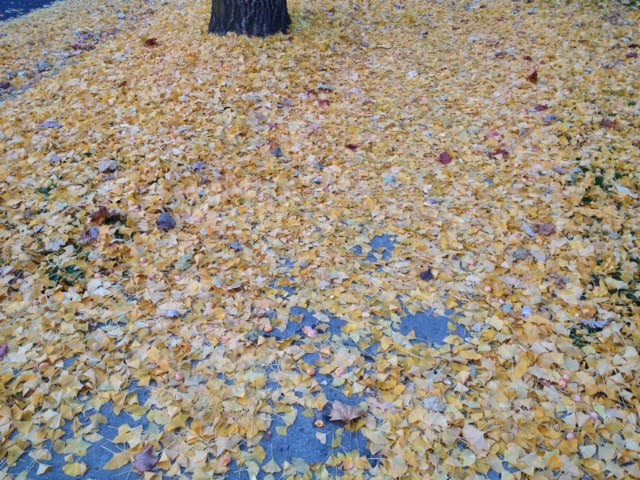
The ginkgo biloba tree. Wonderous and hardy.
Some say it has medicinal qualities. What is certain is that this Southeastern Asia native is hardy and suitable for urban streets here in the United States. It can even change its gender, which is not necessarily a welcome thing.
They sure are beautiful in fall, though.
Join Parul at Happiness and Food each second and fourth Thursday of the month for #ThursdayTreeLove.
Want even more fall color? Come back tomorrow for Skywatch Friday!
Day 24 of the Ultimate Blog Challenge #blogboost
Welcome! I hope I bring a spot of calm and happiness into these uncertain times. I blog about my photography adventures, flowers, gardening, the importance of chocolate in a well lived life, or anything else on my mind.
Showing posts with label ginkgo. Show all posts
Thursday, October 24, 2019
Thursday, November 17, 2016
Throwback Thursday - The Dilemma of the Ginkgo
This post has become somewhat of a yearly fall tradition on my blog. This was first published on November 23, 2013.
The Ginkgo is a survivor. It has beautiful fan-shaped leaves. In the fall, they turn a beautiful yellow. But, quite frankly, it can be a bit of a stinker.
Some cities that have planted them have learned to regret it. Hence, from November of 2013:
Last year, some streets in downtown Binghamton, New York were rebuilt
and re landscaped. This spring, I noticed that some of the young trees
planted were ginkgos.
Ginkgoes are not extremely popular here in Binghamton. I see more of the trees up in Ithaca, and I saw a good number in Iowa City when I used to visit my late aunt. This was back in the 1980's and 1990's and I can remember them on the University of Iowa campus. I've also seen them in New York City.
The ginkgo tree is also called the Maidenhair tree. It is an almost indestructible tree. In Japan they are known as the "bearer of hope" as a number of them survived the 1945 atomic bomb attack on Hiroshima. One of the surviving trees is some 200 years old.
The leaves turn a lovely yellow in the fall, too. But before you rush out to buy this wonderful tree, there is something you should know.
The females produce a seed, surrounded by a pulp. Fortunately, there is no such thing as "smell o blog" because you would be gagging just about now. Some people say the smell resembles the smell of vomit. Others say dog poo. I tend towards the dog poo camp.
That patch of fallen leaves on the West Side of Binghamton, to be accurate, reeks.
This is what the offending (bare) tree looked like in early November, the offending fruits barely visible.
Yes, dear readers, this is the same Ginkgo Biloba that some claim enhances your memory, and may have other medicinal qualities.
Many cities were playing it safe by permitting only male trees. But nature has a way, folks (as anyone who has seen the movie Jurassic Park knows), and it would seem that some of those male trees are now - well, they aren't males any more.
And these cities who planted these wonder trees now wonder what to do.
I wonder if the tree I photographed on the West Side of Binghamton started its life as a male.
Will the City of Binghamton have to face that dilemma in a few year when those small downtown trees mature and perhaps....well, stink?
Have you had this problem where you live?
Day 17 of NaBloPoMo.
![]() |
| Ginkgo Fruit and leaf, West Side of Binghamton, October 2016 |
The Ginkgo is a survivor. It has beautiful fan-shaped leaves. In the fall, they turn a beautiful yellow. But, quite frankly, it can be a bit of a stinker.
![]() |
| Binghamton, New York, October 2015 |
The Dilemma of the Ginkgo
Ginkgoes are not extremely popular here in Binghamton. I see more of the trees up in Ithaca, and I saw a good number in Iowa City when I used to visit my late aunt. This was back in the 1980's and 1990's and I can remember them on the University of Iowa campus. I've also seen them in New York City.
The ginkgo tree is also called the Maidenhair tree. It is an almost indestructible tree. In Japan they are known as the "bearer of hope" as a number of them survived the 1945 atomic bomb attack on Hiroshima. One of the surviving trees is some 200 years old.
The leaves turn a lovely yellow in the fall, too. But before you rush out to buy this wonderful tree, there is something you should know.
The females produce a seed, surrounded by a pulp. Fortunately, there is no such thing as "smell o blog" because you would be gagging just about now. Some people say the smell resembles the smell of vomit. Others say dog poo. I tend towards the dog poo camp.
That patch of fallen leaves on the West Side of Binghamton, to be accurate, reeks.
This is what the offending (bare) tree looked like in early November, the offending fruits barely visible.
Yes, dear readers, this is the same Ginkgo Biloba that some claim enhances your memory, and may have other medicinal qualities.
Many cities were playing it safe by permitting only male trees. But nature has a way, folks (as anyone who has seen the movie Jurassic Park knows), and it would seem that some of those male trees are now - well, they aren't males any more.
And these cities who planted these wonder trees now wonder what to do.
I wonder if the tree I photographed on the West Side of Binghamton started its life as a male.
Will the City of Binghamton have to face that dilemma in a few year when those small downtown trees mature and perhaps....well, stink?
Have you had this problem where you live?
Day 17 of NaBloPoMo.
Thursday, November 19, 2015
Throwback Thursday - The Dilemma of the Ginkgo
They lie there so innocently...but beware.
In 2013, I blogged about the ginkgo tree. Its yellow fall colored, fan shaped leaves make for an incredible color display. But then, there are the fruits that fall.
Here a young ginkgo tree glows in an early November sunrise in downtown Binghamton, New York.
But there is one problem with these lovely trees. It's a good thing there is no such thing as smell-o-blog, as you might be exiting this blog at full speed if you were able to sniff the first picture above.
You see, there is something about ginkgoes, as I blogged about two years ago. Something a bit...well, read the post and see.
The Dilemma of the Ginkgo
Last year, some streets in downtown Binghamton, New York were rebuilt
and re landscaped. This spring, I noticed that some of the young trees
planted were ginkgos.
Ginkgoes are not extremely popular here in Binghamton. I see more of the trees up in Ithaca, and I saw a good number in Iowa City when I used to visit my late aunt. This was back in the 1980's and 1990's and I can remember them on the University of Iowa campus. I've also seen them in New York City.
The ginkgo tree is also called the Maidenhair tree. It is an almost indestructible tree. In Japan they are known as the "bearer of hope" as a number of them survived the 1945 atomic bomb attack on Hiroshima. One of the surviving trees is some 200 years old.
The leaves turn a lovely yellow in the fall, too. But before you rush out to buy this wonderful tree, there is something you should know.
The females produce a seed, surrounded by a pulp. Fortunately, there is no such thing as "smell o blog" because you would be gagging just about now. Some people say the smell resembles the smell of vomit. Others say dog poo. I tend towards the dog poo camp.
That patch of fallen leaves on the West Side of Binghamton, to be accurate, reeks.
This is what the offending (bare) tree looked like in early November, the offending fruits barely visible.
Yes, dear readers, this is the same Gingko Biloba that some claim enhances your memory, and may have other medicinal qualities.
Many cities were playing it safe by permitting only male trees. But nature has a way, folks (as anyone who has seen the movie Jurassic Park knows), and it would seem that some of those male trees are now - well, they aren't males any more.
And these cities who planted these wonder trees now wonder what to do.
I wonder if the tree I photographed on the West Side of Binghamton started its life as a male.
Will the City of Binghamton have to face that dilemma in a few year when those small downtown trees mature and perhaps....well, stink?
Have you had this problem where you live?
Today is day 19 of NaBloPoMo.
In 2013, I blogged about the ginkgo tree. Its yellow fall colored, fan shaped leaves make for an incredible color display. But then, there are the fruits that fall.
![]() |
| 2014, when the leaves fell late |
But there is one problem with these lovely trees. It's a good thing there is no such thing as smell-o-blog, as you might be exiting this blog at full speed if you were able to sniff the first picture above.
You see, there is something about ginkgoes, as I blogged about two years ago. Something a bit...well, read the post and see.
The Dilemma of the Ginkgo
Ginkgoes are not extremely popular here in Binghamton. I see more of the trees up in Ithaca, and I saw a good number in Iowa City when I used to visit my late aunt. This was back in the 1980's and 1990's and I can remember them on the University of Iowa campus. I've also seen them in New York City.
The ginkgo tree is also called the Maidenhair tree. It is an almost indestructible tree. In Japan they are known as the "bearer of hope" as a number of them survived the 1945 atomic bomb attack on Hiroshima. One of the surviving trees is some 200 years old.
The leaves turn a lovely yellow in the fall, too. But before you rush out to buy this wonderful tree, there is something you should know.
The females produce a seed, surrounded by a pulp. Fortunately, there is no such thing as "smell o blog" because you would be gagging just about now. Some people say the smell resembles the smell of vomit. Others say dog poo. I tend towards the dog poo camp.
That patch of fallen leaves on the West Side of Binghamton, to be accurate, reeks.
This is what the offending (bare) tree looked like in early November, the offending fruits barely visible.
Yes, dear readers, this is the same Gingko Biloba that some claim enhances your memory, and may have other medicinal qualities.
Many cities were playing it safe by permitting only male trees. But nature has a way, folks (as anyone who has seen the movie Jurassic Park knows), and it would seem that some of those male trees are now - well, they aren't males any more.
And these cities who planted these wonder trees now wonder what to do.
I wonder if the tree I photographed on the West Side of Binghamton started its life as a male.
Will the City of Binghamton have to face that dilemma in a few year when those small downtown trees mature and perhaps....well, stink?
Have you had this problem where you live?
Today is day 19 of NaBloPoMo.
Subscribe to:
Posts (Atom)