Showing posts with label Civil War. Show all posts

Sunday, May 26, 2024

Honoring Memorial Day 2024

In the United States, Memorial Day is tomorrow.  First, a memory.

In 2002, my spouse, son, and I were on our way from our home in New York State to the Black Hills of South Dakota.  We stopped off in Iowa City, where one of my aunts (now deceased) then lived.  It was the Memorial Day weekend.

Just after we crossed into the city limits, we passed a cemetery.  It was decorated in a sea of American flags.  I could not believe how many flags there were.  

It showed that the residents of Iowa City had not completely forgotten the meaning of Memorial Day, a special day for residents of the United States.

In 2010, I blogged about a GI love story for Memorial Day.  In other years, I've repeated posts about our Memorial Day in the United States.  This year, I'd like to blog once again about the origin of this holiday, which is tied up with our Civil War, 1861-1865.  

Memorial Day was originally called Decoration Day.  It was first observed in 1868 with laying of flowers on the graves of both Union and Confederate troops at Arlington National Cemetery in Virginia.

"Sam the Bear" honors the village of Waterloo, New York - Empire State Carousel

 My home state, New York, was the first to adopt Decoration Day as a holiday.  The village of Waterloo considers itself the birthplace of Memorial Day, and has a museum devoted to the holiday.

After World War I, Decoration Day became a holiday (Memorial Day) to honor the dead of all wars.

I can remember, growing up, when Memorial Day was observed on May 30, no matter what day of the week it was.  In 1971, I believe, it was changed to the current "last Monday in May" so that it could become part of several three day weekends being created.  Many people think that celebrating Memorial Day more as a "first day of summer" blowout beach/BBQ/shopping day has been recent, but apparently even in the early 20th century the day was already starting to drift away from its original meeting.

Another ceremony connected with this holiday is the playing of Taps.  Taps originated during the Civil War, composed by a member of the Army of the Potomac to serve as a "lights out" signal. Research I've done indicates that it didn't take long for Taps to be adopted by both Federal and Confederate armies.  It is so well suited to military burials that, again, its true origin is somewhat buried.


At 3pm, all over the United States,  the 24 notes of Taps will be played as part of a commemoration called Taps Across America.  Each musician has his or her reason for playing.

My late father was a disabled non-combat veteran of World War II.  The war he served in, World War II, took the lives of millions of both civilians and military.  This is a list of the casualties by country.

There is now an official National World War II museum in New Orleans, Louisiana.  I hope to visit it one day.

No matter what war it is, the innocent die and soldiers go off to war, many never to return, or to return whole.

And that is the true meaning of Memorial Day - to honor our war dead and, yes, their loved ones.

Today, tomorrow, and perhaps on all days, let us take a moment to honor the veterans of all wars who gave their lives.  They are our reminders that the price of freedom is sometimes a very steep one for those who pay it on our behalf. 

Let us not dishonor them.

Saturday, November 19, 2022

The Timeless Gettysburg Address

Gettysburg, Pennsylvania.

The Copse, Gettysburg Battlefield, Gettysburg, Pennsylvania

In March 2022, spouse and I visited Gettysburg for several days.  The area was the site for perhaps the most famous battle of the United States Civil War, fought July 1-3, 1863. 

I've been to many Civil War battlefields and related sites, from Prairie Grove, Arkansas (a battlefield I passed twice a day on my way to and from work for several years) to the home of Gettysburg hero and later Governor of Maine Joshua Chamberlain in Brunswick, MaineMonocacy in Maryland,  and sites of final surrender such as Appomattox Court House in Virginia and Bennett Place in Durham, North Carolina.  But nothing can prepare you for Gettysburg, a battlefield which is as much an outdoor memorial as it is a piece of land where some 50,000) people were killed or injured in a massive three day battle.  There are hundreds of memorials and many parts of the battle to learn and ponder.  No wonder that many choose to hire a licensed battlefield guide.

It is so peaceful today, except for the thousands of people who visit this sacred ground each year.

It wasn't pretty.  It wasn't romantic.  In some ways, we still haven't recovered.  We are still surrounded by reminders.  Today is the 159th anniversary of one of these reminders, a short speech that may be the most famous speech ever given in our country.

This speech began simply, as a verbal invitation, followed later by an invitation in writing.

On November 2, 1863, President Abraham Lincoln received this invitation:

"Gettysburg Nov. 2 1863
To His Excellency
A. Lincoln
President U. S.

Sir,
The Several States having Soldiers in the Army of the Potomac, who were killed at the Battle of Gettysburg, or have since died at the various hospitals which were established in the vicinity, have procured grounds on a prominent part of the Battle Field for a Cemetery, and are having the dead removed to them and properly buried.
These Grounds will be Consecrated and set apart to this Sacred purpose, by appropriate Ceremonies, on Thursday, the 19th instant. Hon Edward Everett will deliver the Oration. I am authorized by the Governors of the different States to invite you to be present, and participate in these Ceremonies, which will doubtless be very imposing and solemnly impressive.
It is the desire that, after the Oration, you, as Chief Executive of the Nation, formally set apart these grounds to their Sacred use by a few appropriate remarks. It will be a source of great gratification to the many widows and orphans that have been made almost friendless by the Great Battle here, to have you here personally; and it will kindle anew in the breasts of the Comrades of these brave dead, who are now in the tented field or nobly meeting the foe in the front, a confidence that they who sleep in death on the Battle Field are not forgotten by those highest in Authority; and they will feel that, should their fate be the same, their remains will not be uncared for.
We hope you will be able to be present to perform this last solemn act to the Soldiers dead on this Battle Field.
I am with great Respect, Your Excellency's Obedient Servant
David Wills
Agent for A. G. Curtin Gov. of Penna.[Pennsylvania] and acting for all the States"

In the aftermath of the Battle of Gettysburg, July 1-3, 1863,  some 2500 residents of Gettysburg were left to tend to the thousands of wounded and bury the thousands more who had died during the three day battle. Gettysburg was to be the costliest battle (in lives lost) of the Civil War.   I will spare you the details of the horrific conditions endured that summer by the farmers and others who owned the land where the dead fell, and what overwhelmed remaining Union soldiers and area residents went through, but if you are interested, here is one description. This article also has a harrowing description of what the Confederate soldiers left behind in Lee's retreat experienced.

Eventually, state and local governments came together.  With financial help from every Union state whose citizens died at Gettysburg, lawyer David Willis oversaw the purchase of 17 acres for what became a national cemetery.  It was to be dedicated on November 19, 1863, and the featured speaker was going to be....

...no, not President Lincoln.  He was invited to give some remarks after the featured orator.  You might say, he was invited almost as an afterthought. (more on that shortly).

It was, instead, a noted orator by the name of Edward Everett, a man who had served as a Congressman, a Secretary of State, a Senator and the Governor of Massachusetts, who was to give the main speech. 

It would seem as if the President was being slighted, being treated almost as an afterthought.  But, I have read that was not the case at all. In the 1860's Presidents were not expected to give speeches. That was the job of orators such as Everett, and Lincoln was invited to give a "few words" in his role as President.

Lincoln Memorial, Gettysburg National Cemetary


Ironically, perhaps, Everett would not live to see the end of the Civil War, and Lincoln himself only outlived the end of the war by a few days.  But we are getting ahead of ourselves.

Today is the 159th anniversary of the dedication of Gettysburg's National Cemetery on November 19, 1863, and here is the address Lincoln thought would not long be remembered.

Gettysburg National Cemetery, March 2022


He was wrong.  But what I find most interesting is that no one today knows the exact spot where Lincoln stood to make his speech.  There are some educated guesses.  Nor, until recently, did we even have a photograph of Lincoln making his address.  In the one photo now known, Lincoln's head is barely visible.

There are five known copies of the address, with some differences.  I believe this one is the most commonly quoted, what is now known as the "Bliss copy".

"Four score and seven years ago our fathers brought forth on this continent, a new nation, conceived in Liberty, and dedicated to the proposition that all men are created equal.

Now we are engaged in a great civil war, testing whether that nation, or any nation so conceived and so dedicated, can long endure. We are met on a great battle-field of that war. We have come to dedicate a portion of that field, as a final resting place for those who here gave their lives that that nation might live. It is altogether fitting and proper that we should do this.

But, in a larger sense, we can not dedicate -- we can not consecrate -- we can not hallow -- this ground. The brave men, living and dead, who struggled here, have consecrated it, far above our poor power to add or detract. The world will little note, nor long remember what we say here, but it can never forget what they did here. It is for us the living, rather, to be dedicated here to the unfinished work which they who fought here have thus far so nobly advanced. It is rather for us to be here dedicated to the great task remaining before us -- that from these honored dead we take increased devotion to that cause for which they gave the last full measure of devotion -- that we here highly resolve that these dead shall not have died in vain -- that this nation, under God, shall have a new birth of freedom -- and that government of the people, by the people, for the people, shall not perish from the earth."

Abraham Lincoln
November 19, 1863

Lincoln now belongs to the ages, and it it our turn to protect those hard fought liberties.

Saturday, July 2, 2022

The Gettysburg Cyclorama

A cyclorama is a type of 360 degree oil on canvas painting popular in the late 19th century.   Their popularity died out as motion pictures became available in the 20th century.  Few cycloramas have survived to the present day.

They would depict various events such as fires, battles, and other events of note.

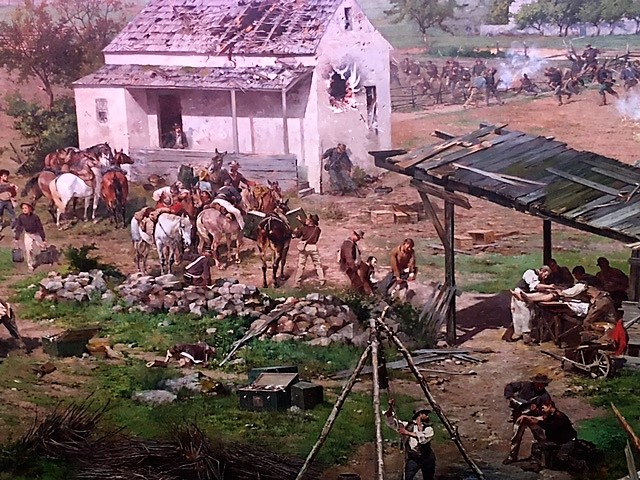
The Gettysburg Cyclorama is a restored painting by French artist Paul Philippoteaux depicting Pickett's Charge, a failed charge by the Confederate troops during the third day of the Battle of Gettysburg in the United States Civil War.  This three day battle was fought July 1-3, 1863, so we are commemorating its 159th anniversary this year.

If that charge had succeeded, the Confederate State of America may well have eventually won their war against the United States.  Historians and people who study the war debate this to the present day.

Today, I want to bring you some of this cyclorama  This particular painting was not the original Battle of Gettysburg cyclorama, which was first displayed in Chicago in 1883.  That painting took a year and a half to create.  The artist interviewed various survivors of the battle and took sketches of the battlefield during a 1882 visit.

There were possibly four Gettysburg cycloramas produced under the direct supervision of this artist: Chicago (1883), Boston (the version now exhibited at Gettysburg, Pennsylvania) Philadelphia (1886), Brooklyn (which became part of New York City in 1898) in 1886.

The version first displayed in Chicago may have been destroyed in a storm in Omaha, Nebraska in 1894.  The Gettysburg National Park Service website states it still survives and is known as the "Wake Forest" version, in dire need of restoration, but I read elsewhere there is evidence of its destruction in Omaha, as mentioned earlier.  Another cyclorama may have been cut up and used as tents for Native Americans.

The version I saw at the Gettysburg (battle) Visitors Center in March of this year was a second commission of Pickett's Charge, first displayed in Boston, Massachusetts in 1884.  Between 2003 and 2008 the painting was restored, and it is, to put it mildly, awe-inspiring.

Let's go in. Yes, it's weird saying "inside a painting" but the painting surrounds you completely.

When you first go in, the lights are dimmed. Then, the show begins.  Lights are raised to duplicate a sunrise, I'm guessing, and the battle is revealed.  (You can download video and stills at this site but these are my pictures.)

This is so realistic that it is said that veterans of the battle cried when they visited the cyclorama back in the 1880's.
The battle was fought on farmland, not far from the small city of Gettysburg, Pennsylvania. (Today, the population is around 7,000 people.)

The painting is  377 feet (114.9m) in circumference and 42 feet (12.8m) high. 

What is missing are the sound effects of battle that are also piped in.  Note that, in addition to the painting, there are real rocks and figures in front of it, which give it the three dimensional look.

These pictures do not begin to do the Cyclorama justice.  

At a time when it seems our country is becoming more split apart, it is well to dwell on the aftermath of the Civil War.  Gettysburg was an important, and terrible, part of this war.  

We must never put ourselves through anything like this, ever again. 

Sunday, February 13, 2022

He Had a Secret

Yesterday, February 12, would have been the birthday of President Abraham Lincoln.  Lincoln was the 16th President of the United States, and our country's President during the United States Civil War.  He was assassinated in April of 1865, several days after the official conclusion of the war.

I blogged about our Civil War during its 150th anniversary, from 2011 to 2015.  Here are several older posts about Abraham Lincoln.

Dining with Abraham Lincoln 

The Handwriting of Abraham Lincoln 

Moments that Changed History 

Something I Saw in the Capitol of South Carolina, the first state that seceded

In the last post above, I had a discussion with a fellow blogger about my belief that this Civil War never ended. If you've listened to news recently, you may be thinking along the same lines, or a different line - that we are on our way to a second Civil War.

When I was born, survivors of that era were still alive and it may be interesting to see a man who claimed to have witnessed Lincoln's assassination. He appeared on a game show in 1956 at the age of 96, months before his death. (He was born in 1860.)


The man's name was Samuel Seymour, the son of a Maryland man who owned enslaved people. (Another little detail of history - states that allowed slavery but did not leave the union were permitted to keep slavery going through out the war.   Maryland was one of four such states.)

His story (his memory mainly is seeing John Wilkes Booth "falling out of the balcony") may or may not be true but it is interesting reading some of the details of Mr. Seymour's life.

Let us remember, today, that history isn't a boring story of dates and battles.  It is the story of real people and real suffering.

History moves on.  What story will we write for the history books?

Saturday, June 19, 2021

Just a Little Old Lady in Tennis Shoes

Today is June 19, 2021.

For many years, I knew June 19 as the birthday of an almost lifelong friend (now, sadly, no longer with us).

As an adult, I also learned that June 19 had another meaning and another name:  Juneteenth.  Here is a brief history of Juneteenth and its meaning.

I never learned about it in school.  Surprising, perhaps, that my school system in New York City, so highly regarded in the 1950's and 1960's, didn't teach me about Juneteenth in the midst of the 1960's Civil Rights Movement.  But they never taught me about the Tulsa Race Riots, either, or so many other occurrences that Black people suffered through in their just over 400 years in our country.

Now, as of three days ago, Juneteenth, June 19, is a Federal holiday.  Its official name is not Juneteenth, but I suspect Juneteenth is going to be what people call it.

But today isn't just the story of Juneteenth, but it is also the story of 94 year Opal Lee, who watched her home destroyed, her parents' belongings burned, on June 19, 1939.  Her parent's crime?  Moving to a white neighborhood of Ft. Worth, Texas.  That lasted until a mob of some 500 whites came to teach them otherwise.

Maybe it worked in the short term, but it also spurred Opal Lee into a lifetime of teaching and activism. Here is some of her story.

In 2016, she decided to walk (at the age of 89) from Ft. Worth, Texas to Washington, DC to deliver a petition to make Juneteenth a Federal holiday.  She called herself a "little old lady in tennis shoes getting into everyone's business". (To my foreign readers, it's a long way from Ft. Worth to D.C.)

Enter the pandemic, which has uncovered so much about ourselves and our nation.  

Last year, when Juneteenth came to national prominence after the murder of George Floyd, a bill making it a  Federal holiday failed in the Senate by one vote.  This year, it passed both houses and was signed into law on Thursday.

Even the world took note.

At 94, Opal Lee doesn't seem to have slowed down much.  But at least today, June 19, 2021, she can pause (for today) to celebrate a victory, because one person, one woman, can make a difference.

I think my late friend, who was a retired teacher, would be happy reading this story.

Thursday, October 29, 2020

A Grave Time

For Halloween season fun, what is more spooky than to go to a cemetery and check out the graves?  It's outdoors, free, and educational.

On October 25, spouse and I visited Spring Forest Cemetery in Binghamton, New York.  Until earlier this month, I had never been there,  although I had passed it (you can see it from NY Route 17) many, many times.  

These are some of the treasures I found (along with some nice fall foliage). Treasures?  No, not treasures of silver or gold.  No, treasures of history.

I never did find the grave I was most interested in finding, that of Colonel David Ireland, a hero of the Civil War Battle of Gettysburg. Ireland was born in Scotland, and married a local woman of a prominent family (the Phelps).   Someone had asked me about my fruitless search- the simple reason was, I was unable to find a map of the cemetery.  Surprising, for this cemetery hold a lot of local history in it.  But I want to pick several graves I did find. I hope are of interest to all of my readers.


This is the grave of Daniel Stevens Dickinson, a politician who passed away in 1866 at the age of 65.  He was a United States senator and, at one time, was seriously considered to be a running mate for Abraham Lincoln in 1864. (Instead, the soon to be infamous Andrew Johnson was chosen).  Here is a blog post I wrote about Dickinson and 1864 a while ago.

The Grave of Ellen Brown, the first female employee of the YMCA, hired in 1886.  Here is some more information on her.


The grave on the left is the grave of a Civil War Major who died in one of the last battles of the Civil War.  The GAR medal indicates this person was a member of the Grand Army of the Republic, which was a fraternal order composed of Union Civil War veterans.  There is also artwork on the grave indicating the grave marker is for a fallen Major. 
Approach this grave and you know this headstone is old.  It reads Lousa Ely, wife of Oliver Ely, born in Lyme, CT. July 25, 1794  died February 16, 1866 (I'm not totally sure about those dates - they were hard to read). I can't seem to find anything on her.


And finally, something (center) that intrigued me because of the artwork. Are you into cemeteries and know anything about the art on this monument?  This is something I need to read up on.

I hope you had a spooky time today.

Tomorrow we'll be back at Spring Forest to watch the sky for Skywatch Friday.

Sunday, July 5, 2020

A Different 4th - Vicksburg and Frederick Douglass

Today, the day after America's Independence Day, and the 168th anniversary of Frederick Douglass' famous (but not famous enough) speech "What To the Slave Is The Fourth of July",  I am repeating a post (with some edits) from July 3, 2011, and adding more at the end.

I first learned about this different 4th of July on Ken Burn's classic TV mini series on the United States Civil War.

Vicksburg, Mississippi, in a former Confederate state, has an online listing of community events.  In 2011 I found, listed in here, along with the Farmers Market, Faith Fest and the Old Court House Flea Market, the "Red, White and Blue" Fourth of July weekend, and the Independence Day fireworks.  Nothing special, here.  Nothing different than what thousands of other cities and towns in the United States were offering, pre-pandemic, celebrating our nation's Independence Day.

Or is it different?

Several generations of citizens of Vicksburg, Mississippi didn't know what a hometown 4th of July celebration was like-because they didn't have one. Stores remained open.  People went about their business.  And stories were told, dark stories, about the Siege of Vicksburg and its surrender to the Union Army on July 4, 1863.  It is said that General Pemberton, the commanding general of the Confederate States of America forces at Vicksburg, chose to surrender Vicksburg to the Union army on Independence Day as he thought they would get more favorable terms of surrender.

After that surrender, Vicksburg did not celebrate Independence Day until 1945.

Even in 1997, they still had a problem with it.

Vicksburg is located on the Mississippi River, one of the most important waterways in our nation.  It was just as important, if not more so, in the 1860's.  It was vital for the Federals to take control of the Mississippi in order to win the war.

Vicksburg stood in the way.  So, it was put under siege by Union forces commanded by General Grant and starved into submission.  As a young girl growing up in the Bronx, I remember drawings in a textbook showing how the residents ended up taking refuge in caves dug into hillsides, and what they used for food as the siege progressed. Rats would have been a gourmet treat.

Towards the end, they were printing their newspaper on wallpaper because they had run out of paper.

For Vicksburg, July 4th didn't stand for our country's birthday but rather was symbolic of what its fellow citizens did to it back in 1863.  I can only think that its citizens going overseas and fighting World War II side by side with the descendants of its former enemies of 80 years before, to fight a strong evil threatening to overtake the world, is what finally started to heal those wounds. 

The descendants of those people still remember, too, which brings us to the present day.

Indeed, the wounds of the Civil War are still there, right underneath our collective skin, both North and South, black and white, Native American, other origins, not fully healed. This year, it is more obvious that not everyone celebrates the 4th of July as their Independence Day, because the do not yet feel free.  Vicksburg isn't alone in not feeling that "the 4th of July" is their holiday.

Here is an opinion piece on this.

You don't need to be a citizen of Vicksburg to feel alienated. Recent events have brought many things to our collective attention, including continued inequalities and parts of our history hidden away out of shame or other reasons.  We have had many years to resolve this situation, and we haven't.

Now, in the midst of a pandemic, we must finally face this head on.  Small steps have been taken, one of the most recent being in Mississippi, the last state to have the Confederate battle flag incorporated into their state flag. That flag was retired this week, but many think that's it ("mission accomplished") for Confederate symbols in state flags.  Part of the reason for this belief is that the "Confederate flag" so proudly displayed in many places even today, was not an official state flag of the Confederate States of America, but, rather, was a battle flag associated with General Robert E. Lee's Army of Northern Virginia.

If we are just concerned with getting rid of Confederate symbols of flags, they are still in many state flags.

It's way past time to look at this history now, but we still have a long way to go. We are only at the beginning.  Changing flags, renaming music groups, and discussing name changes for sports teams is comparatively easy.  Changing hearts is a lot harder, but there are people now ready to do that work.

It's time for us to look again to Douglass, who adopted Rochester, New York as his home in his later years.  Even after growing up an enslaved person, he did not lose his faith in our country.

It's amazing (to me) that Frederick Douglass, at the end of his speech, was hopeful. He said:
"Allow me to say, in conclusion, notwithstanding the dark picture I have this day presented, of the state of the nation, I do not despair of this country......I, therefore, leave off where I began, with hope. While drawing encouragement from "the Declaration of Independence," the great principles it contains, and the genius of American Institutions, my spirit is also cheered by the obvious tendencies of the age."

We are at that point again.  We are living the obvious tendencies of our age.

We write history as we live it. What will our children and grandchildren think when they read ours?

Tuesday, November 19, 2019

One Short Speech

I first blogged this in 2013.  Now that there are those claiming our political divisions will result in a second United States Civil War, it is well we step back and reread history to discover just what the first Civil War did to our country.

It wasn't pretty.  It wasn't romantic.  In some ways, we still haven't recovered.  We are still surrounded by reminders, such as a speech generations of school children had to memorize.
Possibly the most famous speech in United States history began simply, as a verbal invitation, followed later by something in writing.

On November 2, 1863, President Abraham Lincoln received this invitation:

"Gettysburg Nov. 2 1863
To His Excellency
A. Lincoln
President U. S.

Sir,
The Several States having Soldiers in the Army of the Potomac, who were killed at the Battle of Gettysburg, or have since died at the various hospitals which were established in the vicinity, have procured grounds on a prominent part of the Battle Field for a Cemetery, and are having the dead removed to them and properly buried.
These Grounds will be Consecrated and set apart to this Sacred purpose, by appropriate Ceremonies, on Thursday, the 19th instant. Hon Edward Everett will deliver the Oration. I am authorized by the Governors of the different States to invite you to be present, and participate in these Ceremonies, which will doubtless be very imposing and solemnly impressive.
It is the desire that, after the Oration, you, as Chief Executive of the Nation, formally set apart these grounds to their Sacred use by a few appropriate remarks. It will be a source of great gratification to the many widows and orphans that have been made almost friendless by the Great Battle here, to have you here personally; and it will kindle anew in the breasts of the Comrades of these brave dead, who are now in the tented field or nobly meeting the foe in the front, a confidence that they who sleep in death on the Battle Field are not forgotten by those highest in Authority; and they will feel that, should their fate be the same, their remains will not be uncared for.
We hope you will be able to be present to perform this last solemn act to the Soldiers dead on this Battle Field.
I am with great Respect, Your Excellency's Obedient Servant
David Wills
Agent for A. G. Curtin Gov. of Penna.[Pennsylvania] and acting for all the States"

In the aftermath of the Battle of Gettysburg, July 1-3, 1863,  some 2500 residents of Gettysburg were left to tend to the thousands of wounded and bury the thousands more who had died during the three day battle. Gettysburg was to be the costliest battle (in lives lost) of the Civil War.   I will spare you the details of the horrific conditions endured that summer by the farmers and others who owned the land where the dead fell, and what overwhelmed remaining Union soldiers and area residents went through, but if you are interested, here is one description. This article also has a harrowing description of what the Confederate soldiers left behind in Lee's retreat experienced.

Eventually, state and local governments came together.  With financial help from every Union state whose citizens died at Gettysburg, lawyer David Willis oversaw the purchase of 17 acres for what became a national cemetery.  It was to be dedicated on November 19, 1863, and the featured speaker was going to be....

...no, not President Lincoln.  He was invited to give some remarks after the featured orator.  You might say, he was invited almost as an afterthought. (more on that shortly).

It was, instead, a noted orator by the name of Edward Everett, a man who had served as a Congressman, a Secretary of State, a Senator and the Governor of Massachusetts, who was to give the main speech. 

So it sounds like the President was being slighted, being treated almost as an afterthought.  But, I have read that was not the case at all - that, in the 1860's Presidents were not expected to give speeches. That was the job of orators such as Everett, and Lincoln was to give a "few words" in his role as President.

Ironically, perhaps, Everett would not live to see the end of the Civil War, and Lincoln himself only outlived the end by a few days.  But we are getting ahead of ourselves.

Today is the 156th anniversary of the dedication of Gettysburg's National Cemetery on November 19, 1863, and here is the address Lincoln thought would not long be remembered.

He was wrong.

There are five known copies of the address, with some differences.  I believe this one is the most commonly quoted.

Lincoln's Gettysburg Address:

Four score and seven years ago our fathers brought forth on this continent, a new nation, conceived in Liberty, and dedicated to the proposition that all men are created equal. 

 
Now we are engaged in a great civil war, testing whether that nation, or any nation so conceived and so dedicated, can long endure. We are met on a great battle-field of that war. We have come to dedicate a portion of that field, as a final resting place for those who here gave their lives that that nation might live. It is altogether fitting and proper that we should do this.

 
But, in a larger sense, we can not dedicate -- we can not consecrate -- we can not hallow -- this ground. The brave men, living and dead, who struggled here, have consecrated it, far above our poor power to add or detract. The world will little note, nor long remember what we say here, but it can never forget what they did here. It is for us the living, rather, to be dedicated here to the unfinished work which they who fought here have thus far so nobly advanced. It is rather for us to be here dedicated to the great task remaining before us -- that from these honored dead we take increased devotion to that cause for which they gave the last full measure of devotion -- that we here highly resolve that these dead shall not have died in vain -- that this nation, under God, shall have a new birth of freedom -- and that government of the people, by the people, for the people, shall not perish from the earth.


Perhaps I should start rerunning my Civil War Sunday posts which I wrote between 2011-2015, during the 150th anniversary of that dread event, so that my readers (and I) can get a refresher.  But, for now, let's remember one thing - a short speech.

Sunday, June 16, 2019

The Fathers of the United States Civil War

My father, who passed away over 30 years ago, loved history.  He would have been proud, I think, of his daughter blogging about the United States Civil War during its 150th anniversary 2011-2015.

For Father's Day, here is a reworking of my Civil War Sunday Post of Father's Day, 2011.  
Have you ever thought about Civil War figures as fathers?  Enough of them were.   Further, fatherhood was and was not like being a father today.

1.  Infant mortality was high, and even if your child made it past infancy, the father was rare who did not lose at least one child in childhood or young adulthood.

2.  Fathers could forbid their daughters from marrying a prospective suitor - but then, it didn't always mean the daughter would obey. (and, obey was the word for that cultural context.) Jefferson Davis faced this decision with his daughter, Winnie, when she fell in love with a Yankee, the grandson of an abolitionist.  Just like today, sometimes parents must watch their children as adults come to tragic ends.

3.  Then as now, many fathers had to be absent from home frequently, leaving their wives to be both mother and father.  (this hasn't changed, sadly, as many spouses hold down the "Home Fort" while spouses serve in the military - both men and women).

4.  Many fathers found themselves as single fathers when their wives died in childbirth. The solution, in many cases, was to marry again as quickly as possible.

5.  Although losing children was a fact of life, it caused great sorrow to the grieving parents.  Sometimes they didn't recover.  (One example: Mary Todd Lincoln, the wife of Abraham Lincoln.)  There was not much that could be done in those days for depression.

6.  It was not uncommon for Civil War generals to bring sons to visit them at camp.  This is hard for a person of today to imagine, but then again, there was no such thing as email or video chats.

The following information is taken in part from "After The War-The Lies and Images of Major Civil War Figures After the Shooting Stopped" by David Hardin.  

Abraham and Mary Lincoln had four sons.  Only two outlived their father.  One son, Willie, died while Abraham Lincoln was in the White House and both Abraham and Mary took the death very hard. 

Abraham Lincoln's oldest son Robert Todd Lincoln grew up to be a Secretary of War under President James Garfield, who himself was a Major General on the Union side of the Civil War.

Although he did not witness his own father's assassination, Todd Lincoln was at the event where Garfield was assassinated, and also McKinley's.  Lincoln has no direct descendents alive today (the last one died in 1985) but does have living cousins, including actor Tom Hanks.

Jefferson Davis and his wife Varina had six children, four boys and two girls.  None of the boys outlived their parents.  Jefferson Davis' son Joseph, died at the age of five in April of 1864 from injuries suffered in a fall from the Confederate Executive Mansion.  Jefferson Davis does have living descendants.

William Tecumseh Sherman and his wife, Ellen, had four children.  As with Lincoln and Davis, Sherman lost a son, Willie (was this a bad luck name?) in 1863 at the age of nine. (There is interesting speculation concerning how this impacted Sherman.)  A third son, born in 1864, died at the age of six months. Still another son, Tom, became a Jesuit priest but later descended into insanity and died in Louisiana.  Quoting from "After the War":  "The son of the despoiler of Georgia lies in the Jesuit cemetery in Grand Coteau, Louisiana, next to the Jesuit grandnephew of Alexander Stephens, the Confederacy's vice-president."

Ulysses S. Grant, Union General and later President of the United States, and his wife also had four children.  Unlike many of the time, their children all lived to adulthood.  His great grandchildren are all deceased now (the last one died in 2011) but Grant does have living descendants.

Finally, it's time to discuss Confederate General Robert E. Lee. Robert E. Lee and his wife Mary Custis Lee (George Washington's granddaughter) had seven children.  Unlike the other major figures above, Lee's children all lived into adulthood.  One, Custis Lee (a Major General in the Confederate Army), lived into his 80's.  Lee does have living descendants today (as does his Union counterpart, General U.S. Grant).  It will interest you to know of the various political directions Lee's descendants have taken.

On today, Father's Day, we should all be thankful that modern medicine spares many modern parents what these people of some 150 years ago had to go through as fathers (and mothers).

With that, Happy Father's Day to all my readers who have, or have had, fathers, or father figures, in their lives.

Sunday, December 30, 2018

Civil War Sunday - Frederick Douglass

I firmly believe that if we don't remember the lessons of history, we are doomed to repeat the same mistakes that past generations did.

A man by the name of Frederick Douglass died on February 20, 1895.  Our country could use him today.  Hence, I repeat a post from February of 2017:

On February 1, 2017, someone in high office said something that seemed to imply that Douglass was still alive.  His descendants decided to turn that into a teachable moment. 

It is my pleasure to introduce you, my reader (knowing that some of you are not from the United States) to this most remarkable man who had many ties with my native New York State.

Frederick Douglass never knew his exact birth date.  He was born into slavery in Maryland sometime during February of 1818. His original name was Frederick Augustus Washington Bailey.  He barely knew his mother, whom he was separated from at an early age (not uncommon with slaves in that area) and was raised by his grandmother. His birth mother died when Douglass was 10.

At around the age of 12, the young Douglass was hired out to a man living in Baltimore, Hugh Auld, brother of Douglass's owner Thomas Auld. Hugh Auld and his wife were not experienced slave keepers, which may explain what happened next.

Hugh Auld's wife started to teach Douglass the alphabet.  I can not emphasize here the importance of this act - slaves were not permitted literacy, and in many places, teaching a slave to read or write was a crime.  Any slave, in turn, who was literate had to hide that fact or risk heavy punishment or even death.

Imagine that your love of reading must be kept secret, as you have no right to be literate.

Soon enough, Hugh Auld convinced his wife that teaching Douglass was a mistake.  But it was too late.  In secret, Douglass taught himself to read and write, using various resources, including a school primer owned by Hugh Auld's son, and the Bible.  Later, as a teenager, he was hired out to another man and started an underground slave school for the other neighborhood slaves.  He was caught and brutally punished by being hired out to a known "slave breaker".  Almost psychologically broken, he still managed to survive the experience.

Eventually, in 1838, Douglass was able to escape to the free state of Pennsylvania and then onward to free New York City.  He married (he and his first wife were together for 44 years) and they settled in Massachusetts, another free state.

Douglass eventually took the last name of "Douglass" from a poem, The Lady of the Lake, by Walter Scott.  While still living in Massachusetts, he joined the abolitionist movement - a movement to abolish slavery.  By the early 1840's, Douglass was traveling frequently and giving the most eloquent speeches many had ever heard.

Some people didn't even believe he had ever been a slave, so Douglass decided to write the first of several autobiographies to educate the public about his origins and early life story.  This book, Narrative of the Life of Frederick Douglass, An American Slave (published in 1845), is in the public domain here and in most countries.  If you look online, and it is legal, you will find PDFs of it on many websites.  It is about 108 pages.

Keep in mind that Douglass, at this point, is still an escaped slave.  It was quite possible his owner, Thomas Auld, could hire people to capture him and bring him back to slavery.  After all, he was Auld's property.  So, also in 1845, just as the Irish Potato Famine was starting, Douglass traveled to Ireland and Britain, and spent the next two years there.  There are several historical plaques in Britain and Ireland commemorating that visit.  More importantly, British supporters raised enough money  and Douglass was able to purchase his freedom from Thomas Auld.

Returning to the United States in 1845, he began his association with upstate New York, particularly the upstate New York cities of Seneca Falls and Rochester. If you are interested in learning more about Douglass, many of his other writings are online, free to read.

During the Civil War (1861-1865), three of Douglass's sons served in the military.  One became a First Sargent and anther a Sargent-Major.  The third was a recruiter. 

Douglass fought for many causes, including improving the lot of the nation's former slaves (they were all freed after the Civil War), education, and women's right to vote.  He used words, not violence, to advance the causes he believed in.  I must also point out that his beliefs were sometimes complicated, and contradictory.

Douglass believed in the young art of photography, and was the most photographed man, it is said, of the 19th century.

Politically, Douglass was the first African American to be nominated for Vice-President (he did not support this, and did not campaign) and the first African American man to receive a vote for President.

In addition to his work in the abolitionist movement, Douglass also did much work in the women's suffrage movement.  If you are a woman in the United States, you owe much to Frederick Douglass.

Here is another part of this amazing life story: In 1877, knowing his former owner Thomas Auld was dying, Frederick Douglass traveled to Auld's side and they reconciled.  I don't know if I could ever have done that if I had been a former slave.  Could you have?

Which brings me to these statues.

Douglass lived for about 25 years in Rochester, New York, also the home of suffragist Susan B. Anthony.  Near Anthony's home is a small park, and there, you will find this statue, called "Let's Have Tea".  Here, Anthony and Douglass's statues...well, they have tea.  A black former slave and a white school teacher having tea as equals?  That, in itself, would have been a revolutionary act.

Douglass died on February 20, 1895, in Washington, DC, shortly after visiting a meeting of the National Council of Women, and receiving the last standing ovation of his life.

Douglass is buried in Rochester, New York.  Here is his grave in Mt. Hope Cemetery.
Mural of the Douglass-Anthony Bridge, Trader Joes, Pittsford, New York
Also in Rochester is the Frederick Douglass-Susan B. Anthony Bridge.

Although our nation's leader may have incorrectly implied that Douglass was still alive, he was right in one respect.  The vision of Frederick Douglass is alive.  His courage in learning to read and escaping slavery still inspires us.  His supporting the rights of minorities and the rights of women continue to be carried forward by those who still believe in his vision. He taught that protest must always be peaceful, and that we must never give up when protesting for a just cause.

This year (2018) marks the 200th anniversary of Douglass's unknown birthday.

Come to think of it - yes, in a way, maybe Frederick Douglass is still alive - in all of us.

Sunday, December 16, 2018

Throwback - General Order 11

Today,  I repeat a post from December 9, 2012.  Sometimes, the more things change....

Today, my thoughts go back to the first day of Hanukkah in 1862.

We think we are so safe in our homes, but history teaches us that situation can change in seconds. Hatred of certain minorities, including Jews, is on the rise in our country.  We can always learn from history, but we also have to heed its lessons.

On that day, December 17, 1862, General Ulysses S. Grant issued General Order 11, which ordered all Jews living in parts of three states under Federal military control to vacate their homes and leave those states within 24 hours.  It is a sad, and not well known, incident of the United States Civil War.

A copy of the order can be viewed online.

The history of why Grant issued this order can be read at the links above, but to summarize, some Jewish merchants (and Christian merchants also) were engaged in the sale of black market cotton, which benefited the Confederacy.

 This is the order:

  1. "The Jews, as a class violating every regulation of trade established by the Treasury Department and also department orders, are hereby expelled from the Department [of the Tennessee] within twenty-four hours from the receipt of this order.
  2. Post commanders will see to it that all of this class of people be furnished passes and required to leave, and any one returning after such notification will be arrested and held in confinement until an opportunity occurs of sending them out as prisoners, unless furnished with permit from headquarters.
  3.   No passes will be given these people to visit headquarters for the purpose of making personal application of trade permits."
The order affected Jews living in parts of Kentucky, Tennessee, and Mississippi.  And there was no appeal.  Some Jews living in Holly Springs, Mississippi ended up walking 40 miles to Memphis, Tennessee.

What happened next? Newspapers all over the country (thanks to the Associated Press)  took up the cause of the displaced Jews.  Others felt it was a correct decision. Some Jews decided to visit Lincoln in person to plead their cause.  Quoting from the Sun Sentinel article above:

"A Jewish merchant from Paducah named Cesar Kaskel traveled to Washington on a mission to have the order overturned. Upon arrival he was able to arrange through an Ohio congressman a meeting with the president."

When Lincoln hard about the order, he immediately countermanded it.  Please keep in mind that during this period, Lincoln was getting ready to issue the Emancipation Proclamation, which would free slaves in states in active rebellion against the United States - while meanwhile, General Grant was expelling another minority from their homes.

And what about Grant?  He repented this order both publically and privately, but it followed him for the rest of his life.  As students of history know, after the War ended, General Grant ran for President in 1868.  General Order 11 was a campaign issue. In his defense, Grant (after the fact, of course) said:

"I have no prejudice against sect or race, but want each individual to be judged by his own merit. Orders No. 11 does not sustain this statement, I admit, but then I do not sustain that order. It never would have been issued if it had not been telegraphed the moment it was penned, and without reflection."

Could Jews vote for Grant?  They could, and they did.  Grant won the election.
 
History teaches us many things.  With the recent shooting at a Pittsburgh synagogue and other hate crimes of the past several years, this 1862 chapter of our history still has relevance to us today.

Sad.

Sunday, November 25, 2018

Washington Roebling and His Lessor Known Bridge

I published this post several years ago, and thought it would be an interesting throwback post for my readers.

What do Brooklyn, Brunswick, Maine, Cincinnati, Ohio, Gettysburg, Pennsylvania and our United States Civil War have in common?

The answer is, the Roebling family, a family responsible for some of the most historic bridges in this country.  One of their members, a civil engineer by the name of Washington Roebling, served in the United States Civil War.


Chances are, you may well have traveled over at least one bridge designed by the firm of  John A. Roebling's Sons.  These bridges include the Brooklyn Bridge )photo below), the John A. Roebling Suspension Bridge (connecting Cincinnati, OH and Covington, KY) and the bridge above, the Brunswick Topsham Swinging Bridge over the Androscroggin River in Maine (photo above).
Brooklyn Bridge, September 2015, taken from the Brooklyn-Queens Expressway

I have walked across both the Brooklyn Bridge and the Brunswick Topsham Swinging Bridge.  You couldn't ask for two totally different experiences.  The Brooklyn Bridge is traveled by thousands of people daily - by car, by foot, and by bicycle.  The scenery is breathtakingly urban, dominated by skyscrapers on both sides of the East River.  At the time the bridge was built, Brooklyn was a city separate from New York City.  (In some ways it still is-for example, still having its own library system.)

The bridge between Brunswick, Maine (a college town rich in history) and Topsham is a pedestrian only bridge.  Brunswick has many connections to the Civil War, among them the fact that the book Uncle Tom's Cabin was written there and that General Joshua Chamberlain of Gettysburg fame (later the governor of Maine) also lived there for a time.

Washington Roebling served in various capacities as an engineer in the Civil War, including at the Battle of Gettysburg.  Stricken by the bends due to an accident during the building of the Brooklyn Bridge, he spent the last 40 plus years of his life as a physical invalid with a very active mind. Despite his disability, he outlived many people in his family and even ran the family business for a time when in his 80's.

If you've seen the Smithsonian rock and mineral collection at the Museum of Natural History in Washington, DC, you can thank Washington Roebling for the beginnings of that collection.

When you think of engineers and the bridges that link our lives....think of the Roeblings.

Monday, November 12, 2018

Songs of Wartime #MusicMovesMe

It's Monday- time for Music Moves Me.

Who are the #MusicMovesMe bloggers? We are bloggers who blog about music each Monday.  Every other week we have a theme, and on alternate weeks, we can blog about any music we wish.  First, there is XmasDolly,   Her co-conductors are:  Callie of JAmerican Spice,  and ♥Stacy of Stacy Uncorked♥   Also, co-conducting  is  Cathy from Curious as a Cathy .  And finally, there's me. 

<!-- end LinkyTools script —> Our honorary co-host for November is Stacy of Stacy Uncorked.  Today, we have a "freebie" week but next week Stacy will be back with another weekly theme.

Yesterday was the centennial of the end of World War I.  Throughout the world yesterday was Armistice Day - in the United States it's now called Veterans Day. In honor of my late father and father in law, my husband, a couple of Aunts(one was a WAC and one a WAVE), various cousins on both sides of our family and others, I offer these songs reflecting war and the home front.

From our Civil War (1863) as performed by Mitch Miller's chorus:  When Johnny Comes Marching Home Again . 

World War I - Keep The Home Fires Burning 

World War II. This was a tough one for me, as I was born only seven years after the end of the war and my childhood was full of watching World War II movies on TV, and knowing adults who were both veterans and adult casualties (Holocaust survivors).  Do I pick a song sung by soldiers?  A song about the folks at home?  "As Time Goes By" from perhaps the best movie ever made, Casablanca?  A satirical song by Spike Jones and his City Slickers? Something by the Andrew Sisters? 

I'm choosing two.  First, Vera Lynn's The White Cliffs of Dover from 1942.

The other, the hit song "In the Mood" by Glenn Miller, by a man who became, himself, a war casualty on December 15, 1944, over the English Channel.  The plane has never been recovered and the crash remains a mystery to this day.

I didn't find much for the Korean War, so I turned to the TV show M*A*S*H and its opening theme, Suicide is Painless.

I will end with Vietnam, the war I came of age during.  Both the boys growing up next door to me in my early childhood fought in Vietnam (both survived)  and someone I worked with for about ten years.  When I think of that war, I think of the years of anti-war protests.  But what I did was reach for a list of songs veterans of the war remembered the most - and from that, I chose "Fortunate Son" by Credence Clearwater Revival.

I see we have time for one more.
Here is a Billy Joel song I featured on my blog several months ago - Goodnight Saigon.  This is a tribute version and the video has disturbing images (some iconic) of that war. I love the lyrics of this song and how they seem to circle back on themselves - but not quite.  Listening to this song still takes my breath away.

Join the #MusicMovesMe bloggers next Monday for songs of Thankfulness.

Sunday, September 30, 2018

Throwback Sunday- Will the Nation Survive

Originally published April 19, 2015, this is just a reminder that our country, the United States has been through hard times before.   Some pundits now say our country is in a crisis that hasn't been seen since the years right before our Civil War.

When you become discouraged, think of April, 1865.

We can do this.

Tomorrow, I begin the Ultimate Blog Challenge, a month long challenge of posting all 31 days in October.  Good luck to all who plan to participate.

Civil War Sunday - Will the Nation Survive?

April, 1865.

One hundred fifty years ago, the United States was in the midst of an April it would long remember.  The first major Confederate surrender on April 9 signaled, to many, the end of the war (although, that really wasn't true.).  The April 14 assassination of Abraham Lincoln, the first President of the United States to be killed in office, stunned the nation..

Lincoln's killer, 27 year old actor John Wilkes Booth, became the subject of a nationwide manhunt.  After shooting Lincoln in the back of the head while Lincoln was watching a play at Ford's Theatre (just six blocks from the White House), Booth jumped onto the stage, breaking his leg.

Before fleeing, he shouted either ""Sic semper tyrannis" (thus ever to tyrants) or"The South is avenged.".  Eye witness accounts vary.

As a point of trivia, one eyewitness to the 1865 assassination lived long enough to appear on an American game show in 1956, shortly before his death.

Now people were afraid.  The last four years, our country has been at war, with well over (estimated) 1,100,000 casualties (dead/injured/captured). If we used the same percentage of today's population, this would have been over six million people. 

Additionally, recent evidence has come to light that the generally accepted casualty figures were understated - some of this research done locally, where I live (Binghamton University).

Parts of the nation were in ruins. Our President was dead, our Secretary of State seriously wounded and Lincoln's assassin was on the loose. (As part of the plot, the Secretary of State was also attacked in a different location, but survived.)  People asked: Will our government, will our nation survive?

The New York Times, a major New York City newspaper that still publishes today, said YES.

The newspaper was right.

Sunday, September 9, 2018

Civil War Sunday - A Change of Heart

As we seem to be driven further apart daily, here in the United States, I am reminded of the 150th anniversary of our Civil War, 2011-2015, when I would blog each Sunday about something related to the Civil War.

I've maintained, more than once in my blog, that we never stopped fighting this war.

I can remember when, in Summerville, South Carolina (a city of about 49,000 about 25 miles from Charleston) a white woman living in a mainly black neighborhood decided to display the Confederate flag. This was back in 2010.

In the view of Annie Caddell, the flag represented respect and remembrance for her ancestors.  Her black neighbors, seeing the flag as a symbol of hate and oppression, first signed a petition, and then protested.  This rapidly escalated into a "cold" war - neighbors building eight foot high walls inches from their property lines to block their view of the flag, then Ms. Caddell hoisting the flag even higher.  Ms. Caddell said she would die before the flag came down.

Eventually there was a truce - the walls, and the flag, remained, although, in 2015, someone shot at her house after a tragic mass shooting near downtown Charleston by a white man inside a black church during a Bible Study class.

But then the woman had a heart attack.  The result?

The flag came down earlier this year, replaced by the state flag of South Carolina.  

And, recently, the walls were taken down by the neighbors.  One hugged Ms. Caddell on camera.

Annie Caddell still refuses to fly the American flag.  She feels our country is in deep trouble.

I think few of us would disagree.

Wednesday, July 4, 2018

And Forever in Peace May It Wave

I was ready with a light hearted "Happy Fourth of July" post with some flowers.  If you want light hearted only, here are some flowers for you, and I'll caution you not to read any further.

Three cheers for the red...

...white...

and blue.

For those of you who remain, a Facebook friend told me (yesterday) about something trending on Twitter - a hashtag, #SecondCivilWarLetters.

I rarely blog about politics,  and I didn't mean to today, when we are supposed to be celebrating our Independence Day and remembering what the price of freedom is.  But I was intrigued and decided to read some of these tweet "letters", as I am an occasional student of the American Civil War.

During the 150th anniversary (2011-2015) I had a weekly Civil War Sunday feature - you are welcome to look it up and read my posts, if you are so inclined.  I am not a "buff", nor a historian - just someone who enjoys history.

For those who haven't heard the story of how Second Civil War Letters came to be on Twitter yesterday, a brief summary:  a man (I refuse to name or link to him) declared, on Monday, that the Democrats were going to start a Civil War today, the 4th of July, the day we in the United States celebrate as our Independence Day.

The Twitterverse quickly took revenge - people tweeting out "letters" in the style of letters written by soldiers of the first (and hopefully, only) American Civil War.  Some were literate.  Some, in fact, were pretty well done.  Some poked fun of liberals, all poked fun at the "other side" and some were just plain mean.

OK, I get it.  The Battle of Bowling Green (aka the "Bowling Green massacre"), the liberal's love of avocados and Starbucks, the dreaded covfefe.

I learned what "kek" meant.  I had just heard about the Space Force and learned more about various memes than I ever wanted to. 

But after a few too many "letters" especially one describing the (satirical) last words of a dying "alt right" soldier, I sobered up and stopped laughing, because, in fact, a second Civil War is no laughing matter.

My ancestors did not come to the United States until well after the Civil War ended.  It is in my DNA, though, as a third generation American.  I was born and raised in New York City, but I have lived parts of my life in the South - the former Confederacy - in Florida, Texas, and Arkansas, to be exact.  And Kansas - once known as Bloody Kansas.  The Civil War lives on in these places.

A monument to Confederate soldiers, Charleston, South Carolina
When I lived in Arkansas, my daily commute to work involved driving through one Civil War battlefield (Prairie Grove, now an Arkansas state park) and near another one (the Battle of Cane Hill).

Some facts:
The death toll from the Civil War is hard to know, but estimates vary from 620,000 to 850,000 for military- possibly two percent of the then-population of the United States.  The 620,000 figure comes from a study done around 1889  The higher figure is more recent.

The number of "casualties" at Gettysburg - a three day battle that concluded on July 3, 1863 - dead and injured - 51,000.  That's more than the population of Binghamton, New York, where I work.

Let's not forget those taken prisoner in the war (I know someone descended from one of them).  Andersonville (South Carolina). Elmira (New York) and many other prisoner of war camps, on both sides stand as monuments of horror today, as Americans descended to depths we would hope we would never descend to again.

One hundred fifty seven years later, we still can't even agree about the causes of that war.

I fear we are heading towards a second American Civil War, as we turn against our neighbor, against our relatives, against our co-workers.  We can not seem to have any civil (no pun intended) conversation anymore.  Fake news rules.  People receive death threats on social media for expressing their opinions.

Neo-Nazis and their sympathizers can openly deny the Holocaust and be taken seriously.  They were allowed to gather near a synagogue in Charlotteville, Virginia on the Jewish Sabbath one August Saturday (the Charlottesville police having turned away the synagogue's requests for protection) hours before one of their kind allegedly rammed a car into a crowd of counterprotestors.

On this, the 242nd anniversary of our Declaration of Independence, I implore you to think twice about a second American Civil War.  Let us remember the toll of the first.  Let us remember how the trauma still lives with us today.

It's good to laugh for a few minutes.

But then, there is work to be done to make sure the Second Civil War never happens.  One of those opportunities may come soon to a community near you, and will certainly come in November.

Write your Congressperson or Senator. Subscribe to you local newspaper and read it.  Become informed.  Be respectful, always.

And then, VOTE.

Day four of the Ultimate Blog Challenge #BlogBoost