Today is the one year anniversary of my joining Weight Watchers as a last resort. I was overweight, on the border of obesity, prediabetic, with an aching right knee, and I hated myself. My (normal weight) rheumatologist had told me point blank that I had to lose weight, and lose it right now (I was 59) as it was going to get even more difficult as I aged. I have hypothyroidism, and that makes weight loss even more difficult. My father (who never had a weight problem) was a Type II diabetic the last 25 years of his life.
Weight Watchers changed my life, and I lost 41 lb in the past year. They gave me the tools I needed to succeed. I haven't been to meetings ( I do subscribe to their eTools so I still consider myself an active program participant) since April but the weight loss has been steady. (Slow, but steady, with occasional and frustrating plateaus). With the support of my spouse, who has lost 21 pounds himself not being on the program but from eating what he cooks for me, we have made it. My "numbers" are down, although I am not out of the prediabetic woods. I'll know for sure later this month.
I couldn't have done it without the dedication of my spouse, and I want to thank him.
But have we truly "made it"? I have found out how bound up in psychology our weight is. I know HOW to do it, I know why I MUST NOT gain it back, and I know where to get support. But the battle will be ongoing, and will be for the rest of my life.
I have read that some 95% of people gain the weight back. Recently I've been battling, and losing, against the foe of stress eating. I've seen so many people I know lose weight (some on Weight Watchers, some on other good programs, some on their own) and gain it all back.
So, on this one year anniversary, I find myself preparing, literally, to fight for my own health.
Wish me luck, and I wouldn't mind a little encouragement. A year ago I wouldn't have asked. Today, I will.
Have you been fighting this battle, too?
Friday, November 8, 2013


Thursday, November 7, 2013
NaNoWriMo Check in #1 - The Evil of Distraction
The magic number is 8405. It sounds like a lot of words, but in a month of NaNoWriMo, when I am supposed to be writing 50,000 words, I am behind. I should have been at over 10,000 words as of first thing this morning. I'm supposed to average 1,667 words a day, and I'm not. If I keep up this pace, I'll finish on December 7.
Oops.
And there is a very good reason for my lack of verbiage. There has been some busyness in my life, but I've still had time to write. I thought the words would just flow, attempting to write a memoir. After all, it's my life. Certainly I can dredge up 50,000 words worth of - well, memory. Just write the facts, ma'am.
Not so fast.
I am continously wrestling with the "Internal editor", the part of me who wants to think about whether somethign is phrased right, and especially the part that wants to do fact checking.
Fact checking on the Internet, where five innocent minutes quickly turn into "one hour later", is not a good idea right now. Ah, sweet distraction. I should have been doing that in October.
At least, last year, writing fiction, I didn't have to worry about fact checking.
Here's a memory of Mr. Lazar, my 7th and 9th grade English teacher. He was one of the first to seriously encourage me to write. Hey, is he still alive? Time to open Google and see.
What was the name of that hot dog stand on Fordham Road that I loved? When did the Third Avenue El cease service and get torn down?
One advantage of growing up in New York City is that a lot of memories are available online. The disadvantage is, a lot of memories are available online.
For example, I found one of my class pictures, and no, I'm not linking to it.
I found some interesting stuff (interesting to me, anyway). I found a recent video on You Tube that shows a brief (very brief) clip of the housing project where I grew up. (Yes, I am going to show it to you - just not today.) I confirmed that my housing project was, indeed, a goat farm before the project was built - just like my Mom and Dad had told me. Imagine that - a goat farm in New York City, in the 1940's.
Here is a story of my neighborhood- to be more exact, a playground across the street.
You can see how addictive (and distracting) this is.
But now, back to work. I have a chicken memoir to write!
Are you participating in NaNoWriMo? If you are, how are you doing?
If you want to be my writing buddy, here I am.
Wednesday, November 6, 2013
Fall Fancies - The Glow
In upstate New York, we may have gotten our hard freeze (it got down to 19 degrees F at a friend's house- about 7.2 Celsius, on Monday) but the color keeps coming.
 Downtown Binghamton,Monday, right after sunrise on a clear day, during what photographers call "The Golden Hour".
I love the lighting in this picture, which wasn't taken that far away from the last picture in this post.
The rest of these photos were taken Wednesday, during my lunch period at work, in downtown Binghamton. All of these photos were taken with an iPhone.
 Chenango River, taken from Front Street.
 The same river, from another angle. Years ago I would have called the color "boring" but now, I appreciate what browns can look like.
 And a burning bush, right at peak.
 And last but not least, the downtown Binghamton Civil War monument near our County courthouse.
Fall isn't done quite yet but we are getting close..
How is your weather?

I love the lighting in this picture, which wasn't taken that far away from the last picture in this post.
The rest of these photos were taken Wednesday, during my lunch period at work, in downtown Binghamton. All of these photos were taken with an iPhone.


Fall isn't done quite yet but we are getting close..
How is your weather?
Tuesday, November 5, 2013
A Gas of Milk Revisited
Last November 8, I wrote this post at the one week mark of NaNoWriMo, the writing competition I am competing (against the clock, not anyone in particular) in again this year.
Strange how last year's fictional memoir turned into a mental health project. I suspect my "real" memoir is going to turn into one too.
The more things change...
Since I am hard at work on my fourth day of NaNoWriMo, please enjoy this post from November 8, 2012.
Pouring a Gas of Milk
I hope most of those sentences are more coherent than my "gas of water" gem.
One of the biggest challenges of the National Novel Writing Month (writing a 50,000 word novel in the 30 days of November) is keeping your ideas flowing. It's supposed to be all about turning off your inner editor- you know, the inner editor that all bloggers have. Write now, edit after November ends.
The second biggest challenge is staying coherent. Hence the "gas of milk".
I meant to say "glass of milk". To the NaNoWriMo word count, it doesn't matter. But to me, it does.
My third biggest challenge is shutting up the inner voice that keeps saying "no one is going to care about what you write. Boorrrrrrring! "
After reviewing the NaNoWriMo rules, I decided to turn this novel into a mental health project. The flood our area survive last year has now been dwafted, big time, by Sandy. I have friends and family on Long Island, New Jersey, and in NYC. I'm not even sure all of them have power back. Did I happen to mention that, as I pre-write this post, it is snowing heavily down there?
But there is something I have to get out of my system.
And so, I am writing the fictional memoir of someone who could be me in an alternate universe. In that universe, my Mom didn't die when I was 12. She is alive, and 90 years old. (I have a feeling I am channeling a friend and loyal Ramblin with AM blog reader. Fear not, friend, she is not your Mom. She is my Mom, if she had lived to 90.). In that universe, I have the daughter who, in this universe, I never had. (not that I have ever not loved my son.) In that universe, I am working in a career I changed in "real life" years ago. In that universe, I am a writer. Come to think of it, I am one in this universe, too.
I'm working on a book, about something that happened in Binghamton in 1962.
There's one other thing. In this universe, I was not here when the flood happened, when my neighborhood was evacuated. My spouse and I were 7 hours away, on vacation. You can check my blog, posts of September 7-September 11 to see what "really" happened. In this universe, anyway.
About three weeks after the flood, a neighbor offhandedly said to me, "but you weren't here" I don't think he meant anything by it, but it plunged me into a big bout of Survivors Guilt I've never mentioned in this blog until just now.
I have spent the last 14 months wondering what would have happened if we had been home when the flood came. And now I know, because I am writing about it.
Fiction with a dash or two of fact. And a project that will put mental demons to rest, at last. Liberation. Freedom.
Free at last.
Thank you, NaNoWriMo.
Monday, November 4, 2013
The Fall of the Roses
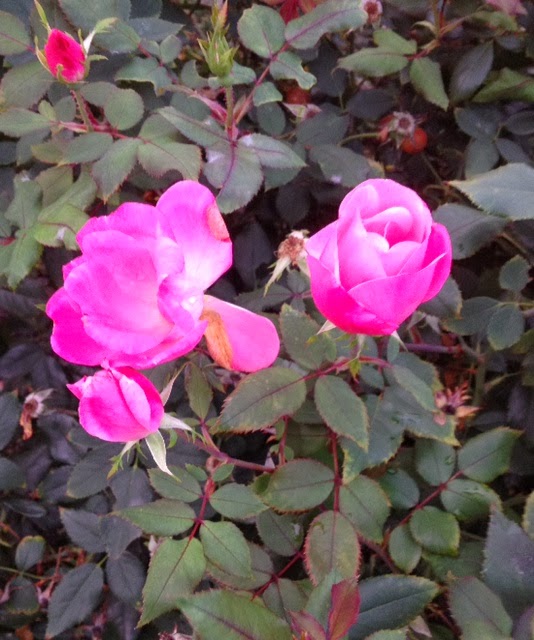
Last night, we had our hard freeze. There were still an amazing number of flowers still in bloom yesterday. That is so rare for an early November day in upstate New York, that I wanted to share some of these last blooms with you.
Most of these pictures were taken at Cutler Botanical Gardens, the free botanical garden run by the Cornell Cooperative here in Binghamton.
These blooms are gone now, dead, but this is what they looked like yesterday.

A single pink rose.

White roses.

A pink multiflora.
 Rose hips.
 And finally, a rose bush on the West Side of Binghamton.
Our weather has been so strange. Saturday it was in the 50's and the trees glowed - we were having a peak foliage day, of sorts, as the final trees were finally starting to turn color.
Yesterday was in the 30's, with snow flurries.
And now...who knows?
Most of these pictures were taken at Cutler Botanical Gardens, the free botanical garden run by the Cornell Cooperative here in Binghamton.
These blooms are gone now, dead, but this is what they looked like yesterday.

A single pink rose.

White roses.

A pink multiflora.


Our weather has been so strange. Saturday it was in the 50's and the trees glowed - we were having a peak foliage day, of sorts, as the final trees were finally starting to turn color.
Yesterday was in the 30's, with snow flurries.
And now...who knows?
Sunday, November 3, 2013
Civil War Sunday-Not As an Afterthought
Possibly the most famous speech in United States history began simply, as a verbal invitation, followed later by something in writing.
On November 2, 1863, President Abraham Lincoln received this invitation:
To His Excellency
A. Lincoln
President U. S.
Sir,
The Several States having Soldiers in the Army of the Potomac, who were killed at the Battle of Gettysburg, or have since died at the various hospitals which were established in the vicinity, have procured grounds on a prominent part of the Battle Field for a Cemetery, and are having the dead removed to them and properly buried.
These Grounds will be Consecrated and set apart to this Sacred purpose, by appropriate Ceremonies, on Thursday, the 19th instant. Hon Edward Everett will deliver the Oration. I am authorized by the Governors of the different States to invite you to be present, and participate in these Ceremonies, which will doubtless be very imposing and solemnly impressive.
It is the desire that, after the Oration, you, as Chief Executive of the Nation, formally set apart these grounds to their Sacred use by a few appropriate remarks. It will be a source of great gratification to the many widows and orphans that have been made almost friendless by the Great Battle here, to have you here personally; and it will kindle anew in the breasts of the Comrades of these brave dead, who are now in the tented field or nobly meeting the foe in the front, a confidence that they who sleep in death on the Battle Field are not forgotten by those highest in Authority; and they will feel that, should their fate be the same, their remains will not be uncared for.
We hope you will be able to be present to perform this last solemn act to the Soldiers dead on this Battle Field.
I am with great Respect, Your Excellency's Obedient Servant
David Wills
Agent for A. G. Curtin Gov. of Penna.[Pennsylvania] and acting for all the States"
In the aftermath of the Battle of Gettysburg, July 1-3, 1863, some 2500 residents of Gettysburg were left to tend to the thousands of wounded and bury the thousands more who had died during the three day battle. Gettysburg was to be the costliest battle (in lives lost) of the Civil War. I will spare you the details of the horrific conditions endured that summer by the farmers and others who owned the land where the dead fell, and what overwhelmed remaining Union soldiers and area residents went through, but if you are interested, here is one description. This article also has a harrowing description of what the Confederate soldiers left behind in Lee's retreat experienced.
Eventually, state and local governments came together. With financial help from every Union state whose citizens died at Gettysburg, lawyer David Willis oversaw the purchase of 17 acres for what became a national cemetery. It was to be dedicated on November 19, 1863, and the featured speaker was going to be....
...no, not President Lincoln. He was invited to give some remarks after the featured orator. You might say, he was invited almost as an afterthought. (more on that shortly).
It was, instead, a noted orator by the name of Edward Everett, a man who had served as a Congressman, a Secretary of State, a Senator and the Governor of Massachusetts, who was to give the main speech.
So it sounds like the President was being slighted, being treated almost as an afterthought. But, an interesting article explains that was not the case at all - that, in the 1860's Presidents were not expected to give speeches. That was the job of orators such as Everett, and Lincoln was to give a "few words" in his role as President.
Ironically, perhaps, Everett would not live to see the end of the Civil War, and Lincoln himself only outlived the end by a few days. But we are getting ahead of ourselves.
As we draw closer to the 150th anniversary of the dedication of Gettysburg's National Cemetery on November 19, 1863, I will blog more about this event that became so important in our nation's history.
On November 2, 1863, President Abraham Lincoln received this invitation:
"Gettysburg Nov. 2 1863
To His Excellency
A. Lincoln
President U. S.
Sir,
The Several States having Soldiers in the Army of the Potomac, who were killed at the Battle of Gettysburg, or have since died at the various hospitals which were established in the vicinity, have procured grounds on a prominent part of the Battle Field for a Cemetery, and are having the dead removed to them and properly buried.
These Grounds will be Consecrated and set apart to this Sacred purpose, by appropriate Ceremonies, on Thursday, the 19th instant. Hon Edward Everett will deliver the Oration. I am authorized by the Governors of the different States to invite you to be present, and participate in these Ceremonies, which will doubtless be very imposing and solemnly impressive.
It is the desire that, after the Oration, you, as Chief Executive of the Nation, formally set apart these grounds to their Sacred use by a few appropriate remarks. It will be a source of great gratification to the many widows and orphans that have been made almost friendless by the Great Battle here, to have you here personally; and it will kindle anew in the breasts of the Comrades of these brave dead, who are now in the tented field or nobly meeting the foe in the front, a confidence that they who sleep in death on the Battle Field are not forgotten by those highest in Authority; and they will feel that, should their fate be the same, their remains will not be uncared for.
We hope you will be able to be present to perform this last solemn act to the Soldiers dead on this Battle Field.
I am with great Respect, Your Excellency's Obedient Servant
David Wills
Agent for A. G. Curtin Gov. of Penna.[Pennsylvania] and acting for all the States"
In the aftermath of the Battle of Gettysburg, July 1-3, 1863, some 2500 residents of Gettysburg were left to tend to the thousands of wounded and bury the thousands more who had died during the three day battle. Gettysburg was to be the costliest battle (in lives lost) of the Civil War. I will spare you the details of the horrific conditions endured that summer by the farmers and others who owned the land where the dead fell, and what overwhelmed remaining Union soldiers and area residents went through, but if you are interested, here is one description. This article also has a harrowing description of what the Confederate soldiers left behind in Lee's retreat experienced.
Eventually, state and local governments came together. With financial help from every Union state whose citizens died at Gettysburg, lawyer David Willis oversaw the purchase of 17 acres for what became a national cemetery. It was to be dedicated on November 19, 1863, and the featured speaker was going to be....
...no, not President Lincoln. He was invited to give some remarks after the featured orator. You might say, he was invited almost as an afterthought. (more on that shortly).
It was, instead, a noted orator by the name of Edward Everett, a man who had served as a Congressman, a Secretary of State, a Senator and the Governor of Massachusetts, who was to give the main speech.
So it sounds like the President was being slighted, being treated almost as an afterthought. But, an interesting article explains that was not the case at all - that, in the 1860's Presidents were not expected to give speeches. That was the job of orators such as Everett, and Lincoln was to give a "few words" in his role as President.
Ironically, perhaps, Everett would not live to see the end of the Civil War, and Lincoln himself only outlived the end by a few days. But we are getting ahead of ourselves.
As we draw closer to the 150th anniversary of the dedication of Gettysburg's National Cemetery on November 19, 1863, I will blog more about this event that became so important in our nation's history.
Saturday, November 2, 2013
Sustainable Saturday - Stalking the Wild Pawpaw
My pawpaw hunt has ended with success.
For the first time in nearly 30 years, I've tasted one. But first, let's back up a little.
Pawpaws are a wild fruit, about the size of your fist, They grow on trees and are pollinated by flies - not bees. The trees are not bothered by pests. The taste is hard to describe - many people describe it as a cross between a banana and a mango. Back 30 years ago, I had never had a mango, so my memory described it as a "banana on steroids". They are highly nutritious, and high in antioxidants.

I first encountered the pawpaw growing wild in rural Northwest Arkansas, in the early 1980's. I saw a pawpaw tree (above) growing in downtown Fayetteville, Arkansas in August, during my first visit since leaving in 1986, and those pawpaw memories came flying back.
Thomas Jefferson grew pawpaws at Monticello, and they grow wild in the Washington, DC area.
You can also buy cultivated varieties, some of which would be hardy where I live in upstate New York.
A lot of this is the work of one man, and the story of the pawpaw is getting to be quite fascinating..
And then I read a local farmers market report saying pawpaws were being sold, in limited quantities, right here in the Binghamton area.
Last Saturday, my spouse and I walked into our localvore store, Old Barn Hollow (in walking distance of downtown Binghamton) and this sight greeted us:
 They had been supplied by a man in Binghamton who had a pawpaw tree, but this was his final harvest for the year. So, we bought one of the smaller ones to try out. As I recalled, I wasn't that crazy about the taste. But, tastes change with age. Maybe my palette had matured.
 These fruits need to be soft and more brownish before you eat them, so we let it sit a few days. We could have let it sit another day or so, but the fruit flies had discovered it. So, it was time to test our pawpaw out.

This is the pawpaw, cut open. The seeds are not edible, as far as I know.
We took the soft flesch and scooped it out of the skin, and ate it just like that.
Verdict: I still think they taste like a banana on steroids. I still tasted the slightly unpleasant undertone, but it wouldn't prevent me from eating it. It would be great baked into a pie, or even blended into a smoothie with strawberries. So yes, I would eat one again, especially if it was one of a number of ingredients in a dessert.
Now as to those seeds - yes, we are going to try to germinate them. More on that another time.
So, I really didn't have to stalk the wild pawpaw-but I would still love to find a wild pawpaw tree I could get fruit from.
Now if I could only find the wild persimmons I still remember from Arkansas.....
For the first time in nearly 30 years, I've tasted one. But first, let's back up a little.
Pawpaws are a wild fruit, about the size of your fist, They grow on trees and are pollinated by flies - not bees. The trees are not bothered by pests. The taste is hard to describe - many people describe it as a cross between a banana and a mango. Back 30 years ago, I had never had a mango, so my memory described it as a "banana on steroids". They are highly nutritious, and high in antioxidants.

I first encountered the pawpaw growing wild in rural Northwest Arkansas, in the early 1980's. I saw a pawpaw tree (above) growing in downtown Fayetteville, Arkansas in August, during my first visit since leaving in 1986, and those pawpaw memories came flying back.
Thomas Jefferson grew pawpaws at Monticello, and they grow wild in the Washington, DC area.
You can also buy cultivated varieties, some of which would be hardy where I live in upstate New York.
A lot of this is the work of one man, and the story of the pawpaw is getting to be quite fascinating..
And then I read a local farmers market report saying pawpaws were being sold, in limited quantities, right here in the Binghamton area.
Last Saturday, my spouse and I walked into our localvore store, Old Barn Hollow (in walking distance of downtown Binghamton) and this sight greeted us:


This is the pawpaw, cut open. The seeds are not edible, as far as I know.
We took the soft flesch and scooped it out of the skin, and ate it just like that.
Verdict: I still think they taste like a banana on steroids. I still tasted the slightly unpleasant undertone, but it wouldn't prevent me from eating it. It would be great baked into a pie, or even blended into a smoothie with strawberries. So yes, I would eat one again, especially if it was one of a number of ingredients in a dessert.
Now as to those seeds - yes, we are going to try to germinate them. More on that another time.
So, I really didn't have to stalk the wild pawpaw-but I would still love to find a wild pawpaw tree I could get fruit from.
Now if I could only find the wild persimmons I still remember from Arkansas.....
Friday, November 1, 2013
Trick or Treating with Superman
Last night, on the eve of NaNoWriMo, I answered the door to give out Halloween treats until the rain got too heavy and the kids stopped coming. In between, I remembered back when I had a little one, too many years ago. Had to get into the groove for writing a memoir, after all.
One Halloween stand out in my memory.
Unlike last night, when temperatures were mild (57 degrees F), we sometimes used to get snow, back in the "old days". On this particular Halloween, we got snow. A lot of snow. As I recall, some 13 inches (what a number, for Halloween!) of wet, gloppy, snow.
In those days of thrift but of not of being too creative, I looked to pajamas, raincoats, and the like as the basis of costumes for my little son. This particular year it was to be pajamas and boots. The combination cried out "Superhero!" and, sure enough, I was able to find superhero pajamas that looked just like the outfit Superman wore. Complete with cape.
A pair of boots completed the outfit. Everyone in upstate New York owns boots so it wasn't an extra expense.
Superman, and his mother, went from neighborhood door to door in the snowstorm. Apparently, not too many other trick or treaters were that crazy, because, as we wound our way through the neighborhood, Superman's plastic pumpkin started to fill up fast.
Too fast. I think people were taking pity on my little one, handing out, two, three, and even four candies to one happy little boy.
We ended up with so much candy, we must have been on a sugar high for months. (Yes, "us" I was a bad mom. A VERY bad mom.)
So, onward now (as of 12:01 am this morning) to my memoir. As you read this post, I'll be typing furiously, about my own childhood. Maybe I'll even think a little about the Halloweens of my childhood in the Bronx.
Do you have good memories of a particular Halloween?
Thursday, October 31, 2013
Fright and NaNoWriMo
Today it's Halloween. A time for decorating, for trick or treating, for pretending you are things you aren't. And to prepare for a writing marathon.
Halloween decorations have become so popular in the United States these last few years, that you find them almost everywhere.
 In Northwest Arkansas, for example, when I visited in August, some decorations were already up. (this was in a Wal Mart parking lot.) I loved the hay bale jack o'lantern.
 I found another hay bale jack o'lantern at a local Southern Tier of New York dairy farm.
Here in upstate New York, bushes are covered in fake spider webs. Pumpkins rest on porches. Inflatable witches rest in some front yards.
 In a downtown Binghamton apartment, a space under a window has been transformed into a graveyard.
 On the West Side of Binghamton, another front yard graveyard.
This is "fake" death and fright, though. Sometimes, the scary truth is just a few hundred feet away.
 In downtown Binghamton we have a 9/11 monument, complete with a girder from the former World Trade Center. Knowing that there are groups who would love nothing better than to inflict this kind of pain on the world (and having just done so, in Kenya, not too long ago) is truly scary.
And, there is one more type of fright. The fright of the writer facing a blank computer screen.
Tomorrow I start my participation in NaNoWriMo. This requires me to write 50,000 words in 30 days. Last year was my first time, but this year I am actually a bit scared. Will I be able to write 50,000 words devoted to a memoir? I've already written some 20,000 words of memory in two previous Camp NaNoWriMos. But this is the big time. My reputation is at stake. I have fans rooting for me! I have writing buddies!
Gulp. Nothing Halloween can scare up for fake fright can compare with this.
So I may not be seeing you that much in November.
I'll be checking in from time to time. You may see some "Best of AM" posts this month, but I plan to continue my daily post schedule.
The preparations are done.
Tomorrow, the work begins.
Halloween decorations have become so popular in the United States these last few years, that you find them almost everywhere.


Here in upstate New York, bushes are covered in fake spider webs. Pumpkins rest on porches. Inflatable witches rest in some front yards.


This is "fake" death and fright, though. Sometimes, the scary truth is just a few hundred feet away.

And, there is one more type of fright. The fright of the writer facing a blank computer screen.
Tomorrow I start my participation in NaNoWriMo. This requires me to write 50,000 words in 30 days. Last year was my first time, but this year I am actually a bit scared. Will I be able to write 50,000 words devoted to a memoir? I've already written some 20,000 words of memory in two previous Camp NaNoWriMos. But this is the big time. My reputation is at stake. I have fans rooting for me! I have writing buddies!
Gulp. Nothing Halloween can scare up for fake fright can compare with this.
So I may not be seeing you that much in November.
I'll be checking in from time to time. You may see some "Best of AM" posts this month, but I plan to continue my daily post schedule.
The preparations are done.
Tomorrow, the work begins.
Wednesday, October 30, 2013
Fall Fancies - The Last Sniff of Summer
Today, a friend and I took a noontime walk in downtown Binghamton, in upstate New York. What did we find, on this lovely mid-50's (about 13 Celsius) late October day?
 Roses are still blooming, despite a mild frost. (We will get our hard freeze in two or three days). My friend sniffed every one we passed, and found a couple of nice scented ones for me to enjoy.
 In a corner near a senior housing development, a lonely flower blooms.
 Nearby, a red tree was showing off. We have an interesting blend right now of bare trees, green trees and colored trees.
 Earlier this morning, I was walking through downtown. At our county courthouse, it was close to dawn and the yellow-brown trees were glowing in the streetlights.
 Moving back a little, this was the overall view.
It's hard to believe that the time of snow isn't too far off But there is actually something a little worrysome in these pictures. As I mentioned, we have trees that haven't turned downtown, and even where I live near Johnson City. It's late to have trees with leaves, and each year, the last leaves leave the trees later and later. We always had full leaf bags before Halloween. This year we haven't even started to rake yet. (we probably will start this weekend.)
My husband has been tracking the last leaf falls for about 10 years now, and there is no change to the pattern of "later and later" yet.
Climate change. Why does anyone deny it?
Trees with leaves are hazards when the first snows come. Snow sticks to leaves and branches, or even entire trees, may come down.
Hopefully, the first true snow (we've already had snow showers) will hold of at least a couple of weeks.
If it is autumn where you are, how are things progressing?


It's hard to believe that the time of snow isn't too far off But there is actually something a little worrysome in these pictures. As I mentioned, we have trees that haven't turned downtown, and even where I live near Johnson City. It's late to have trees with leaves, and each year, the last leaves leave the trees later and later. We always had full leaf bags before Halloween. This year we haven't even started to rake yet. (we probably will start this weekend.)
My husband has been tracking the last leaf falls for about 10 years now, and there is no change to the pattern of "later and later" yet.
Climate change. Why does anyone deny it?
Trees with leaves are hazards when the first snows come. Snow sticks to leaves and branches, or even entire trees, may come down.
Hopefully, the first true snow (we've already had snow showers) will hold of at least a couple of weeks.
If it is autumn where you are, how are things progressing?
Tuesday, October 29, 2013
The Gamechanger
It's one year since Superstorm Sandy made landfall on the East Coast of New York City. Tonight, communities on the shore remember with lit candles and flashlights.
As my regular readers may recall, I was born in the Rockaways, in New York City, one of the areas tragically affected. From afar (over 150 miles away away), I tried to use social media to keep track of what my relatives and friends in New York City were experiencing.
 This kayak on a Brooklyn street some distance from the ocean (photo taken by a friend) was just the tip of the damage.
A year later, enough damage still remains, although the recovery continues.
We can remember what was, in a visit I made to Red Hook (another affected neighborhood, in Brooklyn) shortly before Sandy . And, indeed, I've walked the streets of Red Hook again, as I promised to do in that post.

I want to share some photos with you, on this first anniversary of Sandy, of hope reborn in Red Hook.
 In some places, when I visited in May, the damage was quite apparent.

But nearby, an open garden center was selling blooms.
 A Red Hook housing project has experienced some rough times.

But, just days after the Boston Marathon bombing, Red Hook was raising money for Boston.
Still, so much work remains. In another Brooklyn neighbor, Gerrisen Beach (in walking distance of one of my relatives), rebuilding continues amidst frustration.
This kind of story, thanks to climate change, has become way too common throughout our world.
At a recent local meeting of our neighborhood and town regarding our own post-flood issues from Tropical Storm Lee in September of 2011, officials called Sandy "the gamechanger".
It was the event that made New York State finally take notice, they said, of all that has been happening with our weather.
I hope our officials are right.
As my regular readers may recall, I was born in the Rockaways, in New York City, one of the areas tragically affected. From afar (over 150 miles away away), I tried to use social media to keep track of what my relatives and friends in New York City were experiencing.

A year later, enough damage still remains, although the recovery continues.
We can remember what was, in a visit I made to Red Hook (another affected neighborhood, in Brooklyn) shortly before Sandy . And, indeed, I've walked the streets of Red Hook again, as I promised to do in that post.


But nearby, an open garden center was selling blooms.


But, just days after the Boston Marathon bombing, Red Hook was raising money for Boston.
Still, so much work remains. In another Brooklyn neighbor, Gerrisen Beach (in walking distance of one of my relatives), rebuilding continues amidst frustration.
This kind of story, thanks to climate change, has become way too common throughout our world.
At a recent local meeting of our neighborhood and town regarding our own post-flood issues from Tropical Storm Lee in September of 2011, officials called Sandy "the gamechanger".
It was the event that made New York State finally take notice, they said, of all that has been happening with our weather.
I hope our officials are right.
Monday, October 28, 2013
The Mystery of the Snowbow
Is there such a thing as a snowbow?

My spouse and I saw this in the sky last Thursday about 4:50 pm in Johnson City, New York. We were having a mixed rain/snow shower and we suddenly saw this rainbow - or snowbow? in the eastern sky, while driving.
I took a couple of pictures through the windshield of our car.
Looking online, I find that there may (or may) not be such a thing as a snowbow.
This says no.
This says yes, but what they describe isn't what I saw.
What I think I saw, though, was a true rainbow, produced by the rain component of the shower.
Still, it's the first time I've ever seen a rainbow associated with snow.
To my science minded readers - what do you think?
Sunday, October 27, 2013
Civil War Sunday-On the Less Beaten Path
There comes a time in the life of a student of the United States Civil War where it is time to leave the normal path - the path of major battles, preserved and interpreted in national, state, or county parks - and set off into a not-so-packaged experience.
That time came for me and for my spouse this past August, as we decided to trace a not so well known Civil War battle in Northwest Arkansas at Cane Hill.
As I've blogged about previously, many Civil War battlefields are privately owned, including Cane Hill.
At a nearby state park that preserves a different battle (Prairie Grove), we were able to pick up directions. They are also available online.
I don't know if this was the work of one person, or of many, but I would like to thank whoever took the time (and spent the money) to erect these plaques and trace the path of the battlefield.
 Today, the Cane Hill battlefield is farmland. This is the first stop on the self-guided tour.
 Plaques now exist to educate the student about the battle.

For example, here is where the opening shots were fired.

The second major stop is the abandoned Cane Hill College, which is known today (in another location) as the University of the Ozarks. I do not know what this structure with the name "Cane Hill" is. Nearby, there was a millstone lying on the ground.
 Only one building remains from the Civil War era, which is dorm that was used as a field hospital after the battle.
 Now, there is a historical plaque at the college, and one of the post Civil War buildings looks like it has been used recently. Either that or there is a historic air conditioner in one of the windows on the first floor.
 There was a sidewalk there that I took pictures of but they didn't come out good. It had signatures traced in the concrete - I would guess they were made by graduates of the college.

The next stop is an abandoned mill, Kidd's Mill. Confederates camped behind this mill before the battle, perhaps where I took the picture.

Another view behind the mill.
And...that is where the tour ends. Because we got lost and we were never able to find where we were supposed to go next.
Yes, that is another part of the experience when you are traveling in a rural area. Sometimes roads aren't too well marked, or are in poor condition. We did enjoy ourselves, though, and learned something of Civil War history in a part of the Confederacy too often ignored.
That time came for me and for my spouse this past August, as we decided to trace a not so well known Civil War battle in Northwest Arkansas at Cane Hill.
As I've blogged about previously, many Civil War battlefields are privately owned, including Cane Hill.
At a nearby state park that preserves a different battle (Prairie Grove), we were able to pick up directions. They are also available online.
I don't know if this was the work of one person, or of many, but I would like to thank whoever took the time (and spent the money) to erect these plaques and trace the path of the battlefield.


For example, here is where the opening shots were fired.

The second major stop is the abandoned Cane Hill College, which is known today (in another location) as the University of the Ozarks. I do not know what this structure with the name "Cane Hill" is. Nearby, there was a millstone lying on the ground.


The next stop is an abandoned mill, Kidd's Mill. Confederates camped behind this mill before the battle, perhaps where I took the picture.

Another view behind the mill.
And...that is where the tour ends. Because we got lost and we were never able to find where we were supposed to go next.
Yes, that is another part of the experience when you are traveling in a rural area. Sometimes roads aren't too well marked, or are in poor condition. We did enjoy ourselves, though, and learned something of Civil War history in a part of the Confederacy too often ignored.
Saturday, October 26, 2013
Sustainable Saturday-The Icy Fingers of the Winter to Come
After this Saturday, all but two local farmers' markets go into hibernation until late next spring.
This morning, an icy breeze whipped through the Otsiningo Park farmer's market, as vendors huddled in the 40 degree cold. One vendor was even wrapped up in a blanket in the bed of her truck.
 Even the savoy cabbage was purple with cold. (We bought one of these, and will report on their taste.)
We are still adjusting to the cold here. The coats have come out, and they won't be going back in their closets until April.
Yet, shoppers were out, looking at cabbage, radishes, turnips, green peppers, honey, cheese, and frozen chickens.

We moved on to a farm stand that will be closing for the season Thursday. Russell Farms is located in Pennsylvania, across the border from us in the Southern Tier of upstate New York, and it has a satellite farm stand in Vestal, NY. Next to a farmer's market, Russell Farms is the next best thing. Although they don't grow most of their veggies this time of year, they do have their own apples, and they are selling produce from southern Pennsylvania - Pennsylvania Dutch country.
 For example, this head of savoy cabbage (objects in back of it let you judge how big it is) set us back $1.00.
 They had Romanesque cauliflower, a heirloom from the 16th century.
 We also picked up some green cauliflower.
Next week, our small twice a month indoor winter farmers market begins in downtown Binghamton. And, the farmers wishing to brave the cold for one more month will huddle in the parking lot of the Vestal library. Now, that's dedication.
Will your farmer's market be going indoors for the winter?
This morning, an icy breeze whipped through the Otsiningo Park farmer's market, as vendors huddled in the 40 degree cold. One vendor was even wrapped up in a blanket in the bed of her truck.

We are still adjusting to the cold here. The coats have come out, and they won't be going back in their closets until April.
Yet, shoppers were out, looking at cabbage, radishes, turnips, green peppers, honey, cheese, and frozen chickens.

We moved on to a farm stand that will be closing for the season Thursday. Russell Farms is located in Pennsylvania, across the border from us in the Southern Tier of upstate New York, and it has a satellite farm stand in Vestal, NY. Next to a farmer's market, Russell Farms is the next best thing. Although they don't grow most of their veggies this time of year, they do have their own apples, and they are selling produce from southern Pennsylvania - Pennsylvania Dutch country.


Next week, our small twice a month indoor winter farmers market begins in downtown Binghamton. And, the farmers wishing to brave the cold for one more month will huddle in the parking lot of the Vestal library. Now, that's dedication.
Will your farmer's market be going indoors for the winter?
Friday, October 25, 2013
David, Goliath, Parental Loss, and NaNoWriMo
Do I want to have my soul devoured by a November ritual called NaNoWriMo? I just might, because of an interview I listened to last night. But first, bear with me a moment or two.
Do I want to spend this November feverishly trying to write 50,000 words for my own personal satisfaction, and to show myself (and maybe the world) that I can do it again? My manuscript from last year is still in my computer, with one of the main characters (a fictional daughter by the name of Madison) occasionally pounding on the lid of my laptop from within, demanding that she be let out. I haven't revisited the manuscript nor Madison - it was a work of mental healing, a fictionalized "what if" of my life, something never really meant for public consumption.
But, how can I resist another heart-pounding competition against myself? Bravely, earlier this month, I decided I would be a rebel and write my memoir. (This is a fiction competition, and memoirs aren't fiction. Hence, I would be a "rebel") I've made a couple of stabs at this memoir - back when I didn't know what was involved in writing a memoir.
I have tried to educate myself recently and realize I have a long way to go in actually writing a true memoir.
The doubts were gathering, like grey lake effect clouds on an upstate New York November afternoon. Do I really want to gaze into the navel of my life? (especially if I use cliches like that). Can I do it and write something worthwhile? Oh, that devil, insecurity.
I don't have delusions about this being marketable. I wasn't raised in a dysfunctional family. I didn't survive a war. I have never been an alcoholic or a drug addict (unless you count chocolate as an addiction). I am not famous, not even in my dreams. I have always felt there was nothing significant about me. I'm just an average "Jane" from New York City.
Apparently, I am wrong about being average.
Last night, I listened to a TV interview with the author Malcolm Gladwell, You may not have read his books, but his ideas have entered the modern consciousness - from tipping points to outliers. I read the book "Outliers", and enjoyed it very much. I love the concept of "things aren't necessarily what you think they are." Some critics feel Gladwell oversimplifies, but this isn't meant as a review of Gladwell's ideas. Rather, it is about something Gladwell said in last night's interview.
Gladwell has written a new book called David and Goliath.
To quote the New York Times, the book is " about the advantages of disadvantages — and the disadvantages of seeming advantages.". (One example Gladwell gave is the disproportionate number of successful people with dyslexia - something that caught my ear as one of my cousins has dyslexia.)
Then, something else he said had me suddenly thinking about my memoir-to-be.
Quoting again from the NY Times:
Was having my Mom die at age 12 an advantage for me?
Strangely, in some ways (am I disloyal to my Mom to say so?) I would say "yes".
I now have the theme of my memoir: loss and coming out, a different but better person, on the other side. Loss of a mother as a child. My childhood neighborhood, which turned into a slum when I was still growing up there. Loss of a dream of rural self-sufficiency in Arkansas.
In some ways, we are all survivors of loss. Or, will be survivors of loss, if we live long enough. What can be a more human theme than surviving loss?
I have registered on the NaNoWriMo website. My working title is "An Insignificant Life", in honor of the late author Frank McCourt.
If you plan to participate in NaNoWriMo this year and if you want to be your writing buddy, you can find me under RamblinWritr (no "e").
Do I want to spend this November feverishly trying to write 50,000 words for my own personal satisfaction, and to show myself (and maybe the world) that I can do it again? My manuscript from last year is still in my computer, with one of the main characters (a fictional daughter by the name of Madison) occasionally pounding on the lid of my laptop from within, demanding that she be let out. I haven't revisited the manuscript nor Madison - it was a work of mental healing, a fictionalized "what if" of my life, something never really meant for public consumption.
But, how can I resist another heart-pounding competition against myself? Bravely, earlier this month, I decided I would be a rebel and write my memoir. (This is a fiction competition, and memoirs aren't fiction. Hence, I would be a "rebel") I've made a couple of stabs at this memoir - back when I didn't know what was involved in writing a memoir.
I have tried to educate myself recently and realize I have a long way to go in actually writing a true memoir.
The doubts were gathering, like grey lake effect clouds on an upstate New York November afternoon. Do I really want to gaze into the navel of my life? (especially if I use cliches like that). Can I do it and write something worthwhile? Oh, that devil, insecurity.
I don't have delusions about this being marketable. I wasn't raised in a dysfunctional family. I didn't survive a war. I have never been an alcoholic or a drug addict (unless you count chocolate as an addiction). I am not famous, not even in my dreams. I have always felt there was nothing significant about me. I'm just an average "Jane" from New York City.
Apparently, I am wrong about being average.
Last night, I listened to a TV interview with the author Malcolm Gladwell, You may not have read his books, but his ideas have entered the modern consciousness - from tipping points to outliers. I read the book "Outliers", and enjoyed it very much. I love the concept of "things aren't necessarily what you think they are." Some critics feel Gladwell oversimplifies, but this isn't meant as a review of Gladwell's ideas. Rather, it is about something Gladwell said in last night's interview.
Gladwell has written a new book called David and Goliath.
To quote the New York Times, the book is " about the advantages of disadvantages — and the disadvantages of seeming advantages.". (One example Gladwell gave is the disproportionate number of successful people with dyslexia - something that caught my ear as one of my cousins has dyslexia.)
Then, something else he said had me suddenly thinking about my memoir-to-be.
Quoting again from the NY Times:
"..one of the most unconventional theories in “David and Goliath” is that for certain people, losing a parent early in life can be an advantage. He cites the work of Marvin Eisenstadt, a psychologist who did a study showing that “of the 573 eminent people for whom Eisenstadt could find reliable biographical information, a quarter had lost at least one parent before the age of 10” — and 45 percent had lost a parent before the age of 20."My Mom died (suddenly) when I was 12. And I would say that yes, that loss was the defining moment of my life. In fact, I have never written about it. Some memories of that night in November of 1965 are too painful for me to write about, even nearly 50 years later.
Was having my Mom die at age 12 an advantage for me?
Strangely, in some ways (am I disloyal to my Mom to say so?) I would say "yes".
I now have the theme of my memoir: loss and coming out, a different but better person, on the other side. Loss of a mother as a child. My childhood neighborhood, which turned into a slum when I was still growing up there. Loss of a dream of rural self-sufficiency in Arkansas.
In some ways, we are all survivors of loss. Or, will be survivors of loss, if we live long enough. What can be a more human theme than surviving loss?
I have registered on the NaNoWriMo website. My working title is "An Insignificant Life", in honor of the late author Frank McCourt.
If you plan to participate in NaNoWriMo this year and if you want to be your writing buddy, you can find me under RamblinWritr (no "e").
Thursday, October 24, 2013
Hunting for The Harvest Moon
I am writing this before we know for sure if we got our killing frost this morning here in upstate New York.
It is supposed to get down to 30 degrees, with scattered snow showers. Back on Monday, it was sunny and in the 60's. Things change so quickly in the fall. One day sunny, the next day lake-effect gloomy. One day, nice breeze and the next day a breeze that cuts you to the bone. One day the leaves on trees are green, and the next day (or so it seems) they are gone.
In the fall, the Moon takes over the sky.
In September, our full moon is called the Harvest Moon. The Harvest Moon rises right after sunset and sets right after sunrise the next morning. I never understood why it was called a harvest moon until I lived in rural Arkansas, some 30 years ago.
Back when I grew up in New York City, I had never experienced what the full moon could do. I never saw the true night sky, either. What I saw was a washed out version, with a few constellations scattered here and there.
In Arkansas, living on an unpaved road without lighting, I saw the Milky Way for the first time, and I saw the power of the full moon. I saw it light up our land so brightly you could read by its light. When snow was on the ground, it was almost like daylight. I never stopped marveling over how the night sky was really supposed to look like.
Now that I am back in an urban environment, I no longer read by the light of the Moon. But I still love to see the Harvest Moon of September, and the Hunter's Moon of October.
 Here, in Westover, near Johnson City, NY, we have a harvest moon sunrise.

In the west, meanwhile, the moon was about to set behind a row of trees.
For this year's Hunter's Moon, we were also going to have a penumbral eclipse of the Moon. I was so excited when the clouds broke up and I was able to see the Moon.
But what I couldn't see was the eclipse. I read, later, that my experience wasn't uncommon.
So, in a few minutes I will leave for work, in the dark. When I return home I will know if the frost hit. If it did, I will say goodbye to my flowers and steel myself for the winter to come.
It is supposed to get down to 30 degrees, with scattered snow showers. Back on Monday, it was sunny and in the 60's. Things change so quickly in the fall. One day sunny, the next day lake-effect gloomy. One day, nice breeze and the next day a breeze that cuts you to the bone. One day the leaves on trees are green, and the next day (or so it seems) they are gone.
 |
| Black Walnut Tree, Vestal Rail Trail, Vestal, NY |
In the fall, the Moon takes over the sky.
In September, our full moon is called the Harvest Moon. The Harvest Moon rises right after sunset and sets right after sunrise the next morning. I never understood why it was called a harvest moon until I lived in rural Arkansas, some 30 years ago.
Back when I grew up in New York City, I had never experienced what the full moon could do. I never saw the true night sky, either. What I saw was a washed out version, with a few constellations scattered here and there.
In Arkansas, living on an unpaved road without lighting, I saw the Milky Way for the first time, and I saw the power of the full moon. I saw it light up our land so brightly you could read by its light. When snow was on the ground, it was almost like daylight. I never stopped marveling over how the night sky was really supposed to look like.
Now that I am back in an urban environment, I no longer read by the light of the Moon. But I still love to see the Harvest Moon of September, and the Hunter's Moon of October.


In the west, meanwhile, the moon was about to set behind a row of trees.
For this year's Hunter's Moon, we were also going to have a penumbral eclipse of the Moon. I was so excited when the clouds broke up and I was able to see the Moon.
 |
| Picture taken during the height of the eclipse. |
So, in a few minutes I will leave for work, in the dark. When I return home I will know if the frost hit. If it did, I will say goodbye to my flowers and steel myself for the winter to come.
Wednesday, October 23, 2013
Fall Fancies - The Last True Days of Fall
Fall, to us in upstate New York, is a fleeting thing.
It is the short season of trees turning color - of red, yellow, and brown - before the snow starts to fall.
Monday, it was mild, hitting 60 degrees. Yesterday started out mild, before the cold came in, with a taste of bitter wind. A little after 4:30 I took my exercise walk with my spouse, as the sun shone in our eyes. The sun gets lower every day.
Tonight, we will be getting our killing frost. And, we may also be getting our first snow flurries, if you believe the National Weather Service.
But for now, red, yellow, and brown rule the land.
 Mushroom and burning bush, West Side of Binghamton.

Otsiningo Park, near Binghamton, New York.

Knotwood, an invasive plant, turns yellow in Otsiningo Park.
 Tree on the West Side of Binghamton.
Soon, we will have the last of our fall color.

A burning bush glows. In just a few days these leaves will be a distant memory.
Fall will last until December 21 on the calendar but, for us in upstate New York, it will be gone by the end of the month. Let's enjoy it while it lasts.
It is the short season of trees turning color - of red, yellow, and brown - before the snow starts to fall.
Monday, it was mild, hitting 60 degrees. Yesterday started out mild, before the cold came in, with a taste of bitter wind. A little after 4:30 I took my exercise walk with my spouse, as the sun shone in our eyes. The sun gets lower every day.
Tonight, we will be getting our killing frost. And, we may also be getting our first snow flurries, if you believe the National Weather Service.
But for now, red, yellow, and brown rule the land.


Otsiningo Park, near Binghamton, New York.

Knotwood, an invasive plant, turns yellow in Otsiningo Park.

Soon, we will have the last of our fall color.

A burning bush glows. In just a few days these leaves will be a distant memory.
Fall will last until December 21 on the calendar but, for us in upstate New York, it will be gone by the end of the month. Let's enjoy it while it lasts.
Subscribe to:
Posts (Atom)