Saturday, June 14, 2014

Sustainable Saturday - The Journey of 1000 Miles

Last year I blogged about the possible decline and fall of the Binghamton, New York downtown farmer's market.

Venders were leaving. And, not only vendors were leaving.   Binghamton, a city in upstate New York of around 47,000, once had nearly 80,000 residents.  Hard times had struck some years ago with the decline of major employers such as IBM (which started in Binghamton) and Endicott-Johnson. Ten years ago, even five years ago, many buildings in downtown Binghamton were vacant.

Now, Binghamton (including the downtown) is in the midst of reinventing itself.  But sometimes, it seems like a journey of 1000 miles, which has not gotten that far yet.

I've always maintained a strong local downtown farmer's market (with emphasis on "local" - we do have local farmers here) can be a key to the health of a community.  I've seen it first hand. I point to Fayetteville, ArkansasIthaca, New York. Asheville, North CarolinaCharleston South Carolina. The farmer's market on Union Square in New York City.  (I note here that, for some of these communities, the downtown markets are not their biggest. But all of them are vibrant.)

A neighborhood not that far from downtown Binghamton, New York is a food desert. Many years ago, I lived in that area (the North Side of Binghamton), before it became a desert.  So this is a subject close to my heart.

Last year, I had spoken to a person newly associated with the downtown Binghamton market about my concerns.  There was a vendor who obviously was not selling his own produce - plums in June, here, are just not local.  Yet, he seemed to dominate the market.

Yesterday, I returned to the downtown Binghamton farmer's market for its second session of the year and saw some major changes-all good.  I spoke to a favorite vendor and got the scoop.

The vendor who was obviously selling non local produce is no longer there. He was caught, I was told, buying produce from a local wholesaler, taking off the stickers you find on commercial produce, and selling it at market.
This is what I did find.  VINES,"Volunteers Improving Neighborhood Environments" will be concentrating their efforts on the downtown market this year.  They are dedicated to eliminating the food deserts within Binghamton by use of urban farms, community gardens accessible to the community and other improvements.  LOCAL!

Closer to the Heart, who sells only their own produce. (why this picture won't permit itself to be rotated, I have no idea). I've bought from them many times at the Otsiningo Park Farmers Market so know they are LOCAL!

Sunny Hill Farms. My friend has bought their honey for years. Another friend loves their rhubarb.  LOCAL!

I couldn't get a good angle for a shot, but a vendor that has been to the market for years, Full Quiver Farm, is back.  I've purchased their breads.  LOCAL!

And, finally, a new vendor, Fojo Beans.  I hope they can make it at market, because the beans, while high quality, are pricey for the Binghamton market, I fear. (I hope I'm wrong).  Local coffee roaster!

It's a small start.  But perhaps, a single step in that 1000 mile journey.

Tomorrow - Garden Bloggers Bloom Day.  And this coming week, a mix of flowers and autism.  I hope you enjoy what I have planned for you.

Friday, June 13, 2014

Physical Fitness and An Adult With Autism


Every year, our local "Y" sponsors something called the Corporate Challenge, where people from different companies in our area compete in a number of road races for the fame and glory of themselves and the company they work for.

In 2009 I wrote the below post.  Yesterday, I completed my eighth Corporate Challenge.  I still walked the predicted mile, where you guess your time and try to walk the mile in your exact time.

Once again I didn't win. 

Last year, the event was postponed due to rain, the first time that ever happened.  While cities in Texas ponder if they should drink their toilet water (no, I'm not linking to THAT post yet again), we wish that we could send rain their way, at least on days like this.  Instead, once again, I raced in the rain. (And hurt my back - how, for Pete's sake, do you hurt your BACK by walking????)

And now, in a masterful segue, I will devote the rest of this post to "B", my brother in law, who has autism.

"B" has never walked a Corporate Challenge.  He has never run one.  In fact, I can't remember the last time he ever exercised.

That has become a big problem, because "B" is in his 50's, and, as anyone who has reached that age can testify, things start happening to your body if you don't exercise.

Things happen that aren't good.  In the interest of preserving "B"'s privacy, I will not divulge those health issues "B" is experiencing except for one thing that I do need to share - "B" has asthma, and has had it for many years.

He fears physical activity.  The reason he gives us is his asthma - at least, that's the reason he gives us.  He will walk, maybe a round around the local mall, but that is it.  He fears an attack. In fact, the one time, many years ago, that my spouse took him for a walk, his mother was unhappy with us afterwards, and I know that "B" observed that.  So, it may be a type of learned helplessness.

When his mother had more mobility, she used to mall walk with friends, and he sometimes went with her if she needed a walking companion.  But, that's in the past.  My mother in law can't mall walk any more (she has problems walking, period) and so "B" is not moving.

So, we can't figure out what to do to motivate "B" to move more.   We live 150 miles away, so we are not in his life on a regular basis.  Many times, when we are down there, it is to help his Mom out, celebrate a holiday, or some other occasion where we aren't making time for exercise.  Unfortunately, the neighborhood where "B" and Mom lives has no sidewalks, and walking far is a dangerous thing. In fact, the entire community is not set up for walking.

There is a rail trail - we've used ourselves but it is not sunny, and slippery green stuff grows here and there on the trail.  He would rather walk in the mall, I suspect, which is more familiar to him.

So, what to do to get him moving more?

I hope someone reading this can comment with some suggestions.  Because, "B" has to move.  He has to, for the sake of his health, asthma in consideration, but I do know that people with asthma can exercise with proper precautions.

In the meantime, here is my post from 2009.

Just Racin' in the Rain.....

Just got back from the 2009 Corporate Challenge, an annual event in our area (and maybe nationwide). Employees of various businesses compete, in good fun, in various walking and running events. I'm not a runner, so I did the one walking event, the Predicted Mile. In this race, you race the clock, not others. Participants predict the time they will finish the mile in and the person closest to their prediction wins. The key here is that you can't have a watch or any other way of telling time on your person.

This is my third year of participating and it is a blast.

The first year it was held in August and it was in the 90's, with runners collapsing and ambulances responding. Not a pretty sight. Last year the weather was pretty decent. This year, the heavens opened.

It's been raining since last night with a few breaks. At noon, my walking partner and I did 1 1/2 miles, with rain at the end. Tonight the rain started about 5:30 and it didn't let up. The runners loved it. As for the walkers...well, my new walking shoes aren't so new anymore. But it sure beat being in the 90's.

This year's Corporate Challenge had the highest turnout in 10 years, and they had to split the walkers into two groups. 41 companies, large and small. It's a good event and I hope to participate in the coming years, too.

I'll know tomorrow if I (ha ha) won.

Thursday, June 12, 2014

No Cats Were Harmed in the Posting of This Post

In Tuesday's blog post, I blogged about how my father in law died suddenly, in his sleep, on Christmas night, 1998. 

"B", my 50 something brother in law who has autism, blamed the family cat, Pepe Le Pew.

Pepe - who looked something like the cartoon cat many of us remember from our childhoods, if you are of a "certain age"- never really interacted with "B". Nor did "B" interact with Pepe, at least at anytime I ever remember seeing. My spouse doesn't remember any interactions, either.

In fact, while my spouse (who is several years older than "B") was growing up, he owned several cats.  "B" never showed any interest in those cats, either.  His mother and father did not keep other pets, so we'll never know if "B" would have made a dog his own, or a bird, or any other animal.

Is this usual for someone with autism?

The short answer is "there is an entire spectrum of differences between people with autism".  But one thing is for certain, in my experience:  the myth that a person with autism can not love, is just that - a myth.  (Something else to blog about, one day.)  They just find it difficult to show it in ways we without autism understand.

The longer answer is:  Some people with autism love animals and interact with them more easily than with people.

This could be for a number of reasons.  Animals do not judge our social behavior.  For a person with autism, the social behavior of other humans is a mystery, many times a painful mystery as he or she is rejected by others for reasons not easily understood.  The love of an animal is unconditional.

And, perhaps, the social behavior of a solitary cat or dog is something that a person with autism can pick up on.

The relationship between certain individuals and people with autism can be legendary, such as the famous professor of animal science who has autism, Temple Grandin.  Ms. Grandin, in fact, is an advocate for humane animal slaughter for those animals who are raised for food.  She even addresses the issue of humane animal slaughter in the context of two major world religions.

She writes extensively on animal welfare. 

And, those are not the writing of someone who does not care and can not love.

But, let us return to the situation, after my father in law died, where "B" blamed the family cat, Pepe.

We still don't know why "B" blamed Pepe.  I don't think we'll ever know. Perhaps this was his way of communicating something he saw that night.  An unusual behavior my spouse remembers from his childhood, watching "B" develop in a way unlike his other brother, was that "B" would blame his hand for misbehavior.  "The hand did it", he would insist.

Perhaps "B" saw Pepe trying to enter the bedroom the night my father in law died. (they probably had the door closed that night as we were there.)  Perhaps "B" (who loves to read about scientific topics) had read about folk beliefs that cats could smother young babies.  Perhaps he thought the cat had smothered his father. I can only speculate. 

It's important to note that whatever "B" was trying to communicate, he wasn't violent.  In fact, I have never, ever, seen "B" engage in violent behavior towards others.

He never tried to harm the cat.  And, I am touched by my readers who worried for the cat's fate. 

So, dear readers, let me assure you the cat in question lived to a ripe old age, unharmed (and probably unloved) by "B". Pepe died of natural causes when he was around 16 years old. In his older years, Pepe didn't stay at home much.  He took up with another neighborhood cat, and (with the owner's blessings) spent most of his indoor time with the other cat's owner.

I'm happy Pepe found happiness.  Sometimes, I wonder if "B" is happy with his present life.

And, one more thing to close this story.

My mother in law never replaced Pepe with another cat. To this day, they remain without a pet.

Wednesday, June 11, 2014

Spring Things- Urban Wildflowers

(Before I begin - for those worried about the cat in yesterday's post - no, he was not injured, and lived to an old age).  I will tell the rest of the story tomorrow.

You may be surprised to find wildflowers in an urban area but - wildflowers can be found in so many places.

Friday, I took a walk with a friend along the Chenango River in downtown Binghamton, New York. 
The Dame's rocket (Hesperis matronalis) this year is so beautiful that it is hard to remember that it is an invasive plant.  Strangely, while most people love the scent of this flower, I don't find it that pleasant. (I've blogged before about how I perceive certain scents, and my son is afflicted worse than I am.)
Virginia spiderwort (Tradescantia virginiana) was growing nearby.
Wild grapes, which have just finished blooming.
A couple of miles away, in Otsiningo Park, we find ragged robin (Lychnis flos-cuculi) in a wet area of the park.

And finally, from the week before this, lawn daisies in Skaneateles, New York, which is near Syracuse. I found these flowers everywhere.   Some do not find these welcome at all, as they will take over a lawn if you let them.

It seems like spring has just begun, but it is almost over.  Next week is my last Spring Things.  What do you think I should feature?

Tuesday, June 10, 2014

The Cat Did It - The Start of a Journey

"The cat killed him", my brother in law, "B", insisted.  We couldn't convince him otherwise.

"B", who, at the time, was a man in his early 40's, had lived almost of his life in the house in New York State.  At one time, his siblings lived with him but they eventually grew up, pursued careers, married, and left, not necessarily in that order.

"B" grew up but he never was able to pursue a career or marry.  He has a developmental disability called autism.  He has never had a lady friend.  He has always lived with his mother.

For years, he lived (and still does live) in his own room in a finished basement in the family home.

When his sister left home, she left behind a black and white cat, named Pépé le Pew.

Not "B"'s Family Cat-But Pepe Looked Similar
"B" never really liked the cat, I don't think, but he tolerated him.  He didn't take any care of the cat; that was left to his Mom and Dad.  Pepe was an outdoor cat, but he did come home to eat.

On Christmas Day 1998 my spouse, our then elementary school aged son and I visited my in laws, and "B".  We had a pleasant Christmas dinner and a quiet evening.  My father in law, after we all watched "It's a Wonderful Life", went to bed.

My father in law never woke up.  It was his third, and final, heart attack.

While we were all coping with the suddenness of this death, making funeral arrangements, trying to comfort my son (whose Christmas trip to Grandma and Grandpa had turned into a nightmare), "B" coped with the sudden death however he could. To be honest, between helping to plan the funeral, helping my mother in law, and being with my son, I didn't pay much attention to "B".

Until I noticed something strange, a day or two after the death. Somewhere along the line "B" decided that the cat had killed his father.

Our indoctrination into advocating for "B" was about to begin.

I will continue the story later this week.  Tomorrow, my Spring Things feature.

Monday, June 9, 2014

Kool Aid Irises

They are nearly done in my upstate New York garden. But these irises have a little bit of a history about them, and they may even have more of a history than I suspect.

Maybe.  But I really don't care.
Kool Aid Irises after a Rain
How I wish you could smell these flowers.  Since I can't bring you smell-o-blog, I can bring you the story of how I came to own these irises.

In the early 1990's I worked with a woman. Newly hired by our company, she quickly hit it off with all of her co workers, including me.

One day, she brought me some irises dug up from her garden.  "For you", she said. 

"These are Kool Aid irises", she told me.  "When they bloom they will have the most delicious fragrance. Some people liken it to grape kool-aid and others to grape soda.  And, on occasion, they have rebloomed for me."

I've grown them ever since.  They bloom in late May or early June.  Right now, we still have them but maybe for another day or so.

A post from a local garden blogger to the east of me got to thinking exactly what my Kool Aid irises were. Are they, perhaps, a heirloom, like her white irises are?

I wonder if they are Iris pallida. Their roots, along with roots of a couple of other irises, are used to produce "orris root" powder, an ingredient of potpourri.  (I haven't made potpourri in years, but it's never too late to start again.)
If they are Iris pallida, they are a bearded iris that originated in Croatia. And, even better, there is a variegated variety.   Although, one time, I tried growing a variegated iris, type unknown,and it didn't overwinter for me.

Heirloom or not, I love my Kool Aid irises.  They are hardy, reliable, and deer don't touch them. Although, at one time, we weren't concerned about deer in our urban garden, we've seen deer wandering a block or two away in the past few months.  The one thin they've never done for is rebloom, but that would only be a nice bonus from a lovely iris worth having.

My co worker moved out of the area years ago.  But I'd like her to know, wherever she is now, that her iris rhizome gifts are still blooming annually for us.

Do you know anything about this kind of iris?

Tomorrow - another post about autism.

Sunday, June 8, 2014

Rolling on the Floor Not Laughing

I've realized that I've started to take you, my faithful blog readers, on a journey through an experience called "autism" but I haven't talked about one of the most important thing we must remember as we start our journey.

Dear readers, it is all about support and safety.

I asked my spouse when he first realized that his younger brother, "B", was not developing the same way as his next younger brother.

He was about eight years old, and "B" was three.

"B" was not talking. He would throw tantrums. 

Not only that, but he never crawled.

Instead of crawling, "B" rolled on the floor. Everyone remarked about it, but no one seemed to know the significance.

 Now, this would be an indicator that something was wrong, but not back then.

When my mother in law was sure that something just wasn't right, she encountered pediatricians who had not been trained in developmental issues.  This was the early 1960's.  So she knew something was wrong but just didn't know what to do about it.

Why didn't "B" talk at three?  Well, according to his doctor, it was his mother's fault.  She had spoiled him, letting "B" depend on his two older brothers to communicate on his behalf. Did she know there were other mothers and fathers out there in the same situation?  I'm not sure.

There was no therapy the schools could offer. In fact, his right to a free, appropriate public education was not yet guaranteed by law.

Basically, my mother in law made up whatever she did in raising "B" as she went along, as did other mothers of children with what we know today as autism.

Now, the torch is being passed to us, the siblings and spouses.  And, in many ways, we struggle. I thank you for coming along and promise I will be sharing some good information with you during June.

My mother in law, although she didn't know it then, was not alone in her journey, just like we aren't alone in ours.  For a minute, I want to blog about the mother of perhaps the most famous person with autism today, Temple Grandin.  Her mother, Eustacia Cutler, now travels the world, lecturing on various aspects of autism.

This is what Eustacia Cutler has to say, quoting from her foundation website:

"A strong family is the linchpin that keeps a spectrum person from slipping off course. Family care for that person can be a lifetime task—in early years for parents, in later years for siblings. It stands to reason, therefore, that support for all family members in the early years, will build a strong family able to cope with whatever comes—a more humane and less costly solution than 70 years of institutional support.

As yet no autism organization has given full focus to the disorienting impact of autism on all members of the family.

While some families have the strength of an extended family or community support group, and enough money to buffer the non-stop task, most do not."
Families bend, if not break, under the strain.  There is, according to Ms Cutler, hidden domestic abuse.  There is a debate over whether families with a child who has autism divorce at a higher rate than other families. Life can be hard. 

I guess I am still brooding over the incident I blogged about yesterday, where a young blogger caring for her older sister (parents dead) wrote one post and felt she needed to take the blog down, after some less than appropriate comments.

I wanted to thank everyone who commented on my post yesterday.  I will thank you all individually, too. You, my readers, are awesome.

And in the meantime, those who have family members, the sibs the in laws, the caring friends, need to have safe places to vent, to celebrate, to inform.  There are such places.  I will blog about them later this month.   And yes, we do laugh. We do have good days and good times.  But, overall, it can be so hard.  Thank YOU for your support!

I will continue this journey through autism on Tuesday.

Saturday, June 7, 2014

Sustainable Saturday - To Those Who Hate

Who cares for the members of our society: the elderly, the frailest, or those who can not care for themselves due to physical or mental disability?

It's a job too big for one person.  That is where society is supposed to step in - the combined power of us all.  But too many times, it doesn't work.
Sustainable life isn't all about farmers markets, although I write about them a lot.

Depending on ourselves, or on family, or friends, is a nice philosophy until you have to put it into action. A person who embarks on caregiving without support will, sooner or later, be a person burning out.

If there is anyone in the world right now I would want to have write a guest post for my blog, it would be a woman who had started a blog about her particular situation.

The author was a young woman whose parents are dead, and so the responsibility for caring for her older sister rests on her.  Her sister had severe seizures as a young child, which caused major damage to her brain.  The sister, developmentally, is about the age of three.  She has other issues, too, as a result of this disability.

When the young woman sought respite and housing help from the State she lives in...well, it became an absolute nightmare.  She's not looking for a handout.  She is looking for some respite.  She has taken responsibility for her sister, as have others of us who have people with disabilities in our lives.

It's no surprise to me, and no surprise to anyone who is a sib or a sib-in-law of someone who is physically or developmentally disabled, that she must wade through incredible bureaucracy with rules that make absolutely no sense.  She must deal with agencies who have no idea of the needs of the people and family they are "serving". 

Just think of all the people without loving families who are adrift in that system.

But that isn't what I am blogging about today.  Rather, what I am blogging about is what happened to that young woman's blog.

She had many comments on her first post - which is going to be her last post, because she had to take the blog down.  Let's just say some of the comments were not friendly.

This was actually one of my concerns when I decided to spend part of the month blogging about my brother in law, who has a developmental disability called autism.

Yes, there are those who hate out there, and they just love to deposit their droppings of hate anywhere it is convenient.  They hide in the anonymity of the Internet.  Or, it could be that her blog was visited by people who hate those with disabilities.  To them I say:  being disabled is one minority group that anyone can enter into at any moment.  All it takes is, oh, a car accident.  Or a stroke.  Or cancer.  Or the bite of a tick.  Or being bitten by the wrong mosquito.  Or an injury that gets infected by the wrong bacteria.  And then they will be looking at life from the other side.

What you give, you get.  Life is an echo.

Karma can be a bitch.

I hope that young woman continues to write, somewhere, somehow.  She has a wonderful voice, and it deserves to be heard.

Friday, June 6, 2014

Still in Hiding

Imagine....being as young as two years old.  For reasons you don't understand, you are being separated from your parents.

You are sent to live with strangers.  Every so often, you are moved. Your name is changed.  You can't go out during the day.  Others can't know you're in the house. 

Sometimes you are treated well,  and sometimes, you are abused.

There is a war.  And you are part of it, but you don't understand why. Or, if you were old enough, you did understand, all too well, why people seemed to want you dead.  You knew that sometimes the families who hid you did it out of conviction, but other times, it was for the money that resistance groups somehow found, and paid to them.

Finally, the war is over.  Sometimes you are reunited with your parents.  Sometimes, you never see them again.  Sometimes, almost your entire family is gone forever.  Sometimes, you are forced to remain friendly with the very people who abused you.

And, however your saga of hiding ends, the war stays with you for the rest of your life.

The story of a number of Dutch children hidden from the Nazis in World War II is told in an amazing book about World War II called Hidden Like Anne Frank, that I happen to be reading now.  Each story is thought provoking, sobering and sad in its own way.

In this book, there are no happily ever afters.  There are, instead, many people, permanently damaged by war.  You stare into the faces of the children (each child has a photo), and the pictures of those same people, now elderly.  You think of your own life.  And you are grateful for what you have.

Possibly few of those stories would ever have been written if not for D-Day, June 6, 1944.  On that day, some 160,000 Allied soldiers stormed beaches on the coastline of France.  Although some 9,000 Allied soldiers were killed or wounded on that day, others began the march across Europe to liberate the people.  70 years ago today.

Now, the surviving soldiers of World War II are elderly, and dying, even though at least one man who parachuted in that day parachuted in again. In our country, they die at a rate of approximately one every two minutes.  Each day there are fewer left to tell the tale.  On June 4, Chester Nez passed away.  He was one of the original Navaho Code Talkers, and the last living one.  His battles were in the Pacific Theatre, not the European, but he and others helped make victory possible.

Yet, for almost 30 years, he wasn't allowed to talk about it.  He carried his scars inside, just as these children of hiding, grown up, did.

Today, we still have war.  We still have children damaged by various wars living all around our planet. We even have child soldiers going to war and fighting, some as young as eight years old.  We still have veterans returning from war, scarred for life outside (or inside), and hiding their pain.

One day we will read their memoirs, look into their faces, and we will ask "Why?"

Will we ever have an answer?

Tomorrow, my Sustainable Saturday feature.

Thursday, June 5, 2014

But Will He Press the Button?

It was just a somewhat typical day, living three hours away from a mother in law in her 80's and her son with autism, my brother in law "B".

My spouse and I had last visited my mother in law and "B" over the Memorial Day weekend (the last weekend in May, here in the United States).

For several years, my mother in law has subscribed to one of those medical alarm devices that we used to poke fun of when we were younger.  Now that we are in our 60's and have an elderly relative we care for, it isn't so funny any more.

In fact, I don't know if I should laugh or cry at this parody of the old "I've fallen and I can't get up!" commercial.  Black comedy? or bad taste?

My mother in law has a device she wears on her wrist with a button she is supposed to press if she falls. Pressing the button calls a service that will summon help for her.  At one time they even kept a record of her medications, but, due to privacy concerns, they won't any longer.  The only problem is, she doesn't seem to wear it all the time - or, I suspect, even most of the time.  (Frustration).

On our last visit, we noticed a light flashing on the main alarm unit, which is near her kitchen telephone.  We talked to the alarm service.  The agent thought the button was dying, and said they would send a new device.

Except one never arrived. (This happened once before, incidentally, when they needed to send a new device. We had to call twice because the first one never arrived.). So my spouse called their service number. 

First try: recording said a 20 minute wait.  Called back a few minutes later.  Second try: recording said a 20 minute wait.

Spouse had another number. He called that and the recording didn't even identify the company - just said "Leave a message".  So much for try #3.

On try #4, spouse heard an option to leave a message and someone would call.  He did that and someone finally called.  The agent wanted to test the units remotely (she has two) to see if either one or both were no good. Spouse explained he was three hours from his mother.  So the agent said he would call her.  My spouse said "Wait, let me call my mother first." She does not answer the phone if the number is unknown. Spouse called, she answered and all (we hope) will work as promised.

Turns out the service had the wrong zip code on file. They are going to overnight something to my mother in law.  But, that isn't the end of our story.

One more question remains, one that I pray we never have to find out the answer to:

If my mother in law falls, and is conscious, she can press the button.  But if she is unconscious, will "B" press the button (or, in the alternative, call 911) for her?  He's been shown.  But it's not something we can figure out a test or routine for. It will be a one time thing.

My mother in law thinks he will call.  I only can hope she is right.  None of us know how we will react in an emergency until it happens.

Tomorrow and Saturday, I will be blogging on other topics.  But I will return to "B" next week.

Wednesday, June 4, 2014

Spring Things - Lilacs and Roses

Today would have been my mother's birthday.  She passed when I was 12, back in the mid 1960's.

One thing I associate with her is the memory of the scent of the talcum powder she used - something called Lilacs and Roses.

Here in upstate New York, our lilac season is ending (the three varieties at my house are long gone) and the rose season is barely beginning.  In fact, I haven't seen any roses blooming here yet, but I did find some, this past Saturday, an hour from here on the Cornell University campus in Ithaca, New York.

In honor of my mother's birthday, I'd like to share with you, some pictures of - what else - lilacs and roses.

This was the only lilac on my property when we purchased it over 25 years ago.  We share a hedge with a next door neighbor who, sadly, has dementia.  When he was himself, he used to let us pick lilacs from "his side" and I appreciated that so much.

This year, for some reason, it barely bloomed.
We planted this lilac some three or four years ago. It's doing well.  The only problem is, it was supposed to be yellow. It's a pale lavender but we really don't mind.  The name of the variety is lost to my memory.

We share this white lilac with our other neighbor.

Not my lilac - but I loved the color.

The scent of all these lilacs reminds me of my mother and her beloved talcum powder. But, strangely, as much as I love lilacs (and my spouse also), our son can't stand their fragrance.  To him, lilacs smell like garbage - literally.  There are some others who have the same issue.

As for roses - so many modern varieties have little or no scent.  But, at Cornell University, we found this rugosa rose just opening up - and it already had such a magical fragrance.

Scents can bring back such wonderful memories, can't they?

Happy birthday, Mom - wherever your spirit is.  I inherited my green thumb from you although there is a story behind that.  (Anyone want to read about it?)

What kind of memories does a particular scent bring back for you?

Tuesday, June 3, 2014

Another Change in Direction

We are feeling our way, lost in an unknown land, without a guide, as the guardianship process for my brother in law with autism crawls along.  We've never had a guide for anything pertaining to my brother in law, who was born long before the autism epidemic I touched on yesterday started.

Here I am, a blogger and writer.  Shouldn't I be writing that guide, that book, describing what we have done? What has worked, what hasn't? Our mistakes, so that others don't repeat them?  There are millions of people out there with children with autism, being born or in the process of growing up.  They will need a guide as they transition from raising a child to helping their child in adulthood.

If I don't write it, then who will?, I ask myself.

And then, I get second thoughts.

First, blogging is not book writing.  I enjoy blogging.  It uses an informal voice, it uses links to other blogs and websites, and you can insert other media.  In particular, I enjoy taking photos and posting them.  Others make videos.  I sometimes link to You Tube videos at times.

Books are more static.  It's a whole other thing, I am finding.

I'm finding I'm staying up at night thinking about the blog.  I don't like that.

Also, in thinking about our guardianship efforts, a lot of what we have experienced is specific to New York State, where both we and "B", my brother in law with autism, live.  Some of his other experiences are New York specific (such as something called "Medicaid Service Coordination".

And finally - I think I am rethinking just how much our experience will help others in the future, as social service and societal attitudes are changing so rapidly.  My guide may end up being a historical curiosity if I do it wrong.

 I hoped to use this month's posts as a springboard to (perhaps) writing that guidebook I wish I had in my library.  Now, I am rethinking the project  Perhaps not blogging that book, but gathering thoughts for further editing.  Right now I'm too thought scattered to make a success of this.

I will still do it, just on a smaller scale for now.

In the meantime, I have decided to cut back some (not all together) on the autism posts for this month.  I will still have my Spring Things (I hope you love what I have planned for tomorrow), my Sustainable Saturday.

This is not a failed experiment. In fact, I'm glad I tried it.  I'll just have to see how it progresses.  Worst case, I'll have content for my blog.  There's nothing wrong with that.

If you feel you will get value from more autism posts, please feel free to comment on what might help you.

And, see you tomorrow with some lovely spring photos from upstate New York.

Monday, June 2, 2014

Meet A Statistic

Statistics can be so impersonal.

You can read, for example "the rate of autism is one in 68 children in the United States".  Or, that, just two years ago, it was one in 88.  And before that, one in 100.  And before that....but I don't want to talk about autism statistics today.

What I want to talk about is one of the people in this country with autism - my brother in law.

The world my brother in law grew up in influenced a lot of his life, as it does for us all.  It also influenced the choices that were made for him - both in childhood and adulthood.  It shaped his personality and how he behaves now.  The world of the 1950's and 1960's was one so different than now.

Let me give you a little peek into my brother in law's history.

My brother in law was born in the 1950's, having two older siblings.  Both siblings developed normally. The older is my spouse.

In his infancy, my brother in law, who I will call "B" in these posts, became sick and ran a very high fever.  According to my mother in law, the fever was the dividing line between normal development and things that seemed more and more wrong, compared to how his two older siblings had developed.

The medical profession's answer to that was to offer her criticism and blame.

For example, he wasn't showing any signs of learning to talk and the doctor said it was because she was "spoiling" him.  "B" didn't speak until he was nearly five.

When it came time for his first communion and confirmation, the priest didn't want him to participate, at least not right away.

At some point in education, "B" was put into "special education" classes at what in New York State was called BOCES.  In those days before IDEA and also something called "Section 504" the right of the disabled to a free, appropriate public education did not exist the way it does now.

The BOCES placement did not work for my brother in law.  Every day he would come home, bullied yet again.

At some point, a caring teacher saw something in "B", and he ended up back in "regular" education, graduating high school.  Remember there were no support groups, no Internet, and not even a name for what my brother in law was experiencing.   Until one of her friends talked my mother in law into taking my brother in law to a special place where they would study him, and there would finally be a name, an explanation.

He was 19.  And, the name was autism.

After a short lived try at college (again, without any supports), it was found that my brother in law had some ability to work with his hands, and "B" ended up at an organization called The ARC.  Back then it was called the Association for Retarded Children.   This is a name that would never be tolerated today in the United States.  But, for my brother in law, this became a haven.  The ARC has a long, distinguished history.  His local ARC was founded, in 1974, by parents who craved better for their disabled children.  This year, it celebrates its 50th anniversary.

Here's some more about my brother in law.

My brother in law craves routine, as do all with autism.  His senses are super sensitive. Thunderstorms frighten him.   He had frequent temper tantrums as a young child until he finally learned to talk.  Even today, his ability to carry a conversation is limited, and most conversation is confined to a few specific topics (the weather, a baseball team he loves). 

"B" is not easy to know. He speaks in a flat voice, not making eye contact. He has an ability to remember dates and the weather on each day of his life, but do not think of him as "Rain Man". Every individual "on the spectrum" as the autism spectrum is called, has different strengths and weaknesses.

But, it is clear that he needs help with a lot in life, including advocating for his own future.

Tomorrow - more about the guardianship process my spouse is undergoing.

Sunday, June 1, 2014

A Fortieth Wedding Anniversary and Continuing an Autism Journey

Autism has been in my life for almost forty-four years. It entered my life almost to the day I started to date my spouse.  It entered quietly in the form of his younger brother. 

Today, we are celebrating our fortieth wedding anniversary.   We have been through our share of good times and bad times in these forty years.  We hope we will travel through life together for years to come.  Meanwhile, this younger brother of my spouse's is still in our lives, and still part of our journey.  He's a huge responsibility and my spouse's responsibility will soon be growing even more.

As regular readers of this blog know, my brother in law, in his 50's, is developmentally disabled with a condition called autism.

Autism is a spectrum disorder - some individuals can live lives with less help than others.  Many never live up to their full potential.

For almost a year, my spouse, his oldest brother, has been trying to gain guardianship of his brother.   My in laws never did much to plan for the future of "B".

 It's sad but true. But, considering the times my brother in law was born (the 1950's) not unexpected.

For his entire life, "B" has lived with his mother in New York State.  My father in law passed away over 15 years ago. Since then, it's been just the two of them in a house that once was the home to an entire family.  "B"'s siblings grew up and left.  B grew up and is still there.  He has lived in the same house for almost his entire life.  He has his own room, and his own bathroom.

People with autism do not cope well with change.

Some major changes are coming to "B"'s life.  .We know he is aware of that on some level, but his thoughts are unknown to us.  Autism makes it so difficult for him to communicate with us. We suspect he has a rich inner life, but it will be forever locked away from those of us who love him.

My mother in law, like all of us, is mortal. One day she will no longer be with us.  We had a scare late last year when she was diagnosed with cancer, but she is currently in remission.

But, it's just a matter of time before she may not be able to live independently.  She's fallen several times in recent years, and fell again just before Mother's Day.  Her cancer treatment sapped a lot of her energy.   Thankfully, her mind is intact.  We live some 150 miles from her, which makes us long distance caregivers.  We are part of a large club of baby boomers, but our responsibilities are a little different.  How many of them have sibs or sib-in-laws with physical, mental or developmental disabilities is unknown to us.  That statistic must be out there somewhere.

If my mother in law dies before my spouse gains guardianship, the state of New York will take control of his future, and he will have no choice in the matter.  We don't want that to happen.

Advocating for "B" and trying to help plan his future (something that is difficult for "B" to do on his own) is part of the package of our marriage.    And part of sharing our lives has been "B" entering my life.  I've known him for over 40 years.

This month, I am participating in the 2014 FLX/WordCount Blogathon.  This is my fourth Blogathon, and some of you may have noticed that this isn't my normal Civil War Sunday post.  Indeed, I've decided to devote part of June to blogging more about my brother in law and the impact he has had on my life.  I'll blog more about that decision later this week.  I do not intend to turn this into an "autism" blog, but I do want to share more of this portion of my life with you.

I will still have my Spring Things feature on Wednesday - look forward to showing you some great flower photos taken in my home area of upstate New York.  I'll probably also continue my Sustainable Saturday feature. I hope you'll join me as I temporarily change the focus of my blog.

Please, join me as I begin my 41st year of marriage, and as I continue my journey through autism.

Has autism entered your life in some way?

Saturday, May 31, 2014

Sustainable Saturday - Urban Eggs?

This, with some edits, was first posted August 24, 2010. I am preparing for a month long blog challenge, during which I am going to explore the possibility of trying to blog a book, or, at least, part of a book - a book about having a brother in law with a developmental disability called autism.

I may (or may not) keep my Sustainable Saturday feature for the entire month - and I will not have a Civil War Sunday post this Sunday, or possibly for the rest of the month.

Today-urban eggs.  Tomorrow - please join me for my blogging experiment.  I might even throw in a chicken or two.

Urban Eggs....
No, these ladies aren't urban - and we don't have snow on the ground.
Grow your own eggs in the city!  No, you aren't going to plant them in your garden.  Rather, you will have to keep chickens. (Or ducks - but that's a story for another time).

Urban chicken farming?  What?  Who, me? Well, it is a time honored tradition.  You would be surprised to know which cities allow its citizens to keep chickens. 

Isn't it illegal?  Well, that depends on where you live.  Near to where I live, the city of Binghamton, New York does permit the keeping of chickens.   If it is illegal, don't try it at home. But do consider lobbying for having the law changed. Various communities have changed their laws in recent years.  Be sure to do your research so you don't learn "the hard way" that you can't.

Again, this isn't a political blog so I will keep to my area of expertise - I do love chickens, and I used to keep them. But be aware:  it is work!  (but maybe no more than owning a couple of dogs.)

We haven't tried urban chicken farming.  Yet. I'm not even sure my town (the town of Union) allows it.

I'm not going to give you a lot of advice, having only raised and kept chickens in rural settings.  Instead, if you are lucky and your local laws allow, here are some tips from my store of experience:

1. Stick to the ladies.  You probably will have to, anyway, as urban laws generally ban roosters (for very good reasons).  But chickens will lay eggs quite happily without a rooster.  I doubt they miss the males anyway.  You won't miss roosters either.  They can be very aggressive and they have spurs on their legs. (Ouch!) They don't crow once at dawn and shut up for the day, like I thought while I was growing up in New York City.  Oh no.  It's more like every few minutes and they only stop at night.  They will wear your ladies out. Again, stick to the ladies unless you want to eat chicken, also.

2.  Socialize your ladies.  If you get the chicks young, spend time with them.  Handle them.  They do make good pets, if you don't mind pets who can dig up your garden in seconds flat.  Fence well.  They can fly, especially the smaller breeds and your neighbors won't want chickens in their flowers any more than they want your cats in their flowers. 

3. Get the right breed for your needs.  Decide if you want the chickens for both meat and eggs or just meat, or just eggs.  If you want meat well...is there a place or person who will do the deed or will you have to?  Are you up to it?  It's not pretty.  But some will say you should do this from beginning to end.  Be sure to choose a breed with a name.  Some "all purpose" breeds will give both good meat and nice, brown eggs.

You won't be able to do the mail order of my Thursday post, as you have to get 25 at a time (to keep each other warm).  If you are lucky you have access to a farm store.  Otherwise, you will have to find some friends and split an order.  

4.  But if you do eat your chickens be aware these are not your supermarket chickens.  They will have lots of flavor-and lots of toughness.  There are some very nice recipes out there for "free range" chickens and there is a reason for those recipes. They make wonderful soup, by the way.  Wonderful, golden, tasty true chicken soup. They say it is great for colds.  My son sure swears by chicken soup for colds.

5.  But back to eggs....one thing you also need to be aware of is that egg production is photo sensitive.  In other words, if you want eggs in the winter you are (unless you live in a place like Florida) going to have to put lights on them to artifically extend their day.  If you don't, you aren't going to get many eggs.  Be sure you make provision for that.

Feed?   If you don't have a local farm store you can mail order the food.  They will need a mix of grains, or layer pellets if you want to simplify their feeding.  Great supplements include weeds from your garden and bugs from your garden.  (Squeamish alert) we used to feed our chickens grasshoppers and weeds.  They love both.

6.  Finally, chickens....well, um, that food you feed them comes out the other end.  Don't use it on your garden without aging it, and make sure your neighbors are OK with it.  Otherwise, dispose of in an "organic" manner.  I guarantee it if you offer the used bedding for free you will have some very eager gardeners ready to haul it away for you.  (maybe you could sell them some eggs, too.....)  Be considerate of your neighbors, always.  If you tick them off you aren't going to be successful - period.

Good luck! Take my advice for what it is worth-I hope it is worth something to you.  Maybe one day we will take the urban plunge-although I don't think so. We want to travel too much!

Have you ever kept urban chickens?

Friday, May 30, 2014

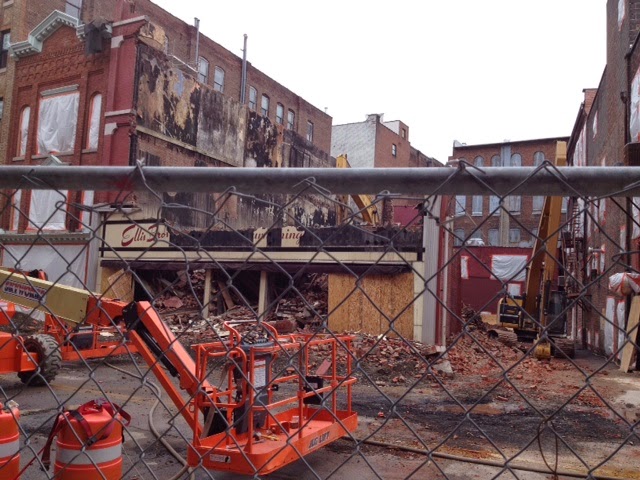
The Lamp in the Window

They thought they could recover after an April 30 fire.

They couldn't.  The building was judged to be in imminant danger of collapse.   The city condemned the historic building.  It had to come down.

It was a sad week in downtown Binghamton, as a 100 plus year old building has been demolished.  A family owned business, Ellis Bros, may leave downtown Binghamton, New York as a result of this fire and demolition. We are a small city in upstate New York, population around 47,000.  We can't afford to lose a long-standing business.
On May 23, the demolition specialists gathered.  The building on the right is the building about to be demolished.  The building directly to the left of it is another historic building, and there was danger that if the demolition wasn't done right, it could be damaged, since the two buildings touch.

There was a lamp barely visible in the window.  My walking companion had had her eyes on that lamp for some time, but now it was too late for her to do anything but view it in the wreckage.
On May 27, demolition started.  By lunchtime, when I came out to look, most of the back was missing, and the workers were at lunch.
Another view, showing windows to nowhere.
Yesterday, the building was more or less down.

A final, farewell view.  I don't know if any parts of that building are salvageable, such as the 100 plus year old bricks, but I do know that the county is waiving part of the "tipping fees" (fees for using the landfill) in an effort to keep Ellis Brothers downtown.

Has something like this happened where you live?

Thursday, May 29, 2014

Best of AM - Mail Order Chickens

This post, with some edits and additions, was first posted in August, 2010.

I never realized that Iowa is the #1 egg producer in the country. 

I lived briefly in Iowa in the 1970's and have been back several times since.  When people think of Iowa, they think of (not necessarily in this order):  Pork, soybeans, corn.  In fact, if you ask my son (who has been to Iowa several times) what he remembers of Iowa, he remembers  miles and miles of boring cornfields.  I don't think I saw many chicken houses there.

When I think of Iowa, I also think of local food, of heritage breeds, of farmers who still care.  Iowa does have at least one heritage breed poultry breeder, who we bought from several times when we lived in Arkansas:  the incomparable Murray McMurray Hatchery.

Iowa also has wonderful, friendly people and a wonderful place we have never been to-the headquarters of the Seed Savers Exchange in Decorah, Iowa and its Heritage Farm..

Exactly the opposite of the current egg scandal farm owners, the folks at Seed Savers work to keep genetic diversity in our seeds, and also seek to keep heritage breeds of certain animals alive.  Their work deserves to be well publicized. 


Too bad Iowa right now is in the news for something totally different-tainted eggs. Half a billion eggs recalled. Thanks to factory farming, shipped to 22 states. It would seem these farms have had many violations-the "same old same old".  I could go into a rant about food safety regulations, but this is not a political blog.  So instead I would like to share some memories of when Iowa farming goes right.

I have fond memories of visiting the Iowa City Farmers Market.  Iowa City is a college town so, as you could expect, they had their share of organic booths.  Of course, everything was locally grown and made.

Yes, in Iowa the small farmer still exists, marketing the most delicious pork and beef (sorry, vegetarian readers), plus all the usual veggies.  In a climate hotter than ours in the northeast, one even saw okra and some other southern favorites for sale.

But I promised to speak about mail order chicken memories. I want to share something about raising chickens and "growing" our own eggs, all from Iowa chickens.

Back in the 1980's, when we lived in rural Arkansas and kept chickens, we would spend the New Year perusing the Murray McMurray catalog, with its brightly colored pictures of what was even then called "rare" chickens.  These are the chickens with names, not numbers:  Barred Rocks, Rhode Island Reds, Black Australorps, Buff Orpingtons, New Hampshire...and on and one-about 130 breeds total.

We would make our selection and place our order (in the mail, of course).  No internet, no fascinating website giving pictures of their operations, no instant update of stock on hand.  Rather, we placed our order and waited for the day we specified.  We did it the "old fashioned" way which, in those days, was the only way.

On the appointed day, there would be a phone call from our local rural post office.  We had to come and get them; they would not deliver.  The box, cheeping away, was rushed home.  In a miracle that we could never get tired of, the living chicks survived the trip.  Just imagine opening a box and being greeted by 25 cheeping 2 day old chicks!  We would take each one out gently, dip its beak in water, and put each precious chick in a little pen under a warm light.  The waterer and feeder were made from mason jars screwed into special "lips".  We fed them commercial but unmedicated chick starter.  After a day or so, they would be ready for supplementation with the occasional June Bug attracted by the light.

This next part is not for the squeamish.  The chicks would get hold of the unfortunate bug and chase each other, trying to snatch what was left of the large bug (it didn't last very long) in a game of chick free-for-all.  The whole while, they would be screaming in delight.

Don't ever say baby chicks are cute.  Not unless you've seen one of those feedings.

You have to love chickens to know them. You have to accept their nature.  Chickens are omnivores, and they lust for blood.  If one of those chicks accidentally got cut, it would have suffered the same fate as that bug.

Then, those chicks would grow, and about 6 months later the female (pullets) would start to lay their small beginner eggs.  The males?  Well, that part isn't for the squeamish either.  (I'll leave the part out about how roosters treat the hens.)  Nothing like a wonderful, thick shelled, fresh egg.  Except if you want to hard boil, in which case you want a slightly aged egg.

We never worried about salmonella.  We ate raw (from scratch) cake batter.  We even made (gasp!) real eggnog!

We moved back to urban life in the mid 1980's, and our chicken life was over. 

But what about Iowa, land of Seed Savers and rare chicken flocks? (At least in 2010 Murray McMurray was still using local farmers to produce their eggs for hatching.)

Moral of story, more important than ever in our brave new world of GMO's:

Support your local farmer.  Know who produces your food.  Know HOW it is produced. Ask questions. Ask lots of questions.

That's one way to protect yourself.

Wednesday, May 28, 2014

Spring Things - Speeding Through May

What a difference a month (give or take a couple of days) makes in upstate New York. 

Forsythia, May 1.
Bradford Pears, May 7.
Lilac, May 16.


Tulip, in my front yard, May 22. Now, almost all the tulips are done.
Azalea, May 22.
Last daffodil in our yard, May 26.
Yellow Mollis Azalea, May 28, West Side of Binghamton, New York.
Spirea May 28.

Is it spring where you live?

Tuesday, May 27, 2014

Best of AM - The Little kitchen of Horrors

This is a true story, first posted in 2011.  I've edited it slightly.  This post is without photos for a reason, as you will soon read.

One day I was cleaning up dishes after breakfast when I saw a little blur to my right, where our stove is.  I know that means a mouse so I turned.  Right next to the stove was a mouse, staring at me.  We started at each other.  I know the mouse must have been startled and would run and hide under the stove.  But no. This mouse stared at me, not sure of what to do, ran across the floor, ran across the floor again back to the beginning and finally (running so close to me that I nearly screamed) ran into the one former bedroom (currently my library) on our ground floor. 

I am not ashamed to admit I ran out of that kitchen and left the dishes half done. I stayed out for about 5 minutes before I would even go back in there.

I left spouse a note, and he bought some mousetraps, put one out that night. Yes, I am not ashamed to say that when it comes to mice, I run for the spouse.

Yesterday morning I saw where the trap had caught a mouse and he disposed of it.

This morning, I went into the kitchen to heat up breakfast and there was a sprung trap by the stove, with a little dead mouse lying underneath the sprung trap.

So I went about my business when suddenly there was a loud clatter and a high pitched squeaking, like an "ee ee ee" but even higher pitched.  THERE WAS ANOTHER MOUSE AND THAT MOUSE WAS ATTEMPTING TO DRAG THE TRAP BEHIND THE STOVE.  But the space was too small.  It kept trying and trying.  I had to eat my breakfast hearing that pathetic "ee ee ee" and the occasional bumping of what I knew was the mouse trying to drag the trap.

The squeaks were so loud. I never went back in to see the final, er, disposition of the matter.
I don't want to speculate if that mouse was trying to save the other mouse, or the relation of the other mouse to him/her.  Or if mice have those types of feelings.  It was creepy.

When my spouse came home from work, he saw the sprung trap and wondered why it was jammed up against the stove.

Now tonight, we have to try to get the other mouse.  How many more are there?

Stephen King would know what to do with this story. 

Do mice take revenge?

And can I ever, even indirectly, kill a mouse again after seeing that sight this morning?

Monday, May 26, 2014

A Scrap of Silk and a Virtual Blood Chit

As the daughter of someone who served in the U.S. Army Air Force during World War II, this story of a scrap of silk was of interest on a  day which has become most interesting, if you hang out on social media on a United States Memorial Day.

The scrap of silk in that blog post is called a "blood chit".  In the instance of the military member whose blood chit is discussed in that post, it was an American Army Air Force man whose plane crashed in China in World War II while flying a mission against the Japanese.  He did not survive.  The local people buried him, kept the chit, and helped recovery workers a year or so later find the grave. This was their way of honoring this man's service.

A blood chit is a document of some sort which is carried by soldiers serving in a place where they can not speak the language.  It gives information about the person carrying the chit so someone who finds the person, injured or worse, can help and knows just to do  They aren't only used in war - for example, a French balloonist who toured the United States in 1793 was given a blood chit by George Washington in case he was lost or injured while ballooning.

Flag placed on curb near Johnson City, New York
 Besides this story from the National Archives, my Facebook timeline seemed to be split between people thanking the military for their service and people who are watching the horror of our VA care scandal with increasing anger.

I think all of our veterans who suffered injury, physical, mental, or both, in their service should be issued a blood chit the minute their service ends. The Veterans Administration (VA) system they manuver speaks a different language and has a different culture.  The vets gave their bodies and minds, and the VA turned its back when they needed help the most.  Records were falsified.  Vets died waiting for treatment, caught in an uncaring bureaucracy.

 But, our country has a long history of not doing right by their veterans - including the disabled veterans of World War II.  I know that because my father was one of them. He never lost his faith in the VA that, at the end, failed him.  My husband is a Cold War veteran, and while he did not serve in combat, he did serve in a dangerous career field.  So, for four years of my life, I was a military wife, and my eyes were opened to a lot of things-including how much of the mission of our military is borne on the back of military dependents.

Parking Space in front of Home Depot, Johnson City, NY
I did not post a "thank you for your service" badge on Facebook.  Instead,  I wish I could give all veterans, past and present, a virtual blood chit.

I want to thank everyone for their service - from the children of the several women I know whose children came back from Iraq and/or Afghanistan with PTSD or other ailments, to the members of the "Silent Generation" who shed their blood to destroy the Nazi threat  If they hadn't done that, I may never have been born.  I want to thank the children I grew up with who served in the Vietnam War, and endured an even worse turning of the American back.

I want to thank the men and women who served with my husband, including the interracial military couple in love who could not find anyone in 1970's Wichita Falls, Texas who would marry them, because that kind of marriage wasn't acceptable in the 1970's. Even if said service members were sworn to give their lives for the freedom of said people, no one would do that one thing for them.

All of you - I DO thank you for your service.  It's amazing, that each generation still sends its members marching off to war, and we still treat our vets with lip service and not much else.

When will our veterans, past, present and future, truly be honored by everyone, including their government?