I haven't blogged about "B", my brother in law with autism, for a while, but that doesn't mean my husband (his guardian) and I have forgotten him. No, quite the contrary.
All his life, "B" has been cared for by his mother, as my regular blog readers know. But time has marched on. He is in his 50's. She is in her 80's, with increasing physical issues.
Their lives have always been intertwined but one day, that will no longer be true.
A couple of years ago a relative, seeing them both sit on a park bench, remarked that they "looked like an old couple who had been together many years".
"B" lives in a split level house with his mother, some 150 miles from my spouse and I. For much of that time, he has lived in a bedroom in a finished basement. He has access to a TV set and his own bathroom. He grew up in that house with his sibs. They left, he stayed with his parents. Some 15 years ago, his father passed away. Now, it is just he and his mother.
He depends on her, but increasingly, she depends on him. And, as much as we would love my mother in law to live forever and be with "B" forever, we know that, one day, she will no longer be able to take care of "B". And, I have a strong suspicion "B" knows this. It is hard to communicate with him.
You have to ask the right questions.
I am not the greatest verbal communicator, either.
Several years ago, my brother in law had an opportunity to move into a residence operated by the local ARC (an advocacy group for children and adults with developmental and intellectual disabilities). He would have shared the residence with a number of other disabled individuals. The residence has a good reputation in the community. He would have a lot of opportunities to participate in various events, including going to ball games and shopping. He would hopefully find activities he would enjoy. Group homes are not a housing solution for all individuals in "B"'s situation, but it is an option.
As I've mentioned before, individuals with autism don't adapt well to change. It is imperative that we find "B" a placement before something happens to my mother in law, to give him time to adjust.
My mother in law turned the placement down - twice. These openings don't come too often. Many openings come from - let's be blunt here - death of a resident.
It is difficult to find good housing situations for those with disabilities. That is a fact, I suspect, everywhere in the United States.
We are investigating housing options up here, miles from where "B" and his mother live, for the future. My mother in law does not want "B" to live apart from her. She wants him with her as long as possible. This is her wish. But, we are finding it difficult to find senior housing that has two bedrooms. Usually, seniors move into one bedroom apartments. There just aren't that many units available where we live - an area that is a lot cheaper than where they live.
(Seeing the lack of senior housing in this area makes us think twice about our future in this area, perhaps a post for another time).
My mother in law wants to age with grace with "B" at her side.
What does "B" want? He wants to be with his brothers (there is another brother in our area besides my spouse).
He wants to be able to eat out. He loves that activity. He loves to shop.
And he wants his own private room, and his own bathroom. He wants quiet. He wants control over his life. He wants his own dignity.
This much we know.
A guardian, incidentally, is not the boss over the person he or she is guardian of. A guardian is supposed to be an advocate. But we all know that you can't always get what you want, and "B" must learn this hard lesson, too.
Appropriate housing, once the time comes. Appropriate, but "B" may not get everything he wants.
Wanting. Having wishes granted. If only it was that easy.
My spouse and I are finding out just how non-easy it is.
"To be continued".
Monday, October 13, 2014


Sunday, October 12, 2014
Civil War Sunday - Gardening During the Civil War
As someone who loves to grow things, married 40 years to a devoted gardener, I've often wondered how people gardened during the Civil War.
For many of us in the modern United States, gardening is not a matter of life and death. There are stores, there are farmers market, if we run out of food.
For many people in the United States during the war, gardening was a subsistence activity.
The home garden fed the family, and animals. It provided both food and medicine, through medicinal herbs, and dyes for homespun wool.
 |
| Farmer's Museum, Cooperstown, NY |
 |
| Pumpkin Patch, Farmer's Museum |
Pumpkins were also grown in the Civil War era garden, along with beets, onions, tomatoes, beans, cabbage and potatoes. Food from the garden and available livestock was supplemented by hunting.
Especially in the Confederacy, as the war continued and food became both scarce and expensive, growing your own food became more and more a necessity.
 |
| I suspect this is a chicken breed that existed at the time of the war |
Next week, I will return to the war itself, possibly blogging about a battle in Kansas - another in my series about the "neglected West" of the Civil War.
Saturday, October 11, 2014
Sustainable Saturday - Heirloom Apple Crisp
Early fall in upstate New York.
 Many things say "fall" upstate. For example, trees turning color. We've had our first flush of color. The second will come now that many areas have had their first frost.
 More early fall color for you.
Frost. We haven't received one yet where I live near Johnson City, New York, but the outlying areas have received their frosts, and the trees will be bare all too soon.
For me, the best part of fall is the food. So today's topic will be: apples.
We are in apple growing country, and some of the apples grown here are heirloom varieties.

There is a farm near Ithaca, New York, that specializes in heirloom apples. At least once a year, we visit their booth at the Ithaca Farmers Market to pick up some unusual varieties.
But even in our local apple stores in the Binghamton area, we can purchase heirlooms such as 20 Ounce , a native NY variety from the 1800's.
There are many more apple varieties than you can find in your average supermarket. Many of the older varieties don't ship well, or don't keep well, or don't bear reliably year after year. But if you can find them, they are worth the effort.
Be sure, also, that you buy the right apple. You must ask yourself: How do you intend to use your apple?
Fresh eating? (my favorites are Honey Crisp, Autumn Crisp, and some of the eating heirlooms, especially the russets.)
Baking? (my favorite is Northern Spy, but they are just starting to come in, so I didn't have any on hand yesterday.) You can also try Rome and Cortland. And, Honey Crisps can be used in baking.
Tart Eating? Empire is your pick. It used to be my favorite apple.
I, personally, am not a fan of Red Delicious or MacIntosh, but they have their fans.
At one you pick place in this area, here is today's schedule.
"Saturday 11th - 9 am to 4 pm Empire, Cortland, Red & Golden Delicious, Ida Red, Jonagold, Northern Spy"
Which brings me to one of my favorite desserts, apple crisp. Last fall, I blogged about a Weight Watchers apple crisp recipe I was using. This year, I am experimenting with a different Weight Watchers recipe.

Doesn't this look yummy?
I decided to experiment with adding frozen blueberries (which I picked from a U Pick farm in August). At times, I've also put pears and/or blackberries into my apple crisps. Yesterday, I decided to make an apple crisp with what I had on hand - 20 ounce apples, and frozen blueberries.
Sorry for my friends outside the United States - you'll have to do your own conversions into metric, oven temperatures, etc.
Fruit Crisp (9 inch square pan, serves 9)
2 pounds baking apples (I used 20 Ounce)
4 tbsp brown sugar (you can also use 1 tbsp sucralose as an alternative)
2 tsp lemon juice
1 cup frozen blueberries (I didn't thaw them)

Peel and slice cored apples. Mix all ingredients together. Place in a 9 inch square baking dish that has been oiled or buttered.
Top with topping. Keep in mind this is an adaptation of a low-cal topping. It may not suit you.
Topping
1 cup quick oats
4 tbsp brown sugar
4 tbsp light butter
1/2 tsp freshly ground allspice (since I, amazingly, didn't have cinnamon on hand)
1 tsp vanilla extract
Mix topping together and top.
Bake at 350 degrees for about 50 minutes or until the apple slices are the consistency you want. Let cool, unless you can't wait to eat it.
How did it do? The blueberries dyed the apples nearby purple, but it tasted good. The topping was "OK" (I'm still experimenting with getting these lower calorie toppings moist.) But next time, I may use Northern Spy apples. The 20 ounce holds its shape well, but I would prefer a moister apple.
Do you have a favorite apple? Do you have a favorite apple recipe?
Frost. We haven't received one yet where I live near Johnson City, New York, but the outlying areas have received their frosts, and the trees will be bare all too soon.
For me, the best part of fall is the food. So today's topic will be: apples.
We are in apple growing country, and some of the apples grown here are heirloom varieties.
There is a farm near Ithaca, New York, that specializes in heirloom apples. At least once a year, we visit their booth at the Ithaca Farmers Market to pick up some unusual varieties.
But even in our local apple stores in the Binghamton area, we can purchase heirlooms such as 20 Ounce , a native NY variety from the 1800's.
There are many more apple varieties than you can find in your average supermarket. Many of the older varieties don't ship well, or don't keep well, or don't bear reliably year after year. But if you can find them, they are worth the effort.
Be sure, also, that you buy the right apple. You must ask yourself: How do you intend to use your apple?
Fresh eating? (my favorites are Honey Crisp, Autumn Crisp, and some of the eating heirlooms, especially the russets.)
Baking? (my favorite is Northern Spy, but they are just starting to come in, so I didn't have any on hand yesterday.) You can also try Rome and Cortland. And, Honey Crisps can be used in baking.
Tart Eating? Empire is your pick. It used to be my favorite apple.
I, personally, am not a fan of Red Delicious or MacIntosh, but they have their fans.
At one you pick place in this area, here is today's schedule.
"Saturday 11th - 9 am to 4 pm Empire, Cortland, Red & Golden Delicious, Ida Red, Jonagold, Northern Spy"
Which brings me to one of my favorite desserts, apple crisp. Last fall, I blogged about a Weight Watchers apple crisp recipe I was using. This year, I am experimenting with a different Weight Watchers recipe.
Doesn't this look yummy?
I decided to experiment with adding frozen blueberries (which I picked from a U Pick farm in August). At times, I've also put pears and/or blackberries into my apple crisps. Yesterday, I decided to make an apple crisp with what I had on hand - 20 ounce apples, and frozen blueberries.
Sorry for my friends outside the United States - you'll have to do your own conversions into metric, oven temperatures, etc.
 |
| 20 ounce apple and leaves from my yard |
2 pounds baking apples (I used 20 Ounce)
4 tbsp brown sugar (you can also use 1 tbsp sucralose as an alternative)
2 tsp lemon juice
1 cup frozen blueberries (I didn't thaw them)
Peel and slice cored apples. Mix all ingredients together. Place in a 9 inch square baking dish that has been oiled or buttered.
Top with topping. Keep in mind this is an adaptation of a low-cal topping. It may not suit you.
Topping
1 cup quick oats
4 tbsp brown sugar
4 tbsp light butter
1/2 tsp freshly ground allspice (since I, amazingly, didn't have cinnamon on hand)
1 tsp vanilla extract
Mix topping together and top.
Bake at 350 degrees for about 50 minutes or until the apple slices are the consistency you want. Let cool, unless you can't wait to eat it.
How did it do? The blueberries dyed the apples nearby purple, but it tasted good. The topping was "OK" (I'm still experimenting with getting these lower calorie toppings moist.) But next time, I may use Northern Spy apples. The 20 ounce holds its shape well, but I would prefer a moister apple.
Do you have a favorite apple? Do you have a favorite apple recipe?
Friday, October 10, 2014
A Thankful Friday and Paw Paw Update
Thank you, readers, for making the daily posts I write an enjoyable experience. I appreciate each and every one of you when you stop by, and when you comment. Reading each comment is like opening up a little gift.
So, before I launch into a little story on how one of my readers helped me with a problem, I want to ask you all a favor:
What would you like me to write about in the coming weeks? I like to write about what appeals to me each day. But, what do YOU want to see? Gardening? More pictures? How-To's? Recipes? (I don't cook, but my spouse loves to cook.) More photos of upstate New York?
I will take your suggestions and see what I can do with them.
And now, a shout out to reader Howard Giles. On Tuesday, I blogged about three paw paw plants we had germinated this spring. My spouse and I had saved seeds from a paw paw purchased last fall from a locavore store, stratified them, and planted them this spring in pots.
The paw paw grows wild in portions in the United States and I remembered them from living years ago in rural Arkansas. Their fruit tastes like a cross between a mango and a banana, and, indeed, they are a temperate zone cousin of various tropical fruits.
It was a nice project, but now frost was coming, and I needed to know how to keep the seedlings alive. I don't have the room to grow them on my property.
Howard Giles to the rescue - he commented and suggested I contact an extension service if we had one.
Cornell Extension is a wonderful resource - one I don't use enough. (And, dear readers, if you have an extension service in your area - I'm confident yours is just as wonderful.) I kicked myself.
Then, I did what he suggested - I contacted our local Cornell extension service. And within a few hours, I had my answer from one Linda Swoboda. I want to pass her advice along:
 "I would suggest that you transfer these small trees into a larger
pot, 2 or 3 times as big as they are in now, with good soil and sink the
pots into the ground in a shaded area outside. Full sun, even winter
sun is hard a young pawpaw trees. Water them
in well. The roots will continue to develop and grow all winter. The
leaves will drop soon, so don't worry too much about what is eating
them. It could be a slug - check under the pots to see if they are
hiding there in the daylight hours. [I didn't find any.] In the spring
the trees can be transplanted to their permanent location. However, I
have read that in order to get fruit in the future, 2 unrelated pawpaw
trees need to cross pollinate. So these seedling siblings will not be
fertile - you will need another tree of a different
source."
"I would suggest that you transfer these small trees into a larger
pot, 2 or 3 times as big as they are in now, with good soil and sink the
pots into the ground in a shaded area outside. Full sun, even winter
sun is hard a young pawpaw trees. Water them
in well. The roots will continue to develop and grow all winter. The
leaves will drop soon, so don't worry too much about what is eating
them. It could be a slug - check under the pots to see if they are
hiding there in the daylight hours. [I didn't find any.] In the spring
the trees can be transplanted to their permanent location. However, I
have read that in order to get fruit in the future, 2 unrelated pawpaw
trees need to cross pollinate. So these seedling siblings will not be
fertile - you will need another tree of a different
source."

So, before I launch into a little story on how one of my readers helped me with a problem, I want to ask you all a favor:
What would you like me to write about in the coming weeks? I like to write about what appeals to me each day. But, what do YOU want to see? Gardening? More pictures? How-To's? Recipes? (I don't cook, but my spouse loves to cook.) More photos of upstate New York?
I will take your suggestions and see what I can do with them.
And now, a shout out to reader Howard Giles. On Tuesday, I blogged about three paw paw plants we had germinated this spring. My spouse and I had saved seeds from a paw paw purchased last fall from a locavore store, stratified them, and planted them this spring in pots.
The paw paw grows wild in portions in the United States and I remembered them from living years ago in rural Arkansas. Their fruit tastes like a cross between a mango and a banana, and, indeed, they are a temperate zone cousin of various tropical fruits.
It was a nice project, but now frost was coming, and I needed to know how to keep the seedlings alive. I don't have the room to grow them on my property.
Howard Giles to the rescue - he commented and suggested I contact an extension service if we had one.
Cornell Extension is a wonderful resource - one I don't use enough. (And, dear readers, if you have an extension service in your area - I'm confident yours is just as wonderful.) I kicked myself.
Then, I did what he suggested - I contacted our local Cornell extension service. And within a few hours, I had my answer from one Linda Swoboda. I want to pass her advice along:
She even sent me a couple of links, which I read. Thank you, Linda!
I'm disappointed that these three plants, if they survive, won't be able to cross pollinate. So, no paw paws are in our future. But we are going to do what she suggests.
And then, next spring, I need to find a forever home for these trees, because, according to my reading, they need to be planted in their forever home next spring.
So that is the story of my paw paws. Next spring, I'll see if they made it.
And again, thank you to my readers for making this possible. And now, I look forward to your suggestions.
Thursday, October 9, 2014
The Continued Odyssey of the Rosemary
Back in 2011, I wrote a post about growing an evergreen herb called rosemary.
This is not an easy undertaking in upstate New York, where rosemary is not hardy. And, now that my spouse is in his 60's, the ritual of fall lugging plants inside and spring lugging plants outside into our zone 5 garden may be approaching its end in not too many more years. (And, maybe not. My spouse is stubborn.)
Still, although the matriarch of our rosemary family and its oldest child are gone, its other children live on. Right now, we have two rosemary plants - a third died over this past winter.
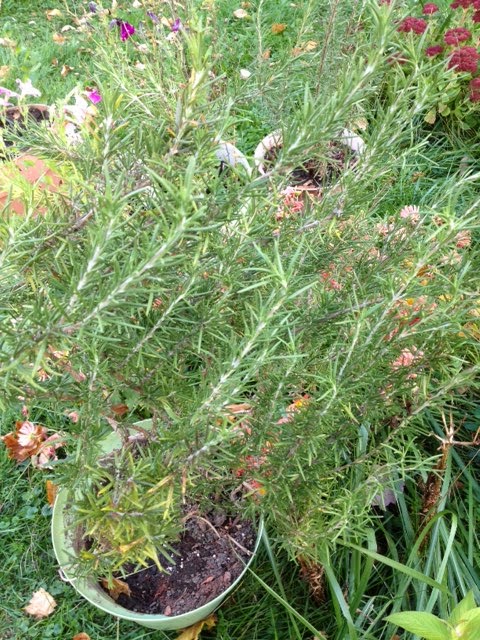
Here is one of the remaining two plants, safely potted up and waiting for a possible frost. I tried and tried to get a decent picture and I don't know why it was an issue today. I think this one is as good as it is going to get.

So here is another picture.
What is rosemary good for? Some say memory. Others say seasoning. I think they are both right.
So here's my story, and I am grateful that, for at least this winter, the odyssey will continue.
(Thank you, Gardening-4-Life, for giving me the inspiration for today's post.)
Sometimes I really envy zone 7 and zone 8 gardeners. They can grow so much that we can't here in upstate NY. Plants such as camellias, one of my favorite flower. And, they can grow plants outdoors all year that we have to take in, or plant as annuals. Things such as paperwhites. Dahlias. And rosemary.
To grow rosemary in upstate NY you have to have a strong back, and a good sense of weather timing. Let me explain....
In the late 1980's (I forget the exact year), we went somewhere and saw rosemary plants for sale. At that time, it was not that common to find herbs for sale, at least around here. We bought two plants.
Our local neighborhood groundhog quickly took care of one of the plants. But the other one thrived.
Problem: we knew the plant wouldn't survive the fall. So come fall, dear spouse potted up the plant and brought it inside. Little did he know of the odyssey he was embarking on.
Rosemary is not that easy to grow indoors (it tends to get too dry) so the first quest was to find out how to keep it moist, but not too moist. And, we had to find a sunny place for it. At that time, we didn't have any nice sunny windows. So spouse had to rig up a lighting system. All for one little plant. But spouse loves to use rosemary in his cooking.
That winter was a type of hopscotch. If it warmed up, the plant went out. If it was cooling off the plant went back in. Out, in. Out, in. A lot more in than out, because our winters tend to be very snowy, cold-and long. But we noticed that the plant looked better if it could spend even a few hours outside. We knew, though, that it wouldn't survive much of a frost.
The plant made it, and the next year it went back into the ground once danger of frost was past. (For us, that's usually early to mid May.)
Then in the fall, back into a (larger) pot, and back indoors when our first frost threatened to hit in October.
Sometimes, when we brought the plant in, spouse would accidentally knock off a branch. One time, (this was before the Internet, so we couldn't just run to our computers and look stuff like this up) spouse got the idea to put the sprig in water and see what happened. To his delight, it grew roots. He potted it, and now we had two plants. And then three.
Over the years, the original rosemary plant got larger and larger. It bloomed, beautiful little purple flowers. Its trunk was like wood, gnarled, like a large bonsai. There were some close calls with cold weather. Spouse experimented with various types of overwintering. For some years, he used the basement (with a grow light). As our son grew older we had the use of a former bedroom, and the plant did better there.
The plant got larger and larger. Fortunately spouse is very strong and (unlike me) a strong back. It was no problem to transport the matriarch rosemary plant in and out.
The years passed. The babies were adults now, in large pots, too. And the matriarch kept going.
Finally, a couple of years ago, the unthinkable happened. We left the plants out and it got down to about 28 degrees. The younger plants were frostbit, but we were able to nurse them back to health.
It was too late for the matriarch.
Almost the entire plant died. One little branch survived, but it was obvious the plant wasn't going to make it. Spouse finally clipped off the last little branch and put it in water.
The matriarch lived, we think, about 18 years. The oldest "child" now is about 18 years old, too.
We still have the matriarch in our back yard. Last year, a volunteer tomato plant sprouted near it and grew up using the dead rosemary as support. We tied it to the gnarled trunk. The frost came, the tomato plant died, and we left the pot out for the winter.
This spring, it's still out there. Spouse has taken a couple of clippings of it still fragrant trunk for special BBQ's. He intends to continue to use it until it's gone.
A fitting end to a special plant.
This is not an easy undertaking in upstate New York, where rosemary is not hardy. And, now that my spouse is in his 60's, the ritual of fall lugging plants inside and spring lugging plants outside into our zone 5 garden may be approaching its end in not too many more years. (And, maybe not. My spouse is stubborn.)
Still, although the matriarch of our rosemary family and its oldest child are gone, its other children live on. Right now, we have two rosemary plants - a third died over this past winter.
Here is one of the remaining two plants, safely potted up and waiting for a possible frost. I tried and tried to get a decent picture and I don't know why it was an issue today. I think this one is as good as it is going to get.
So here is another picture.
What is rosemary good for? Some say memory. Others say seasoning. I think they are both right.
So here's my story, and I am grateful that, for at least this winter, the odyssey will continue.
The Odyssey of the Rosemary
Sometimes I really envy zone 7 and zone 8 gardeners. They can grow so much that we can't here in upstate NY. Plants such as camellias, one of my favorite flower. And, they can grow plants outdoors all year that we have to take in, or plant as annuals. Things such as paperwhites. Dahlias. And rosemary.
To grow rosemary in upstate NY you have to have a strong back, and a good sense of weather timing. Let me explain....
In the late 1980's (I forget the exact year), we went somewhere and saw rosemary plants for sale. At that time, it was not that common to find herbs for sale, at least around here. We bought two plants.
Our local neighborhood groundhog quickly took care of one of the plants. But the other one thrived.
Problem: we knew the plant wouldn't survive the fall. So come fall, dear spouse potted up the plant and brought it inside. Little did he know of the odyssey he was embarking on.
Rosemary is not that easy to grow indoors (it tends to get too dry) so the first quest was to find out how to keep it moist, but not too moist. And, we had to find a sunny place for it. At that time, we didn't have any nice sunny windows. So spouse had to rig up a lighting system. All for one little plant. But spouse loves to use rosemary in his cooking.
That winter was a type of hopscotch. If it warmed up, the plant went out. If it was cooling off the plant went back in. Out, in. Out, in. A lot more in than out, because our winters tend to be very snowy, cold-and long. But we noticed that the plant looked better if it could spend even a few hours outside. We knew, though, that it wouldn't survive much of a frost.
The plant made it, and the next year it went back into the ground once danger of frost was past. (For us, that's usually early to mid May.)
Then in the fall, back into a (larger) pot, and back indoors when our first frost threatened to hit in October.
Sometimes, when we brought the plant in, spouse would accidentally knock off a branch. One time, (this was before the Internet, so we couldn't just run to our computers and look stuff like this up) spouse got the idea to put the sprig in water and see what happened. To his delight, it grew roots. He potted it, and now we had two plants. And then three.
Over the years, the original rosemary plant got larger and larger. It bloomed, beautiful little purple flowers. Its trunk was like wood, gnarled, like a large bonsai. There were some close calls with cold weather. Spouse experimented with various types of overwintering. For some years, he used the basement (with a grow light). As our son grew older we had the use of a former bedroom, and the plant did better there.
The plant got larger and larger. Fortunately spouse is very strong and (unlike me) a strong back. It was no problem to transport the matriarch rosemary plant in and out.
The years passed. The babies were adults now, in large pots, too. And the matriarch kept going.
Finally, a couple of years ago, the unthinkable happened. We left the plants out and it got down to about 28 degrees. The younger plants were frostbit, but we were able to nurse them back to health.
It was too late for the matriarch.
Almost the entire plant died. One little branch survived, but it was obvious the plant wasn't going to make it. Spouse finally clipped off the last little branch and put it in water.
The matriarch lived, we think, about 18 years. The oldest "child" now is about 18 years old, too.
We still have the matriarch in our back yard. Last year, a volunteer tomato plant sprouted near it and grew up using the dead rosemary as support. We tied it to the gnarled trunk. The frost came, the tomato plant died, and we left the pot out for the winter.
This spring, it's still out there. Spouse has taken a couple of clippings of it still fragrant trunk for special BBQ's. He intends to continue to use it until it's gone.
A fitting end to a special plant.
Wednesday, October 8, 2014
Fall Fancies - Fall Glow
The sun has risen on a beautiful October day in upstate New York. I didn't get to see the total lunar eclipse, but look at this sunrise sky!
 The "red sky at warning, sailor take warning" saying will come true tonight, but it was a mild, breezy day for an October 8.
At this time of year, it is time to put the garden to bed.
 Spouse has been busy in our community garden, clearing it out. Leeks will be stored, cutting off most of the tops, and putting them in our refrigerator. Cabbages - well, we don't know yet.
We didn't have that successful a season, but I should blog about that later this month.
We have to have our community garden cleared out by the end of the month, when it closes down.

At home, we have dug and potted up three poinsettias and an orange geranium.
Our rosemary plants are also safely in pots, ready to be brought in when the frosts hit.
Coleus cuttings are taken and are in water, waiting for the cuttings to root. We are also rooting our Persian Shield.
Soon, we will be harvesting our ginger, again grown in a large pot - we got several hands of the root - not hardy here in upstate New York.
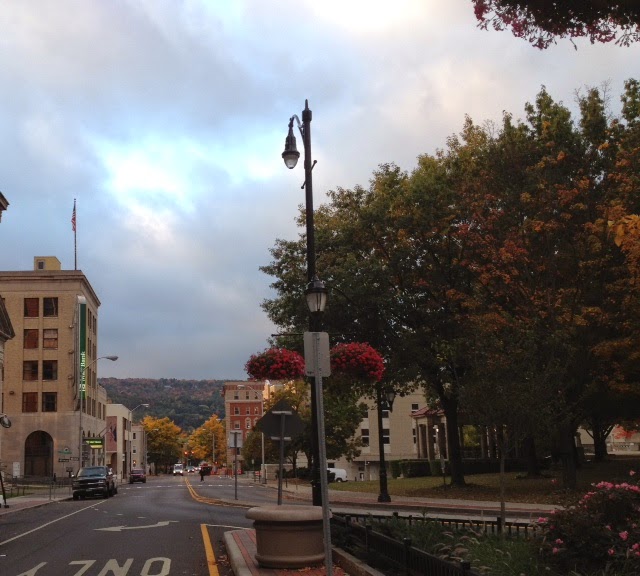
The sun angle makes everything shine with a special light at this time of year. I will leave you with one more photo - sunrise in downtown Binghamton, New York today.
Were you able to witness the total lunar eclipse last night?
At this time of year, it is time to put the garden to bed.
We didn't have that successful a season, but I should blog about that later this month.
We have to have our community garden cleared out by the end of the month, when it closes down.
At home, we have dug and potted up three poinsettias and an orange geranium.
Our rosemary plants are also safely in pots, ready to be brought in when the frosts hit.
Soon, we will be harvesting our ginger, again grown in a large pot - we got several hands of the root - not hardy here in upstate New York.
The sun angle makes everything shine with a special light at this time of year. I will leave you with one more photo - sunrise in downtown Binghamton, New York today.
Were you able to witness the total lunar eclipse last night?
Tuesday, October 7, 2014
Save My Paw Paw Plants!
It's that dreaded time of year, when it is time to say goodbye to the garden.
Saturday morning, portions of Johnson City, New York (near to where I live) experienced frost. At my house, it got down to an unexpected 35 degrees F (1.6 Celsius). We had not expected it to get that cold, never mind cold enough to get a frost.
But my guardian angel was watching over my garden, apparently, and my plants are still alive and not frost damaged - for now.
My spouse and I have been busy doing all our fall preparations and we should be nearly set - except for one thing.
Our paw paws.
These are two of the three surviving plants we started from seed.
What are paw paws, anyway?
Paw paws are a native American fruit. They taste like a cross between bananas and mangoes. They grew wild in Arkansas, where we lived nearly 30 years ago, and that is where I first ate them. Last year, a Binghamton, NY resident brought some paw paws to Old Barn Hollow, a locavore store in Binghamton - I bought one, ate one for the first time in nearly 30 years, and saved the seeds.
Of the seeds, we got almost perfect germination although it took a long time - and only three plants are left.
They don't look as good as they did on September 21 - slugs or something else are eating the leaves. And, with the frost, these trees should go dormant. We shouldn't be ovewintering these indoors, and we have no where to plant these. We can't overwinter them in pots outdoors. They are marginally hardy in this area, and really need to be in the ground.
So, a dilemma.
What should I do to save my paw paws?
Do my gardening friends have any suggestions?
Saturday morning, portions of Johnson City, New York (near to where I live) experienced frost. At my house, it got down to an unexpected 35 degrees F (1.6 Celsius). We had not expected it to get that cold, never mind cold enough to get a frost.
But my guardian angel was watching over my garden, apparently, and my plants are still alive and not frost damaged - for now.
My spouse and I have been busy doing all our fall preparations and we should be nearly set - except for one thing.
 |
| Paw Paws 9-21-14 |
Our paw paws.
These are two of the three surviving plants we started from seed.
What are paw paws, anyway?
Paw paws are a native American fruit. They taste like a cross between bananas and mangoes. They grew wild in Arkansas, where we lived nearly 30 years ago, and that is where I first ate them. Last year, a Binghamton, NY resident brought some paw paws to Old Barn Hollow, a locavore store in Binghamton - I bought one, ate one for the first time in nearly 30 years, and saved the seeds.
Of the seeds, we got almost perfect germination although it took a long time - and only three plants are left.
They don't look as good as they did on September 21 - slugs or something else are eating the leaves. And, with the frost, these trees should go dormant. We shouldn't be ovewintering these indoors, and we have no where to plant these. We can't overwinter them in pots outdoors. They are marginally hardy in this area, and really need to be in the ground.
So, a dilemma.
What should I do to save my paw paws?
Do my gardening friends have any suggestions?
Monday, October 6, 2014
Is There Such a Thing as Too Much Pumpkin?
Pumpkins and upstate New York go together like - well, fall color and upstate New York.
(and, at this time of year, overcast clouds go together with fall in upstate New York like.... but I digress).
What is a pumpkin? It is a Cucurbitaceae, or a squash, related to melons, gourds, and cucumbers. In the United States, until recent years, orange pumpkins were the most popular. Now, white pumpkins are also gaining in popularity. And, heirloom pumpkins are making a comeback - green, warted, flattish, and others. There are miniature pumpkins for tabletops, smallish pumpkins ("sugar" pumpkins) for pies, large pumpkins for carving and huge pumpkins for growing contests and punkin chunkin.
Pumpkins are used in other parts of the world, too, in various ways from decorations to soup.
I have never grown pumpkins, because they are far from my favorite food (although I love other winter squashes, especially butternut, delicata and acorn), but they are easy enough to grow, especially where I live in upstate New York.
When I grew up, in the New York City of the 1950's and 1960's, pumpkins had three uses:
 1. Jack o'lanterns;
2. Pumpkin seeds (roasted and sold as snacks; and
3. Pumpkin pie.
Now, in upstate New York, and elsewhere in the United States, everything seems to have pumpkin in it, whether you want it or not.
In our local small supermarket (and I emphasize "small"), I found the following for sale, besides the actual pumpkin fruit (yes, pumpkin is a fruit, but we won't get too technical here):
Pumpkin flavored coffee
Pumpkin pizzelle cookies
Pumpkin quick bread and muffin mix
Pumpkin bar mix
Pumpkin ice cream
Pumpkin spice mix
Sparkling spiced pumpkin cider
Pumpkin spice marshmallows
Pumpkin, canned
Pumpkin cream cheese spread
Frozen pumpkin ravioli
Pumpkin roll with cream cheese filling
Pumpkin flavored coffee creamer
Which leaves people like me who don't like pumpkin, baffled.
How did eating punkin-I mean, pumpkins-get to be so popular? Yes, I know the flesh is nutritious, and the seeds are nutritional powerhouses. But still? That taste?
Do you like to eat pumpkin flavored foods? Or do you hope this is a fad that will go away? Or, is pumpkin not eaten where you live?
 |
| Country Wagon Produce, Maine, NY |
(and, at this time of year, overcast clouds go together with fall in upstate New York like.... but I digress).
What is a pumpkin? It is a Cucurbitaceae, or a squash, related to melons, gourds, and cucumbers. In the United States, until recent years, orange pumpkins were the most popular. Now, white pumpkins are also gaining in popularity. And, heirloom pumpkins are making a comeback - green, warted, flattish, and others. There are miniature pumpkins for tabletops, smallish pumpkins ("sugar" pumpkins) for pies, large pumpkins for carving and huge pumpkins for growing contests and punkin chunkin.
Pumpkins are used in other parts of the world, too, in various ways from decorations to soup.
I have never grown pumpkins, because they are far from my favorite food (although I love other winter squashes, especially butternut, delicata and acorn), but they are easy enough to grow, especially where I live in upstate New York.
When I grew up, in the New York City of the 1950's and 1960's, pumpkins had three uses:
2. Pumpkin seeds (roasted and sold as snacks; and
3. Pumpkin pie.
Now, in upstate New York, and elsewhere in the United States, everything seems to have pumpkin in it, whether you want it or not.
In our local small supermarket (and I emphasize "small"), I found the following for sale, besides the actual pumpkin fruit (yes, pumpkin is a fruit, but we won't get too technical here):
Pumpkin flavored coffee
Pumpkin pizzelle cookies
Pumpkin quick bread and muffin mix
Pumpkin bar mix
Pumpkin ice cream
Pumpkin spice mix
Sparkling spiced pumpkin cider
Pumpkin spice marshmallows
Pumpkin, canned
Pumpkin cream cheese spread
Frozen pumpkin ravioli
Pumpkin roll with cream cheese filling
Pumpkin flavored coffee creamer
Which leaves people like me who don't like pumpkin, baffled.
How did eating punkin-I mean, pumpkins-get to be so popular? Yes, I know the flesh is nutritious, and the seeds are nutritional powerhouses. But still? That taste?
Do you like to eat pumpkin flavored foods? Or do you hope this is a fad that will go away? Or, is pumpkin not eaten where you live?
Sunday, October 5, 2014
Civil War Sunday - The Refrigerator
Everyone loves nostalgia.
When nostalgia ties into the Civil War, and local history, it becomes perfect nostalgia.

Consider this refrigerator. Have you ever seen anything like it?
No, it isn't from the United States Civil War (1861-1865). It is from either the late 1920's or early 1930's. It is called a Monitor Top refrigerator, and, when it came out, you could buy it from your local utility company. They used one of two refrigerants, sulfur dioxide or methyl formate, and there are still monitor tops working today, almost 100 years later. (The way modern refrigerators are made, maybe I should consider buying a monitor top.)
This model was displayed at Olums back in June. Olums is a local appliance store celebrating its 100th year in business.
The monitor top refrigerator was, I understand, the first affordable refrigerator on the market. The first ones, in U.S. Dollars, cost $300 - about $4,000. in today's money. It was a lot of money back then, too, so people paid them off in monthly payments to the utility company.
But what is the link to the Civil War and to local history?
When I was growing up in New York City in the late 1950's and early 1960's, one of the few things I remember about my elementary school studies on the U.S. Civil War was a battle. It was the Battle of Hampton Roads, Virginia, where, for the first time in history, two ironclad vessels fought each other. One of these vessels, the U.S.S Monitor, was built partially from wood that came from an area just a couple of miles from where I live.
This refrigerator also reminded me of a small local mystery (mystery to me, anyway) surrounding a missing historical marker. I blogged about it back in 2011. With some edits, that post follows.
And the refrigerator? See that refrigeration unit on top of that refrigerator? It reminded so many people of the turret of the U.S.S. Monitor. So it became the "monitor top refrigerator", named after a Civil War vessel.
That vessel, by the way, can be viewed (what is left of it, that is) at a museum in Virginia, where I hope to visit next spring.
Now, today's mystery, which I still haven't solved.
I am trying to solve the mystery of the Missing U.S.S. Monitor Marker.
The 150th anniversary of the battle, off the coast of Virginia of the Union ironclad U.S.S. Monitor vs. the Confederate ironclad Merrimack (not the Merrimac, which was another ship put into service around 1864) won't be until next March. But I am hoping to solve this mystery before then.
The wood from which the keel of the Monitor was cut came from this area, now occupied partially by a site called Finch Hollow.
The site of the sawmill where the keel of the U.S.S.Monitor was milled is in walking distance of my home near Johnson City, in upstate New York. The site is, in the present day, occupied by an enclosed shopping mall, the Oakdale Mall.
Apparently, back around 1998, there was a historical marker in the Oakdale Mall commemorating the history of the Monitor.
I have no idea what has happened to the marker. My spouse, who has a very good memory, doesn't remember ever seeing the marker. So now I have a little mystery on my hands.
Re Finch Hollow, it still exists. If you drive north on Oakdale Road (which runs north and south, just to the west of the mall) from the mall, you will find a nature center. I haven't been there in many years, but I remember going there with my then young son. I don't remember any commemoration of its role in the Civil War on the site, however.
The Monitor (what is left of it) was discovered in 1973 and parts have been brought to The Mariners' Museum in Newport News, VA. The keel, I am sure, is long gone. Restorers are in a race against time to preserve the remaining metal parts and guns. I hope to visit the museum sometime before the end of the Civil War 150th anniversary commemorations.
I could have solved the mystery of the marker (perhaps) last Wednesday, as I was given a brochure inviting people to the opening of a new Civil War exhibition at a local Binghamton museum, Roberson Center. Broome County historian Gerald Smith was supposed to be there at a small reception. I wasn't able to make it, although I do hope to get to the museum next weekend for the official grand opening.
Or, I could email Mr. Smith. But that wouldn't be as much fun as trying to research this out now, would it?
Do you own an appliance from years ago that is still working? (I do - a waffle iron that is older than I am.)
When nostalgia ties into the Civil War, and local history, it becomes perfect nostalgia.
Consider this refrigerator. Have you ever seen anything like it?
No, it isn't from the United States Civil War (1861-1865). It is from either the late 1920's or early 1930's. It is called a Monitor Top refrigerator, and, when it came out, you could buy it from your local utility company. They used one of two refrigerants, sulfur dioxide or methyl formate, and there are still monitor tops working today, almost 100 years later. (The way modern refrigerators are made, maybe I should consider buying a monitor top.)
This model was displayed at Olums back in June. Olums is a local appliance store celebrating its 100th year in business.
The monitor top refrigerator was, I understand, the first affordable refrigerator on the market. The first ones, in U.S. Dollars, cost $300 - about $4,000. in today's money. It was a lot of money back then, too, so people paid them off in monthly payments to the utility company.
But what is the link to the Civil War and to local history?
When I was growing up in New York City in the late 1950's and early 1960's, one of the few things I remember about my elementary school studies on the U.S. Civil War was a battle. It was the Battle of Hampton Roads, Virginia, where, for the first time in history, two ironclad vessels fought each other. One of these vessels, the U.S.S Monitor, was built partially from wood that came from an area just a couple of miles from where I live.
This refrigerator also reminded me of a small local mystery (mystery to me, anyway) surrounding a missing historical marker. I blogged about it back in 2011. With some edits, that post follows.
And the refrigerator? See that refrigeration unit on top of that refrigerator? It reminded so many people of the turret of the U.S.S. Monitor. So it became the "monitor top refrigerator", named after a Civil War vessel.
That vessel, by the way, can be viewed (what is left of it, that is) at a museum in Virginia, where I hope to visit next spring.
Now, today's mystery, which I still haven't solved.
Civil War Sunday-The Mystery of the Monitor Marker
The 150th anniversary of the battle, off the coast of Virginia of the Union ironclad U.S.S. Monitor vs. the Confederate ironclad Merrimack (not the Merrimac, which was another ship put into service around 1864) won't be until next March. But I am hoping to solve this mystery before then.
The wood from which the keel of the Monitor was cut came from this area, now occupied partially by a site called Finch Hollow.
The site of the sawmill where the keel of the U.S.S.Monitor was milled is in walking distance of my home near Johnson City, in upstate New York. The site is, in the present day, occupied by an enclosed shopping mall, the Oakdale Mall.
Apparently, back around 1998, there was a historical marker in the Oakdale Mall commemorating the history of the Monitor.
I have no idea what has happened to the marker. My spouse, who has a very good memory, doesn't remember ever seeing the marker. So now I have a little mystery on my hands.
Re Finch Hollow, it still exists. If you drive north on Oakdale Road (which runs north and south, just to the west of the mall) from the mall, you will find a nature center. I haven't been there in many years, but I remember going there with my then young son. I don't remember any commemoration of its role in the Civil War on the site, however.
The Monitor (what is left of it) was discovered in 1973 and parts have been brought to The Mariners' Museum in Newport News, VA. The keel, I am sure, is long gone. Restorers are in a race against time to preserve the remaining metal parts and guns. I hope to visit the museum sometime before the end of the Civil War 150th anniversary commemorations.
I could have solved the mystery of the marker (perhaps) last Wednesday, as I was given a brochure inviting people to the opening of a new Civil War exhibition at a local Binghamton museum, Roberson Center. Broome County historian Gerald Smith was supposed to be there at a small reception. I wasn't able to make it, although I do hope to get to the museum next weekend for the official grand opening.
Or, I could email Mr. Smith. But that wouldn't be as much fun as trying to research this out now, would it?
Do you own an appliance from years ago that is still working? (I do - a waffle iron that is older than I am.)
Saturday, October 4, 2014
Sustainable Saturday - 167 Pages
I'm looking at 167 pages that try to spell out my neighborhood's future. Wit flooding becoming more and more of a threat each year worldwide due to changing climate, this plan may be something others want to pay attention to.
What is a neighborhood, anyway? And what does it have to do with sustainability?
A website defines neighborhood as follows:
Many houses were ruined and were abandoned. Earlier this year, demolition began, finally, of once cherished houses that were now only rotting eyesores. Some 44 houses in Westover will eventually be torn down, if I read this report correctly. By law, the land those houses sat on must remain undeveloped, or developed into something like a park or other green land.
In a meeting I attended last year, speakers explained that demolition, if not done right, can ruin a neighborhood. What will be left, after the demolition, is some streets with only a couple of occupied houses, and large gaps in between. Houses, and neighbors, become isolated. Ways are being discussed to mitigate that, because a neighborhood is more than just a collection of houses.
One thing I learned from the meeting is that there are ways to handle potential flood damage. Zoning laws where we live, for example, require businesses to have a certain number of parking spaces. Those spaces are paved, and rain can not penetrate conventional paving. But there is something called permeable paving, which would allow the movement of storm water into the ground. (And, there was discussion of the fact that zoning laws tend to require more spaces than normally needed.)
About a mile from my house, and uphill from it, is a major shopping mall. Its roof may be replaced (it's under discussion now) by a green roof, and some parking lot rain runoff may be handled by various techniques. This may help with the problem of flash flood runoff.
A neighborhood must be in harmony with its environment.
Along with the residences, there was damage was a building once occupied by some 1300 workers, a building owned by the Air Force and rented to BAE Systems, Inc. That building (actually several buildings joined together) is some 600,000. square feet, one of the largest wood framed building in the United States.
 For three years now it has awaited its fate after it was announced, in November of 2011, that it could not be repaired. Without a definite plan, my neighborhood will never be able to move forward into the future.
Of course, those 1300 workers will never be returning. Right now, they are in buildings a few miles down the road, but BAE may decide to leave our area all together. We need businesses to return. We need their tax dollars.
A neighborhood needs jobs.
 Now, the BAE demolition date was just announced. We know now that demolition will begin next spring lasting into the summer. And the cost? At least 17.3 million dollars.
So what happens after demolition?
That is where the 167 pages comes in. There are grand plans for those 30 acres- mixed use residential/commercial use, a movie theatre, ball parks.
The drawing even shows a farmers market.
I have mixed feelings about this plan. Would I, for example, want to live in a place that, just three years ago, was under several feet of water for a couple of days, no matter how many flood control techniques are used in its building?
Not many of us get to plan the future of our neighborhood - a plan that, for us, must take climate change into account.
A neighborhood needs vision. Let's hope this vision is the right one.
What is a neighborhood, anyway? And what does it have to do with sustainability?
A website defines neighborhood as follows:
The term neighborhood has many meanings and uses. For example, neighborhood can be used to refer to the small group of houses in the immediate vicinity of one's house or to a larger area with similar housing types and market values.On September 7 and 8, 2011, my neighborhood of Westover, near Johnson City, flooded due to two tropical storms just a few days apart, dropping a total of 13 inches of rain and capping the rainiest summer on record.
Neighborhood is also used to describe an area surrounding a local institution patronized by residents, such as a church, school, or social agency. It can also be defined by a political ward or precinct. The concept of neighborhood includes both geographic (place-oriented) and social (people-oriented) components.
Many houses were ruined and were abandoned. Earlier this year, demolition began, finally, of once cherished houses that were now only rotting eyesores. Some 44 houses in Westover will eventually be torn down, if I read this report correctly. By law, the land those houses sat on must remain undeveloped, or developed into something like a park or other green land.
In a meeting I attended last year, speakers explained that demolition, if not done right, can ruin a neighborhood. What will be left, after the demolition, is some streets with only a couple of occupied houses, and large gaps in between. Houses, and neighbors, become isolated. Ways are being discussed to mitigate that, because a neighborhood is more than just a collection of houses.
One thing I learned from the meeting is that there are ways to handle potential flood damage. Zoning laws where we live, for example, require businesses to have a certain number of parking spaces. Those spaces are paved, and rain can not penetrate conventional paving. But there is something called permeable paving, which would allow the movement of storm water into the ground. (And, there was discussion of the fact that zoning laws tend to require more spaces than normally needed.)
About a mile from my house, and uphill from it, is a major shopping mall. Its roof may be replaced (it's under discussion now) by a green roof, and some parking lot rain runoff may be handled by various techniques. This may help with the problem of flash flood runoff.
A neighborhood must be in harmony with its environment.
Along with the residences, there was damage was a building once occupied by some 1300 workers, a building owned by the Air Force and rented to BAE Systems, Inc. That building (actually several buildings joined together) is some 600,000. square feet, one of the largest wood framed building in the United States.
Of course, those 1300 workers will never be returning. Right now, they are in buildings a few miles down the road, but BAE may decide to leave our area all together. We need businesses to return. We need their tax dollars.
A neighborhood needs jobs.
So what happens after demolition?
That is where the 167 pages comes in. There are grand plans for those 30 acres- mixed use residential/commercial use, a movie theatre, ball parks.
The drawing even shows a farmers market.
I have mixed feelings about this plan. Would I, for example, want to live in a place that, just three years ago, was under several feet of water for a couple of days, no matter how many flood control techniques are used in its building?
Not many of us get to plan the future of our neighborhood - a plan that, for us, must take climate change into account.
A neighborhood needs vision. Let's hope this vision is the right one.
Friday, October 3, 2014
The Natural Art of Indecision
Indecision.
Do you think indecision is a failing of yours? Well, don't judge too quickly. Let's look at Mother Nature and how she makes up her mind.
Here in upstate New York, nature is having a hard time making up its mind. If trees could talk, this might be what they are talking about at this very moment where I live, in the Binghamton, New York area.
 Should I turn color like this?
 Should I stay green?
 Or, maybe I can do both.
Some trees..er, people, just can't make up their minds. Not right away, anyway. But Nature gets things done. (Too bad, as many of us here would like this changing color season to last forever. Or, if it had to end, for Nature to skip right over winter and return to spring.)
So, if you find it hard to decide, you are in good company.
Learn the lessons of Nature. Everything in its time, and a time for everything. Express your true nature. Be true to yourself. In the end, you will accomplish your purpose.
Don't stress over the process. Do you think a tree thinks about how it will turn color? No. It just does it, having faith that it will work out in the end.
It's Friday. Be happy.
What is making you happy today?
Do you think indecision is a failing of yours? Well, don't judge too quickly. Let's look at Mother Nature and how she makes up her mind.
Here in upstate New York, nature is having a hard time making up its mind. If trees could talk, this might be what they are talking about at this very moment where I live, in the Binghamton, New York area.
Some trees..er, people, just can't make up their minds. Not right away, anyway. But Nature gets things done. (Too bad, as many of us here would like this changing color season to last forever. Or, if it had to end, for Nature to skip right over winter and return to spring.)
So, if you find it hard to decide, you are in good company.
Learn the lessons of Nature. Everything in its time, and a time for everything. Express your true nature. Be true to yourself. In the end, you will accomplish your purpose.
Don't stress over the process. Do you think a tree thinks about how it will turn color? No. It just does it, having faith that it will work out in the end.
It's Friday. Be happy.
What is making you happy today?
Thursday, October 2, 2014
Better Knowledge through Advertising?
As someone who majored in cultural anthropology some 40 years ago while going to college in New York City, I have always been fascinated by methods used to get insights into culture.
One thing my anthropology professors taught me was to step outside my own culture, and try to look at is as an outsider might. You can't study other cultures, after all, until you understand how your own culture works.
Have you ever wondered at these little parts of American culture? These were questions posed to me as part of my study of anthropology, and some of them are as true now as they were in my New York City college 40 plus years ago:
-why do doctors in our country traditionally wear white coats?
-why do we prefer square or rectagular rooms to round rooms?
-why do things have to come in three? We believe that deaths of famous people come in threes. Our jokes may demand three people involved to make it "feel right". For example, there are many variations of the genie granting three wishes to someone type joke. Or, the "three people walk into a ____" type joke. Or, even three legged animal jokes.
(I'll stop at three questions. Most of you will feel better if I do.)
One of the best ways to learn about culture is through advertising. I've always enjoyed vintage ads, which combines the study of anthropology with the study of history. I own some World War II magazines, and my favorite parts are the ads. They reflect both history and culture.
If you want a fascinating glimpse into what we as a people were like just a few years ago, check out these vintage ads. An innocent ad for a tie shows a historic role of men and women. Another ad promotes a product bragging it makes people as fat as pigs. And still another ad promotes television watching for children. (Warning, at least one of the other vintage ads shown is not what you would call G or PG).
There are some ads in there so offensive to our modern cultural training that I dare not even describe them, especially the one featuring the man trying to get a female employee to try a new postage machine.
Makes you wonder about some of our modern ads and what they show about our culture.
What do you think today's ads will teach about our world to those of tomorrow?
One thing my anthropology professors taught me was to step outside my own culture, and try to look at is as an outsider might. You can't study other cultures, after all, until you understand how your own culture works.
Have you ever wondered at these little parts of American culture? These were questions posed to me as part of my study of anthropology, and some of them are as true now as they were in my New York City college 40 plus years ago:
-why do doctors in our country traditionally wear white coats?
-why do we prefer square or rectagular rooms to round rooms?
-why do things have to come in three? We believe that deaths of famous people come in threes. Our jokes may demand three people involved to make it "feel right". For example, there are many variations of the genie granting three wishes to someone type joke. Or, the "three people walk into a ____" type joke. Or, even three legged animal jokes.
(I'll stop at three questions. Most of you will feel better if I do.)
One of the best ways to learn about culture is through advertising. I've always enjoyed vintage ads, which combines the study of anthropology with the study of history. I own some World War II magazines, and my favorite parts are the ads. They reflect both history and culture.
If you want a fascinating glimpse into what we as a people were like just a few years ago, check out these vintage ads. An innocent ad for a tie shows a historic role of men and women. Another ad promotes a product bragging it makes people as fat as pigs. And still another ad promotes television watching for children. (Warning, at least one of the other vintage ads shown is not what you would call G or PG).
There are some ads in there so offensive to our modern cultural training that I dare not even describe them, especially the one featuring the man trying to get a female employee to try a new postage machine.
Makes you wonder about some of our modern ads and what they show about our culture.
What do you think today's ads will teach about our world to those of tomorrow?
Wednesday, October 1, 2014
Fall Fancies - What Season Is It Anyway?
Here in southern upstate New York, the weather says "summer" but the leaves say "fall".
Temperatures in the 70's F (low 20's Celsius) and lots of sunshine - not our typical fall weather. I pinch myself almost daily, wondering when it will end.
We have had so much early color, I want to share it with you, my valued blog readers, as we begin a new month. I welcome new readers from the couple of blog challenges I am in this month with a visual treat - I do this every Wednesday, reflecting something about the current season we are in.
 This was taken Saturday, near Owego, New York. The river is the Susquehanna. The trees are further along now.
 Nothing says "fall" like bright yellow trees.
 This neighborhood tree is "probably" a white ash. I am not sure, nor is the woman I depend on for some tree and plant identification, the sister of a friend.
 This is probably a type of dogwood - Cornus sericea, my friend's sister thinks. I found this growing in Sapsucker Woods near Ithaca, which is a bird sanctuary run by Cornell University.
 Also at Sapsucker Woods, a beautiful sunny Saturday near a pond.
I can't say enough nice things about Sapsucker Woods, which is a bit more than an hour's drive from where I live. There are many nature trails, most of them level and easy to walk (important to me, as my right knee isn't in the best shape). The visitors center is fantastic, and so is the birding. When I go somewhere, the birds hide and mock me with their calls - saying, no doubt, stuff like "hidefromher! hide hide hide" in bird language. And, best of all, it is free.
If you are a birder, Sapsucker Woods will be a place you can spend most of the day.
Upstate New York - so many people, when they think "New York State", think New York City. New York City is just a small part of our beautiful state.
What kind of scenery do you have where you live?
Temperatures in the 70's F (low 20's Celsius) and lots of sunshine - not our typical fall weather. I pinch myself almost daily, wondering when it will end.
We have had so much early color, I want to share it with you, my valued blog readers, as we begin a new month. I welcome new readers from the couple of blog challenges I am in this month with a visual treat - I do this every Wednesday, reflecting something about the current season we are in.
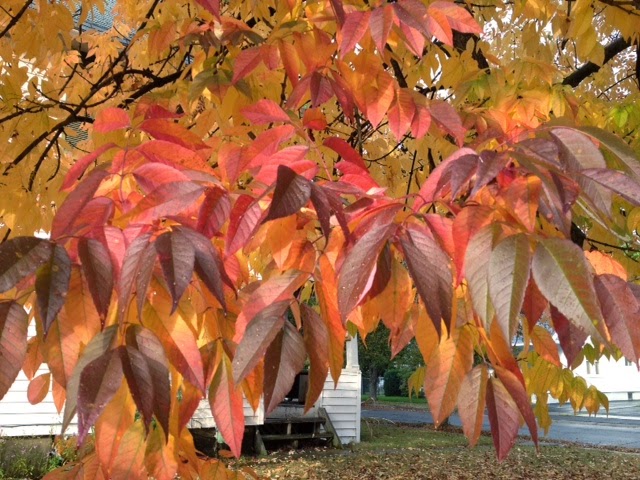
I can't say enough nice things about Sapsucker Woods, which is a bit more than an hour's drive from where I live. There are many nature trails, most of them level and easy to walk (important to me, as my right knee isn't in the best shape). The visitors center is fantastic, and so is the birding. When I go somewhere, the birds hide and mock me with their calls - saying, no doubt, stuff like "hidefromher! hide hide hide" in bird language. And, best of all, it is free.
If you are a birder, Sapsucker Woods will be a place you can spend most of the day.
Upstate New York - so many people, when they think "New York State", think New York City. New York City is just a small part of our beautiful state.
What kind of scenery do you have where you live?
Tuesday, September 30, 2014
Don't Panic!
As I am writing this blog post, our United States' Center of Disease Control is holding a press conference about the first case of Ebola in Dallas, in the state of Texas.
Up to now, this was something that Americans watched in TV.
Ebola. It was far away. It happened to someone else.
Then, Americans developed it in Africa. Now, it is here, arriving in the body of an individual who arrived in the United States, from Liberia (without symptoms), on September 20. The person showed symptoms several days later, and was hospitalized. The tests have come back positive for Ebola.
Plagues are nothing new to mankind. We in developed countries like to think we are better, somehow, than the people we read about in old histories - the panic, the quarantines, the nobility fleeing cities full of dead.
Well, we are not too far from that type of behavior.
Ebola is a huge threat in Africa. It speaks not just to the health of millions of fellow humans. The Washington Post, a newspaper in our nation's capital, reported earlier today that "Ebola-stricken Liberia is descending into economic hell."
For our country? We do not know yet what will come of this. But history has a lot to teach us about epidemics.
If you are interested, here is information on some of the worst epidemics in history. The death tolls were, using a modern idiomatic expression, epic.
Ebola is only spread by exposure to body fluids from a person with the active sickness. It has a high mortality, even with medical treatment. Sick individuals must be isolated You can see how a medical system could easily be overwhelmed by massive numbers of cases. Of course, the CDC is doing what they can to prevent any such mass outbreak. They knew this day would come.
But, increasingly, we are all connected. We breathe the same air (noting that Ebola is not spread by air, but other epidemic sicknesses can be). We travel by air transport to all parts of the world in just hours. Sooner or later, a plague in one part of the world shows up in other parts.
So, there is no need to panic (yet) although I will admit that if I was living anywhere near Dallas, I would be a bit more concerned. But, this first case of Ebola in the United States is just the latest example of how we are all connected - for good or for bad. Our challenge now in the States is clear-not only to keep Ebola under control, but to keep our fear under control. To educate all medical professionals is also essential, as health care professionals can spread it. They are our front line of defense, too.
How will we rise to this challenge? That remains to be seen.
With this post, I conclude several blog challenges I entered this month. Next month? I may taper back. But, I still plan to continue my daily blog posts. This continues to be my personal challenge.
Up to now, this was something that Americans watched in TV.
Ebola. It was far away. It happened to someone else.
Then, Americans developed it in Africa. Now, it is here, arriving in the body of an individual who arrived in the United States, from Liberia (without symptoms), on September 20. The person showed symptoms several days later, and was hospitalized. The tests have come back positive for Ebola.
Plagues are nothing new to mankind. We in developed countries like to think we are better, somehow, than the people we read about in old histories - the panic, the quarantines, the nobility fleeing cities full of dead.
Well, we are not too far from that type of behavior.
Ebola is a huge threat in Africa. It speaks not just to the health of millions of fellow humans. The Washington Post, a newspaper in our nation's capital, reported earlier today that "Ebola-stricken Liberia is descending into economic hell."
For our country? We do not know yet what will come of this. But history has a lot to teach us about epidemics.
If you are interested, here is information on some of the worst epidemics in history. The death tolls were, using a modern idiomatic expression, epic.
Ebola is only spread by exposure to body fluids from a person with the active sickness. It has a high mortality, even with medical treatment. Sick individuals must be isolated You can see how a medical system could easily be overwhelmed by massive numbers of cases. Of course, the CDC is doing what they can to prevent any such mass outbreak. They knew this day would come.
But, increasingly, we are all connected. We breathe the same air (noting that Ebola is not spread by air, but other epidemic sicknesses can be). We travel by air transport to all parts of the world in just hours. Sooner or later, a plague in one part of the world shows up in other parts.
So, there is no need to panic (yet) although I will admit that if I was living anywhere near Dallas, I would be a bit more concerned. But, this first case of Ebola in the United States is just the latest example of how we are all connected - for good or for bad. Our challenge now in the States is clear-not only to keep Ebola under control, but to keep our fear under control. To educate all medical professionals is also essential, as health care professionals can spread it. They are our front line of defense, too.
How will we rise to this challenge? That remains to be seen.
With this post, I conclude several blog challenges I entered this month. Next month? I may taper back. But, I still plan to continue my daily blog posts. This continues to be my personal challenge.
Monday, September 29, 2014
Saturdat In the Park
When I was young, my Dad would leave the house every day to commute to his job in Manhattan.
He always made one stop before heading towards the "El" station where he caught his train downtown. It was to Manny's candy store on White Plains Road in the Bronx. Dad had Manny hold a copy of the New York Daily News newspaper for him to read on the trip to work. He would pay Manny a week ahead of time so he wouldn't lose a minute in the tightly choreographed dance of leaving our apartment at just the right time, spending a few seconds at Manny's, and then climbing several flights of stairs to the Gun Hill Road platform where he hoped he hadn't missed his train.
(This was my elementary school. In the last second of the video, you see the train passing by the city housing project where I grew up.)
The newspaper was his link to the world. He would usually be able to grab a seat, and he would spend the next hour reading that newspaper from cover to cover.
He never missed a day of reading his newspaper.
Now, skip forward a generation.
Newspapers? My son (mid 20's) doesn't read them at all. I still do. But when I do, I am shocked at the errors I find. I'm not even a professional writer, or a professional proofreader. If I find the most obvious, how many more are there that I miss?
On Thursday, I was greeted by this headline for a local event: "PAST tour Saturdat looks at 'Mad Men'-era homes".
At first, I thought they had declared a new, eighth day of the week. I could use an additional day, especially if it is one where I don't have to go to my paying job. Just imagine the possibilities...
We could have a new take on a popular song of the 1970's - Saturdat in the Park.
All those songs about Saturday night? Time to redo them, too.
But let's be serious for a moment. Why should I care if there is a typo in the local newspaper?
Because it HAPPENS ALL THE TIME.
I was brought up to believe that journalism is all about accuracy. Newspapers had an important function in our society. Doing investigative reporting. Getting "the scoop". Keeping us informed.
In our day, though, we depend on other media - media that seems to have turned news into entertainment. It's killing the newspaper industry, so they flail around, trying to find something, anything, to cling to. So far, the industry hasn't found its life line.
Sadly, so many people I know have given up on our local newspaper. How can you depend on a story being accurate if a newspaper can't even properly proofread their own stories and headlines?
Newspapers all over the country are dying, shutting their doors, laying off people who care about the written word. And meantime, they are consolidating operations. I suspect these errors are slipping through because there's a proofreader somewhere - let's say, in Asbury Park, New Jersey, who is now doing the proofreading for umpteen newspapers where, in the past, each paper did its own.
Or, worse - maybe that story was written by a robot.
No, I'm not in the news business. Never have been. But newspapers have been a part of my life from the moment I was born. I wish I had something concrete to suggest. I'm fresh out of ideas.
If my father was alive, he would be shaking his head. He loved his morning paper so much.
Will you be sorry to see newspapers go, if they do go? Or, do you think there is hope for them?
He always made one stop before heading towards the "El" station where he caught his train downtown. It was to Manny's candy store on White Plains Road in the Bronx. Dad had Manny hold a copy of the New York Daily News newspaper for him to read on the trip to work. He would pay Manny a week ahead of time so he wouldn't lose a minute in the tightly choreographed dance of leaving our apartment at just the right time, spending a few seconds at Manny's, and then climbing several flights of stairs to the Gun Hill Road platform where he hoped he hadn't missed his train.
The newspaper was his link to the world. He would usually be able to grab a seat, and he would spend the next hour reading that newspaper from cover to cover.
He never missed a day of reading his newspaper.
Now, skip forward a generation.
Newspapers? My son (mid 20's) doesn't read them at all. I still do. But when I do, I am shocked at the errors I find. I'm not even a professional writer, or a professional proofreader. If I find the most obvious, how many more are there that I miss?
On Thursday, I was greeted by this headline for a local event: "PAST tour Saturdat looks at 'Mad Men'-era homes".
At first, I thought they had declared a new, eighth day of the week. I could use an additional day, especially if it is one where I don't have to go to my paying job. Just imagine the possibilities...
All those songs about Saturday night? Time to redo them, too.
But let's be serious for a moment. Why should I care if there is a typo in the local newspaper?
Because it HAPPENS ALL THE TIME.
I was brought up to believe that journalism is all about accuracy. Newspapers had an important function in our society. Doing investigative reporting. Getting "the scoop". Keeping us informed.
In our day, though, we depend on other media - media that seems to have turned news into entertainment. It's killing the newspaper industry, so they flail around, trying to find something, anything, to cling to. So far, the industry hasn't found its life line.
Sadly, so many people I know have given up on our local newspaper. How can you depend on a story being accurate if a newspaper can't even properly proofread their own stories and headlines?
Newspapers all over the country are dying, shutting their doors, laying off people who care about the written word. And meantime, they are consolidating operations. I suspect these errors are slipping through because there's a proofreader somewhere - let's say, in Asbury Park, New Jersey, who is now doing the proofreading for umpteen newspapers where, in the past, each paper did its own.
Or, worse - maybe that story was written by a robot.
No, I'm not in the news business. Never have been. But newspapers have been a part of my life from the moment I was born. I wish I had something concrete to suggest. I'm fresh out of ideas.
If my father was alive, he would be shaking his head. He loved his morning paper so much.
Will you be sorry to see newspapers go, if they do go? Or, do you think there is hope for them?
Sunday, September 28, 2014
Civil War Sunday - The Wounds of War
On October 5, 2014, a memorial will be dedicated within sight of our nation's Capital building in Washington, DC.
The American Veterans Disabled for Life Memorial, will honor all living and dead American disabled war veterans, "regardless of conflict".
I could not help but think back to the Civil War. None of the images I saw connected to this memorial seem to be of the Civil War era. Yet, this war made our country, for better or worse (actually, both, in my opinion), what it is today. I hope that the intent of this memorial is to honor the brave men and women (yes, women) who fought on both sides of our United States Civil War.
What happened when the wounded vets, many of them amputees due to the state of battlefield medicine in the 1860's, ccame back home after the war concluded in 1865? Have you ever wondered?
How many wounded veterans of the war returned? A lot. They numbered in the hundreds of thousands.
Experiences differed somewhat for the veterans of the former Confederacy and the veterans of the Union Army. The Union disabled veterans suffered, but one advantage they had was being on the winning side of the war.
The disabled Confederate veterans were banned from getting much, if any, help from the United States government (including the granting of pensions to the disabled) by the 14th Amendment to the Constitution. (This was remedied in law in 1958, but by then, most anyone eligible for help had died.) They, and their hometowns (many reduced to rubble as the war was fought mainly in the South), suffered terribly.
My father, as my regular blog readers know, was a disabled veteran of World War II. My ancestors did not come to the United States until the 20th century, so I had no blood relatives in the Civil War (to the best of my knowledge.) But, due to my experiences growing up as the daughter of a disabled veteran, I hope that the intent of this memorial extends to those who fought in this domestic war of family against family.
The American Veterans Disabled for Life Memorial, will honor all living and dead American disabled war veterans, "regardless of conflict".
I could not help but think back to the Civil War. None of the images I saw connected to this memorial seem to be of the Civil War era. Yet, this war made our country, for better or worse (actually, both, in my opinion), what it is today. I hope that the intent of this memorial is to honor the brave men and women (yes, women) who fought on both sides of our United States Civil War.
What happened when the wounded vets, many of them amputees due to the state of battlefield medicine in the 1860's, ccame back home after the war concluded in 1865? Have you ever wondered?
How many wounded veterans of the war returned? A lot. They numbered in the hundreds of thousands.
Experiences differed somewhat for the veterans of the former Confederacy and the veterans of the Union Army. The Union disabled veterans suffered, but one advantage they had was being on the winning side of the war.
The disabled Confederate veterans were banned from getting much, if any, help from the United States government (including the granting of pensions to the disabled) by the 14th Amendment to the Constitution. (This was remedied in law in 1958, but by then, most anyone eligible for help had died.) They, and their hometowns (many reduced to rubble as the war was fought mainly in the South), suffered terribly.
My father, as my regular blog readers know, was a disabled veteran of World War II. My ancestors did not come to the United States until the 20th century, so I had no blood relatives in the Civil War (to the best of my knowledge.) But, due to my experiences growing up as the daughter of a disabled veteran, I hope that the intent of this memorial extends to those who fought in this domestic war of family against family.
Saturday, September 27, 2014
Sustainable Saturday - Nature Paints by Number
I have been in a summer mood the past couple of days. Here in the Binghamton area of upstate New York, it has been so sunny, so warm, and so non-humid that you would think it was a wonderful day in July and not the end of September.
 With our trees starting to turn color, we decided to drive today about an hour north, into the Finger Lakes. Which is how I ended up seeing these jars of honey, glowing in the mid morning sun.
 We were at the Saturday Ithaca, New York, Farmers Market, one of the best in the country.
 It is located on the shores of Cayuga Lake, one of the Finger Lakes of upstate New York. Nearby, people can dock boats. Along the market side of the lake are picnic benches, where you can sit and watch people or nature.
 It is unfortunate that some of what they sell is quite expensive, but there is also a lot of more reasonably priced produce. A lot of it is organic, and market rules demand it must be grown within 30 miles of the market.
Nature paints with such lovely colors, doesn't it?
We aren't that far from the end of the growing season. If we had weather like this every day, we would quickly take it for granted. But we know that the bitter winds of winter will soon blow. The days grow shorter every day, and more and more trees turn color every day.
These days are precious, and numbered by nature, even as it paints us an apology for what is to come.
One day, our frost will come, followed by the first freeze, and then the first flakes of snow, tumbling out of cloudy skies.
And the markets will move indoors and hunker down for the cold months.
But for now, honey glows and produce sings.
Nature paints with such lovely colors, doesn't it?
We aren't that far from the end of the growing season. If we had weather like this every day, we would quickly take it for granted. But we know that the bitter winds of winter will soon blow. The days grow shorter every day, and more and more trees turn color every day.
These days are precious, and numbered by nature, even as it paints us an apology for what is to come.
One day, our frost will come, followed by the first freeze, and then the first flakes of snow, tumbling out of cloudy skies.
And the markets will move indoors and hunker down for the cold months.
But for now, honey glows and produce sings.
Friday, September 26, 2014
Fog and Fall
Would we appreciate fall as much as things looked the way they do every day of the year?
Perhaps that is the true reason why we don't get 12 months of fall here in upstate New York (or anywhere else, I don't think.)
 Here, we commonly get morning fog in late summer and early fall. I love the muted colors in this shot taken today in downtown Binghamton, New York.
 This building, the Perry Building, is an amazing blue in the noonday sun. Here, it looks more grey. In the fog you can see another historic building damaged by a fire, the Press Building, behind it.
 Our library, on the edge of downtown, has a garden. A historic mansion (Phelps Mansion) and a historic church are in the background.
 At lunchtime, the sun is out brightly, in this long shot showing trees starting to turn and the small downtown Binghamton farmers market.
 After work yesterday, I saw red trees blazing on Grand Boulevard on the West Side of Binghamton. Despite the clouds we had yesterday, it was so pretty.
Would we pay attention to trees if they looked like this every day of the year? I doubt it. Instead, we have fall foliage forecasts with predictions as to when peak foliage will occur.
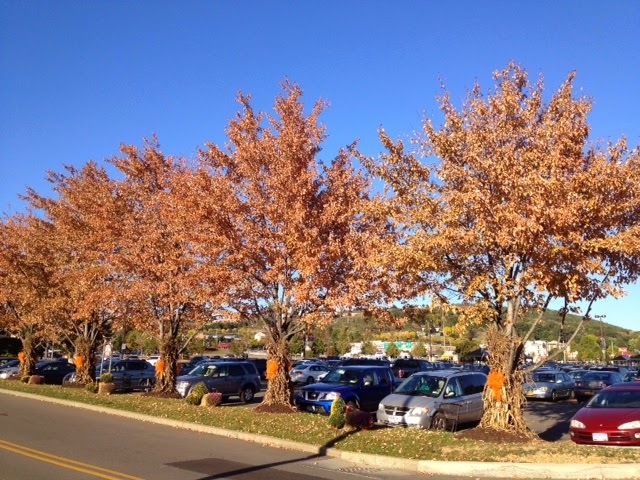 I don't know what kind of trees these are. They are already brown, as you can see in this photo taken tonight, but someone has dressed them up with orange bows, and mums along the ground add more color.
Fog and fall go together in upstate New York just like - well, fog and fall.
What kind of weather are you experiencing right now?
Perhaps that is the true reason why we don't get 12 months of fall here in upstate New York (or anywhere else, I don't think.)
Would we pay attention to trees if they looked like this every day of the year? I doubt it. Instead, we have fall foliage forecasts with predictions as to when peak foliage will occur.
Fog and fall go together in upstate New York just like - well, fog and fall.
What kind of weather are you experiencing right now?
Thursday, September 25, 2014
The Disappearing Smells of Childhood
Can smells disappear, never to be smelled by anyone again?
Apparently so.
Do you have a special smell of childhood? Think about it - does that smell still exist?
I remember the scent of the lobby of the apartment in the Bronx where my mother's mother and father lived. I remember the smells of cooking food.
The building still exists (it was built in 1930, and was converted to co-op housing many years ago) so perhaps those smells still exist.
The other is the smell of overcooked cabbage. Forgive me, blog readers from England, but that is one smell I hope never to have to smell ever again. We had war brides from England living in my childhood apartment building, and when they decided to cook cabbage, it was an all day affair. (I must have a thing about the smell of cooking food....)
Please, someone from England, tell me you don't cook cabbage all day any more.

But the smell my spouse associates with fall - the smell of burning leaves - is a smell that exists in fewer and fewer places, as the practice has been banned in many United States municipalities.
Those aren't the only smells that are disappearing, either.
It's doubful that teens or those in their twenties remember the smell that vacumn tubes made when they were in the warming up process make - except, perhaps, for my son. Old technology fascinates him.
How many people, as another example, remember the scent of mimeograph (ditto) sheets? And, while we are at it, have you ever wondered why someone on an email is "cc"d" (as in carbon copied)?.
Now you know.
Is there a smell from your childhood that no longer exists?
Apparently so.
Do you have a special smell of childhood? Think about it - does that smell still exist?
I remember the scent of the lobby of the apartment in the Bronx where my mother's mother and father lived. I remember the smells of cooking food.
The building still exists (it was built in 1930, and was converted to co-op housing many years ago) so perhaps those smells still exist.
The other is the smell of overcooked cabbage. Forgive me, blog readers from England, but that is one smell I hope never to have to smell ever again. We had war brides from England living in my childhood apartment building, and when they decided to cook cabbage, it was an all day affair. (I must have a thing about the smell of cooking food....)
Please, someone from England, tell me you don't cook cabbage all day any more.
But the smell my spouse associates with fall - the smell of burning leaves - is a smell that exists in fewer and fewer places, as the practice has been banned in many United States municipalities.
Those aren't the only smells that are disappearing, either.
It's doubful that teens or those in their twenties remember the smell that vacumn tubes made when they were in the warming up process make - except, perhaps, for my son. Old technology fascinates him.
How many people, as another example, remember the scent of mimeograph (ditto) sheets? And, while we are at it, have you ever wondered why someone on an email is "cc"d" (as in carbon copied)?.
Now you know.
Is there a smell from your childhood that no longer exists?
Wednesday, September 24, 2014
Fall Fancies -The Transition
Fall has come to the Binghamton, New York area where I live. Fall is meeting summer and preparing to take over.
Our weather, this week, is actually warming up and is sunny and pleasant, but the plants aren't fooled.
 The trees are starting to turn color
 Bee on an aster, along the Chenango River in downtown Binghamton.
 Also along the Chenango River in downtown Binghamton, asters and goldenrod bloom side by side.
 Sedums are coloring up.

"Burning" bushes are coloring up. This one from today is in the library garden at the Broome County Library in Binghamton, New York.
Soon enough, with the first frost, summer will give way to fall. For some, it is the best time of year.
My "Summer Ramblings", in honor of the second day of fall, have transitioned into "Fall Fancies". Every Wednesday until winter, I will blog about something seasonal.
Do you live in a four season climate? What is your favorite season, and why?
Our weather, this week, is actually warming up and is sunny and pleasant, but the plants aren't fooled.
"Burning" bushes are coloring up. This one from today is in the library garden at the Broome County Library in Binghamton, New York.
Soon enough, with the first frost, summer will give way to fall. For some, it is the best time of year.
My "Summer Ramblings", in honor of the second day of fall, have transitioned into "Fall Fancies". Every Wednesday until winter, I will blog about something seasonal.
Do you live in a four season climate? What is your favorite season, and why?
Subscribe to:
Posts (Atom)