Showing posts with label invasive plants. Show all posts

Friday, May 3, 2024

Cloudy and Invasive White #SkywatchFriday

April 17, Otsiningo Park, Binghamton, New York.

Over the years, Callery pears have taken over more and more and are now considered invasive where I live in the Southern Tier of New York.  (We commonly call them Bradford pears here, but Bradford pears are just one variety of Pyrus calleryana, an Asian pear variety that was brought here in the early 1900s with the best of intentions.  But we all know about good intentions, right?  You can read more about Callery pears and why they have become a problem here.

Three states so far have banned their sale:  our neighboring state Pennsylvania, Ohio, and South Carolina.

In a way, it's a shame, because I believe the lovely flowering trees in the following photos are Callery pears (their flowers certainly smell like their flowers - bad) and if not, I'm sure I'll be corrected.  Otsiningo Park has a lot of them.

So let's take in a walk from April 17 and view the trees and the sky.

Invasive but pretty.

Finally, the sky without the trees.

Joining Yogi and other sky watching bloggers each Friday (now that Blogging from A to Z is over and I am back to my normal schedule) for #SkywatchFriday.

Sunday, May 19, 2019

Good Intentions Gone Bad

Yesterday, spouse and I took an exercise walk on our local Rail Trail (a walking trail that was railroad tracks years ago, when we still had rail service in our area).

So many sweetly smelling flowers are out right now - but there's a catch.

First, though, the flowers.
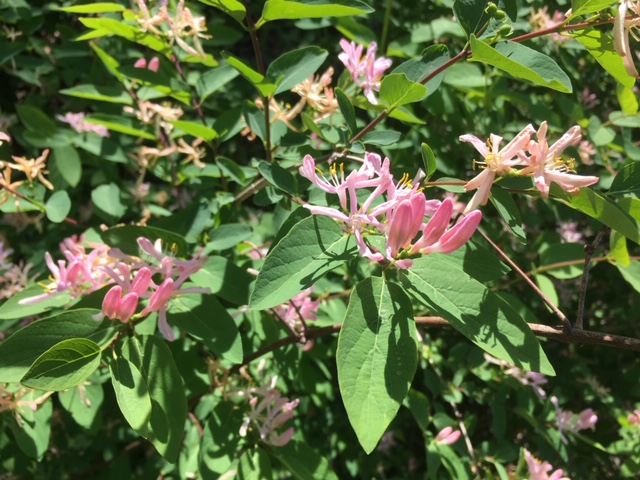
There are a number of honeysuckles blooming along the trail.  I know that some are native and some are imported invasives.  As there is so much of these, I suspect these are both invasives.  Here, pink.  I am wondering if this is something called showy fly honeysuckle, or Bell's honeysuckle, which is actually a hybrid.
Here, yellow and white.  I believe this is invasive Japanese honeysuckle, Lonicera japonica

These are definitely an invasive - Russian olive (and no, they don't produce olives) or Elaeagnus angustifolia.  My spouse loves their scent.  I don't.

Here's a closeup of the flower of the Russian olive.

These are fast growing shrubs that were introduced in the early 1900's as windbreaks and were valued as they would tolerate salt along highways.  However, besides choking out less rapidly growing native plants, they will use so much water they will use water other plants need.

Sometimes, what makes non native plants initially valued is what ends up allowing the plant to cause such damage.  In other words, good intentions gone bad.

Do you have any invasive plants or animals/insects that you battle where you live?

Wednesday, May 22, 2013

Spring Things - Invasion of the Aliens

They can be beautiful. They can be fragrant.

They are also deadly.

It's the invasion of the aliens - the alien plants, the invasives.  If you have a back yard, chances are you have one invasive species in it.  These invaders crowd out native plants and change our environment.  They can have adverse impacts on wildlife.  They tend to be fast growers.  The most famous invasive may be kudzu but there are lot of other aliens lurking out there in a backyard or vacant lot near you.

Some examples of invasives now blooming here in upstate New York:
Russian Olive. (taken on the Vestal Rail Trail, our local rail trail. That is far from the only invasive species on that trail - soon enough, the rugosa roses will be in bloom.  Yes, another invasive.)
Honeysuckle (taken on banks of Susquehanna River, downtown Binghamton, New York.)

A different honeysuckle (same location).

And finally, wisteria.  Not all wisterias are invasive, but Japanese wisteria is invasive in a lot of the East Coast of the United States.  In March, you can see this beautiful purple bloom up in trees in parts of South Carolina and Georgia. Problem is, it also kills the trees, as does Chinese wiseria.  I found this specimen of wisteria today on the West Side of Binghamton in an ornamental situation, and this may not be one of the invasive species.  I certainly hope it is.

What invasive plants are a problem in your area?