Showing posts with label Rochester. Show all posts

Saturday, April 20, 2024

Rochester (New York) Redux #AtoZChallenge

 Rochester, New York, is New York State's fourth largest city, with a population of about 211,000.  It was the birthplace of a number of businesses known worldwide, including Eastman Kodak, Xerox, and Bausch and Lomb.  

A number of famous people made Rochester their home, including social reformer, writer, newspaper publisher, and abolitionist Frederick Douglass (who started his life in slavery) and abolitionist, women's rights activist and suffragist (including an arrest for daring to vote in a Presidential election) Susan B. Anthony.  

Yes, I've blogged about Rochester for Blogging from A to Z before, but this city deserves another mention.

Today, I want to take you to two parts of Rochester - the historic East End and one of the United States' first public arboretums, Highland Park.

The historic Little Theatre, which opened in October of 1921, and, today, shows indie and other movies.

I now have an ID on this East End building I featured in my "K" A to Z post, thanks to Tom at Tom the Backroads Traveler:  "The Hiram Sibley Building was built in 1925 at the corner of East Avenue and Alexander Street in Rochester, New York. It was named in his honor by his son Hiram Watson Sibley, and designed by Shepley, Bulfinch and Abbott of Boston."  (Hiram Sibley, among other things, was a founder of, and first president of, Western Union.  Are any of my readers old enough to remember telegrams?)

One of many decorations on the outside of the East End garage.

Let's move to Highland Park.  These pictures were taken April 9.

Outside the Lamberton Conservatory, which we visited in 2016.  It's well worth the time.  Unfortunately we were on our way out of Rochester and didn't have time to visit this time.

However, here is a picture I took inside in 2016. 

The glacial terrain of Highland Park makes for beautiful hills and valleys.  Rochester, like many other places, is ahead of what should be blooming at this time of year.

Weeping cherry.

Highland Park is known for its Lilac Festival each May.  I wouldn't be surprised if they have lilacs in bloom before the end of the month.  In fact, for April Fools Day, they posted on social media that their lilacs were in full bloom.  I hope they didn't trick anyone out of the area!

Hopefully, I'll see their lilacs in bloom one day.  I think I was last there for the lilacs nearly 30 years ago.

"R" day at the Blogging from A to Z Challenge.  My theme Gardens, History, Art and The Unexpected.

Friday, April 12, 2024

Knowing Knowledge - Total Eclipse of the Total Eclipse #SkywatchFriday #AtoZChallenge

We live in New York State,  perhaps 100 miles outside the zone of totality for the April 8 total eclipse of the sun. We knew that if we wanted to see the total eclipse we would have to travel.  But, given our normal weather on April 8 of any year, we also Knew that many early April days are cloudy. We could even have a snowstorm.  Going anywhere was a gamble. Should we travel west or easst, or try to stay within New York State?

After some research we decided on Rochester, New York.  We signed up for a eclipse watching festival at Rochester's Museum and Science Center (RMSC), figuring that if the weather was bad, we'd have plenty of other things to do.  If the weather was good....

Know what?

It was almost good.  In fact, April 7 was beautiful with blue skies.  April 9 was beautiful with blue skies.

But oh, that April 8.  If only we had Known....

Is this a historic building on East Avenue?  I have no idea

It started nice.  Here's the sky at 9:15 am as we walked from the parking garage to the RMSC, where we would view the eclipse.  But it rapidly clouded up.  

With the eclipse starting at 2:07 pm and totality starting at 3:20, we just Knew things weren't going to happen the way we wanted them to.  But that was the chance we took, right?

 1:33 pm.  The festival emcee tries to keep spirits up, explaining that someone he knew had watched a prior eclipse in a rainstorm.  Just before totality the rain stopped and the sun came out.  And we didn't even have rain.  The clouds were from a warm front.

2:50 pm.  The eclipsing sun is in that picture somewhere.  But note how those clouds look.  So far, nothing out of the ordinary.

By 2:59 pm something strange is happening to the clouds. The temperature is noticeably dropping. The clouds are getting - lumpy.  It's also a little darker than the picture shows - my iPhone 13 mini was doing some automatic light adjustment.  I wish I had known how to stop it.

3:09 pm, 11 minutes before totality.

3:18 pm, two minutes before totality.   It was darker than it looks.  Meanwhile, the temperature had dropped even more.  It was getting darker and darker.  I felt a breeze.

3:20 pm.  A shadow swept across the parking lot where we were watching.  This is my fourth total solar eclipse but I've never seen one totally clouded up.   We can't see the sun, but I Knew, with my eclipse experience's Knowing Knowledge that totality has arrived.

Part of the horizon is blocked (it really wasn't a good viewing location) and I can barely see the 360 degree sunset I know I should be seeing.  Meanwhile, the parking lot lights have snapped on.  Aaaargh!  The emcee says they tried to override the lights but couldn't. 

The three minutes and 38 seconds of totality have begun.  Elsewhere in the parking lot, a couple are getting married.  But alas, no sun.  Strangely, I can see two small crescents in this picture.  Can you? 

3:21 pm.

Reverse sunset 3:21 pm.

3:22 pm. and I decide to take several shadow shots on the ground.  Here's one.

As soon as it was over, the large crowd headed right for the exits.  We did, also, even as the sky brightened up.

The eclipse ended - or should I say, the total eclipse of the total eclipse, as my spouse called it - at 4:30 pm.

The sun showed itself again about 5:30 pm.

So, what do we know?

We are not in control.  Not on April 8, not ever.  I feel for the people in the crowd - from the huge buildup on media this is not what they had signed up for and I heard a lot of comments while exiting along the lines of "this was overrated"..  But there is always something to see and learn when you are a Skywatcher.  I can just hope I can view another total eclipse before my time on Earth is over.

Joining Yogi and other skywatchers today for #SkywatchFriday.

"K" day at the Blogging from A to Z Challenge.  My theme Gardens, History, Art and The Unexpected.


Thursday, April 28, 2022

Xerox (Original Home of) #AtoZChallenge

Only three more days in April, and only three more days to the Blogging from A to Z Challenge.  We have reached the letter X, which, for many A to Z'ers, is the most difficult letter.

I waffled, this year, between three different "X" words but settled on the word "Xerox".  You might say, "But you aren't living up to your theme, "From Florida to Vermont With Stops In Between".  

And you would be right, in a way.  But today, we are going to visit Rochester, New York, the third largest city in New York State.  Rochester has a historic connection with a "X" letter.

Rochester has a long and rich history.  Part of its history is industrial in nature.  Various companies started here, among them Eastman Kodak, Bausch and Lomb, French's (famous for their mustard) and a company originally called the Haloid Photographic Company.  Haloid manufactured photographic equipment and papers.

In 1938, the xerographic imaging process was invented by a physicist,  Chester Carlson in Queens, a borough of New York City.  Xerography is (according to Merriam-Webster) "a process for copying graphic matter by the action of light on an electrically charged photoconductive insulating surface in which the latent image is developed with a resinous powder (such as toner)."

The Haloid Company acquired the rights to xerography in 1947 and brought the process to commercial use so successfully that the company changed its name to the Xerox Corporation in 1961. Eventually, when people thought of Xerox, they immediately thought of office copy machines.  Growing up, I remember office copy machines being called (incorrectly, as this is not a generic name) "Xerox machines".

Although Xerox Corporation's ownership has changed over the years and is no longer headquartered in Rochester, Rochester itself remains an interesting city with many spots of beauty.  Let's visit some of them.

Cat at entrance of Warner Castle, a structure built in 1854 to resemble a Scottish castle.  Its sunken gardens are well worth the visit. 

Highland Park, September, 2016.  Their famed lilac festival begins in another week.  The park was one of several in Rochester designed by Frederick Law Olmsted, who also helped to design Central Park in New York City.

Tricolor beech in the park, one of many majestic trees in the park.

One of the several tortoises in the park's Lamberton Conservatory.  This one is a "repeat offender".

Cactuses in Lamberton Conservatory.

Black Button Distillery, Rochester, which was founded by a grandson of a man who owned a button factory.  He wanted to participate in the family button business but there was just one problem - he was colorblind.

Grave of either Henry Lomb or John Jacob Bausch, Mt. Hope Cemetery

Mural inside a Rochester area store showing the Frederick Douglass–Susan B. Anthony Memorial Bridge.

Tomorrow, another post in New York State.  Join me for "Y" day tomorrow.

Wednesday, April 21, 2021

Rochester (New York) #AtoZChallenge #WordlessWednesday

I'm going to let some pictures do the talking today (mostly) because this is a city partially made famous by photography.

Rochester, New York is the third largest city in New York State.  It is chock full of history - Susan B. Anthony and Frederick Douglass, among others, lived there.  The pipe cleaner, the digital camera and Kodak camera (remember the Kodak camera?) were invented in Rochester. 

Rochester is also called the Flower City, for good reason.  

Why don't we make a quick visit to Rochester?

Our first stop is Warner Castle, built in 1854 as a private residence with a sunken garden. 

A mural inside the building.


Part of its sunken garden.

Next, the George Eastman mansion, on East Avenue.  If you are of a certain age, you remember "Eastman Kodak".  George Eastman was the founder of Kodak and his home is now a art and photography museum.

Highland Park is the site of a large lilac festival each May.  I haven't been to the festival in years.  All I can offer you is a picture of one of their trails in September.

The home of Susan B. Anthony.  If you are a woman living in the United States and are 18 or older, you can thank Susan B. Anthony (among others) for your right to vote.

Her grave, in Rochester's Mt. Hope Cemetery.


Frederick Douglass, the famed abolitionist, is also buried at Mt. Hope.

It is a tradition (not shown) for women to place their "I voted" stickers on Anthony's gravestone.

I hope you enjoyed my digital photography, which would not have been possible without this city in New York State, my theme for the Blogging from A to Z Challenge "R" day.


Joining up with Sandee at Comedy Plus for #WordlessWednesday.

Sunday, July 5, 2020

A Different 4th - Vicksburg and Frederick Douglass

Today, the day after America's Independence Day, and the 168th anniversary of Frederick Douglass' famous (but not famous enough) speech "What To the Slave Is The Fourth of July",  I am repeating a post (with some edits) from July 3, 2011, and adding more at the end.

I first learned about this different 4th of July on Ken Burn's classic TV mini series on the United States Civil War.

Vicksburg, Mississippi, in a former Confederate state, has an online listing of community events.  In 2011 I found, listed in here, along with the Farmers Market, Faith Fest and the Old Court House Flea Market, the "Red, White and Blue" Fourth of July weekend, and the Independence Day fireworks.  Nothing special, here.  Nothing different than what thousands of other cities and towns in the United States were offering, pre-pandemic, celebrating our nation's Independence Day.

Or is it different?

Several generations of citizens of Vicksburg, Mississippi didn't know what a hometown 4th of July celebration was like-because they didn't have one. Stores remained open.  People went about their business.  And stories were told, dark stories, about the Siege of Vicksburg and its surrender to the Union Army on July 4, 1863.  It is said that General Pemberton, the commanding general of the Confederate States of America forces at Vicksburg, chose to surrender Vicksburg to the Union army on Independence Day as he thought they would get more favorable terms of surrender.

After that surrender, Vicksburg did not celebrate Independence Day until 1945.

Even in 1997, they still had a problem with it.

Vicksburg is located on the Mississippi River, one of the most important waterways in our nation.  It was just as important, if not more so, in the 1860's.  It was vital for the Federals to take control of the Mississippi in order to win the war.

Vicksburg stood in the way.  So, it was put under siege by Union forces commanded by General Grant and starved into submission.  As a young girl growing up in the Bronx, I remember drawings in a textbook showing how the residents ended up taking refuge in caves dug into hillsides, and what they used for food as the siege progressed. Rats would have been a gourmet treat.

Towards the end, they were printing their newspaper on wallpaper because they had run out of paper.

For Vicksburg, July 4th didn't stand for our country's birthday but rather was symbolic of what its fellow citizens did to it back in 1863.  I can only think that its citizens going overseas and fighting World War II side by side with the descendants of its former enemies of 80 years before, to fight a strong evil threatening to overtake the world, is what finally started to heal those wounds. 

The descendants of those people still remember, too, which brings us to the present day.

Indeed, the wounds of the Civil War are still there, right underneath our collective skin, both North and South, black and white, Native American, other origins, not fully healed. This year, it is more obvious that not everyone celebrates the 4th of July as their Independence Day, because the do not yet feel free.  Vicksburg isn't alone in not feeling that "the 4th of July" is their holiday.

Here is an opinion piece on this.

You don't need to be a citizen of Vicksburg to feel alienated. Recent events have brought many things to our collective attention, including continued inequalities and parts of our history hidden away out of shame or other reasons.  We have had many years to resolve this situation, and we haven't.

Now, in the midst of a pandemic, we must finally face this head on.  Small steps have been taken, one of the most recent being in Mississippi, the last state to have the Confederate battle flag incorporated into their state flag. That flag was retired this week, but many think that's it ("mission accomplished") for Confederate symbols in state flags.  Part of the reason for this belief is that the "Confederate flag" so proudly displayed in many places even today, was not an official state flag of the Confederate States of America, but, rather, was a battle flag associated with General Robert E. Lee's Army of Northern Virginia.

If we are just concerned with getting rid of Confederate symbols of flags, they are still in many state flags.

It's way past time to look at this history now, but we still have a long way to go. We are only at the beginning.  Changing flags, renaming music groups, and discussing name changes for sports teams is comparatively easy.  Changing hearts is a lot harder, but there are people now ready to do that work.

It's time for us to look again to Douglass, who adopted Rochester, New York as his home in his later years.  Even after growing up an enslaved person, he did not lose his faith in our country.

It's amazing (to me) that Frederick Douglass, at the end of his speech, was hopeful. He said:
"Allow me to say, in conclusion, notwithstanding the dark picture I have this day presented, of the state of the nation, I do not despair of this country......I, therefore, leave off where I began, with hope. While drawing encouragement from "the Declaration of Independence," the great principles it contains, and the genius of American Institutions, my spirit is also cheered by the obvious tendencies of the age."

We are at that point again.  We are living the obvious tendencies of our age.

We write history as we live it. What will our children and grandchildren think when they read ours?

Sunday, December 30, 2018

Civil War Sunday - Frederick Douglass

I firmly believe that if we don't remember the lessons of history, we are doomed to repeat the same mistakes that past generations did.

A man by the name of Frederick Douglass died on February 20, 1895.  Our country could use him today.  Hence, I repeat a post from February of 2017:

On February 1, 2017, someone in high office said something that seemed to imply that Douglass was still alive.  His descendants decided to turn that into a teachable moment. 

It is my pleasure to introduce you, my reader (knowing that some of you are not from the United States) to this most remarkable man who had many ties with my native New York State.

Frederick Douglass never knew his exact birth date.  He was born into slavery in Maryland sometime during February of 1818. His original name was Frederick Augustus Washington Bailey.  He barely knew his mother, whom he was separated from at an early age (not uncommon with slaves in that area) and was raised by his grandmother. His birth mother died when Douglass was 10.

At around the age of 12, the young Douglass was hired out to a man living in Baltimore, Hugh Auld, brother of Douglass's owner Thomas Auld. Hugh Auld and his wife were not experienced slave keepers, which may explain what happened next.

Hugh Auld's wife started to teach Douglass the alphabet.  I can not emphasize here the importance of this act - slaves were not permitted literacy, and in many places, teaching a slave to read or write was a crime.  Any slave, in turn, who was literate had to hide that fact or risk heavy punishment or even death.

Imagine that your love of reading must be kept secret, as you have no right to be literate.

Soon enough, Hugh Auld convinced his wife that teaching Douglass was a mistake.  But it was too late.  In secret, Douglass taught himself to read and write, using various resources, including a school primer owned by Hugh Auld's son, and the Bible.  Later, as a teenager, he was hired out to another man and started an underground slave school for the other neighborhood slaves.  He was caught and brutally punished by being hired out to a known "slave breaker".  Almost psychologically broken, he still managed to survive the experience.

Eventually, in 1838, Douglass was able to escape to the free state of Pennsylvania and then onward to free New York City.  He married (he and his first wife were together for 44 years) and they settled in Massachusetts, another free state.

Douglass eventually took the last name of "Douglass" from a poem, The Lady of the Lake, by Walter Scott.  While still living in Massachusetts, he joined the abolitionist movement - a movement to abolish slavery.  By the early 1840's, Douglass was traveling frequently and giving the most eloquent speeches many had ever heard.

Some people didn't even believe he had ever been a slave, so Douglass decided to write the first of several autobiographies to educate the public about his origins and early life story.  This book, Narrative of the Life of Frederick Douglass, An American Slave (published in 1845), is in the public domain here and in most countries.  If you look online, and it is legal, you will find PDFs of it on many websites.  It is about 108 pages.

Keep in mind that Douglass, at this point, is still an escaped slave.  It was quite possible his owner, Thomas Auld, could hire people to capture him and bring him back to slavery.  After all, he was Auld's property.  So, also in 1845, just as the Irish Potato Famine was starting, Douglass traveled to Ireland and Britain, and spent the next two years there.  There are several historical plaques in Britain and Ireland commemorating that visit.  More importantly, British supporters raised enough money  and Douglass was able to purchase his freedom from Thomas Auld.

Returning to the United States in 1845, he began his association with upstate New York, particularly the upstate New York cities of Seneca Falls and Rochester. If you are interested in learning more about Douglass, many of his other writings are online, free to read.

During the Civil War (1861-1865), three of Douglass's sons served in the military.  One became a First Sargent and anther a Sargent-Major.  The third was a recruiter. 

Douglass fought for many causes, including improving the lot of the nation's former slaves (they were all freed after the Civil War), education, and women's right to vote.  He used words, not violence, to advance the causes he believed in.  I must also point out that his beliefs were sometimes complicated, and contradictory.

Douglass believed in the young art of photography, and was the most photographed man, it is said, of the 19th century.

Politically, Douglass was the first African American to be nominated for Vice-President (he did not support this, and did not campaign) and the first African American man to receive a vote for President.

In addition to his work in the abolitionist movement, Douglass also did much work in the women's suffrage movement.  If you are a woman in the United States, you owe much to Frederick Douglass.

Here is another part of this amazing life story: In 1877, knowing his former owner Thomas Auld was dying, Frederick Douglass traveled to Auld's side and they reconciled.  I don't know if I could ever have done that if I had been a former slave.  Could you have?

Which brings me to these statues.

Douglass lived for about 25 years in Rochester, New York, also the home of suffragist Susan B. Anthony.  Near Anthony's home is a small park, and there, you will find this statue, called "Let's Have Tea".  Here, Anthony and Douglass's statues...well, they have tea.  A black former slave and a white school teacher having tea as equals?  That, in itself, would have been a revolutionary act.

Douglass died on February 20, 1895, in Washington, DC, shortly after visiting a meeting of the National Council of Women, and receiving the last standing ovation of his life.

Douglass is buried in Rochester, New York.  Here is his grave in Mt. Hope Cemetery.
Mural of the Douglass-Anthony Bridge, Trader Joes, Pittsford, New York
Also in Rochester is the Frederick Douglass-Susan B. Anthony Bridge.

Although our nation's leader may have incorrectly implied that Douglass was still alive, he was right in one respect.  The vision of Frederick Douglass is alive.  His courage in learning to read and escaping slavery still inspires us.  His supporting the rights of minorities and the rights of women continue to be carried forward by those who still believe in his vision. He taught that protest must always be peaceful, and that we must never give up when protesting for a just cause.

This year (2018) marks the 200th anniversary of Douglass's unknown birthday.

Come to think of it - yes, in a way, maybe Frederick Douglass is still alive - in all of us.

Sunday, February 19, 2017

Civil War Sunday -Let's Have Tea

After a nearly two year hiatus, I am starting up, at least for the remainder of February, and all of March, my United States Civil War Sunday feature.   Although I am not a historian, I have always been interested in history.  After all, history is the story of all of us, past and present - not just events, but people.

And who doesn't like a good story about a great person?

I firmly believe that if we don't remember the lessons of history, we are doomed to repeat the same mistakes that past generations did.

A man by the name of Frederick Douglass died on February 20, 1895.  Our country could use him today.

On February 1, someone in high office said something that seemed to imply that Douglass was still alive.  His descendants decided to turn that into a teachable moment. 

It is my pleasure to introduce you, my reader (knowing that some of you are not from the United States) to this most remarkable man who had many ties with my native New York State.

Frederick Douglass never knew his exact birth date.  He was born into slavery in Maryland sometime during February of 1818. His original name was Frederick Augustus Washington Bailey.  He barely knew his mother, whom he was separated from at an early age (not uncommon with slaves in that area) and was raised by his grandmother. His birth mother died when Douglass was 10.

At around the age of 12, the young Douglass was hired out to a man living in Baltimore, Hugh Auld, brother of Douglass's owner Thomas Auld. Hugh Auld and his wife were not experienced slave keepers, which may explain what happened next.

Hugh Auld's wife started to teach Douglass the alphabet.  I can not emphasize here the importance of this act - slaves were not permitted literacy, and in many places, teaching a slave to read or write was a crime.  Any slave, in turn, who was literate had to hide that fact or risk heavy punishment or even death.

Imagine that your love of reading must be kept secret, as you have no right to be literate.

Soon enough, Hugh Auld convinced his wife that teaching Douglass was a mistake.  But it was too late.  In secret, Douglass taught himself to read and write, using various resources, including a school primer owned by Hugh Auld's son, and the Bible.  Later, as a teenager, he was hired out to another man and started an underground slave school for the other neighborhood slaves.  He was caught and brutally punished by being hired out to a known "slave breaker".  Almost psychologically broken, he still managed to survive the experience.

Eventually, in 1838, Douglass was able to escape to the free state of Pennsylvania and then onward to free New York City.  He married (he and his first wife were together for 44 years) and they settled in Massachusetts, another free state.

Douglass eventually took the last name of "Douglass" from a poem, The Lady of the Lake, by Walter Scott.  While still living in Massachusetts, he joined the abolitionist movement - a movement to abolish slavery.  By the early 1840's, Douglass was traveling frequently and giving the most eloquent speeches many had ever heard.

Some people didn't even believe he had ever been a slave, so Douglass decided to write the first of several autobiographies to educate the public about his origins and early life story.  This book, Narrative of the Life of Frederick Douglass, An American Slave (published in 1845), is in the public domain here and in most countries.  If you look online, and it is legal, you will find PDFs of it on many websites.  It is about 108 pages.

Keep in mind that Douglass, at this point, is still an escaped slave.  It was quite possible his owner, Thomas Auld, could hire people to capture him and bring him back to slavery.  After all, he was Auld's property.  So, also in 1845, just as the Irish Potato Famine was starting, Douglass traveled to Ireland and Britain, and spent the next two years there.  There are several historical plaques in Britain and Ireland commemorating that visit.  More importantly, British supporters raised enough money  and Douglass was able to purchase his freedom from Thomas Auld.

Returning to the United States in 1845, he began his association with upstate New York, particularly the upstate New York cities of Seneca Falls and Rochester. If you are interested in learning more about Douglass, many of his other writings are online, free to read.  Or, you can watch a 44 minute "living history" depiction of Douglass produced by a Virginia TV station.

During the Civil War (1861-1865), three of Douglass's sons served in the military.  One became a First Sargent and anther a Sargent-Major.  The third was a recruiter. 

Douglass fought for many causes, including improving the lot of the nation's former slaves (they were all freed after the Civil War), education, and women's right to vote.  He used words, not violence, to advance the causes he believed in.  I must also point out that his beliefs were sometimes complicated, and contradictory.

Douglass believed in the young art of photography, and was the most photographed man, it is said, of the 19th century.

Politically, Douglass was the first African American to be nominated for Vice-President (he did not support this, and did not campaign) and the first African American man to receive a vote for President.

In addition to his work in the abolitionist movement, Douglass also did much work in the women's suffrage movement.  If you are a woman in the United States, you owe much to Frederick Douglass.

Here is another part of this amazing life story: In 1877, knowing his former owner Thomas Auld was dying, Frederick Douglass traveled to Auld's side and they reconciled.  I don't know if I could ever have done that if I had been a former slave.  Could you have?
Which brings me to these statues.

Douglass lived for about 25 years in Rochester, New York, also the home of suffragist Susan B. Anthony.  Near Anthony's home is a small park, and there, you will find this statue, called "Let's Have Tea".  Here, Anthony and Douglass's statues...well, they have tea.  A black former slave and a white school teacher having tea as equals?  That, in itself, would have been a revolutionary act.

Douglass died on February 20, 1895, in Washington, DC, shortly after visiting a meeting of the National Council of Women, and receiving the last standing ovation of his life.

Douglass is buried in Rochester, New York.  Here is his grave in Mt. Hope Cemetery.
Mural of the Douglass-Anthony Bridge, Trader Joes, Pittsford, New York
Also in Rochester is the Frederick Douglass-Susan B. Anthony Bridge.

Although our nation's leader may have incorrectly implied that Douglass was still alive, he was right in one respect.  The vision of Frederick Douglass is alive.  His courage in learning to read and escaping slavery still inspires us.  His supporting the rights of minorities and the rights of women continue to be carried forward by those who still believe in his vision. He taught that protest must always be peaceful, and that we must never give up when protesting for a just cause.

Next year will mark the 200th anniversary of Douglass's unknown birthday - and we can even hope that our President will wholeheartedly join in.

Come to think of it - yes, in a way, maybe Frederick Douglass is still alive - in all of us.

Tuesday, November 8, 2016

A Day of Nature and Calm

Are you stressed out by this election season?

Allow my blog to bring you a measure of calm and peace on this most stressful of days. (If you don't live in the United States, you may well be stressed by this election, too. So why don't you take a few moments out for a Day of Nature?)

As promised, here is your Day of Nature and Calm.  An election free zone.

Breathe in.  Breathe out.
Let's begin with a picture of the resident cat at Warner Castle, Rochester, New York

First, some mood music.  Take your pick or play your own:

Strawberry Swing - Coldplay 
 Peaceful, Easy Feeling - The Eagles.

Learning to Fly:  Pink Floyd

And now, imagine yourself...
Statues on a dock, near Pittsford, New York
On the Erie Canal in upstate New York on a beautiful late summer day, fishing.
On the shores of Canandaigua Lake, Canandaigua, New York, watching a sunset.

Eating lunch at the Broome County Courthouse, Binghamton, New York, November 7.
Near Johnson City, New York, at sunset, November 6
Sitting in a backyard.  It is so peaceful.

Breathe in, breathe out. 
It's almost time to awaken.
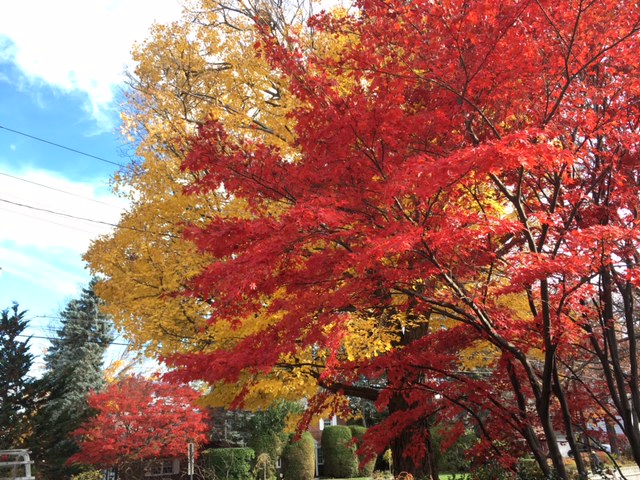
Japanese Maple, Binghamton, New York, November 6

Start to awaken.  Feel the peace.
Now, start to awaken a little more.  Stretch.  Go forth, without stress.


Day 8 of NaBloPoMo.