Showing posts with label books. Show all posts

Tuesday, October 8, 2024

By Some Other Author?

Imagine you are a female blogger.  Because you are a woman, you aren't allowed to blog.  So, if you want to, you have to have a man publish your blog posts - and he gets all the credit.  All the fame. Chances are, you would be forgotten by history.

By Any Other Name by Jodi Picoult takes a controversy that has been raging for hundreds of years - were Shakespeare's plays written by William Shakespeare, or by other persons (perhaps more than one) under his name - and bases a historical novel on this question.  

Most of the people suggested as the possible true authors of Shakespeare's plays are men, perhaps more than one man, but what if one or more were women?  Perhaps it was women, knowledgeable of the theater, who could not publish plays under their own name because that just wasn't done, but had to have them published by a man? The man, of course, got the credit, the fame, most of the money, and would be known forever as their author.  Or, maybe just one woman wrote some of those plays?

Now, what if one of this woman's descendants struggles here in modern day America as she tries to get her play, based on the life of her ancestor, performed?

That is the basic plot of By Any Other Name, the second novel by Jodi Picoult I've read.

First, a confession (please hold the hate mail and comments).  I had to read Shakespeare's plays in junior high and high school English.  I hated them. I dreaded them.  I couldn't understand the language.  I couldn't visualize the action.  As an adult, I've never sought them out, either to read or to watch a play, or to see a movie based on one of them.

It didn't matter which plays they were.  I remember I had to read The Taming of the Shrew,  Hamlet, Othello, Macbeth, and probably one of the historical plays like Richard III.  I remember none of them fondly.  It was a joyless slog for this person who loves to read and always has.

So, why would I even want to read this book? 

I took the chance because I absolutely loved the other Jodi Picoult book I read, Wish You Were Here.  Plus, I enjoy an occasional historical fiction book.

I was instantly absorbed into the book, but I also had some disappointments along the way.  Nevertheless, I gave it four stars out of five on Goodreads.

My observations:

1.  It was obvious Jodi Picoult put in many hours of research on Elizabethan England and modern theater.  I should note that Emilia Bassano Lanier, who Picoult posits as the woman who may have written several of Shakespeare's plays, was a real person who led a hard but fascinating life.  She has modern day descendants, some of whom may be living in Tennessee.  

I love extensively researched writing and Jodi Picoult put hours and hours of research into this book.  It shows, and perhaps that's why I was more drawn to the Emilia Bassano

2.  I loved the Emilia Bassano portions of the story, although I also thought the plot dragged with too much explanation occasionally. I was much less enthusiastic about the story of her descendant, Melina Green.  I especially felt that Green's dialogs discussing the sexism and racism of the modern theater did not flow naturally from context, but were just words put into the characters' mouths to express the author's opinions.  

I could not feel Green's personal struggles the same way as I did Bassano's, which included Bassano becoming, not by choice, the mistress of a much older man when she was 13.  In her 20's, after she became pregnant, a cousin forced into a marriage to a abusive man.  And then, there was the Plague that ended up killing about 25% of the population of London.

3.  I thought the modern day Melina Green's story ending was a bit too-good-to-be-true fairy tale-ish.  I would have been happier, in general, if the book had been shorter.

Despite the flaws, I would highly recommend this book, and I could see it being discussed in a high school English (or even history) class. 

So, am I now going to run out and read any Shakespeare? (Or, better yet, see one of his plays.  These were, after all, plays to be experienced live, not read?).  Right now, it's still ano, but one never knows.

Have you read this Picoult book?

Tuesday, July 9, 2024

Light Summer Reading 2024

I signed up for a reading challenge at our local library.  They do this every summer and all you need to do is report, by August 16 (the challenge started June 24) every book you've read.  No pressure and you don't even have to take books out of their library branch.  You just write down the title and author on a form they provide you on a paper form.

Nor, like some other libraries, do you have to challenge yourself by reading different types of books they specify. or keep track of how long you read each day.  I'm way past those kind of challenges. I just read what I want, when I want. 

There is a drawing at the end.  I won a prize several years back but now I enter because I'm reading anyway, so why not?

Considering that I've recently read books like James, by Percival Everett (excellent, and I highly recommend), my first two choices may surprise you.  They surprised me.

Last year, one of my summer reading selections was a YA (Young Adult) book called The Summer I Turned Pretty, by YA best selling author Jenny Han.  I had no idea that the book was an Amazon Prime series or part of a series that has sold over four million books.

But the book was addictive.  I couldn't tell you why, but the story appealed to me.  (I do know one reason, but then I'd have to place a Spoiler Alert on this post).  These types of books are not even close to my preferred genres (SF, dystopian, and yes, I will and have read good YA books in both).  I detested the name of the protagonist - her given name is Isabel but everyone calls her Belly.  It's a coming of age story - the summer Belly realizes she is no longer a child.

And yet, here I was racing to finish the book and staying up nights to read, which I normally don't do anymore.

Fast forward to this year.

I decided to read the second and third books of the series, It's Not Summer Without You and We'll Always Have Summer  These are best sellers, also, and follow Belly and other characters as they enter their college years and become young adults.

And again, I lost sleep because I couldn't put the books down.  Turns out I liked the second book.  The third one was a major disappointment.  And yet...I still couldn't put it down.

I don't know what ingredients author Jenny Han puts in her writing, but her books (and TV series) have been big successes.  Addictive, and they were for me, too.

So now that I've finished the trilogy, what's on my reading list?

I'm not going to read any more Jenny Han books at this point of time.  It's back to my normal reading habits.

I've started The Good Lord Bird, by James McBride, but a book I had on reserve, After Annie by Anna Quindlen, has come off reserve and I need to get going on that book, too. (Yes, I read more than one book at a time).  I know the latter book won't be light reading, but we'll see how it goes.

Doing any summer reading this year?

Thursday, May 2, 2024

First Quarter Reading - Non Fiction

This winter was the winter of non fiction, for the most part. And, sadly, these are books we may find so painful that they are slow going.  But they deserve our attention.

A lot of my first three months of this year were taken up by two non-fiction books.

1.  The Cost of Free Land:  Jews, Lakota and an American Inheritance, by Rebecca Clarren.  Every page of this book was packed with a history I had never fully learned in school, despite taking a couple of courses in college on the Indigenous peoples who once inhabited all the land we now call the United States of America.

Rebecca Clarren tells the story of her great-great-grandparents, the Sinykins, who fled early 20th century Russia and its anti antisemitism, to settle on land in South Dakota.  The 160 acres of land they were granted was land which had been taken from its original Indigenous inhabitants by means cruel and not surprising - a trail of broken treaties, deliberate starvation, and the forcing of the Indigenous people to abandon their culture and way of life.  Various European centers were given (or sold cheaply) the land for homesteading, including the Sinykins.

The Sinykins, and other Jews, had come out west fleeing oppression and seeking opportunity, only to benefit from the oppression of the former Indigenous inhabitants.  

Ms. Clarren asks: How does she deal with a legacy like that?  This book documents her journey.

Ms. Clarren's attempts to answer that question and learn more about her family's story and the Indigenous peoples it is intertwined with is well worth reading.

Rating:  Five out of five stars.

2. Prequel: An American Fight Against Fascism by Rachel Maddow.  This book is a chilling examination of how the Hitler government waged a well funded war of disinformation with the United States in the 1930's and 1940's, capturing the minds and loyalties of some of our elected officials, police chiefs, religious leaders, and famous, influential people. Our legal system failed in some spectacular ways.

I will state right here that no matter what your political leanings are, this is a history book you should read.  

The large cast of characters include Henry Ford, Charles Lindbergh and his wife Anne, Louisiana governor and later Senator Huey Long, the architect Phillip Johnson, Senator Burton Wheeler of Montana, and Congressman Hamilton Fish III.  There were also the common citizens, working under dangerous conditions, to expose what was happening.

When I finished reading this book, I felt like our country dodged one very large bullet - a bullet that may have led us into becoming an ally of Hitler, if not worse.  

And as for the relevance with today, I will leave that to you, dear reader, as this is not normally a political blog.  But again, no matter where you stand on the political spectrum, I believe this is a must read.

Rating:  Five out of five stars.

This month, I will be devoting myself to recovering from the Blogging from A to Z Challenge. My Reflections post will probably post on May 7.

Saturday, December 2, 2023

My Current Booklist

I have an Echo Dot and it has the most annoying habit of trying to recommend books to me.  I can't figure out how to turn it off.

In all my life, I have rarely needed book recommendations, especially once the Internet came into existence.  When I was younger, I would read the New York Times Book Review back when I used to buy the Sunday New York Times.  In the past few years, there is a free publication called Book Page I can get at some local libraries.

In the old days, I would have to either use the library reserve list, or buy, books I wanted that the library did not have readily available but I could still find reading material by physical browsing of the shelves.  I've spent many happy work lunch break hours in libraries. 

Then, e books came along.  While many have embraced them, I never had.  I just don't get the same experience with an ebook.  True, you can change the font size and true, you (with many ebooks) can press on words you don't know the meanings of, and get a definition.

But I can't fall into an ebook the way I can a physical book.  It's just not the same experience.

For a while, the pandemic cured me (or so I thought) of needing a physical book.  In the couple of months libraries closed here in New York State in the early days of Covid, I found refuge in ebooks. 

It helped tremendously when the New York (City) Public Library opened its ebook collection to residents of New York State (I believe the Brookyn Public Library also did this) and my iPad became my library.  The beauty of this system was that when the book was due, it disappeared.  No fines.

But now, I've gone full circle.  I want physical books again.  I still use the New York (City) Public Library but if my local library gets a book in when I am reading the ebook, I return the ebook.

Right now, I have these titles out as ebooks:  I have anywhere from 16 to 19 days left before they vanish.

Chain Gang All Stars by Nana Kwame Adjei-Brenyah.  This is a debut novel that takes place in a near future dystopia.  The author is from downstate New York and I'm OK with it as an ebook but I really wish I could have the physical book. I'm perhaps a quarter of the way through.

Prequel:  An American Fight Against Fascism by Rachel Maddow.  This is non fiction I was looking foward to reading, but I'm already struggling with reading it as an ebook.

The Cost of Free Land:  Jews, Lakota, and an American Inheritance by Rebecca Clarren.  This is a stunning book by a Jewish woman who grew up in rural South Dakota and what happened when she started to dig into her family's history of having fled pogroms in Eastern Europe only to collide with the Indige­nous peoples who had once lived on that same land.   I have a long way to go but I think I can manage with this as an ebook.

And, on the reserve list of ebooks:

Julia: A retelling of 1984 by Sandra Newman.  This is a retelling of this classic story from the point of view of a character who was never fully developed in the original.  This was authorized by the estate of 1984's author George Orwell.  I have some trepidation because I tried reading another book by Sandra Newman, The Country of Ice Cream Star and it was a Did Not Finish for me.

So, what happened today?  I found a physical copy of Julia at my local library.

I took it out.  I have three weeks and I know it probably won't be able to be renewed.  So I might stay on the ebook reserve list.

I can't read four books like this in the next 20 or so days, though.  So some decisions need to be made.

But Alexa isn't going to help me with those decisions. I don't want her blurting out unsolicited book recommendations when I ask her to set a timer or ask her when a certain football game will be on.  I really wish I could shut her up sometimes.

What do you do when books suddenly pile up on you?

Tuesday, October 3, 2023

Let Freedom Read

It's become a sad tradition on my blog.  I so wish it was an unnecessary tradition.

October 1-7 is Banned Book Week. 

It seems that every year, observing this week (which actually is needed each and every week of the year) becomes more and more important.  Our freedoms are slipping away.  We will lose them if we don't value them. 

This year, the theme is "Let Freedom Read".  I wish I could copy an email I received yesterday from the New York Public Library, written by author Judy Blume.  She said it so much more elegantly than I can.

Here is an explanation of some of the terms being used below.

Here is an infographic.  One of these sobering statistics is how much censorship has been on the rise.  Incidents have almost doubled between 2021 and 2022. (I apologize for the size of this infographic; I can't make it any bigger.  However, you can find the original of this and the one below at the American Library Association website. ) Or, one can only hope, at your own public library, where you may also find a display of banned books. 

At our local library, my spouse picked up one of the books from a display of books that have been banned:  The Call of the Wild, by Jack London.  He loved that book as a child (as did I).

I've read at least two other books that have been banned from time to time as part of my schooling:  Animal Farm by George Orwell, and The Catcher in the Rye by J.D. Salinger.  My son read another banned book as part of his schooling: The Giver, by Lois Lowry.

If you look at reasons books are challenged or banned, they will range widely, from the author's political beliefs, to violence, to descriptions of witchcraft, to profanity, to depictions of drug use.  

In 2022, Dr. Seuss Enterprises decided to no longer offer for publication six Dr. Seuss books.

Sometimes, all it takes is someone wondering if a library even has a book.

Take, for example, the example of the library in Bonners Ferry, Idaho.

I was so fortunate to have parents who did not control my reading.  They would take me to the library, or to a bookstore, and just stand by while I made my selections.  Never once did they try to change my mind.  They might discuss a book with me, but I was free to read it.

These are the top "most challenged" books, noting there is a big difference between challenged and banned (as explained in a link at the beginning of this post). 

People can challenge books in an effort to protect children (the largest group challenging are parents) from difficult ideas or situations but too many times it comes down to a desire to censor beliefs that run counter to certain groups' or powerful interests' beliefs.  But don't take it from me.

Quoting from the ALA's website:

"As Supreme Court Justice William J. Brennan, Jr., in Texas v. Johnson , said most eloquently:

If there is a bedrock principle underlying the First Amendment, it is that the government may not prohibit the expression of an idea simply because society finds the idea itself offensive or disagreeable.

If we are to continue to protect our First Amendment, we would do well to keep in mind these words of Noam Chomsky:

If we don't believe in freedom of expression for people we despise, we don't believe in it at all.

Or these words of Supreme Court Justice William O. Douglas (" The One Un-American Act." Nieman Reports , vol. 7, no. 1, Jan. 1953, p. 20):

Restriction of free thought and free speech is the most dangerous of all subversions. It is the one un-American act that could most easily defeat us."

Freedom of reading.  Freedom of thought.

Let Freedom Read.

Tuesday, April 11, 2023

Independent #AtoZChallenge

 Independent book stores are not common in the New York State county I live in.  When I moved here over 30 years ago, we had several.  They are all history now, although I think one may still be operating online, run by a retired librarian and her husband.  We have a couple of more recent ones, but, when I looked on Yelp for bookstores in my county, most of them listed weren't in my county. Some weren't even close to my county. 

Meanwhile, Greenville, South Carolina, population a bit over 70,000, has six independent bookstores.

Spouse and I visited two of them back in February.

M. Judson Booksellers and Camilla Kitchen in downtown Greenville calls themselves "A Modern Literary Hub in Downtown Greenville, South Carolina" and they are, with frequent author booksignings and lots of other community events.


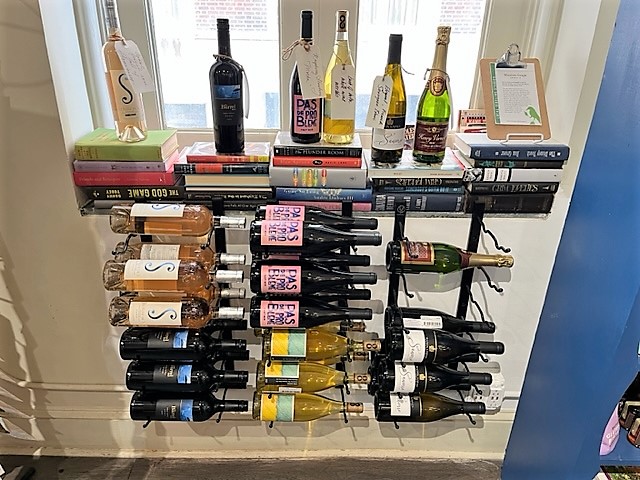
This is a sight you will never see in New York, despite our state being a leading wine producer (because bookstores and most other retail outlets can not sell wine - even New York wine. (climbing off soapbox).


Fiction Addiction is in a shopping center, and is smaller than M. Judson.  

While we browsed, we overheard a conversation with a frequent customer.  This store prides itself on picking the perfect book for its customers.  That's part of the beauty of frequenting local businesses.

Here are some other bookstores I've run across in South Carolina.  Sadly, the last one has closed.


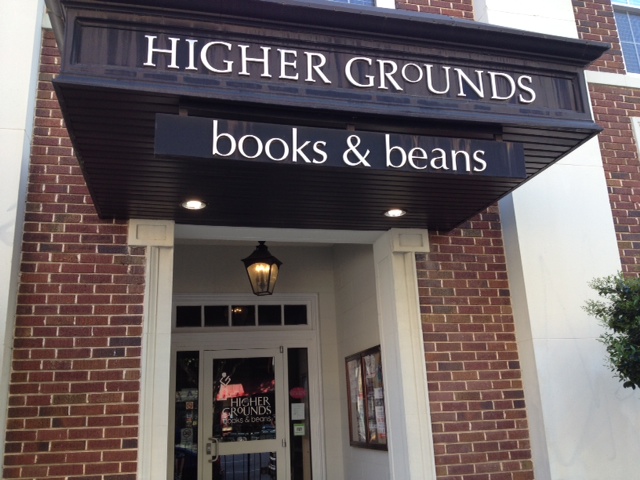
Higher Grounds in Columbia, South Carolina is a church outreach project, and their Facebook page seems to indicate this is more of a cafe than a bookstore.

Finally, let's pay tribute to A Very Little Bookstore, now closed, in Summerville, South Carolina.  It was a children's book store.  I read that it had flooded at one point, but I'm not sure that was the reason for it going out of business.  Their Facebook page has been taken down.


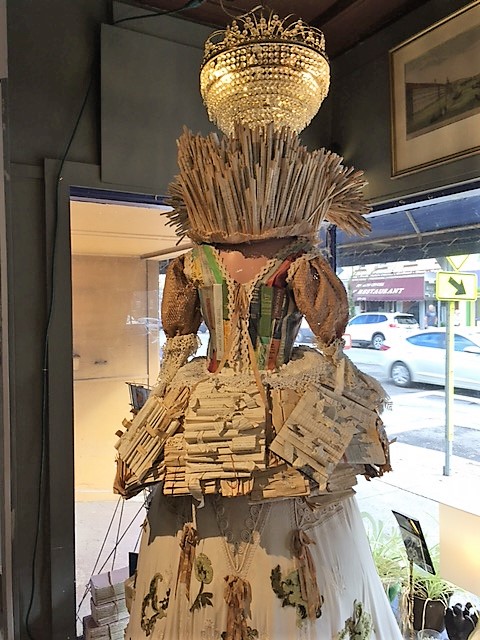
I loved its store window. 

I love reading.  I'm sorry the store didn't make it, because I filled my house with children's books once upon a time.

What is your favorite bookstore?

"I" day of the Blogging from A to Z Challenge. My theme:  Exploring South Carolina and the Eastern United States.

Tuesday, February 28, 2023

A Book and Its Cover

How do we choose books to read?  One way, consciously or not, is the cover.

Thinking of book covers makes me think of a post I wrote back in 2012 and reran in 2015.  It follows, with some edits.

Book covers bring back memories of the first author who I consciously fell in love with (his writing, not the author himself.)

When I was 10 years old and growing up in New York City, I broke my leg roller skating.  I was treated at a hospital in the Bronx (a borough of New York City).  I had to go back to the hospital periodically to see the doctors during my recovery.   On one visit, at the hospital gift store, one of my parents bought me a book to read.  I don't know how or why, but they picked "A Princess of Mars" by Edgar Rice Burroughs.

It changed my life.

I don't know how many young people have heard of Edgar Rice Burroughs.  Even in my day (this was in the early 60's) enough children may have known Edgar Rice Burroughs mainly through Tarzan movies.  Reruns of old Tarzan movies featuring Johnny Weissmuller were a staple of weekend movie afternoons on non-network local New York City channels.

But this book my parent bought me was something different.  The cover attracted me immediately - an exotically dressed woman in peril, with a muscular man, holding a sword, defending her.  Although the book started slowly, I quickly got into the story once the hero, John Carter, reached Mars.  I ended up devouring the other 10 books of the series over the next few years.  Then, I went on to other series written by Burroughs - the Venus books, many of the Tarzan books, one of the Pellucidar books, and a couple of his non-series books.

I loved those book covers on the Ballantine and Ace versions of the Martian books from the 1960's.  In doing research, I found that other Edgar Rice Burroughs books were graced with unforgettable covers.  They really wanted to make you buy and read the contents.    Even after I grew up, the tradition of spectacular book covers continued.

Here, Burroughs himself writes about his experiences with illustrations of his books.

I don't know how popular Edgar Rice Burroughs remains, and I haven't read one of his books in many years. 

If you are interested in reading the Martian (Barsoom) books of Edgar Rice Burroughs, or some of his other books in the public domain, they are available for free online.

Wednesday, February 8, 2023

My 2022 Library Valentine #WordlessWednesday

At least two of our local libraries have Valentine's Day giveaways, where they wrap books and you, the patron, can take one of the books home and keep it.

This was the display at my local library this year, and a post I wrote about their giveaways back in 2017. 

This is the book I picked last year.

To my surprise, when I opened the book, I discovered I already owned it.  I just had never read it.

To my greater surprise, it wasn't exactly the book I owned.  The book I own is on the left.  What I got as a gift is on the right.

Turns out that something rare had happened between the author and her publisher.  She was allowed a do-over, expanding the book,. She also edited or rewrote certain passages, something that was prompted by various book reviewers.

So, I now own two versions of this book called Orphan Train.   The topic has interested me, every since (back in the late 1970's) I met an older woman in Wichita, Kansas (we worked together for a time), who explained she had been a rider on an orphan train.  I don't know when but the last train was in 1929.  She must have been one of the last passengers.

She never gave me many details; her childhood was a painful time.   

Here's more information on the Orphan Trains.

Thank you, library, for this annual book giveaway.

Joining Sandee at Comedy Plus for her #WordlessWednesday.

Tuesday, December 13, 2022

Jolabokaflod

 Yes, I love my native United States.  But I sometimes wonder what kind of person I would have turned out to be if I had been born and raised somewhere else.

Like, perhaps, Iceland.

Who knows, but with all the times I dreamed of the midnight sun as a child, I may have had a previous life somewhere in the northlands.  

The 2017 Great American Eclipse, and its tie with sweet tea and Iceland.

There was last year's Postcard from Iceland, too.  

All I need to do to visit Iceland (now that COVID restrictions are a thing of the past, hopefully) is conquer my fear of flying (and spending too much money).

Of all the things that intrigue me about Iceland, about the most intriguing is the Jolabokaflod, the Christmas Book Flood.

I've known about the custom from various Facebook postings, but this blog post reminded me of it. 

Can I imagine a country where the holiday season begins with the arrival of the Bokatidindi (Book Bulletin), a catalog of every book published that year in the country?  Can a book lover like me even begin to imagine?  Maybe it's like the Sears catalogs of my youth but full of books instead of home goods and clothes?

This website discusses what happens next.  Basically, the custom is to have their main Christmas meal on Christmas Eve.  Along with the meal, they drink Malt og Appelsín (a soft drink that includes orangeade) and then it's time for gift giving.  Book gift giving, that is.  People give books to each other on Christmas Eve, and spend the evening (and maybe the rest of the year) reading their gifts.

I've read that 93% of the residents of Iceland read at least one book a year, and an Icelander averages 2.4 books a month.  I'm not sure what my count is, but I know several bloggers who read a lot more than I do.  Not only that, but I've read that one out of 10 Icelanders publish at least one book in their lifetimes.

Now, that's a country I can get into.

Can I imagine a Christmas Eve book exchange? 

Would you?

Saturday, December 10, 2022

Condensed Memories

Do you remember Readers Digest Condensed Books?

Earlier this week I had lunch with several women I work/used to work with.  One of them had a box on the curb in front of her house filled with books.

"Do you want them?" she asked.  I said yes and she seemed so happy I was taking them.  She knows how much I love to read.

Here's the box showing a couple of the books.

Yes, I was one of those who purchased these condensed books as a teen (back in the 1960's).  I have the box in my house now, wondering when I will look through this and recognize any of the books that I received during my subscription years.  I remember that reading some of the condensed versions led me to reading the full books.

I even found a list of books published in the series and their condensed books.

Does Readers Digest even publish these anymore?

They do, although they don't call them Condensed Books anymore; they call them Select Editions.

I'm wondering if my friend was giving them away because she found they couldn't be donated to a library book sale.  I know our local library booksales don't accept them.  It's strange in a way, because I remember these books being quite popular at one time.

Which brings me to my Thursday post, where I showed a bookstore in a small town in my part of New York State and the book Christmas trees they have in their window.  One tree included some books whose pages were carved into art.  

I normally wouldn't ever want to see a book carved up into "art" but it got me to thinking of the thousands of no longer wanted books out there. Better to make them into art, I'm thinking, rather than into trash.  There are places you can donate them to (noting I haven't verified any of the article I am linking to, but I'm sure a lot of books end up in landfills eventually.

When I'm done with these books I hope that isn't their fate.

They bring back too many condensed memories for me.  I wish there was a good way to send them on to someone who would appreciate a condensed book or two.

Now to find time to add them to my to be read pile.

Thursday, December 8, 2022

Indie Book Trees

 Let's take another quick visit to Owego, New York, once named "The coolest small town in America".

Since 1976, Owego has had an indie bookstore, Riverow Books.  This is one of their traditions:

Christmas trees made out of books!

I hadn't been there since COVID, so I don't know how new this third tree is.  The items in the middle of the tree are books that have been cut to make works of art.  It's hard to see, but I didn't have a good place to set up the photo as there were people around and I didn't want to get them in the photo.

Next spring, Owego will be even cooler because a second bookstore is opening in the village.  It will be called Spellbound Books.

Imagine...a village of just around 3900 people having two indie bookstores.

The town Owego is in (a town in New York is a subdivision of a county), also called Owego, has around 19,000 people, incidentally.

Riverow, (and Owego) incidentally, are well worth the visit. 


Tuesday, December 6, 2022

The Missing Hearts

This past week, I finished a book called "Our Missing Hearts" by Celeste Ng.

This is the first novel by Ms. Ng I've read.  Unlike her other two novels, this is a dystopian novel.  Or perhaps not quite dystopian, because almost everything in this book has happened before, in one form or another.  This happens to be a genre I enjoy but this book hit a little bit too close to home.  It was chilling - a near future United States that is totally believable.

Briefly, this is the plot: Bird (a nickname; his given name is Noah) is a 12 year old boy with an Asian mother and a white father.  He lives with his father in a future United States which was transformed by a terrible economic crisis fifteen years before, called simply The Crisis.  China and South Korea are blamed (correctly or not) for The Crisis and eventually, anyone who is, or looks like, they are of Asian origin bore the brunt of this popular belief. 

PACT (the Preserving American Culture and Traditions Act) is passed by Congress in a bipartisan vote and signed into law 10 years before the events in this novel begins.  Among other things, PACT gives the government the right to remove children from any household not deemed patriotic enough.  Books are censored, eventually removed from libraries, and pulped.  The pulp is then used to manufacture toilet paper.  One such book is a book of poetry called "Our Missing Hearts" written by Bird's mother, the daughter of Chinese immigrants, which inspires those who engage in small acts of rebellion against PACT.

To prevent Bird from being taken, Bird's mother left the family and went into hiding three years before the novel begins.  Bird's father, protectively, denounces his wife and tells his son to forget his mother.  But then a communication comes in the mail....

A memory came back to me.

In 2020, my spouse and I were supposed to go to my 50th high school reunion. Well, not all of it.  Not the expensive dinner dance that would have taken place in Manhattan (also necessitating a hotel stay). But rather, I looked forward to an Alumni Day at our school.   I ha not set foot in my high school since my graduation, nor had I gone to previous reunions.  No matter.  Thanks to COVID, the 2020 reunion was cancelled.  

There were a handful of people I wanted to see again.  One of them was a woman I shared a locker with for part of my high school years.  We remained in touch during college and for a couple of years after we graduated.  Gradually, we lost touch.

I can't remember what initially attracted us to start a friendship.  We came from totally different backgrounds.  Me - Jewish, with grandparents from Belarus and from Austria-Hungary.  My locker mate was the daughter of Chinese immigrants.  My high school, back then, had a lot of Asian students.  It has many more now.

Today (based on statistics I found online) my high school is about 23% white and 79% "minority".  What would the framers of PACT had felt about that?

I must confess to this: When I started hearing about the large uptick in hate crimes against Asians in 2021, it was just part of the flood of news all of us are subject to.  It's overwhelming, the news, if you pay attention to each and every thing. But then, something caught in my mind.  It was wrong for me to ignore what was happening.

My thoughts turned to my former high school locker mate and college pen pal more than once, as I saw videos of elderly Asians attacked on the street, some fatally.  If she is alive today, my friend has closed in on 70, like me.  If her parents are still alive, they are probably in their 90's.  All of them are vulnerable in a way that I can not fully understand because my experience is not their experience. 

Did my lockermate have children?  Grandchildren?  What has been their experience?

I walk down the street and my face does not provoke hate.  Others walk down the street and face daily harassment or worse.  

Under PACT, all of that would have happening openly, with no recourse.

(I highly recommend Ng's novel, incidentally, although it was hard for me to get through some parts of it, and I had to put the book aside for several days more than once.)

Are we on our way to a similar future United States?  It's up to us.

Tuesday, November 29, 2022

Is There Such a Thing As Too Much Reading?

Too many books, too little time.

I sometimes feel as if I've read too many books recently.  Some of them are blurring together There are so many good books out there and I have the time.  

Let me share three with you.

I've blogged before that book reviews are not my strength.  They bring me back to nightmarish school days when I had to write (gulp) book reports.  What can I say?

There are several books that stand out, though, and I am nominating them for my personal "best of 2022" list.

1.  Tomorrow, Tomorrow and Tomorrow by Gabrielle Zevin.  I've read three of her young adult books and this is the first of her adult books I've read.  It's a story of two gamers who meet as children and their subsequent life stories, together and apart. Zevin is an avid gamer and I am not.  But, from the very first sentence, I was drawn into the book.  It wasn't boring for a minute and several parts of it (no spoilers!) left me gutted - I cared about the two main characters and the other major characters so much.

2.  Sea of Tranquility by Emily St. John Mandel.  This is my third of her books I've read.  The first, Station Eleven (set in the aftermath of a flu that killed much of the population of Earth), I consider one of the best books I've ever read.  The second book, The Glass Hotel, was a quick DNF (did not finish) for me.  I just couldn't get into it, despite all the rave reviews.

Although it is connected to The Glass Hotel, you don't need to have read (or liked) The Glass Hotel. I'm so glad I went ahead and gave Sea a try.

Sea of Tranquility isn't a pandemic book like Station Eleven, but I don't think it could have been written without the COVID experience we all had, in our own way, back in 2020.

This book spans over 300 years, and weaves back and forth in time. Only great authors can pull something like this off, and Mandel is a great author.

3.  This final book was one I read for the first time several months ago.  It deserved a reread because it was one of those books I just couldn't fully absorb the first time around.  The fact that I read it as an e-book didn't help.  I've never gotten the hang of reading ebooks, especially on the platform the New York [City] public library uses. I don't fall into their worlds the same way as I do with a well written physical book.

There's just something special about physical books, and when I saw this final book at the local library, I immediately took it out.

How High We Go In the Dark by Sequoia Nagamatsu, was a debut book and I never would have known it - the writing was that good.  Where do I even begin?

The body of a young girl who died about 30,000 years ago in what is now Siberia is found, uncovered thanks to global warming.  Along with the thawed body is a once dormant virus that infects the researchers investigating the find, and from there, it makes its way to the remainder of the world.

This plague isn't COVID, but is a virus unlike any we have experienced up to now.  It initially seems to strike children, and this virus causes organs to change into other organs.  Death is slow and extremely painful.  There is no cure.  Some lucky children can get organ transplants or get into experimental programs.  The death toll soars.

From this beginning, in various somewhat interconnected chapters introducing various characters and following some of them through time, the book explores themes such as how people adapt to the unthinkable. Culture changes, too.

What I also enjoyed was that a lot of the related stories took place in a non-Western culture.

Were there disappointing books?  Yes, several, and perhaps blogging about them will help me decide if they are worth another chance. (One I did finish; another one I am on the verge of abandoning midway through). Just not today.

Read any good books lately?


Tuesday, September 20, 2022

Banned Books Week 2022

For those of us who love to read, we know we live in dangerous times.  The forces of censorship seem to grow stronger every day.  In 2022, we live in a state of constant crisis, which is why I try to keep world events out of my blog.  I strive to bring some peace and beauty to my readers.  But it's hard.  

 In the United States, everything has become political.  We are all, it seems, in crisis mode, with "breaking news" appearing on our television screens multiple times a day.  We are even questioning some of our core values, which isn't necessarily a bad thing.  

But censorship is a different thing.  This week is Banned Books Week, running from September 18-24.

There are increasing calls for books to be banned from various venues including:  Schools. Bookstores. Libraries.

Take, for example the continuing situation in Idaho at the Boundary County Library in Bonners Ferry.  Five years ago, it was awarded the title "Best Small Town Library in America".

Or, take  what happened earlier this year at the Vinton, Iowa public library. 

Banned Books Week has never been just about words on a page (or an ebook screen).  Those who want to exercise absolute mind control over populations know that.

The Banned Books Week's website says:

"By focusing on efforts across the country to remove or restrict access to books, Banned Books Week draws national attention to the harms of censorship. The ALA Office for Intellectual Freedom (OIF) compiles lists of challenged books as reported in the media and submitted by librarians and teachers across the country."


The Top 10 Challenged Books of 2021 are listed on the site.  Most of these books may not be familiar to you.

But I bet this list contains books that many of us are familiar with.

  • The Color Purple by Alice Walker.
  • The Great Gatsby by F. Scott Fitzgerald.
  • I Know Why the Caged Bird Sings by Maya Angelou.
  • Lord of the Flies by William Golding.
  • Of Mice and Men by John Steinbeck.
  • One Flew Over the Cuckoo's Nest by Ken Kesey.
  • To Kill a Mockingbird by Harper Lee.

Here's another way to look at it:  46 of the top 100 books of the 20th century have had efforts to ban them.  On the list below, the highlighted books are the ones people have tried to get banned. (Sorry, these are from pictures I took so are a little hard to read).


It can be scary to resist these forces that want to control our reading, but people have resisted. Some who feel that certain books don't belong in school or public libraries use the argument that people can always buy those books.  But, what if they don't have money?  Or, worse yet, if banning books from libraries becomes OK, isn't pressuring bookstores just around the corner?  Or, if publishers "voluntarily" pull certain books off the shelves?

Wait-it's already happened. 

Censorship, even "self-censorship"  Is. Just. Plain. Wrong.

 I ask myself, will I have the courage if censorship forces come to a library or bookstore near me?  do from time to time?  Will I be reading banned books in public on the lawn of my local library like some in Bonners Ferry, Idaho, have done?

But, if people don't resist, what will our future look like?

Tuesday, August 23, 2022

Facing the Future by Remembering The Past

A heads up: this post includes some discussion of a book that takes a deep dive into COVID's affect on those who experienced the pandemic, especially in the second part of the book.  It may hit too close to home for some.  The research this author did for this book, incidentally, is outstanding. So onward to my thoughts:

A few days ago, I finished reading a book by Jodi Picault called "Wish You Were Here". It's my first book by her, and if this is like her other works, it won't be my last. (I hope the next one doesn't disappoint - I've had that happen with prolific writers).  

In a nutshell (because if I revealed the plot, it would have to contain a major spoiler), two 30-somethings, Diana and Finn, have their entire lives planned.  They will marry, buy a house, get a particular breed of dog, have two children, and visit a list of places.  Diana is an associate art specialist at a major New York City auction house.  Finn is a surgical resident at a major Manhattan hospital. 

Their careers are both on track.

Diana and Finn have purchased tickets to visit the Galapagos Islands, where Diana suspects that Finn will propose to her. It's the trip of their lifetimes.  It took them four years to save up.  They are supposed to leave in mid-March, 2020.

And then....COVID.  Everything changes, and the book is an examination of life during the first months of the pandemic from several different angles.  The book, for me, was a wrenching, emotional experience.

I had forgotten so much about those months.  Perhaps we all have, in a kind of mutually agreed on amnesia.  We don't want to remember.  We think, perhaps, that forgetting will make it easier to move on.  Or maybe we still deny it never happened.  Denial can be a type of forgetting, too.

But we need to look inward and to document our experiences.  We should ask ourselves, in that review, if our actions are making the world, or at least our neighborhood, a better place.

Are we bringing happiness to others?  Do our words, our writing, our photography, our volunteer work, our paid work, bring meaning to us?  Joy, or another positive thing, perhaps, to others?

This book stayed with me after I turned the last page. I stayed in its world.  As harrowing as what was presented could be, I didn't want to let go.

Those books are the best kinds of books.

But other things happened while I was reading the book.

Hydrangeas, Ross Park, Binghamton, 8-20-22

While I was reading the book, I read a blog post by a fellow midlife (or later) blogger, Laura, who has written candidly on her blog about various challenges in her life.  She considers some of her health challenges a gift, teaching her to look at others with compassion.  One of her latest posts bluntly discusses "What It's Like to Age Faster than my Friends".

Here is the blog post, and I invite all my readers to read and ponder it.

It seems to me (and many other people I've read) that we in the United States have become more selfish.  Less caring of our neighbors and community.  Some have turned to social media with posts and thoughts that will terrify you.

Finally, a man I went to high school with, the life partner of a friend of many years, and a man who fought his years long battle with cancer with grace and courage, would have turned 69 on Sunday.  But he passed away recently, so, instead, his birthday was marked with remembering the good man he was.

We are all granted a number, the number of breaths we will take in our individual gardens of life.  Most of us don't know that number.  But some of us do. I have been blessed by a lifetime longer than that of many people on this Earth, including my mother, and several "in real life" friends who passed in their 50's and 60's.  In a couple of years, I will be as old as my father was.  

Both my parents passed suddenly.  Here one day and gone the next. Both had health challenges that impacted their life spans.

So what am I doing with the years and health I've been blessed with?  Have I tended my garden of life?  Or is it getting overgrown with weeds, drooping in a drought brought on by not enough of the rain called self love?

We live in perilous times.  Anxious times.  But that makes self care, and finding meaning, even more important.

It may be time to reexamine our lives once again, and remember what we've been through in the pandemic times.

If we forget the past, we won't have a roadmap to the future.  History teaches us that without a roadmap, things never end well.  

What road will we choose?

Thursday, July 21, 2022

The Boundaries of Libraries

I wish I could post pictures of butterflies or daylilies today.

OK, just one.  I'll post one, the Citrus Kick I bought last week. 

But today, I have to discuss something more serious than flowers or daylilies.

Our local library is running two adult reading programs. One, which all the county libraries are participating in, involves having a card stamped each time you visit a library.  The other, only for customers of Your Home Library in Johnson City, New York, involves reading a minimum of six books between late June and mid August.  I'm up to four, so I'm sure I'll make the reading deadline.

You don't have to pay me to read.  Back when I worked in downtown Binghamton, New York, I was in walking distance of the public library, and I would go there two or three times a week.  The library has a small flower garden with a covered picnic table and several benches and tables.  Since COVID, I was only in that garden once, to take some pictures.

When I was young, I wanted to be a bookmobile librarian.  I grew up in New York City and had access to one of the greatest library systems in the United States.  I was fortunate.  My parents allowed me to read whatever book I wanted. As an adult, I explored becoming a librarian when I lived briefly in Iowa.

In general, librarians are some of the most awesome people you'd ever want to meet.  They have been on the front lines of fighting against censorship for many years, but now, they are being tested like almost never before.

There's always been book banning and censorship, but it is reaching new levels.

I have a Facebook friend, someone I have never met, but I have read her blog for several years.  She lives in the Bonners Ferry, Idaho area (she writes about this town in her blog, but otherwise I am not revealing any personal information or linking to her blog).

Bonners Ferry. Idaho, a small town of about 2,639 people, was named after Bonners Ferry, operated by one Edwin Bonner.  His ferry was used to transport men and mules to the Canadian Gold Rushes of the 1870's. Its library, the Boundary County library, was once named "The Best Small Library in America". 

The Best Small Library in America is being besieged. The people doing it think they are doing right by their children and their beliefs.  But the situation is spiraling into harassment and possible violence.

If you read the library's Facebook page, you will see postings that may well alarm you, if you believe in free speech and expression.  The Spokane, Washington newspaper also featured an opinion piece on this situation this past Sunday. I am not linking to this directly, because I suspect Blogger has become sensitive to certain content not rated G or PG, but you can easily do a search engine search for that and the Boundary County library.  The opinion piece is also posted on the Facebook page.

The situation has a lot of detail, and I think it would be better to read it directly from the sources.

A regular meeting today of the Board of Trustees, meantime, was cancelled "in the interest of public safety".  The reason was "due to an increase in harassing behavior, derogative accusations, and a purported threat of violence".

I am thousands of miles from Idaho. My Home Library should be safe.  Why should I care?

Because if what is happening to the Boundary County library hasn't come to a library (or bookstore) near you yet, it may well be on its way.  What is happening in Idaho is happening elsewhere.  People are on edge.  People are fearful their liberties are being taken away.  Librarians are facing unceasing pressure, and it's only getting worse.  Communities are being divided.

It isn't just Idaho.  Here's another library, in Vinton, Iowa, facing pressure.

While I'm on the subject, it would also be a good time to mention that Banned Books Week isn't that far off - this year it will be September 18-24.  To quote from the ALA website:

"Books unite us. Books encourage boundless exploration and allow readers to spread their wings. Stories give flight to new ideas and perspectives. Reading—especially books that set us free—expands our worldview. Censorship, on the other hand, locks away our freedom and divides us from humanity in our own cages."

Our country is going to have to make a choice sooner rather than later. 

The alarms are ringing.  Will the American public respond?  Will they turn out and show their support and help libraries resist this pressure?

Tuesday, March 29, 2022

An Outlawed Disappointment

A week or so ago, I picked a book in a St. Patrick's Day draw at a local library.  The book I chose, along with several others, was wrapped and only had a tag identifying the genre, and a quote from the book.

The genre was given as "historical fiction" and the quote was "Knowledge can be very valuable...but only if people want it.  If they don't, it can be worse than useless."

The luck of the draw gave me a book to read called "Outlawed" by Anna North.  Because my next month is taken up with the Blogging from A to Z Challenge, I wanted to review the book.  True, I'm a bit less than halfway through the book, but I'm ready.

I don't know what to make of the book, so let me blog about it a little.

First, it isn't historical fiction.  It takes place in an alternate history.  In this history, the United States (and maybe the world) suffered a terrible flu in the 1830's, which killed off most of the population.  The United States crumbled, independent cities and towns arose,  and the dominant religion became a type of Christianity where the Baby Jesus was worshiped after one Mother Mary had a vision where Baby Jesus offered help to end the pandemic.  The Bible was supplemented by a work by "Burton", which was in everyone's home.

The role of women, by the 1890's (when the story takes place) has become one of reproduction and not much else.  (Given the need to repopulate, that might not be a surprise.) Women are married off in their teens.  If they don't become pregnant within a year or so, the unlucky women become outcasts.  If some one becomes ill, if a woman miscarries, if a baby is born with defects, the barren woman can be blamed, and can be executed.  Or, if more fortunate, driven out of town to die. 

At best, a barren woman can hope to join a convent, where she will be (relatively) safe.  Maybe.

I was eager to read more of the book.  Historically, barren women had not had an easy time of it.

The book centers around such a woman.  Ada, daughter of a midwife, wants to follow in her mother's footsteps.  Instead, she is married off at 17, doesn't become pregnant, and suddenly is fighting for her future as a barren woman.  She joins a convent, but ends up dissatisfied and goes off to join a gang the Mother Superior tells her about.

The opening sentence of the book grabs you:  "In the year of our Lord 1894 I became an outlaw".  There are flashes of great writing in this book, like the quote that chose me to pick this. (I don't own the book, by the way.  I have to return it in another two weeks.)

But then, after a few chapters, I started thinking that the novel has lost its way.  I wonder if part of the problem is that it tried to be too much - a dystopia, a pandemic book, an alternate history, an LGBTQ+ novel, a Western.

The best parts of the book describe Western landscapes and elements of skills a cowboy/cowgirl must master.  But the rest?  I haven't quite given up on it but I have a feeling things aren't going to improve.

It's too bad.  This could have been so fresh, so powerful.  

I don't think it's going to get better.  I hope I'm wrong.

But I don't mind.  That draw introduced me to a new genre: the alternate history Western.

Have you ever been disappointed by a book?

Tuesday, March 22, 2022

The St. Patrick's Day Mystery Luck of the Draw

We are fortunate here, where I live in the Southern Tier of New York, to have several local libraries to choose from.  My library card allows me to use libraries in a four county area, but I like to stay local.  Within what I consider local, there are four libraries I can visit.  And I do.

A library visit can be an adventure.  You never know what you might find, be it a book you want to read, or a little mystery.

Last week, at the library in Vestal, New York, we saw this display.

The sign said:

Luck of the Draw

The Library Leprechaun is loose.
He has hidden these titles from view.
While all appears golden and glittery,
some books may be sad, filled with misery.
Will you take a chance and hope that you're lucky?
Don't blame us if your book is quite yucky.
 
The tags gave only the genre and a quote from the book.  Based on this quote, I chose this book.  The flip side of the tag above said my mystery book was "historical fiction".

I took my chances and this is what I got.  This book isn't mine to keep, but it is one I never would have taken out if it wasn't for the Luck of the Draw.  I only have one slight quibble, which is that (after looking the book up on Goodreads) this isn't historical fiction.  It's more something taking place in an alternate history, which is, fortunately, a genre I enjoy.

Luck?

Once I finish my current book, we'll see if this is good, or yucky.

Have you ever taken a chance on a book?

Saturday, February 26, 2022

Two Stories One Reality

Painting with words makes a static printed page come alive.

A great author draws you into a story with a few well chosen words, and keeps you in the world he or she has drawn.  You never want to leave, as you read on.  At the end of the book, you feel a little sad, and a part of you remains in that world for hours, maybe days.

When that world intersects with reality, you enter a whole other dimension.

I've been reading a book called "All The Light We Cannot See" by Anthony Doerr.  It's the second book of his I have read.  The first, "Cloud Cuckoo Land" is now on my personal list of "Best books I have ever read".  I strongly suspect "All The Light We Cannot See" will be joining it.

"All The Light We Cannot See" is a story of two children growing up in 30's and early 40's Europe. Marie-Laure lives in Paris and lost her sight at age six.  She is being raised by her father, who is a locksmith working at the Museum of Natural History.  When the Nazis breach Paris, father and daughter flee to the French city of Saint-Malo, where an uncle of her father lives.  Meanwhile...

In Germany, orphaned siblings Werner Pfennig and his younger sister Jutta grow up in an orphanage. Their father, a miner, died years ago in the mines.  Boys in the orphanage all share a common fate - they leave the orphanage at 15 to work in the mines.  But Werner has a special talent for radio electronics, and the Nazis send him to a special school for training instead.  Eventually, he joins the military and is stationed in Saint-Malo.

I know the lives of Marie-Laure and Werner will intersect, but how, I do not yet know.

What I do know is that Anthony Doerr is one of the most talented word painting author I have ever read.  It was surreal, reading his description of people fleeing Paris in advance of the Nazis, because as I was reading the passages, the TV was showing coverage of the Russians invading Ukraine.  Civilians packed train stations trying to get out of the country.  Many abandoned their cars to walk because driving was hopeless. 

The fleeing on TV, the fleeing in the book, all identical, all merging into one terrifying reality.  Seeing it live, you feel like this author was there on the scene, in Paris, in Saint-Malo. Only the names and nationalities of the people have changed.

It could be anyone.  It could have been you or me.

A bit later in the book (it weaves back and forth in time) the shelling of Saint-Malo is described.  Allow me to share this passage with you:

"Artillery has stopped for the moment, and the predawn fires inside the walls [of the city of Saint-Malo] take on a steady middle life, an adulthood.  The western edge of the city has become a holocaust of crimson and carmine... The largest has curdled into a pillar like the cloud of tephra and ash and steam that billows atop an erupting volcano.  From afar, the smoke appears strangely solid, as though carved from luminous wood."

Will this be the fate of cities in Ukraine?

Two stories, over 70 years apart, but one horrifying reality. 

All to satisfy the ambitions of one man.

Just like all those years ago....

Thursday, December 30, 2021

My 2021 Reading List

I love reading.  I always have.  Now, as I approach the age of 70, I read but I seem to be so distracted that the day slips away, and I find I spend more and more with magazines and Internet reads.

It isn't for lack of opportunity.  I own many books.  I also take books out from our local library, and hve ebooks on my Kindle. (I way prefer physical books, however.)  I also regularly take out e-books from the New York (City) public library, which, thanks to the pandemic, I have access to as a New York State resident.

What I decided to do this last week of December is compile a list of books read, or books I started and did not finish, for whatever reason.  I've included reviews  (some taken from a blog post I wrote in July of this year, and shortened):  I've assigned "stars" on a scale of one to five.

Razorblade Tears by S.A. Cosby.  I generally do not get into thrillers, but this book had so many good reviews, I decided to pick it up.  It's a harrowing book, but I am so glad I read it.

Two ex-cons, one black, the other white, team up to find the killer(s) of their sons, who were married to each other.  Both the fathers had rejected their gay sons,  and are propelled both by the need for vengeance and their guilt over how they treated their sons.   There is blood and violence, all of which rings true.  Be forewarned!. There's not much more I can say without spoiler alerts.   The plotting and the writing are both first class.

Five Stars.

The Auschwitz Photographer - The Forgotten Story of the World War II Prisoner Who Documented Thousands of Lost Souls by Luca Crippa and Maurizio Onnis   This is the true story of photographer Wilhelm Brasse, a Polish/Aryan gentile who refused to swear allegiance to the Nazis after they conquered Poland. He was deported to Auschwitz-Birkenau in 1939 and spent the rest of the war as a prisoner.  Because of his background as a professional photographer, the SS chose him to take intake photos of the prisoners. He was forced to take other types of photos, too, and we are not spared the details.

As the war ended, Brasse was ordered to burn the photos he took. He started to, but changed his mind as a final act of defiance.  We have him to thank for many of the Auschwitz photos that survived the war.

Five Stars. 

Klara and the Sun by Kazuo Ishiguro. 

Dystopian literature is one of my preferred genres.  I had already read Ishiguro's Never Let Me Go, a chilling story of an alternate present where human clones are bred to be used for organ donations. That book has never let me go - like all good books, it continues to echo in my mind from time to time.  Klara does not echo in the same way.  It is a deceptively simple story of a solar powered AF (Artificial Friend) who is purchased as the companion of a girl who has been genetically modified to increase her intelligence, and is slowly dying as a result.

Don't be fooled.  This is not a simple story and Klara is far from a simple AF.  Ishiguro provides the exact amount of information at the exact right time.

Five Stars 

Zero Fail, The Rise and Fall of the Secret Service" by Carol Leonnig. The United States' Secret Service is tasked with many duties, the most important of which is the 24 hour day protection of the President and Vice-President of the United States and his/her family.  Carol Leonnig, an investigative journalist with over 20 years experience, wrote a well documented (and scary) book of triumphs and failures taking place mainly from the Kennedy administration to right after the end of the Trump administration.  

You learn a lot about our various Presidents.  It's not always pretty.

Five Stars

The Kitchen Front by Jennifer Ryan tells the story of four women competing in a British cooking contest in 1942.  The prize: being a co-host for the BBC's cooking show, The Kitchen Front.  Their task?  Create the best edible recipes with food readily available in the food rationing system.  The contest is fictional but the radio show was real.  I loved the historical details and the strong female characters, which is why I gave it the rating I did.  But I also feel the book fell short in character development and the ending was somewhat unlikely.

Four Stars

The Silence of the Girls by Pat Barker.  This is a retelling of Homer's The Iliad from the point of view of a female character, Briseis, a Trojan queen taken captive and enslaved when the Greeks take her city and sack it.   I don't read much historical fiction but this intrigued me because I have never read The Iliad. 

On the whole, the book was well written. However, the British slang threw me out of the story more than once (minor quibble - certainly the soldiers couldn't speak in Greek for the English audience).  Just yesterday, I found the sequel in the library and took it out.

Four Stars. 

The Forest of Hands and Teeth, by Carrie Ryan.  I enjoy dystopian literature and (some) zombie literature.  I love a good zombie apocalypse, and looked forward to a good read.  The book disappointed. Stilted writing and one of the weirdest love triangles I've ever run across in dystopian young adult literature ruined the book, although I did finish it.   I won't be seeking out the sequels.

The End of Men by Christa Sweeney-Baird.  This book was written not long before before the COVID-19 pandemic.  So, one could compare and contrast the reactions to the pandemic in the book (a virus that kills only males, and kills most of them) to what happened "in our "2020 and beyond" reality. The book is presented to us as written by an (initially) unknown author some years after the pandemic struck, telling the story of various survivors.

The book also ponders many questions, some of which we will need to answer for ourselves as we move towards our future.

Five Stars.

She Who Became the Sun by Shelley Parker-Chan 

This started out great, but after about 75 pages, I just couldn't get into it anymore.  A Did Not Finish.

Libertie by Kaitlyn Greenidge

Similar to She Who Became the Sun, it started out great, and then, it wasn't. However, I feel that I may have failed the book.  I may give it another try in 2022.   Another Did Not Finish, for now.

These are the books I am currently reading.

Cloud Cuckoo Land by Anthony Doerr (just started the other day).  So far, I'm finding the several interwoven stories interesting.

The Dressmakers of Auschwitz by Lucy Adlington.   The author did not start out intending to write this book, but found the story while doing research on fashion and was fortunate enough to be able to interview the last surviving dressmakers.  What I love is that this is the first comprehensive look I've found of the daily life of women in a concentration camp. It's a slow read - lots of detail. Well worth your time.  This is shaping up as a Five Star read.

The Bird Way - A New Look at How Birds Talk, Work, Play, Parent, by Jennifer Ackerman. I've read this on and off.  My spouse may read this more than I will.

There's more, but I don't quite remember.

So, do I try to make a New Years's Resolution to read more?  No. I haven't done resolutions in years. But I need to go back to my roots, and start reading more in 2022.

Are you an avid reader?  What were some of your favorite reads? (If you blogged an end of year reading post, please feel welcome to drop a link to it.)