One hundred years ago today, my father was born.
July 14, 1914. The world is on the brink of World War I, going through a series of crises, but no one knows how close to war the world is yet. My father is too young to know. He certainly doesn't know that the life expectancy for a male born in 1914 is only 52 years. Or that the leading causes of death in 1914 included tuberculosis, influenza, and diarrhea. Or that his one daughter would use something called the "Internet" one day to blog, and to pay tribute to him.
My father was born and grew up in Brooklyn, in a neighborhood called Brownsville. My grandfather owned a candy store, which he ran with the help of his wife, my grandmother, and his six children.
In the 1930's, my father's mother died, from complications of high blood pressure, an illness so easily treated today. My father ended up quitting high school after two years.
He doesn't have too much of an Internet presence, my father, but there are a couple of things I can find. I looked at his record in the 1940 census, still living at home with his father and several siblings. 1942, his enlistment record in the United States Army, where his term of enlistment was for the duration of World War II "plus six months", show him as "single with dependents". I suspect one of the dependents was his younger brother, the only sibling still alive today.
The military experience shaped his life. For the first time, he was out of Brooklyn. He saw the South. He saw India. He would sometimes tell me stories about his time in India as bedtime stories.
My father didn't make it to the end of the war. He suffered a head injury and was flown back to the States. He was given an honorable discharge but suffered the aftereffects of that injury for the rest of his life.
After the war, my father married. When I was 12, my mother died, and my father raised me to adulthood as a single father in his Bronx apartment in a city housing project.
When his last sister died, in the mid 2000's, the funeral procession didn't go directly to the cemetery. It wound through Brooklyn, going through some neighborhoods before it got on the highway. I wondered where we were going and why. It didn't occur to me at the time that we were going near to where where she, and my father, had grown up. One final tribute. My father had died almost twenty years before.
I owe a lot to my father and the simple, everyday lessons he taught me.
He did what he could the best he knew how. He ended his life in
Brooklyn, in the same facility where his own father spent his last days.
I am participating in NaBloPoMo, a monthly blogging challenge. This month's theme has been "Decades". I haven't been following the theme much, but it really got me to thinking how much our world has changed in the 100 years since my father was born.
And, how much the world has stayed the same.
Happy birthday wherever you are, Dad.
Monday, July 14, 2014


Sunday, July 13, 2014
Civil War Sunday - The Fort Circle
An urban greenbelt. The United States Civil War. Wildflowers. Hiking. Dog parks. Sites full of trash. Even a community garden.
Could anyone in 1864 have foreseen what all of these would have in common?
Let's step back in time a minute.
The Union's capital had been in danger since the Civil War began in 1861. Quoting from the National Park Service website:
It's hard for me, a citizen of 2014, to fully understand what it must have felt like to be a resident of Washington, DC. during the Civil War, and be under the threat of invasion.
A ring of forts was built around the capital to defend it. Some of the names live on today in neighborhood names: Fort Totten, Fort Dupont, among others. Apparently, portions of other forts still exist.
It's been years since I've been to Washington, DC but I was amazed at what I was able to find in a quick Internet check. Fort DeRussy is part of Rock Creek Park, a lovely park heavily used today for recreation. The site of Fort Reno is used today for outdoor concerts. I'm sure my readers who are familiar with the DC area can tell me a lot more about what appears to be called "The Fort Circle".
But back to the Civil War...
On July 12, 1864, the dreaded attack came. The Confederates had seen a chance of success as General Grant had withdrawn many of the defenses and moved them south to Petersburg, in Virginia. The rebels attacked from Maryland, to the North of the Union capital.
Confederate General Jubal Early had, earlier in the week, been held back at what is now known as the Battle of Monocacy, near Frederick, Maryland - held back long enough for the Union Army to send reinforcements to the now-undermanned Washington DC forts. In the meantime the call went out for anyone - anyone - to volunteer to man the forts.
President Abraham Lincoln, on July 12, 1864, stood on the parapet of Fort Stevens (one of the northernmost forts, now near the site of the former world famous Walter Reed Hospital) as Confederate forces attacked. He wanted to see the battle, and, amazingly (from our modern point of view) he got his wish.
Lincoln went down into history as the only serving United States president to come under unfriendly fire, as Confederate sharpshooters saw him and opened fire.
A young Oliver Wendell Holmes, a man who served in the Civil War, was seriously injured on three separate occasions, and later served on the United States Supreme Court, claimed he yelled at the President, "Get down, you damned fool!", but various sources I investigated online say this may never have happened.
A Union soldier standing next to Lincoln, however, was shot, by a Confederate sharpshooter standing on the grounds of what became Walter Reed Hospital. Someone else won a Medal of Honor.
The Confederates, finally repelled, turned back, and retreated into Virginia on July 13, 1864.
Here's some more information on what has become of these former fortifications that guarded our nation's capital.
One, Fort Dupont, is now used for recreation, and a portion has been converted into community gardens.
Other sites remain endangered.
I wouldn't mind visiting some of these former forts one day. If you've been to any of these, or are familiar with the areas they are in, please feel free to comment below.
This, incidentally, is my 1700th published post. What a day to celebrate it on - a day that helped to preserve our nation's history.
Could anyone in 1864 have foreseen what all of these would have in common?
Let's step back in time a minute.
The Union's capital had been in danger since the Civil War began in 1861. Quoting from the National Park Service website:
"In 1860, the Union capital, Washington, D.C., was a sleepy city of approximately 62,000 residents. The city sat almost completely unprotected, with Fort Washington, the lone fortification, being 12 miles south. Virginia, a Confederate state, lay on one side of the city, and Maryland, a slave-owning state, was on the other, leaving Washington dangerously vulnerable. Realizing the potential danger the city faced, the Union army constructed additional fortifications for the city."Meanwhile, the capital of the Confederate States of America was only about 110 miles away. Today, on Interstate highways, you can cover the distance (not including traffic delays) in about two hours.
It's hard for me, a citizen of 2014, to fully understand what it must have felt like to be a resident of Washington, DC. during the Civil War, and be under the threat of invasion.
A ring of forts was built around the capital to defend it. Some of the names live on today in neighborhood names: Fort Totten, Fort Dupont, among others. Apparently, portions of other forts still exist.
It's been years since I've been to Washington, DC but I was amazed at what I was able to find in a quick Internet check. Fort DeRussy is part of Rock Creek Park, a lovely park heavily used today for recreation. The site of Fort Reno is used today for outdoor concerts. I'm sure my readers who are familiar with the DC area can tell me a lot more about what appears to be called "The Fort Circle".
But back to the Civil War...
On July 12, 1864, the dreaded attack came. The Confederates had seen a chance of success as General Grant had withdrawn many of the defenses and moved them south to Petersburg, in Virginia. The rebels attacked from Maryland, to the North of the Union capital.
Confederate General Jubal Early had, earlier in the week, been held back at what is now known as the Battle of Monocacy, near Frederick, Maryland - held back long enough for the Union Army to send reinforcements to the now-undermanned Washington DC forts. In the meantime the call went out for anyone - anyone - to volunteer to man the forts.
President Abraham Lincoln, on July 12, 1864, stood on the parapet of Fort Stevens (one of the northernmost forts, now near the site of the former world famous Walter Reed Hospital) as Confederate forces attacked. He wanted to see the battle, and, amazingly (from our modern point of view) he got his wish.
Lincoln went down into history as the only serving United States president to come under unfriendly fire, as Confederate sharpshooters saw him and opened fire.
A young Oliver Wendell Holmes, a man who served in the Civil War, was seriously injured on three separate occasions, and later served on the United States Supreme Court, claimed he yelled at the President, "Get down, you damned fool!", but various sources I investigated online say this may never have happened.
A Union soldier standing next to Lincoln, however, was shot, by a Confederate sharpshooter standing on the grounds of what became Walter Reed Hospital. Someone else won a Medal of Honor.
The Confederates, finally repelled, turned back, and retreated into Virginia on July 13, 1864.
Here's some more information on what has become of these former fortifications that guarded our nation's capital.
One, Fort Dupont, is now used for recreation, and a portion has been converted into community gardens.
Other sites remain endangered.
I wouldn't mind visiting some of these former forts one day. If you've been to any of these, or are familiar with the areas they are in, please feel free to comment below.
This, incidentally, is my 1700th published post. What a day to celebrate it on - a day that helped to preserve our nation's history.
Saturday, July 12, 2014
Jammin' in the Kitchen
It's been a lot of years since my spouse and I made strawberry jam. We aren't big jelly/jam eaters. Years ago, when we lived in rural Arkansas and had access to wild strawberries, elderberries, sumac, and blackberries (and my red and black raspberry plants), and nearby peach orchards, we used the bounty of Nature to make homemade jams, jellies and marmalade.
But that was many years ago.
We still enjoy going to U-Pick places for blueberries and raspberries. Yesterday, a U-Pick farm in the area around our home near Johnson City, New York announced that today was going to be its last day for strawberry picking. At the same time, they were picking raspberries. Blueberries were still a week away, otherwise we would have had a fruit trifecta.
 The strawberry plants still had many ripe berries for the picking. We picked about 6 pounds in short order. As usual, we got carried away and picked more than we needed. (But it's so much fun, dear readers!)
I'm not the biggest fan of frozen berries, and my spouse is not a fan of fruit pie or quick bread (!) so I knew we needed to do something fast with these berries. They were almost too ripe. I can hear all my readers screaming "STRAWBERRY SHORTCAKE!" but I am on Weight Watchers.

Then, we went to the raspberry bushes. There, the pickings were not as easy, between the brambles, wild thistles all over the area, and a shortage of ripe berries. So we ended up with fewer raspberries than we wanted.
But, all those strawberries! Those wonderful, soft strawberries, warm from the sun, bursting with juice. Pleading with me to be eaten. How could I resist?

A couple of days ago, I had seen this almost sugar free recipe for strawberry jam online. It sounded good-only two tablespoons of sugar for five half pints of jam. And, just my luck, our local supermarket had this special Ball pectin for no or low sugar jams. Alas, it was a cooked jam, but you can't have everything.
So, while my spouse dug out long unused half pint jars, washed them in soapy water, got lids out (we still can, just not much, so we had the needed supplies) and got the canning kettle to boiling, I also set to work.
 First, I took two pounds of the strawberries we picked earlier today, hulled, and washed them.
 I crushed them with a potato masher. To this, I added 1/2 cup water and two tablespoons sugar. Finally, I added two tablespoons of this type pectin that hadn't even existed the last time I made jam.

Bringing to a hard boil, I boiled for one minute. Then, my spouse ladled the jam into the waiting, sterilized jars. They went into a boiling water bath for 10 minutes. (Most people would skim the foam off the top, but we were too lazy.)
 Out it comes.
 The finished result.
Now, doesn't this make you long for some vanilla low fat yogurt with a strawberry topping? No? What would you have done?
Comment below!
But that was many years ago.
We still enjoy going to U-Pick places for blueberries and raspberries. Yesterday, a U-Pick farm in the area around our home near Johnson City, New York announced that today was going to be its last day for strawberry picking. At the same time, they were picking raspberries. Blueberries were still a week away, otherwise we would have had a fruit trifecta.
I'm not the biggest fan of frozen berries, and my spouse is not a fan of fruit pie or quick bread (!) so I knew we needed to do something fast with these berries. They were almost too ripe. I can hear all my readers screaming "STRAWBERRY SHORTCAKE!" but I am on Weight Watchers.
Then, we went to the raspberry bushes. There, the pickings were not as easy, between the brambles, wild thistles all over the area, and a shortage of ripe berries. So we ended up with fewer raspberries than we wanted.
But, all those strawberries! Those wonderful, soft strawberries, warm from the sun, bursting with juice. Pleading with me to be eaten. How could I resist?
A couple of days ago, I had seen this almost sugar free recipe for strawberry jam online. It sounded good-only two tablespoons of sugar for five half pints of jam. And, just my luck, our local supermarket had this special Ball pectin for no or low sugar jams. Alas, it was a cooked jam, but you can't have everything.
So, while my spouse dug out long unused half pint jars, washed them in soapy water, got lids out (we still can, just not much, so we had the needed supplies) and got the canning kettle to boiling, I also set to work.
Bringing to a hard boil, I boiled for one minute. Then, my spouse ladled the jam into the waiting, sterilized jars. They went into a boiling water bath for 10 minutes. (Most people would skim the foam off the top, but we were too lazy.)
Now, doesn't this make you long for some vanilla low fat yogurt with a strawberry topping? No? What would you have done?
Comment below!
Friday, July 11, 2014
Festival Time
July Fest has arrived in downtown Binghamton, New York, a small city of about 47,000. people.
Sad to say, but many people in this area hesitate to come to downtown Binghamton. For many years, buildings sat vacant for years. This is changing. New businesses open almost month by month. Binghamton has a ways to go before it can return to when its downtown was vibrant, but the journey has begun.
So, why come? If you are interested in architecture, downtown Binghamton will satisfy your needs.
(If the author of the article I'm linking to knew how to spell "Binghamton", it might have been better. No, we aren't on Long Island. No, we aren't a Hampton.)
 Here's another picture of the Brunner building, for you architecture fans, taken by my "guest photographer". Some pictures today are mine, some are hers. Visible in this picture is a green man.
This is only one of many treasures awaiting the visitor, although enough buildings still need renovation.
 July Fest itself is another reason to come. The sound of music was in the air today, with a jazz and music festival that merged with July Fest in 2010. Like so many other times, music helped to revive what for, a while, had been a declining July Fest. Now the festival grows each year, and expanded from two days to three a year or two ago.
The building in the upper right hand corner with the two top stories a different color than the lower stories, is another historic building, owned by a life insurance company.
 People were posing with Mr. Peanut on normally busy Court Street.
Elsewhere, art booths were set up on one street. Along Court Street, crafts and food vendors were selling their merchandise. It's nice to have a street fair downtown.
The Friday farmer's market was selling lettuce, swiss chard, squash, herbs. I had an interesting talk with one of the vendors, which I will hopefully blog about more later this month.
Flowers were blooming everywhere.
July Fest continues tomorrow and Sunday. If you live anywhere near Binghamton, please come out. Architecture? flowers? food? jazz? crafts? Lovely art? You'll find it all.
Do you have local festivals where you live?
Sad to say, but many people in this area hesitate to come to downtown Binghamton. For many years, buildings sat vacant for years. This is changing. New businesses open almost month by month. Binghamton has a ways to go before it can return to when its downtown was vibrant, but the journey has begun.
 |
| The Brunner Building, downtown Binghamton |
So, why come? If you are interested in architecture, downtown Binghamton will satisfy your needs.
(If the author of the article I'm linking to knew how to spell "Binghamton", it might have been better. No, we aren't on Long Island. No, we aren't a Hampton.)
This is only one of many treasures awaiting the visitor, although enough buildings still need renovation.
The building in the upper right hand corner with the two top stories a different color than the lower stories, is another historic building, owned by a life insurance company.
Elsewhere, art booths were set up on one street. Along Court Street, crafts and food vendors were selling their merchandise. It's nice to have a street fair downtown.
The Friday farmer's market was selling lettuce, swiss chard, squash, herbs. I had an interesting talk with one of the vendors, which I will hopefully blog about more later this month.
 |
| Lilies, downtown Binghamton |
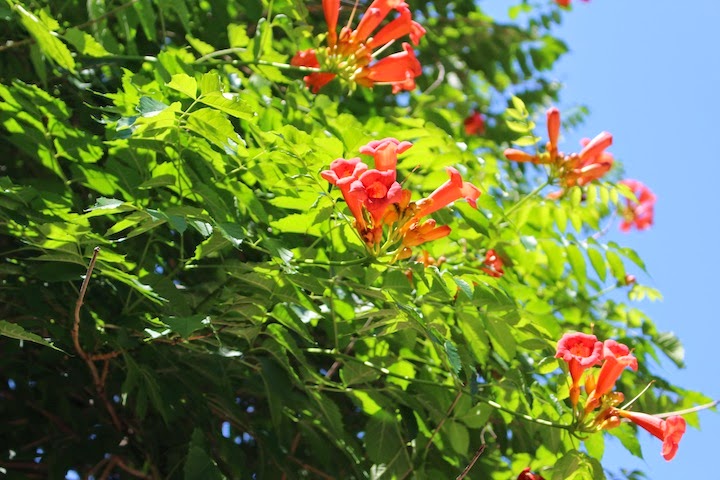 |
| Trumpet Vine, downtown Binghamton |
July Fest continues tomorrow and Sunday. If you live anywhere near Binghamton, please come out. Architecture? flowers? food? jazz? crafts? Lovely art? You'll find it all.
Do you have local festivals where you live?
Thursday, July 10, 2014
The Time for Fear
I have my chance. I can make a difference with my blogging pen, or at least my email pen. Or keyboard. Or whatever you want to call it.
And I don't know what to say.
No, let's rephrase that. I do know what I want to say, but I also have to be persuasive. I have to make sense.
Nor, dear reader, can I wait until my normal Sustainable Saturday post to blog about this.
In some past blogging posts, I've expressed my concerns about a local farmer's market in downtown Binghamton, New York. It has been declining in recent years. This year, it has reduced its days from two (Tuesdays and Fridays) to one (Fridays). I never would have known by looking at their website, which had last been updated, apparently, in 2012 (although when I went back yesterday to check the link, they did have something about the reduced hours.).
When I've posted about my concerns, I've gotten some very good suggestions from my blog readers, at least one of whom is a vendor at a farmer's market (not ours). My commenters agree this market should be using social media to get the word out.
Do people even know the market exists, a couple of people asked me. It made me stop and think. The only reason I know the market exists is because I work downtown, and that's the truth.
Their Facebook page? It's almost silent. The market has asked for interaction. Last night, I posed this as a comment:
"I am very concerned about the future of this market, especially with the cut in hours. I've worked in downtown Binghamton the past 16 years. Binghamton needs this market so badly. I'm encouraged by the presence this year of VINES and other local producers. What can a customer do to help boost the market?"
I will be awaiting their response with great interest (none yet). Their page, incidentally, has 934 likes. 32 visits. Not that much interaction. I know that Facebook makes it hard for pages that don't have interaction to flourish. I am not a Facebook expert. I did share the page with my personal Facebook friends but only a few live in this area.
I've also shared on my blog's fan page (RambinwithAM), but I don't get much activity on that page, so I don't know how much good the share will be. I know if I do something like this once, it's not going to help. You can't post once and run.
But it was a mailing, not a post on Facebook, that set me off to writing this blog post.
Last night, there was a a circular from our state assemblywoman, Donna Lupardo, in my mailbox.
"Farmers markets support our local farmers and our local economy - and they provide healthier food choices." it said. It listed the local markets, including the Binghamton market.
Inside, Ms. Lupardo wrote:
Write to Donna, my heart said.
Then, the doubting whispers came.
Donna Lupardo? She won't listen. (I don't even know her!)
I don't have time for this. I have to be part of the solution if I open my mouth (or keyboard). I work full time. My spouse is close to gaining guardianship of his disabled younger brother. I'm a long distance caregiver to an elderly mother in law. One day she will fall again or she'll be in harm's way from a storm or something else will happen.
I have ideas, but who am I? I am not a marketing person. I am not a saleswoman. I am "just" a person who has visited farmers markets, including downtown markets, in places including Fayetteville, AR, Charleston, SC, and Asheville, NC. I see those markets thrive.
Take Asheville. Asheville's population is about 86,000. Binghamton's population is about 47,000. But Asheville has 17 farmers markets. They have at least two farmers markets downtown (called Tailgate markets in North Carolina), both thriving. And their parking situation is not that great, either. I know comparing Asheville to Binghamton is not fair. They are two totally different cities. But perhaps we can learn from these cities.
I needed to sleep on this. I needed my subconscious to suggest what to say to this assemblywoman.
I think I got my answer early this morning, as I was waking up.
This Friday there will be a festival downtown. There will be another festival (existing festival, new venue) in late August. The students will be returning to college in August. More and more students are moving into downtown. The City of Binghamton is actively encouraging students to move downtown. Those students may be the market's future.
For now, I need to start writing. The time for fear is over.
Wish me luck!
And I don't know what to say.
No, let's rephrase that. I do know what I want to say, but I also have to be persuasive. I have to make sense.
Nor, dear reader, can I wait until my normal Sustainable Saturday post to blog about this.
In some past blogging posts, I've expressed my concerns about a local farmer's market in downtown Binghamton, New York. It has been declining in recent years. This year, it has reduced its days from two (Tuesdays and Fridays) to one (Fridays). I never would have known by looking at their website, which had last been updated, apparently, in 2012 (although when I went back yesterday to check the link, they did have something about the reduced hours.).
When I've posted about my concerns, I've gotten some very good suggestions from my blog readers, at least one of whom is a vendor at a farmer's market (not ours). My commenters agree this market should be using social media to get the word out.
Do people even know the market exists, a couple of people asked me. It made me stop and think. The only reason I know the market exists is because I work downtown, and that's the truth.
Their Facebook page? It's almost silent. The market has asked for interaction. Last night, I posed this as a comment:
"I am very concerned about the future of this market, especially with the cut in hours. I've worked in downtown Binghamton the past 16 years. Binghamton needs this market so badly. I'm encouraged by the presence this year of VINES and other local producers. What can a customer do to help boost the market?"
I will be awaiting their response with great interest (none yet). Their page, incidentally, has 934 likes. 32 visits. Not that much interaction. I know that Facebook makes it hard for pages that don't have interaction to flourish. I am not a Facebook expert. I did share the page with my personal Facebook friends but only a few live in this area.
I've also shared on my blog's fan page (RambinwithAM), but I don't get much activity on that page, so I don't know how much good the share will be. I know if I do something like this once, it's not going to help. You can't post once and run.
But it was a mailing, not a post on Facebook, that set me off to writing this blog post.
Last night, there was a a circular from our state assemblywoman, Donna Lupardo, in my mailbox.
"Farmers markets support our local farmers and our local economy - and they provide healthier food choices." it said. It listed the local markets, including the Binghamton market.
Inside, Ms. Lupardo wrote:
"Dear Neighbor,
I thought you would find it helpful to have a list of farmers markets in the City of Binghamton and the Towns of Union and Vestal. Buying locally grown, fresh produce and products made in the community really benefits everyone. It's good for the local economy....."
 |
| One end of the Binghamton, NY market |
Then, the doubting whispers came.
Donna Lupardo? She won't listen. (I don't even know her!)
I don't have time for this. I have to be part of the solution if I open my mouth (or keyboard). I work full time. My spouse is close to gaining guardianship of his disabled younger brother. I'm a long distance caregiver to an elderly mother in law. One day she will fall again or she'll be in harm's way from a storm or something else will happen.
I have ideas, but who am I? I am not a marketing person. I am not a saleswoman. I am "just" a person who has visited farmers markets, including downtown markets, in places including Fayetteville, AR, Charleston, SC, and Asheville, NC. I see those markets thrive.
Take Asheville. Asheville's population is about 86,000. Binghamton's population is about 47,000. But Asheville has 17 farmers markets. They have at least two farmers markets downtown (called Tailgate markets in North Carolina), both thriving. And their parking situation is not that great, either. I know comparing Asheville to Binghamton is not fair. They are two totally different cities. But perhaps we can learn from these cities.
I needed to sleep on this. I needed my subconscious to suggest what to say to this assemblywoman.
I think I got my answer early this morning, as I was waking up.
This Friday there will be a festival downtown. There will be another festival (existing festival, new venue) in late August. The students will be returning to college in August. More and more students are moving into downtown. The City of Binghamton is actively encouraging students to move downtown. Those students may be the market's future.
For now, I need to start writing. The time for fear is over.
Wish me luck!
Wednesday, July 9, 2014
Summer Ramblings - Days of Milk and Roses
It's the second week of July already. Here in upstate New York, it feels like summer is already half over.
Around the 4th of July we had a gorgeous, low humidity weekend. Now the humidity, bringing promise of severe weather, is back. Sadly, the severe weather struck Madison County in New York (near Syracuse) last night, killing at least four.
My thoughts go out to all affected by the storms last night, in New York and Ohio.
We ended up with rain, some wind, and interesting clouds. My son and I both got interesting pictures with our iPhones (above).
We may not like that kind of weather but some plants just drink it up. Literally.
The milkweed is starting to bloom.
Common milkweed, Asclepias syriaca, has a fragrant flower famously loved by monarch butterflies. Its nectar is loved by many butterflies, and the plant has a lovely, decorative seedpod in the fall. It is moderately toxic, however, to humans.
 A different plant, July 6.
Meanwhile, roses are still in bloom, including the later hybrid and heirloom varieties, at the free of charge Cutler Botanic Gardens in Binghamton, New York.
 This, the Elmshorn rose, is a hybrid dating from around 1951.
 Crested Musk, an heirloom rose from 1827.
 Birdie Blye, from 1901.
 Raubritter, a David Austin recommended rose.
Alas, the Japanese beetles are out in force, too. When I first moved to upstate New York in the mid 1980's, they would arrive around July 4. Now, they come a little earlier. I saw a couple of rose bushes yesterday while exercise walking in the humid afternoon, and the rose flowers were infested. It isn't only roses they eat - we haven't been able to ever grow sorrel, which I love to make a cold soup with. The Japanese beetles consider it a gourmet delight.
So many flowers, so little time, as we continue to ramble through summer.
What have you been doing this summer?
Around the 4th of July we had a gorgeous, low humidity weekend. Now the humidity, bringing promise of severe weather, is back. Sadly, the severe weather struck Madison County in New York (near Syracuse) last night, killing at least four.
My thoughts go out to all affected by the storms last night, in New York and Ohio.
 |
| Taken by my son near Maine, NY |
 |
| My version, near Johnson City, NY |
We may not like that kind of weather but some plants just drink it up. Literally.
The milkweed is starting to bloom.
 |
| June 29 |
Meanwhile, roses are still in bloom, including the later hybrid and heirloom varieties, at the free of charge Cutler Botanic Gardens in Binghamton, New York.
Alas, the Japanese beetles are out in force, too. When I first moved to upstate New York in the mid 1980's, they would arrive around July 4. Now, they come a little earlier. I saw a couple of rose bushes yesterday while exercise walking in the humid afternoon, and the rose flowers were infested. It isn't only roses they eat - we haven't been able to ever grow sorrel, which I love to make a cold soup with. The Japanese beetles consider it a gourmet delight.
So many flowers, so little time, as we continue to ramble through summer.
What have you been doing this summer?
Tuesday, July 8, 2014
The Mad Plant Grower
No, I'm not a plant scientist, or a hybridizer. Rather, I can see myself in my retirement, trying to grow things that are a bit out of the normal sphere of gardening.
I'm not ready to retire yet, nor is my spouse. But, we are trying some of that experimentation.
Some experiments succeed. Some fail.
A success? Growing ginger, something we never thought would grow in our zone 5b garden in the Binghamton area of upstate New York, until we saw a vendor in the Ithaca, New York farmers market selling young, locally grown ginger. Then, someone in our Otsiningo Park Farmers Market sold it. So we tried growing a pot of ginger (from roots purchased in an Asian food store) last year, and got a marvelous harvest.
 This year, we are trying again. The ginger started to germinate on June 27. When it is further along, I will give you an update.
A failure? Our pawpaws. Last year, we located some in a localvore store, and stratified the seeds in the refrigerator. We then planted in small pots.
Nothing ever happened.
We aren't giving up, but I don't think we have a success. Hopefully we will be able to try again this fall.
Have you tried any experiments with plants? How did it work out?
I'm not ready to retire yet, nor is my spouse. But, we are trying some of that experimentation.
Some experiments succeed. Some fail.
A success? Growing ginger, something we never thought would grow in our zone 5b garden in the Binghamton area of upstate New York, until we saw a vendor in the Ithaca, New York farmers market selling young, locally grown ginger. Then, someone in our Otsiningo Park Farmers Market sold it. So we tried growing a pot of ginger (from roots purchased in an Asian food store) last year, and got a marvelous harvest.
A failure? Our pawpaws. Last year, we located some in a localvore store, and stratified the seeds in the refrigerator. We then planted in small pots.
Nothing ever happened.
We aren't giving up, but I don't think we have a success. Hopefully we will be able to try again this fall.
Have you tried any experiments with plants? How did it work out?
Monday, July 7, 2014
Nostalgia Was the Word
I love Frankie Valli and the Four Seasons. My spouse, whose favorite music genre is hard rock, loves Frankie Valli and the Four Seasons.
Both of us were born in the early 1950's. The Four Seasons was the soundtrack of several years of our lives. In 2012, in fact, I wrote a blog post about the 50th anniversary of the Four Seasons. If you want to hear some of their best songs, click on over.
So when we heard, at the last minute that Frankie Valli was going to appear in Washington, DC for "A Capital Fourth", we sighed. It was too late for us to change plans, so in Binghamton, New York we were staying. And, anyway, we have been to Washington, DC twice for the Fourth of July. Both times, the temperatures were hot and steamy.
Although it is hard to imagine if all you've ever seen is the TV coverage of the Independence Day activities in our nation's capital, it is almost impossible to sit close enough to the live music performances to actually appreciate them. Both times we were in DC, we decided to stick with the fireworks and not even try to get close enough to the music.
Just our luck, thanks to a hurricane in the Carolinas, the weather there on July 4, 2014 was perfect.
So, last night we watched Frankie Valli's performance thanks to our DVR. Thanks to the Jersey Boys Broadway show and Clint Eastwood directed movie, one could say that Frankie Valli is more popular than ever.
Frankie Valli is 80 years old. But, I don't hear it in his voice. He still has that wonderful falsetto.
He did one of my favorite songs, Grease, from a musical movie adapted from a play. Over the years, the story has been modified several times. Bee Gee Barry Gibb wrote the song, but Frankie Valli performed it.
Here is Frankie Valli in 1978, in fact, performing the song. When you see this live performance - the dancers may be dressed like the 50's but the performance screams disco and "1978!".
The fascinating thing about nostalgia is that we all, after a certain age, seem to fit a hazy veil over our childhoods. Everything seems to have been better "back then". The music was better, people behaved better, and things were just as they should have been.
But, in reality, some things change for the better - and some don't. As for music, history will probably be the final judge of which decade had the best music.
Do you have a favorite singer or group from your growing up years?
Both of us were born in the early 1950's. The Four Seasons was the soundtrack of several years of our lives. In 2012, in fact, I wrote a blog post about the 50th anniversary of the Four Seasons. If you want to hear some of their best songs, click on over.
So when we heard, at the last minute that Frankie Valli was going to appear in Washington, DC for "A Capital Fourth", we sighed. It was too late for us to change plans, so in Binghamton, New York we were staying. And, anyway, we have been to Washington, DC twice for the Fourth of July. Both times, the temperatures were hot and steamy.
Although it is hard to imagine if all you've ever seen is the TV coverage of the Independence Day activities in our nation's capital, it is almost impossible to sit close enough to the live music performances to actually appreciate them. Both times we were in DC, we decided to stick with the fireworks and not even try to get close enough to the music.
Just our luck, thanks to a hurricane in the Carolinas, the weather there on July 4, 2014 was perfect.
So, last night we watched Frankie Valli's performance thanks to our DVR. Thanks to the Jersey Boys Broadway show and Clint Eastwood directed movie, one could say that Frankie Valli is more popular than ever.
Frankie Valli is 80 years old. But, I don't hear it in his voice. He still has that wonderful falsetto.
The fascinating thing about nostalgia is that we all, after a certain age, seem to fit a hazy veil over our childhoods. Everything seems to have been better "back then". The music was better, people behaved better, and things were just as they should have been.
But, in reality, some things change for the better - and some don't. As for music, history will probably be the final judge of which decade had the best music.
Do you have a favorite singer or group from your growing up years?
Sunday, July 6, 2014
Civil War Sunday - From Monocacy to Ben-Hur
But the area was anything but peaceful in July of 1864.
Maryland was a slave state, a border state, that did not secede. It would pay for its decision. And, like in all border states, residents fought for both sides.
 |
| The Sharpsburg Fire Department logo shows the Civil War connection |
But the Confederates were not finished yet. In 1864, their plan was to capture Washington DC, the capital of the United States, a capital that lay one river (the Potomac) away from the Confederate border. They would do this by approaching from Maryland.
And who was there to defend the Capital? Washington, DC was heavily fortified, but, as it turned out, not heavily enough. And not only that, but:
Things were not going well in the Civil War. It had been going on for three bloody years. Hundreds of thousands of people killed, wounded, missing, held prisoner, dying from disease, wounds, and starvation. And, it was an election year. It may see a certainty to us in 2014 that Abraham Lincoln would be reelected, but it wasn't certain in July of 2014.
The Union was stalemated on several fronts. And now, the Confederates had invaded.
Who was standing in their way?
Some Union troops, led by a previously disgraced general, General Lew Wallace. Wallace, a former governor of Indiana, had seen battle at Ft Donelson and at Shiloh, in Tennessee (another border state) in 1862. At Shiloh, some of his actions were controversial. He was removed from command and reassigned in disgrace. Eventually, he ended up at Monocacy Junction, facing a much larger, and more experienced, Confederate Army.
Washington, DC needed some time, enough time to get more troops into the area to defend it. Would they get it?
On July 9,1864, the Confederates, under the command of Jubal Early, won the Battle of Monocacy. (Monocacy is named after a river that is a tributary of the Potomac River.) The Union suffered some 1300 casualties in this battle that many have never heard of. There is a wonderful description of the background of the battle, and the battle itself, here.

This is part of the battlefield today.

The battlefield itself is free, and well worth the visit.

A display in the Visitors Center.

The Confederates were delayed a day. They lost at Ft. Stevens, inside the District of Columbia (the "DC" of Washington, DC, which is not technically in any state) on July 11-12, a battle witnessed by Abraham Lincoln. After their loss, the Confederates retreated still again. It can safely be said that the delay at Monocacy Junction saved our nation's capital from falling into Confederate hands.
General Grant later wrote in his memoirs:
"If Early had been but one day earlier, he might have entered the capital before the arrival of the reinforcements I had sent. ... General Wallace contributed on this occasion by the defeat of the troops under him, a greater benefit to the cause than often falls to the lot of a commander of an equal force to render by means of a victory."
So, what did this all have to do with Ben-Hur?
In 1880, the disgraced General Lew Wallace finished a book called "Ben-Hur: A Tale of the Christ." It became a best seller, topping even the sales of a novel that influenced the country in the years before the Civil War, "Uncle Tom's Cabin". Ben-Hur remained the all time best selling American novel until replaced by a Civil War epic novel, "Gone with the Wind".
In 1959, Ben-Hur was made into an epic movie, starring Charleston Heston as Ben-Hur. It has been seen, and loved, by millions. I read the book a very long time ago. I've seen the movie many times.
From disgrace to helping to save our Nation's capital to Ben-Hur. Not bad as a legacy.
Saturday, July 5, 2014
Sustainable Saturday - The Airshow and the Glider
Today, we had an airshow in the Binghamton area of upstate New York. Sounds so simple.
It was our first one since 2009. So many reasons. Cancelled due to airport construction. One cancelled because our area was still recovering from a massive flood. Cancelled due to extensive road construction. Last year, it almost happened, but then it was cancelled. One reason given was te budget cuts and its effects on military airshow participants. This one was nearly cancelled, too. A local casino stepped up and sponsored the show, along with several other businesses.
We had the usual kinds of performers - acrobatic airplanes, a couple of vintage airplanes that had been restored (one from 1931), the Golden Knights parachute team from the United States Army. Lots of noise, of course.
The louder the plane, the more children seem to like it. And, it was pretty nice watching expert parachutists. My son has parachuting on his bucket list. I don't.
But it was one act that seemed to make the people around me really take notice, including the children, and it surprised me a little. I've been to several air shows in my life, and this was a new act for me.
The pilot spoke as he was being lifted to the starting point of his act. The name of the act was the Manfred Radius Sailplane. A sailplane (which I call a glider)????

His glider was lifted into the air by an airplane and brought to attitude. Then, it separated from the airplane and started to glide down - totally under the power of the atmospheric air, heated by the sun.
Classical music played as the glider turned smoke on and made shapes high up in the sky. Sun gleamed off its wings as it started down in the almost cloudless sky.. It made a shape like a heart and children whispered "it's a heart! It's making a wish!" It may have been doing acrobatics - it was hard to tell.
I wish I knew what the piece was. I'm not knowledgeable about many of the performing arts. I could imagine this music being played at a ballet. Soft, slow, it was perfect music for gliding.
I've thought on and off about riding in a (non-acrobatic) glider one day. My spouse and I live only an hour or so from one of the premier soaring areas in the United States - Harris Hill.
This is what a flight from Harris Hill looks like. What I love about gliding is the silence. I was in a single engine aircraft many years ago and the loud drone literally put me to sleep. I missed the entire experience.
Perhaps you can't call a glider truly sustainable - it needs a powered airplane to tow it. But, it depends on forces of nature to fly, once up. You must know where you can catch thermals - a column of rising air. You must think like a bird.
Have you ever ridden in a glider?
It was our first one since 2009. So many reasons. Cancelled due to airport construction. One cancelled because our area was still recovering from a massive flood. Cancelled due to extensive road construction. Last year, it almost happened, but then it was cancelled. One reason given was te budget cuts and its effects on military airshow participants. This one was nearly cancelled, too. A local casino stepped up and sponsored the show, along with several other businesses.
We had the usual kinds of performers - acrobatic airplanes, a couple of vintage airplanes that had been restored (one from 1931), the Golden Knights parachute team from the United States Army. Lots of noise, of course.
 |
| You can barely see two Golden Knights under the plume of pink smoke |
But it was one act that seemed to make the people around me really take notice, including the children, and it surprised me a little. I've been to several air shows in my life, and this was a new act for me.
The pilot spoke as he was being lifted to the starting point of his act. The name of the act was the Manfred Radius Sailplane. A sailplane (which I call a glider)????
His glider was lifted into the air by an airplane and brought to attitude. Then, it separated from the airplane and started to glide down - totally under the power of the atmospheric air, heated by the sun.
Classical music played as the glider turned smoke on and made shapes high up in the sky. Sun gleamed off its wings as it started down in the almost cloudless sky.. It made a shape like a heart and children whispered "it's a heart! It's making a wish!" It may have been doing acrobatics - it was hard to tell.
I wish I knew what the piece was. I'm not knowledgeable about many of the performing arts. I could imagine this music being played at a ballet. Soft, slow, it was perfect music for gliding.
 |
| Glider Acrobatics |
This is what a flight from Harris Hill looks like. What I love about gliding is the silence. I was in a single engine aircraft many years ago and the loud drone literally put me to sleep. I missed the entire experience.
Perhaps you can't call a glider truly sustainable - it needs a powered airplane to tow it. But, it depends on forces of nature to fly, once up. You must know where you can catch thermals - a column of rising air. You must think like a bird.
Have you ever ridden in a glider?
Friday, July 4, 2014
Loving It By Leaving It
Today is the 4th of July. This is the birthday of my country, the United States of America.
 Patriotism is everywhere. Someone left this flag in front of my house, and all over my neighborhood. A similar thing happened on Memorial Day.

Even the flowers were being patriotic today. Well, without the blue.
For many, many years I took Independence Day for granted. I shouldn't have - I grew up in a neighborhood where a lot of Holocaust survivors had settled, and I met other immigrants - from Cuba, from Romania, from China.
But I had never spent an Independence Day away from the United States - until 2008, when my spouse and I found myself leaving the United States for Canada, on our way to Saint John, New Brunswick.
We had always wanted to see the Bay of Fundy, and that was the week my spouse was able to get off - the week following July 4.
At the U.S./Canada border, a Canadian border agent questioned our motives for visiting Canada and looked at us funny - like we were about to commit some kind of crime. Why, after all, would two Americans want to leave their country on this most important day?
Perhaps he still had heartburn from a bad piece of Canada Day cake . That's a custom that I wish our country would adopt, by the way - after all, July 4 is the birthday of our country. I love how various towns in Canada will serve a Canada Day cake to its citizens.
Perhaps, one day, I will plan to participate in both holidays. We only live some 180 miles from Canada, after all.
Anyway, back to the border, we were finally allowed in, and quickly realized we were in a place where July 4 was simply the day between July 3 and July 5. No big deal. And, we realized, there would be no fireworks. No parades. No nothing. Crickets.
Well, we had asked for it, leaving our native land.
I love fireworks. I love 4th of July fireworks even better. What had I been thinking? But, so be it.
After a long drive, we arrived at our lodgings in downtown Saint John. We wandered down to the waterfront, hungry. After deciding on a restaurant, we sat at an outdoor table and put our order in. And then we overheard the people at the next table, excited about the fireworks Saint John was going to have, not too far away, that night.
July 4 fireworks in Canada?
It turned out that we had arrived on the first decent day in July. The Canada Day fireworks had been delayed by rain on July 1. And on July 2. And on July 3.
July 4? Bingo!
So, that evening, my spouse and I stood in a patriotic crowd of Canadians who celebrated their birthday, three days late, with fireworks. And I pretended it was our Independence Day.
I'm so glad they held their fireworks up just so we could join them on July 4. Who says Canadians aren't some of the friendliest people in the world?
But I'll never leave the United States on July 4 again. And so tonight, I am at home near Binghamton, New York. Today we walked, and my spouse BBQ'd a turkey breast.
 It was rather cool, but we could have been in a hurricane or in heavy rains instead had we been vacationing on the coast. I'm not complaining.
And now, we are getting ready to go to a baseball game, with fireworks after.
What did you do today?
Even the flowers were being patriotic today. Well, without the blue.
For many, many years I took Independence Day for granted. I shouldn't have - I grew up in a neighborhood where a lot of Holocaust survivors had settled, and I met other immigrants - from Cuba, from Romania, from China.
But I had never spent an Independence Day away from the United States - until 2008, when my spouse and I found myself leaving the United States for Canada, on our way to Saint John, New Brunswick.
We had always wanted to see the Bay of Fundy, and that was the week my spouse was able to get off - the week following July 4.
At the U.S./Canada border, a Canadian border agent questioned our motives for visiting Canada and looked at us funny - like we were about to commit some kind of crime. Why, after all, would two Americans want to leave their country on this most important day?
Perhaps he still had heartburn from a bad piece of Canada Day cake . That's a custom that I wish our country would adopt, by the way - after all, July 4 is the birthday of our country. I love how various towns in Canada will serve a Canada Day cake to its citizens.
Perhaps, one day, I will plan to participate in both holidays. We only live some 180 miles from Canada, after all.
Anyway, back to the border, we were finally allowed in, and quickly realized we were in a place where July 4 was simply the day between July 3 and July 5. No big deal. And, we realized, there would be no fireworks. No parades. No nothing. Crickets.
Well, we had asked for it, leaving our native land.
I love fireworks. I love 4th of July fireworks even better. What had I been thinking? But, so be it.
After a long drive, we arrived at our lodgings in downtown Saint John. We wandered down to the waterfront, hungry. After deciding on a restaurant, we sat at an outdoor table and put our order in. And then we overheard the people at the next table, excited about the fireworks Saint John was going to have, not too far away, that night.
July 4 fireworks in Canada?
It turned out that we had arrived on the first decent day in July. The Canada Day fireworks had been delayed by rain on July 1. And on July 2. And on July 3.
July 4? Bingo!
So, that evening, my spouse and I stood in a patriotic crowd of Canadians who celebrated their birthday, three days late, with fireworks. And I pretended it was our Independence Day.
I'm so glad they held their fireworks up just so we could join them on July 4. Who says Canadians aren't some of the friendliest people in the world?
But I'll never leave the United States on July 4 again. And so tonight, I am at home near Binghamton, New York. Today we walked, and my spouse BBQ'd a turkey breast.
And now, we are getting ready to go to a baseball game, with fireworks after.
What did you do today?
Thursday, July 3, 2014
Where Do You Want to Be In Ten Years?
Retirement.
 Is it the end of the road?
Years ago, I used to play The Game of Life with my young son. This board game has a fascinating history - it was created by Milton Bradley (yes, there was a real Milton Bradley) in 1860.
In the Game of Life version we played, after high school, you could choose either to go to college or start work immediately. You chose a profession, got married, had children, did various things, and ended up in one of two retirement villages, depending on how much money you had.

And then, I suppose, you drove into the sunset. As I recall, that's where the game ended. You added up your money and other assets and the player who had the most won.
Won. As if life was a competition. For some people, of course, it is. I'm not one of them.
For many people reading this blog, retirement may be years away. But today's NaBloPoMo's prompt is "What do you think you will be doing 10 years from now?" Retirement came immediately to mind. My spouse and I are both in our early 60's. We hope we can be retired by the time we are in our early 70's.
Yesterday, I asked my spouse where he would like to be in 10 years, and he responded "on this planet".
My spouse is a man of few words.
As for me, I wonder about retirement, because I know several people around my age, and even younger, who are retired. Some retired voluntarily. At least three of them retired to take care of elderly parents and stayed retired when the parents left the planet. Several retired when their employers, long time employers decided they were not needed anymore.
Some had no choice about what they were going to do once retired (the caregivers). Others had no time to think of it before it happened. But I also know several people who retired, with high expectations, and found themselves working again (generally not for the same employers they retired from) within a matter of months.
Guess that sunset wasn't too attractive. One man was plain bored. Several discovered they missed income coming in.
So I wonder: if I want to be retired in 10 years, what for me, makes a successful retirement?
I would need to do something with purpose, I know that.
Retirement has to be more than growing flowers.
My spouse wants to garden, but the growing season here in upstate New York is barely six months long. There is an interest he's passionate about, and I suspect he will engage in that. (And no, it's not golf.)
After that, what? Travel? We don't have enough money for non stop travel. But we hope to have the health, and physical ability, to travel.
After working for so much of our lives, so much of our identities, and our interactions with others, is work place related. So we must make sure these needs are taken care of. Retirement planning is a lot more than making sure you have enough money.
So, the short answer: doing things we love to do. Maybe even, still blogging, if blogging still exists.
Where do you want to be in 10 years?
Years ago, I used to play The Game of Life with my young son. This board game has a fascinating history - it was created by Milton Bradley (yes, there was a real Milton Bradley) in 1860.
In the Game of Life version we played, after high school, you could choose either to go to college or start work immediately. You chose a profession, got married, had children, did various things, and ended up in one of two retirement villages, depending on how much money you had.
And then, I suppose, you drove into the sunset. As I recall, that's where the game ended. You added up your money and other assets and the player who had the most won.
Won. As if life was a competition. For some people, of course, it is. I'm not one of them.
For many people reading this blog, retirement may be years away. But today's NaBloPoMo's prompt is "What do you think you will be doing 10 years from now?" Retirement came immediately to mind. My spouse and I are both in our early 60's. We hope we can be retired by the time we are in our early 70's.
Yesterday, I asked my spouse where he would like to be in 10 years, and he responded "on this planet".
My spouse is a man of few words.
As for me, I wonder about retirement, because I know several people around my age, and even younger, who are retired. Some retired voluntarily. At least three of them retired to take care of elderly parents and stayed retired when the parents left the planet. Several retired when their employers, long time employers decided they were not needed anymore.
Some had no choice about what they were going to do once retired (the caregivers). Others had no time to think of it before it happened. But I also know several people who retired, with high expectations, and found themselves working again (generally not for the same employers they retired from) within a matter of months.
Guess that sunset wasn't too attractive. One man was plain bored. Several discovered they missed income coming in.
So I wonder: if I want to be retired in 10 years, what for me, makes a successful retirement?
 |
| Astilbe, My Back Yard, late June 2014 |
Retirement has to be more than growing flowers.
 |
| Community Garden, Otsiningo Park, early June 2014 |
My spouse wants to garden, but the growing season here in upstate New York is barely six months long. There is an interest he's passionate about, and I suspect he will engage in that. (And no, it's not golf.)
 |
| Motel, Mt. Pleasant, South Carolina |
After working for so much of our lives, so much of our identities, and our interactions with others, is work place related. So we must make sure these needs are taken care of. Retirement planning is a lot more than making sure you have enough money.
So, the short answer: doing things we love to do. Maybe even, still blogging, if blogging still exists.
Where do you want to be in 10 years?
Wednesday, July 2, 2014
Summer Ramblings - Shiny Happy Lilies
Yesterday, July 1, was the hottest day (so far) of the year here in the Binghamton area of upstate New York. In just two more days, July 4 will be our Independence Day, here in the United States. Yesterday was Canada Day in Canada, about 170 miles from where I live.
July, in our area, means lilies. From the end of June on, our area explodes in displays of lilies. Day lilies, Asiatic lilies, hybrid lilies, and other lilies are gearing up for their bloom season.
 A beautiful Asiatic lily in our front yard. We got this as a gift plant a couple of years ago.
 Here's another picture, during what photographers call the "golden hour": the last hour of daylight.
Up to now, we've grown mainly day lilies. Of any flowering plant, the day lily is perhaps the ideal plant for our climate. It is almost impossible to kill. There are some 13,000 (that isn't a misprint) varieties in various colors and sizes - ranging from one to four feet tall Some are fragrant. Some are ruffled. Some are multicolored. They are even edible, noting that some people are allergic to them.

Here is our first day lily, a yellow day lily in our front yard. These flowers only last a single day, but a plant can remain in bloom for weeks. And, needless to say, there are day lilies for every blooming season - early, midseason, and late.
We have several day lillies not yet in bloom. I hope to be able to show them to you by July 15, Garden Bloggers Bloom Day.
In the meantime, here are some lilies (day lilies and others) blooming in other yards.
 West Side of Binghamton.
 Downtown Binghamton. Yes, we have yards, and ornamentals, in downtown Binghamon.
 Pink.
Pink.
 Even the former BAE Systems factory building, abandoned after our flood of September, 2011, has day lilies blooming among the weeds that have grown up in the former landscaping.
 One more lily picture for today.
Do lilies make you happy? They make me happy.
Do you enjoy growing flowers? Or buying and arranging cut flowers for your table? What are your favorites?
July, in our area, means lilies. From the end of June on, our area explodes in displays of lilies. Day lilies, Asiatic lilies, hybrid lilies, and other lilies are gearing up for their bloom season.
Up to now, we've grown mainly day lilies. Of any flowering plant, the day lily is perhaps the ideal plant for our climate. It is almost impossible to kill. There are some 13,000 (that isn't a misprint) varieties in various colors and sizes - ranging from one to four feet tall Some are fragrant. Some are ruffled. Some are multicolored. They are even edible, noting that some people are allergic to them.
Here is our first day lily, a yellow day lily in our front yard. These flowers only last a single day, but a plant can remain in bloom for weeks. And, needless to say, there are day lilies for every blooming season - early, midseason, and late.
We have several day lillies not yet in bloom. I hope to be able to show them to you by July 15, Garden Bloggers Bloom Day.
In the meantime, here are some lilies (day lilies and others) blooming in other yards.
Do lilies make you happy? They make me happy.
Do you enjoy growing flowers? Or buying and arranging cut flowers for your table? What are your favorites?
Subscribe to:
Posts (Atom)