Tuesday, July 9, 2013

Signs above Manhattan

Last Friday, my spouse and I walked the High Line, the elevated New York park that was formerly freight train tracks, for the first time.  Although it was our first time, it won't be our last.

One thing you can say about New York City weather in July - it is hot. And humid.  But despite that, crowds walked the High Line. 

With a head half spinning from the heat, and totally disoriented with the joy of being surrounded by trees and flowers in Manhattan, I started taking pictures.

Something that struck me right away were the signs on nearby buildings.  After all, when you have four million visitors to a place each year, you want to have your sign out there.

For example, Patagonia asks us to take an "environmental pledge". (I don't buy their clothing, so this is not an endorsement.)  Why not, near a park dedicated to the environment?

Then, I saw this sign above 10th Avenue in Chelsea.  Apparently, this sign is a favorite of people on Flickr.  It's one of my favorites, too.  This was our first view and the sign was so perfect against the Manhattan building backdrop.

And then, we got a little closer.  It really was for a parking lot!  Considering that it really does take a miracle to find parking in most of Manhattan - I think the Almighty would really rather have residents and tourists take the subway (we did) and let Him concentrate on the really important stuff.

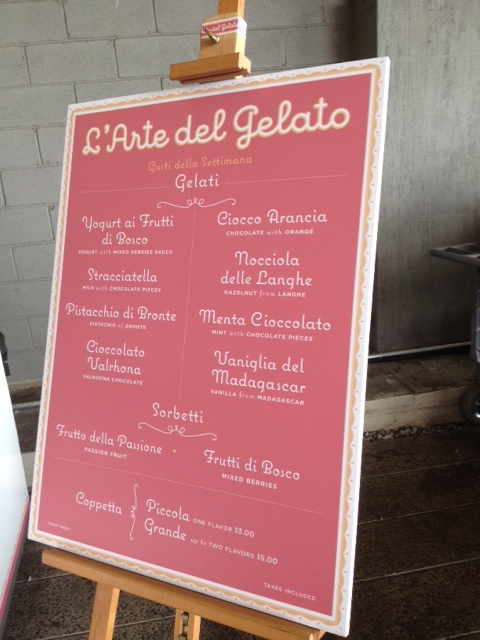
Finally, I am going to be mean and make your mouth water.  Here are signs by a couple of the food vendors on the High Line. 

In New York City, foods blend together.  There was also a "taco truck" and a gourmet "soda works".

Tomorrow, a special Simply Summer post. I'll resume blogging about the High Line- its flowers and its arts - later this week or next.

Monday, July 8, 2013

Welcome to the High Line

On a hot summer day in Manhattan, we visited a park.  It was 93 degrees and humid, but nothing was going to stop us.
Echinacea purpurea "Vintage Wine"

.

This is what the park looks like from street level as you walk on the cobblestones of  Gansevoort Street in the Meatpacking District.


Once upon a time, this park was a "spur" of the New York Central Railroad.  Freight trains ran on this from 1934 to 1980.  Then, for years, it sat there, abandoned.  Eventually,  CSX Transportation, Inc. donated the abandoned line to the City of New York.
Some of the original track is still there, planted in flowers, grasses and trees.
Climb these stairs (or take the elevator) and prepare to be amazed.  You are about to walk on the High Line.

What is the High Line? It is trees, plants, wildflowers, domestic flowers, grasses, food vendors, young people, old people.  Four million people a year visit it.  It even has a blog.  One mile of the 1.45 miles is now open.  The park won't be complete until 2014, but there is so much to see now.

If you aren't into plants, look at the public art (more on that in another post).  If you aren't into art, look at the signs, and the city scenery around you.  No matter how many times you have seen Manhattan (I am a native New Yorker, by the way, and lived there for some 21 years) you haven't seen the biggest city in our country like this.

Come with me on my High Line walk.  I'll be posting photos (and details) from time to time in the coming weeks.

What is your favorite public park?

Sunday, July 7, 2013

Civil War Sunday - Paula Deen and the Civil War

Next week we mark the 150th anniversary of the start of a terrible riot in New York City.  On July 13, 1863, an event related to the Civil War...well, you'll have to come back to read more about it.

But something that is happening now, in our United States, has echoes of the event now called the New York Draft Riots. It won't be commemorated next week in the same way that famous battles, such as Gettysburg, were, which is why I need to blog about it. 

But first, back to the present.

By now, if you are an American, you have heard of a woman by the name of Paula Dean.  Many of us are probably sick of hearing about her, and I don't intend to add any fuel (to to speak) to the fires that are already burning.  But the fact that this fire is burning at all is proof, as I have said too many times, that we are still fighting the Civil War (just less physically) here in the United States.

Just go on any of the thousands of web sites carrying coverage (of any sort) of the Paula Dean controversy and read the comments.  The articles themselves may be of some interest but it's the comments that will really interest you.

I have a number of fans abroad (thank you!), so let me briefly explain who Paula Dean is.  She is a celebrity chef, restaurant owner, creator of various lines of cooking equipment that, until recently, were sold in major department stores, and is basically a one woman industry.  Paula has (or, actually, had) several cooking shows on a cable network called The Food Network.

She has an awful lot of fans in this country who love her decadent, butter-heavy recipes.  I may not eat in that style, but I also believe in personal responsibility, so if you want to check out her recipes, "go for it".

She and her family are responsible for a lot of tourism to Savannah, Georgia, a city I last visited in March of this year, and a city that I love.

Paula being in the news started with a former restaurant manager suing Paula and her brother for racial harassment and another kind of harassment I can not mention in a "G" rated blogging competition.  In a deposition for the lawsuit, Ms. Deen admitted to using a word I would have been severely punished for using in my childhood, but also a word that is still way too commonly used in this nation.  As a result, Paula Deen has lost her contract with the Food Network and is quickly losing endorsements and other contracts.

She has kept a lot of her fan base, and I can say that she has a lot of fans in upstate New York, where I live.  A lot of people feel for her plight.  But, by now, you are asking "what does Paula Dean have to do with the Civil War?"

Paula Dean had ancestral relatives who were slave owners.  Don't be shocked by this; most people who lived between the founding of our country (and prior!) and the Civil War era (1861-1865) benefited either directly or indirectly by slavery.  And then there were the slaves - let's not forget about them.

With that in mind, listen to portions of the interview.

Paula Deen's great grandfather committed suicide after the Civil War. He was despondent.  His life was ruined.  And, his "30 workers" ran away.

Those 30 workers weren't workers except in the loosest definition of the word.  They were SLAVES,  human chattel, to use and abuse however the owner wished.  Perhaps Paula Deen's great grandfather didn't abuse his slaves (if you ignore the fact that enslaving people is abuse), but the truth is, they weren't "workers".   So, Paula seriously can not utter that word that describes what those workers were.

No, I don't mean the N word.

Instead, she can't utter the S word.  You know, Slave.  As in "yes, my family owned other human beings at one time". 30 were a lot?  How about one? Many descendents of slave owners have faced that part of their geneology.  Many others haven't. I can't speak for the descendents of said slaves but they can speak just fine for themselves.

Don't tell me those workers were like family, Paula.  Yes, humans thrown into circumstances shared with other humans form bonds.  But, what does that tell you, that those 30 workers ran away after the war.  You're surprised?  They were slaves and now they were free.  Free like you and me, to make something of the rest of their lives.  And they obviously (to use another cliche) voted with their feet.

Our country has a long way to go.  Race relations are a delicate topic. It remains delicate.  Will the Paula Deen episode allow us to finally lance that boil upon the skin of our nation?  I doubt it.

Next week:  the New York Draft riots.

Saturday, July 6, 2013

Sustainable Saturday - Up on the Roof and the Fire Escape

It's July and summer is already a couple of weeks old.  New York gardening season is in full swing.

Especially in New York City.

New York City?  The land of the "concrete canyon"? Well, yes.  Wherever you find a spare piece of ground near where people live, you may well find green sights like these:

Photographed from the High Line elevated park, Manhattan, New York City (see low building on left side, with trees.  Yes, this is a rooftop garden - and they may well have edibles planted there, too.)  (And yes, I am going to do a feature on my visit to the High Line next week.)


I think this plant may be a luffa plant - but whatever it is, it is climbing up a fire escape ladder in Brooklyn.

A Brooklyn zucchini, growing in a narrow strip between an apartment building and the sidewalk.  And here are some more plants in that garden:
Swiss chard and tomatoes.
Eggplant in back, tomato in front.

No dirt?  No problem!  Here's a tomato plant in a container. Doesn't need to be a fancy container, either. (Apartment dwellers do have other challenges - which I am well aware of as I lived in an apartment without a balcony or access to the roof for some 21 years.)
And dill.

Finally, in a small backyard - a fig tree. (Wish we could have good fig trees by where I live in upstate New York.)  See the small trunk next to the pole.

Have you seen gardens in large cities?  Does your city have any special program to encourage them?

Friday, July 5, 2013

Lemonade Crocheting and Knitting

The spouse of my friend in Brooklyn has to spend a lot of time in doctor's offices to be treated for a medical condition.   My friend normally comes with  him and waits for him while he has his treatment - sometimes waiting an hour (or even more).

Out of boredom, she started to do her needlework while waiting.

She does beautiful crocheting and knitting work - and, recently, has been working on projects for pediatric oncology patients.

I crochet but I do not knit, and I wanted to show off her work because I know quality work when I see it.  I think the work, and the cause, is fantastic. 

A crocheted blanket and some knit hats.
Another crocheted blanket.
And finally, some hats and scarves.

Aren't these beautiful?  (Lately, she has had some yarn donated to her but I suspect enough of these projects were done using her own money.) We have the cliche "lemons out of lemonade" - this is about as lemony as you can get.

I've done a handful of crocheting for charity but never anything like this.

Have you ever done crocheting or knitting for charity?

Thursday, July 4, 2013

The 150th Anniversary of the Fall of Vicksburg

(A partial rewriting of a post from July 3, 2011).

Today is July 4, Independence Day for the United States. 

I first found this story out on Ken Burn's classic TV mini series on the United States Civil War.  (As I write, keep in mind that I am a native of New York State.)

Vicksburg, Mississippi, in a former Confederate state, has an online listing of community events.  Listed in here, along with the Farmers Market, Faith Fest and the Old Court House Flea Market, is the "Red, White and Blue" Fourth of July weekend, and the 4th of July fireworks.  Nothing special, here.  Nothing different than what thousands of other cities and towns in the United States offer in celebrating our nation's Independence Day.

Or is it different?

Several generations of citizens of Vicksburg, Mississippi didn't know what a hometown 4th of July celebration was like-because they didn't have one. Stores remained open.  People went about their business.  And stories were told, dark stories, about the Siege of Vicksburg and its surrender to the Union Army on July 4, 1863.  It is said that General Pemberton, the commanding general of the Confederate States of America forces at Vicksburg, chose to surrender Vicksburg to the Union army on Independence Day as he thought they would get more favorable terms of surrender.

After that surrender, Vicksburg did not celebrate Independence Day until 1945.

Even in 1997, they still had a problem with it.


We must try to understand why Vicksburg  felt that way.   Vicksburg is located on the Mississippi River, one of the most important waterways in our nation.  It was just as important, if not more so, in the 1860's.  It was vital for the Federals to take control of the Mississippi in order to win the war.

Vicksburg stood in the way.  So, it was put under siege by Union forces commanded by General Grant and starved into submission.  As a young girl growing up in the Bronx, I remember drawings in a textbook showing how the residents ended up taking refuge in caves dug into hillsides, and what they used for food as the siege progressed. Rats would have been a gourmet treat.

Towards the end, they were printing their newspaper on wallpaper because they had run out of paper.

For Vicksburg, July 4th didn't stand for our country's birthday but rather was symbolic of what its fellow citizens did to it back in 1863.  I can only think that its citizens going overseas and fighting World War II side by side with the descendents of its former enemies of 80 years before, to fight a strong evil threatening to overtake the world, is what finally started to heal those wounds. 

As William Tecumseh Sherman said, "War is Hell".  Especially for civilians caught in the crossfire.

In another twist of history, the same Union General Sherman, the day after Vicksburg's surrender, started practicing for what would become his infamous "March to the Sea" by marching through Central Mississippi and burning Jackson.

The descendents of those people still remember, too.

Indeed, the wounds of the Civil War are still there, right underneath our collective skin, both North and South, not fully healed.  This was true when I first wrote about Vicksburg in 2011, and is still true today.  The wounds may not fully heal even in my lifetime.

Tomorrow, back to my regular blogging schedule.

If you are in the United States, have a wonderful Independence Day.

Wednesday, July 3, 2013

The Sentinals and the Heroes

When I visited Gettysburg, as I did at the dawn of the 21st century, I was immediately struck by one thing on the preserved battlefield. 

The stone sentinels.  The bronze sentinels.

On the battlefield, there are statues.  Monuments.  Monument after monument.  In a way, you can consider Gettysburg as a huge outdoor art gallery.  It's overwhelming, and, if you don't know the history behind them, even a bit puzzling.

Battalion monuments. Individual monuments. State monuments.  Union monuments.  Confederate monuments.  Monuments and markers where people fought, and people died.  Monuments in meadows and hills.  I wish I had my pictures in electronic form from that trip, but I don't.

According to battlefield historians, people actually ask how those monuments were protected during the battle and how all the bullet holes were repaired afterwards.  (They also ask questions such as "how did they direct traffic during the battles?" and "why were all the battles fought in national parks?")

I don't think I would last long as a public historian, not that I am even a historian. 

But I digress - just a little.  I had promised to blog about Confederate heroes at Gettysburg today. 

Day three of the Battle of Gettysburg dawns.  Actually, the fighting started at 4am, before dawn.

Both sides basically occupied the same ground as they had at the end of the second day's fighting.  In the morning, the Confederates would try (and fail) to take Culp's Hill.  The rebels then made a deadly gamble.

First, there would be a massive bombardment of the Union center under General Longstreet, lasting nearly two hours.  Then, 12,000 Confederate troops were ordered to attack the heart of the Union lines. 

Divisions headed by Major General Isaac R. Trimble, Major General George Pickett and the other headed by Brigadier General General James Johnston Pettigrew, participated.

The "charge" (which it wasn't for those soldiers; it was a walk across a mile of hell and over a stone fence, as bullets mowed them down) is, today, commonly called "Pickett's Charge" after General George Pickett.  I am not a military historian, and I am not going to debate the details of who ordered it, who didn't want to do it, and so forth.  One thing, though, is certain. People have been trying to blame one participant or the other for the defeat for the past 150 years.

Today, you can find "the high water mark of the Confederacy" on the Gettysburg battlefield.  This is as far as the Confederates got in their invasion of the North, during Pickett's Charge.  They would never get that far again.


Except for one small instance, the Confederates were not able to break through the Federal lines.  Pickett lost over half of his division.  He lost every one of his 15 regimental commanders. 

So, could you say, that those 12,000 Confederates were heroes?  Perhaps.  They were certainly brave, as they continued to charge while their fellow soldiers died all around them.  I do not agree with their cause but I can't argue against their bravery.

If we look for a one true hero of Gettysburg, we will probably never find that person. 
Confederate reenactors

So, the battle finally ended, but at what a cost - 51,000 dead, injured, captured.  There were some skirmishes on July 4, but the battle is considered to have ended on July 3.

Are you related to anyone who fought in the Civil War, and may have been at Gettysburg?

Tuesday, July 2, 2013

Hold the High Ground

150 years ago yesterday, near a small town in southeast Pennsylvania, Confederate skirmishers and four Union soldiers ran into each other.  Few men were expecting a fight.  No one would have chosen what happened next.

The rebels, it is said, were on the march to try to find shoes, a clothing item that enough of their men had to do without because provisions, and funds, were inadequate.  They hoped to find shoes in that small town of Gettysburg, Pennsylvania.  What they found was a fight. As the day progressed, more and more soldiers joined the fight and the day ended with the Confederates in possession of Gettysburg and some 16,000 casualties dead, injured or captured.

Day two dawned with the promise of another hot southeastern Pennsylvania day. The cause of the Confederate States of America lay in the balance, as both sides realized by now.  There would be so many stories to tell after that day was over.  Today I concentrate on a couple of men on the Union side of the battle. 
And the Confederates?  Their turn comes tomorrow (weather permitting, as our county is under a flood warning.)

Flag of 137th NYVI

One of the heroes of the day was a man "unsung", a man who died in 1864 from dysentery and was unable to promote his cause after the war.  Little is known about his early life, and most people have never even heard of him.

Colonel David Ireland and his 137th New York Volunteer Infantry regiment played a key role in maintaining control of Culp's Hill, suffering many casualties.  If this hill had been captured by the Confederates, the battle may well have been lost. The high ground had to be held at all cost.

A month after the battle, he married the daughter of a prominent man in Binghamton, New York and then went off to war.  He never saw his bride again, and had no children.

His tomb is not a tourist attraction. He is buried in a cemetery which can be seen from the eastbound lane of U.S. 17 as you go through Binghamton, New York. 

Much more is known about another colonel, a man from Maine, a man who had made a living as a college professor and ended up winning the Medal of Honor for his actions at Little Roundtop that day.  Thomas Desjardin, an expert on this man, Joshua Chamberlain, gave a talk at the Gettysburg Battlefield on Sunday and painted a picture of - well, an unpromising child.


Chamberlain stuttered -he couldn't get past the letters P B and L. He became quiet and reserved, afraid of social interaction. (As an adult, he would utter sentences such as "The time has come when we are to determine whether we are a nation or a - or a - or a basket of chips")

He had to learn German to be admitted to Bowdoin College. He locked himself into the attic of his home and practiced until he learned German.  He subsequently learned six other foreign languages and spoke them all fluently.

In 1852, as a senior in Bowdoin College, he witnessed a private reading of Uncle Tom's Cabin by Harriet Beecher Stowe. He never forgot it.

This stutterer had to make a commencement speech and almost panicked when he saw famous alumni in the audience - novelist Nathaniel Hawthorne, poet Henry Wadsworth Longfellow and politician/future President Franklin Pierce.  But he held it together.  He ended up becoming a professor of rhetoric at Bowdoin College.

He changed from a mild mannered professor to an ardent soldier after the Civil War broke out, remembering that private reading of Uncle Tom's Cabin, and believing in the cause of abolition.
Federal reenactors fire volley at Owego, New York

Chamberlain had never commanded a regiment in battle before Gettysburg. He had never been in a real "stand up battle" (one where the two sides line up staring at each other and fire at each other).  And he was charged to hold a hill, Little Round Top, "at all hazard" - meaning, unto death.  The high ground had to be held by the Union.  The Confederates knew that to win the battle, they would have to take Little Round Top.

Chamberlain was suffering from an attack of malaria on July 2, 1863.  Many of his men were suffering from dysentery.  Chamberlain was shot twice during the battle, once in each leg.  His men didn't have enough ammunition - and then, after wave after wave of Confederates were rebuffed - they ran out of bullets.

And, dreaming up a maneuver that is still taught today in military colleges, Chamberlain ordered his men to fix bayonets and commanded his Union troops to move in a particular way and against overwhelming odds his men held the hill.

Later in the war, in another battle, he suffered grievous wounds that he survived, but caused him tremendous pain for the last fifty years of his life.  He went on to a distinguished career as Governor of Maine and President of Bowdoin College.  Chamberlain, like David Ireland, has no direct descendents - he (in a colloquial term used in those days) "daughtered out".


His tombstone reads simply:

Joshua L. Chamberlain
1828 ----- 1914

There were other Union heroes that day  - such as cavalry officer John Buford.

My plans for the 150th anniversary of day 3 will be telling a story or two of the Confederates at Gettysburg.  Or perhaps, it will be the turn of our local weather to dominate the news again.  Let's hope not.

Monday, July 1, 2013

On A Warm July 1 Morning

On a warm summer morning one July 1, birds sang.  Perhaps children were out picking raspberries on the edge of a small town in Southeast Pennsylvania.

Perhaps some of them were picking wild strawberries.

And other picked the abundant wildflowers, perhaps to put in a bouquet for their mothers.
None of these people knew what would happen in the next three days.  At the end of July 1, 1863, 16,000. soldiers would lie dead, wounded or captured.  All together, from July 1 to July 3, 1863,  51,000 casualties....and the Confederates turned back from their aim to capture Harrisburg, Pennsylvania and force the Union to recognize the Confederate States of America.  But at what a cost.

Today, Tuesday and Wednesday are the 150th anniversary of the Civil War Battle of Gettysburg, the pivotal battle in Pennsylvania which changed the course of American history.  This battle was the bloodiest battle in the Civil War/American history. 

Thursday, July 4, will be the 150th anniversary of the fall of Vicksburg, in Mississippi, a siege which also shaped the course of American history.

In recognition of these watershed events in the Civil War, I will be devoting the next four days on my blog to the Civil War.  This won't be "just any" coverage - if you were bored to tears in school by your history classes,  I promise this will not be your school's dreaded dead or dying on arrival history instruction.  I hate dead history myself.  I know not all of my blog readers are into the Civil War, so you may want to come back on Friday for some nice wildflowers.

For today, I'd like to have Senator Angus King of Maine provide the "video" for my blog.  (If you don't want to listen to the video, a transcript of the speech is included - but I do recommend the video. You'll see why.)  It's almost 13 minutes, but it is time well spent, and will give you an overview of some of the events of this battle, including the actions of one man - Joshua Chamberlain - a man who had been a professor in a Maine college the year before.

So what else is interesting about Senator King? He was born, not in Maine (a Union state) but in Virginia (a former Confederate state). And he is an Independent (not a Republican or a Democrat) - "his own man".


In the next couple of days, I'd like to tell you some stories about the battle of Gettysburg, perhaps some you have never heard of before, including two with a local, upstate New York slant.  You'll learn things many people do not know about Joshua Chamberlain, the hero of Little Roundtop, who spent a lot of his life in Brunswick, Maine,. You'll also find out about the role my home area of upstate New York played in the Battle of Gettysburg - one you, and many others, probably have never heard of.

And, you'll read a story about Vicksburg, Mississippi, the city with a long memory which refused to...no, I'm not going to tell you.  You'll have to come back July 4th and see.

For those joining me today in either Camp NaNoWriMo or the Ultimate Blog Challenge, welcome!

Sunday, June 30, 2013

Civil War Sunday - The Reunions

Today, we are on the eve of the 150th anniversary of the Battle of Gettysburg, in southeast Pennsylvania.

On C-SPAN 3 (a non profit cable channel initially created by the cable industry here in the United Stats) I've been watching live coverage of various Civil War historians giving talks about various aspects of the battle and the people who were part of it.

Earlier this evening, I watched a live interview with writer Jeff Shaara.  He is not a historian, but a writer of historical fiction.  When he writes a novel (Civil War oriented or otherwise) he goes directly to source documents, and, for him, "it's all about the characters".  He tells history through the story of the people who were involved.

Jeff Shaara also talked about the Gettysburg reunions - the 50th and 75th reunions, to be exact.

Shaara told us that, in the 50th reunion (in 1913) sicknesses ran rampant as the veterans, mostly in their 70's, camped on the battlefield.  The bodies of the veterans had been weakened by malaria and dysentery suffered during the war.  Now, climbing hills and hiking across land they had fought on as young men, they became sick once again.


But, they wanted so much to be there.  Federal and Confederate veterans shook hands and ate together. Confederate veterans once again voiced the "rebel yell".  The Civil War shaped these men - for good or bad, it followed them all their lives.

The last verified veteran of the Battle of Gettysburg died in 1950 at the age of 102.

Now it is up to future generations to remember the Civil War,  the story of America's past. Part of the history of the human race.

Word!

Today is "Word Cloud" day and the final day of the Word Count 2013 Blogathon.  Later today, I will post my Civil War Sunday post.

To create a Wordle "word cloud" go to the Wordle website and enter the URL of your blog's main page. You can choose different fonts, sizes, colors and even layouts. Then, in order to save it, you must do a screen shot and save it in Paint (if you are using a PC, which I am) and edit out your computer's  taskbar and whatever else doesn't belong. And voilà! (I can't get rid of some of the spaces, though so it saved a bit strange. If I make it bigger, the image is too big for the screen.

 Mine shows what's been on my mind: Farmers Markets.  Am I surprised?


My wrap up of the 2013 WordCount Blogathon will come later this week.  Tomorrow I start the Ultimate Blog Challenge and Camp NaNoWriMo. In the meantime: celebration!  I have survived my third Blogathon!

Do you enjoy making word clouds? Have you ever made one as a tool to analyze your blog?

Saturday, June 29, 2013

Sustainable Saturday - Saturday Otsiningo Market and Community Garden

After blogging yesterday about a failing downtown Binghamton, New York farmer's market, I had a much difference experience today at the Otsiningo Park Saturday market on the edge of Binghamton, New York in a county park.


An overcast sky did not stop shoppers from coming out.

It's almost July, and we are hitting the main part of our growing season.  Items in season include lettuce, snap and sugar peas, zucchini, and fresh herbs.  Fruits include strawberries and sweet bing cherries.

One booth even had broccoli and cauliflower.


 These lettuces were from earlier in June. We are more into the main, full grown lettuces now.


I bought some cherries and some strawberries.  At one time, you couldn't even get local sweet cherries - the times (and climate) are a'changin.  One local orchard even offers u-pick cherries.


 I noticed that a number of vendors had signs indicating where in New York or Pennsylvania (we are near the Pennsylvania border so Northern Tier Pennsylvania growers in our Southern Tier New York market are considered local)  their fruit came from. A far cry from downtown Binghamton's Friday market and the suspect produce I blogged about yesterday.


Later, we spent some much needed time in our community garden plots, which are a few hundred feet from the market.  Rain and soggy soil has kept us out.  While spouse planted swiss chard and yellow beets for the fall, I weeded and weeded and surveyed the garden. Our beans are flowering, our summer squashes don't have squash bugs (yet), and the Godzilla sunflowers (photo above) are doing just fine.

And what about Bob, the heirloom paste tomato we bought on a whim after our main tomatoes were already planted?  It's growing nicely, and flowering although the plant still isn't as big as those tomatoes planted before it.  If we get good seed from it, a blogger from Nebraska has offered to swap tomato seeds with me.  We'll have to see.  Unfortunately, our spring and summer rains don't bode well for late blight, which ruined our entire tomato crop in 2009. (My spouse even got into the newspaper with a picture of him standing by some of the dead tomato plants before he ripped them up).

What local foods are selling in your markets this weekend?

Friday, June 28, 2013

The Decline and Fall of the Binghamton Farmers Market?

Alas, poor Binghamton, New York Farmers Market, I knew thee well.  I fear I will be writing your eulogy before long.

I believe a downtown farmer's market has become essential to the well being of any American downtown.  One example? In the early 1980's I lived in Northwest Arkansas and, for a while, worked in downtown Fayetteville, Arkansas.  Their downtown was vibrant and had a vibrant farmer's market.  Cause and effect?  I don't know but I hear that Fayetteville's market is better than ever. (I hope I can see it again this fall for the first time in almost 30 years).

In 2012, the farmers market in Fayetteville was voted the best in the "large farmer's market" category.
Meanwhile, there is the farmers market in downtown Binghamton, New York, also known as the Incredible Shrinking Farmers Market. It's been a struggle for years. For a while looked like things were improving.  For a year or two, booths were increasing. 

Now, the market is now down to two or three booths on Friday, their busier day.  On Tuesday, the less busy day, it is even worse. 

One of the regular booths obviously is not selling local produce.  They sell tomatoes out of season (but could have been greenhouse grown). But they were recently selling plums.  In June? In upstate New York? Seriously?

Is there a reason this grower posts pictures of their "fields"? I don't doubt they grow some of their own produce, but I will not buy from them because I can't depend on them selling local.   If I want supermarket produce I go to a supermarket.   I don't trust the Binghamton farmer's market. 

Binghamton, New York (population about 47,000.) has a downtown with no nearby supermarkets, and  is trying to attract more and more Binghamton University students to rebuild.  That can happen (Raleigh, North Carolina) successfully.  There are a lot of office workers, in addition to the students and the other people who live in walking distance of downtown, who would love a good farmer's market.  This is a downtown trying to come back to life despite the odds.  It needs all the help it can get.

I once talked to a vendor who had sold at the downtown market, and left.  He told me that the narrow street the market is located on could not accommodate his trailer. That complaint is valid. Has the City thought about relocating the market to another part of downtown that would be more user friendly to vendors?

So, it's time, perhaps for something new.  How about local craftspeople like the Ithaca market (an hour away) has?   What about offering free parking with purchase? Theme days? Events that would interest students when the university is in session?  Soon, there will be two downtown microbreweries.  Will they be able to sample their wares?

Has the market thought of changing the Friday hours to something like 3-5:30 so that office workers can pick up produce on the way home?  Perhaps "take out" food vendors could be brought into the Friday market so office workers could pick up a cooked entree for dinner.  Evening markets are rare in this area.  I've seen them succeed in other places, such as Asheville, North Carolina.

Vibrant farmers markets are possible.   For downtown Binghamton's survival, one is essential.

I'd love to hear from someone who knows more about why the downtown Binghamton farmer's market is failing.  I know getting a good market up and running is difficult, and I don't mean this post to be critical - but, rather, an attempt to see what is wrong and have the opportunity to blog about what could be done to fix it.

Did your area have a struggling farmers market that managed to turn itself around?

Thursday, June 27, 2013

Food Nostalgia Isn't All It's Cracked Up to Be

I was a child of the 50's and 60's and I remember the "bad old days" of American cooking, before "ethnic" (as it was called back then) ingredients became every day staples in our supermarkets.

No mangoes.  No jicama.  No fresh water chestnuts.  No salsa.   At least, none in our local Bronx markets.

Back then, someone could publish directions for a "Honorable Chinese Dinner" and feel they weren't insulting one of the oldest cuisines in the world. (In all fairness, the article did compare the "art" of Chinese cooking to the "art" of carving fine jade.) Meanwhile, my introduction to "Chinese cooking" was the double decker cans of LaChoy Chow Mein - one can with the chow mein, and a can of crispy "chow mein" noodles that I sometimes made for dinner as a teen -  before I discovered the joys of baking my own bread and cooking in a wok.

I love to look at old cookbooks - but the "Better Homes and Gardens Meals with a Foreign Flair" cookbook from 1963 a blogger recently wrote about shows just how much cooking in the United States has progressed.

In fact, there's a blog devoted to horrible cookbooks of the 40's, 50's and 60's.  (You must read this blog, even if you weren't alive back in "those days" - you owe it to yourself).  No wonder the residents of the United States didn't have a weight problem!

I don't want to insult the "home cooks" of the 50's and 60's who made genuine, "down home" food - including, in this area, spiedies and "hot pies" - just the commercial versions of what someone out there thought we should be eating.

So, my readers, it is true confession time.  'Fess up in the comments:
Did you eat  Swanson's TV Dinners?
Did you make molded food with Knox Gelatin?
Or, worst of all - did your Mom serve you Miracle Margarine? (mine did)

Or, are you nostalgic for those days, perhaps because you never lived through them?

Wednesday, June 26, 2013

Simply Summer - Fruits Blooms and Berries

It's summertime, the living is somewhat easy (at least more relaxed), and I have renamed my Wednesday feature "Simply Summer". 

Take a walk with me through some parks and neighborhoods in the Binghamton, New York area to see what is blooming and what is berrying.
My thanks to a certain reader who is an expert on plants and will be helping me out from time to time.
First up, rhus glabra - smooth sumac.  I found this in Otsiningo Park near Binghamton, New York.

When I lived in rural Arkansas we experimented with making a tea from the berries of sumac.  It was too tart for my taste.  I've now found the leaves and roots of this particular sumac were used medicinally by Native Americans. 
Second - mulberry.  This tree was dropping black berries all over the sidewalk in front of a house on the West Side of Binghamton.

Third- elderberry.  These were in bloom last week on the Vestal Rail Trail. 

This is a closeup of the flower, which is edible, as is the fruit.  Years ago, again in Arkansas, we used to make fritters with the flowers (which can also be used medicinally) and jam with the fruits. (needless to say, you can make wine,too.)  Elderberries are a member of the honeysuckle family.

I want to close with a couple of fruits of non-native invasive honeysuckles.  Beautiful the flowers are, beautiful the fruits are - but these plants do not belong in our ecosystem-period.

This nonnative honeysuckle could be Lonicera Morrowii or L. maackii, and to me (and her) it looks more like the latter.

And, finally, another nonnative honeysuckle, Lonicera Tatarica, Tatarian honeysuckle.

Next Wednesday, I may be blogging about the Civil War (due to the 150th anniversary of the battle of Gettysburg) so the next Simply Summer feature may be in two weeks.
Do you like summer? If you do, what is your favorite part?

Tuesday, June 25, 2013

Science Fiction Weather

This week it is supposed to be very warm and humid.  "Very warm" around these parts of upstate New York, means temperatures in the high 80's.  Humid means...well, humid.  Sticky.  Hazy hills.

Sunday, at our house, it reached 90 degrees F (32.2 C).  Yesterday it reached 87 before a gust front came out of nowhere (or so it seemed).  Thunder rumbled like it was trapped in a kettledrum.  I had never heard thunder quite like that.

Nowadays, every weather event feels like it came out of a science fiction novel.  The weather doesn't feel right. The clouds don't look right. My spouse insists he hears a monk parakeet (Quaker parrot) in the backyard sometimes - a bird we've never heard here before. Now, thunder doesn't sound right, either.

It's creepy.  All is not right with the world.  What used to be normal is now something to dread.  The cycles have been broken.  Things don't make sense. 

But then, nature does make sense.   There were scenes like the above (and worse) through our area.

When I got home yesterday, my neighborhood was littered with tree branches and limbs.  One of my hanging baskets was struck by something and lies on its side on the ground, the metal hangers ripped off and lying nearby.  Amazingly, the flowers are still intact although the cracked basket is a total loss.  Tomorrow, I'll take care of getting it into a new basket. 

Downed tree branches are nothing new, of course.  Areas to the north and eat of us have been getting severe weather so it could be lots worse.  There were flash flood warnings to the north and the east of us.  We got little rain out of this system but that may change quickly.

Derecho.  A derecho (super-straight line winds) stretching from Chicago, through Indiana and almost to Ohio yesterday.  A couple of tornadoes, trucks blown off roads, but again, it could have been worse. We remember what happened last year, in states to the south of us. A swatch of some 700 miles of downed trees, wind damage, days without power in the midst of a heat wave, closed food stores and gas stations, all caused by a "super derecho".  Our brave new post-climate change world.

Thursday we have a "potential for heavy rainfall". With the rivers running high, we might also have the potential for floods.  That also seems to be a common thing, world wide, in our brave new post-climate change world.  Once again, weather related anxiety gnaws at me.  At our community.

Along with kettledrum thunder.

This morning, I hear the birds sing, and look forward to another very warm, humid day.

How's the weather where you live?

Monday, June 24, 2013

Haiku Monday - The Dreaded Purple Trap

Today, bloggers participating in the 2013 WordCount Blogathon write haiku.  Two years ago, I wrote Civil War haiku. Last year's haiku day includes a definition of haiku.

Except for the three line, 5-7-5 syllable count, my "haiku" doesn't really qualify as true haiku.  But since when has that kept me from my once a year effort to make true haiku fans cringe?

Today's haiku are based on something I saw the other day on a walk through my neighborhood near Johnson City, New York.  My heart sank when I saw the dreaded purple box.  Indeed, there are two ash trees, side by side, just blocks from where I live.


The magnificent ash
Survived kids, floods and squirrels,
Standing patient guard.

The ash borer came.
Will the purple trap find one?
What will happen now?


The magnificent ash.  900 million ash trees in New York State are endangered.  The emerald ash borer has arrived.

The last thing I wanted to do for Haiku Monday was write one about the emerald ash borer, which now is in 19 states in the United States, and threatens various types of ash trees, including the one that baseball bats are made from.  The emerald ash borer is not the first invasive species (or fungus) that comes from overseas to endanger a beloved tree.  And it will not be the last.

Just because the purple box traps that are put into trees (with a botanical lure) have appeared in my neighborhood doesn't mean the ash borer has. (These beetles are also attracted by blue and purple colors.)  But it's not a good feeling, based on the past history of trees in the United States.

There was the American chestnut, brought low by a fungus.

There was the American Elm, many dead from a pathogen carried by the elm bark beetle.  So many Elm Streets in our nation, so few elms left.

And now, we battle for our friends, the ash trees.  Not just us here in the United States battle. Canadians battle.  Meanwhile, in Europe, Norwegians and others battle an ash fungus.

It isn't a good time in which to be an ash tree.

Don't move firewood, we are told.  Slow down the spread.  Give scientists a chance to find a natural answer to this beetle.

Are beloved trees in your neighborhood or country endangered by a foreign foe?

Sunday, June 23, 2013

Civil War Sunday - All Roads Lead to Gettysburg

In September of 1862, the Army of Northern Virginia had invaded Union territory, in Maryland, and had fought an epic battle near Sharpsburg, Maryland on a field near Antietam Creek.  Robert E. Lee's eventual goal was to capture Harrisburg, Pennsylvania.  His hope was that the will of the Union to continue the war would be broken by Harrisburg's capture, and the Union would then have allowed the Confederate states to go their separate ways.

Harrisburg, at the time, was the capital of the second most populous state in the Union, Pennsylvania and a major railroad center.  But the capture of Harrisburg was not to be.  The Confederates lost at what we know as the battle Antietam, and retreated back to Confederate territory.  It was a dear loss of lives on both sides, with approximately 22,717 casualties (dead, wounded, captured).  Antietam was the bloodiest one day battle in the Civil War, but the worst was yet to come in 1863.

Now, in June of 1863, Lee's army is on the move again, invading Maryland.  His aim, once again, was to capture Harrisburg and break the will of the Federals.   On June 24, 1863, there would be another skirmish at Sharpsburg, Maryland.  Through the rest of June, there would be various skirmishes and actions, as Lee brought the war again to Union territory.  Various places in Maryland, and then north into Pennsylvania, became places of battles.  McConnellsburg, Pennsylvania.  Hanover, Pennsylvania.  Carlisle, Pennsylvania. 

Lee, at the last minute, had to divert from Harrisburg, because the Union Army of the Potomac, he discovered, was closer than he thought. So he ordered troops poised to invade Harrisburg, to march to another place instead... a small town called Gettysburg, where 51,000. people would be killed, injured or captured between July 1 and July 3, 1863.  The mind can barely comprehend it.  

Our local regiment, the 137th New York Volunteer Infantry, under the command of one David Ireland, would help hold Culp's Hill on the night of the second day of battle.  A local photographer has produced this collage of his photos of monuments (mainly of New York but some Confederate) and vintage photos of Gettysburg.  It is only a few minutes long, and well worth your time.

The Confederates lost the battle, and retreated, and with them retreated their hope of victory in Pennsylvania.  But the war would go on for almost another two years.

Why do people pour into Gettysburg for the 25 year anniversaries?  What makes it so special, so sacred?  Part of it is its proximity to the most densely populated part of the United States.  Gettysburg is 50 miles from Baltimore, 90 miles from Washington, DC and 250 miles (approximately) from where I live in upstate New York.

I won't be there this July, due to circumstances. But I have been to Gettysburg, and I hope to return later this year.  But what a gathering it will be between next weekend and the weekend after. Not just because of the local connection but because Gettysburg created the modern United States we all live in.

Saturday, June 22, 2013

Sustainable Saturday - Under The Shade of the Butchered Tree

This week, British blogger Caro Ness wrote a wonderful poem about a Chestnut tree.  (most of our chestnuts in the States have been destroyed by a blight - but that's a story for another day).

Caro, you inspired me to write about neighborhood trees in my Westover, and nearby Binghamton, in upstate New York. 

Neighborhood trees are a blessing to the urban neighborhood, providing shade, food for wildlife, and beauty. They reduce air pollution, provide wind breaks, save energy and, in some cases provide food for humans.  As such, they are a good topic for a Sustainable Saturday. 
In my part of upstate New York, the catalpa trees are in bloom, and this one in my neighborhood is putting on quite a show. 
One branch was hanging low, and I was able to get a nice closeup of the flowers on this native tree.

Fortunately for this tree, it didn't live in nearby Binghamton.  But the one below does live in Binghamton.

 If you are a Binghamton homeowner, seeing this on your tree brings dread, because...
...soon enough, your tree will look like this.

Can you imagine a scenic street such as Riverside Drive lined with butchered trees like this?  And now, the butchering is spreading to nearby neighborhoods, despite public outcry.

NYSEG, the local electric utility that everyone loves to hate, has the right to trim trees to avoid problems with power lines.  I won't ask the obvious "why were these type of trees planted under power lines to begin with?"  So, they try to prune and the trees are fatally tangled with the powerlines.  And, these are NYSEG employees not tree pruning experts.  Can't NYSEG afford to hire someone knowledgeable to oversee this operation?  Don't they make enough off we the people who pay some of the highest electric rates in the country?

Can you just imagine what would happen if we get a snow before leaves are off the tree?  The weakened infrastructure of that tree is not going to take the weight too well.

Binghamton homeowners aren't taking the weight of their butchered trees too well, either.

If you have a nice, shady tree - enjoy it, enjoy its benefits and be grateful you don't live in Binghamton, New York.


Friday, June 21, 2013

My Eternal Obsession with the Midnight Sun

Today, in the United States, it is the first day of summer.  In some areas of Alaska, they have 24 hours of light.  In Fairbanks, Alaska, they will be holding the Midnight Sun baseball game - played without any artificial light - first pitch at 10:30 pm.

A lot of famous baseball players (before they got to the majors) played for the Alaska Goldpanners - including Hall of Famer (and former New York Met) Tom Seaver.  Watch him get the last out in the 1965 Midnight Sun game and see if you don't get chills.  I do.  Repeat after yourself:  this is near midnight.  This is near midnight.  Time for my annual and eternl obsession with....(Please be sure to read the update at the end of this post).

Eternal Sunsets of the Spotting Mind(from one of my early blog posts.)

 When I was growing up in the Bronx,I used to have dreams about living in a place where the sun never set. In these dreams, sometimes the sun would set, but it would be very late at night. I would gaze out my window at 11pm (in my dream) and it would still be light. Sometimes, though, it was dark all the time. I would look at the stars, and they were different. This would, for some reason, frighten me.

When I found out that there were, indeed places which had 24 hour light and 24 hour dark depending on the time of year, I began to wonder about what it would truly be like to see the sun at midnight, or experience total darkness.

As an adult, I haven't had that opportunity (either way) except through the Internet.

Last year, through Eternal Sunset, I tracked a location in Antarctica and a location in Fairbanks, AK for an entire year. However, neither location has the true 24 hour swing - Fairbanks, for example, has a maximum daylight time of 21 hrs and 45 minutes (approximately.) They do have 24 hour "light"on the day of the summer solstice but the sun does set.

Now, I have, again through Eternal Sunset, found an actual 24 hour web cam location - in Norway. Svalbard and Longyearbyen, to be exact. Right now, as I write this, it is almost midnight. The sun is right on the horizon. The web cam is pointed at it. It is 28 degrees above zero, snow on the ground, and several people on snowmobiles are clearly visible. I wish I could be allowed to post a picture from this website. This is a childhood dream come true. What is it like to live there?

There are photos of this area, and stunning would not begin to describe it. What does the person who runs this website do for a living? Does he sleep at all during the arctic day? Has he ever been to more temporate climes? If so do our days and nights seem weird to him?

One day I will sign his guestbook, although I'd better not tell him about my obsession with the Midnight Sun. Some things are better left unsaid.

(2013 postscript - I follow a blog written in Fairbanks, AK.  The blogger, Sue Ann Bowling, is participating once again in the Word Count Blogathon.  She has just been diagnosed with ovarian cancer and is waiting for the pathology tests to come back.  Please drop by and send some good wishes her way.)

Thursday, June 20, 2013

Watermelon Oreos?

Would you eat a watermelon flavored Oreo? 

I haven't tried one yet but this inspires me to blog about my favorite cookie:  the Oreo Cookie.
I am still pining away for the limited edition Strawberry Milkshake Oreo. 

The Strawberry Milkshake Oreo.  The best Oreo ever-strawberry creme, chocolate cookie.  (Nabisco, when will you ever bring it back?  And, is it true that it is still sold in Canada even today?)

Yesterday, someone at work told me about a limited edition lemon Oreo (with blonde cookies).  She let me taste a couple today and they are good.  They would be better with the chocolate cookies, but that's not what Nabisco is marketing. (Note: as always, I do not get compensated from anyone for any product review - not that I do them very often). Not cloyingly sweet, like the birthday cake Oreo (ugh) or the candy corn Oreo (double ugh, but I detest genuine candy corn so what was I doing tasting one of these?) or the "this has to be a joke, right?" chocolate creme Oreo.

So I went online to research the lemon oreos and read instead about the limited edition Watermelon Oreos just introduced here in the United States.

 Could Oreo be outdoing themselves with new flavors?  I've read several online reviews about the watermelon Oreos (again, with blonde cookie) - and people actually like them.  They are not artificially over-watermelonated (is that a word?).  Why they are both red and green is beyond me - and who needs artificial color like this - but I am intrigued.

Of course, two of these watermelon Oreos are 150 calories and a lot of Weight Watchers points.  Too many, considering that REAL watermelon is zero points and lots of nutrition.

But I am intrigued.  If I can get to a Target soon (it's a Target exclusive) I may be tempted to buy a package. (but don't tell my former Weight Watchers leader.)

There are a lot of Oreo flavors that aren't sold in the United States.  Why not?  Perhaps we aren't ready for Green Tea Oreos (which do appeal to me) but why not the tri-chocolate Oreos they sell in Mexico? Each cookie a different chocolate and the creme a third kind of chocolate?  Or mango/orange Oreos?  Or raspberry Oreos?

Come on, Nabisco.  Bring back the Strawberry Milkshake Oreo and bring on the Mexican chocolate Oreo!  You are missing a marketing opportunity!

Have you had any of the "unusual" (to the United States, that is) Oreos?  What did you think of them?