Thursday, June 5, 2014

But Will He Press the Button?

It was just a somewhat typical day, living three hours away from a mother in law in her 80's and her son with autism, my brother in law "B".

My spouse and I had last visited my mother in law and "B" over the Memorial Day weekend (the last weekend in May, here in the United States).

For several years, my mother in law has subscribed to one of those medical alarm devices that we used to poke fun of when we were younger.  Now that we are in our 60's and have an elderly relative we care for, it isn't so funny any more.

In fact, I don't know if I should laugh or cry at this parody of the old "I've fallen and I can't get up!" commercial.  Black comedy? or bad taste?

My mother in law has a device she wears on her wrist with a button she is supposed to press if she falls. Pressing the button calls a service that will summon help for her.  At one time they even kept a record of her medications, but, due to privacy concerns, they won't any longer.  The only problem is, she doesn't seem to wear it all the time - or, I suspect, even most of the time.  (Frustration).

On our last visit, we noticed a light flashing on the main alarm unit, which is near her kitchen telephone.  We talked to the alarm service.  The agent thought the button was dying, and said they would send a new device.

Except one never arrived. (This happened once before, incidentally, when they needed to send a new device. We had to call twice because the first one never arrived.). So my spouse called their service number. 

First try: recording said a 20 minute wait.  Called back a few minutes later.  Second try: recording said a 20 minute wait.

Spouse had another number. He called that and the recording didn't even identify the company - just said "Leave a message".  So much for try #3.

On try #4, spouse heard an option to leave a message and someone would call.  He did that and someone finally called.  The agent wanted to test the units remotely (she has two) to see if either one or both were no good. Spouse explained he was three hours from his mother.  So the agent said he would call her.  My spouse said "Wait, let me call my mother first." She does not answer the phone if the number is unknown. Spouse called, she answered and all (we hope) will work as promised.

Turns out the service had the wrong zip code on file. They are going to overnight something to my mother in law.  But, that isn't the end of our story.

One more question remains, one that I pray we never have to find out the answer to:

If my mother in law falls, and is conscious, she can press the button.  But if she is unconscious, will "B" press the button (or, in the alternative, call 911) for her?  He's been shown.  But it's not something we can figure out a test or routine for. It will be a one time thing.

My mother in law thinks he will call.  I only can hope she is right.  None of us know how we will react in an emergency until it happens.

Tomorrow and Saturday, I will be blogging on other topics.  But I will return to "B" next week.

Wednesday, June 4, 2014

Spring Things - Lilacs and Roses

Today would have been my mother's birthday.  She passed when I was 12, back in the mid 1960's.

One thing I associate with her is the memory of the scent of the talcum powder she used - something called Lilacs and Roses.

Here in upstate New York, our lilac season is ending (the three varieties at my house are long gone) and the rose season is barely beginning.  In fact, I haven't seen any roses blooming here yet, but I did find some, this past Saturday, an hour from here on the Cornell University campus in Ithaca, New York.

In honor of my mother's birthday, I'd like to share with you, some pictures of - what else - lilacs and roses.

This was the only lilac on my property when we purchased it over 25 years ago.  We share a hedge with a next door neighbor who, sadly, has dementia.  When he was himself, he used to let us pick lilacs from "his side" and I appreciated that so much.

This year, for some reason, it barely bloomed.
We planted this lilac some three or four years ago. It's doing well.  The only problem is, it was supposed to be yellow. It's a pale lavender but we really don't mind.  The name of the variety is lost to my memory.

We share this white lilac with our other neighbor.

Not my lilac - but I loved the color.

The scent of all these lilacs reminds me of my mother and her beloved talcum powder. But, strangely, as much as I love lilacs (and my spouse also), our son can't stand their fragrance.  To him, lilacs smell like garbage - literally.  There are some others who have the same issue.

As for roses - so many modern varieties have little or no scent.  But, at Cornell University, we found this rugosa rose just opening up - and it already had such a magical fragrance.

Scents can bring back such wonderful memories, can't they?

Happy birthday, Mom - wherever your spirit is.  I inherited my green thumb from you although there is a story behind that.  (Anyone want to read about it?)

What kind of memories does a particular scent bring back for you?

Tuesday, June 3, 2014

Another Change in Direction

We are feeling our way, lost in an unknown land, without a guide, as the guardianship process for my brother in law with autism crawls along.  We've never had a guide for anything pertaining to my brother in law, who was born long before the autism epidemic I touched on yesterday started.

Here I am, a blogger and writer.  Shouldn't I be writing that guide, that book, describing what we have done? What has worked, what hasn't? Our mistakes, so that others don't repeat them?  There are millions of people out there with children with autism, being born or in the process of growing up.  They will need a guide as they transition from raising a child to helping their child in adulthood.

If I don't write it, then who will?, I ask myself.

And then, I get second thoughts.

First, blogging is not book writing.  I enjoy blogging.  It uses an informal voice, it uses links to other blogs and websites, and you can insert other media.  In particular, I enjoy taking photos and posting them.  Others make videos.  I sometimes link to You Tube videos at times.

Books are more static.  It's a whole other thing, I am finding.

I'm finding I'm staying up at night thinking about the blog.  I don't like that.

Also, in thinking about our guardianship efforts, a lot of what we have experienced is specific to New York State, where both we and "B", my brother in law with autism, live.  Some of his other experiences are New York specific (such as something called "Medicaid Service Coordination".

And finally - I think I am rethinking just how much our experience will help others in the future, as social service and societal attitudes are changing so rapidly.  My guide may end up being a historical curiosity if I do it wrong.

 I hoped to use this month's posts as a springboard to (perhaps) writing that guidebook I wish I had in my library.  Now, I am rethinking the project  Perhaps not blogging that book, but gathering thoughts for further editing.  Right now I'm too thought scattered to make a success of this.

I will still do it, just on a smaller scale for now.

In the meantime, I have decided to cut back some (not all together) on the autism posts for this month.  I will still have my Spring Things (I hope you love what I have planned for tomorrow), my Sustainable Saturday.

This is not a failed experiment. In fact, I'm glad I tried it.  I'll just have to see how it progresses.  Worst case, I'll have content for my blog.  There's nothing wrong with that.

If you feel you will get value from more autism posts, please feel free to comment on what might help you.

And, see you tomorrow with some lovely spring photos from upstate New York.

Monday, June 2, 2014

Meet A Statistic

Statistics can be so impersonal.

You can read, for example "the rate of autism is one in 68 children in the United States".  Or, that, just two years ago, it was one in 88.  And before that, one in 100.  And before that....but I don't want to talk about autism statistics today.

What I want to talk about is one of the people in this country with autism - my brother in law.

The world my brother in law grew up in influenced a lot of his life, as it does for us all.  It also influenced the choices that were made for him - both in childhood and adulthood.  It shaped his personality and how he behaves now.  The world of the 1950's and 1960's was one so different than now.

Let me give you a little peek into my brother in law's history.

My brother in law was born in the 1950's, having two older siblings.  Both siblings developed normally. The older is my spouse.

In his infancy, my brother in law, who I will call "B" in these posts, became sick and ran a very high fever.  According to my mother in law, the fever was the dividing line between normal development and things that seemed more and more wrong, compared to how his two older siblings had developed.

The medical profession's answer to that was to offer her criticism and blame.

For example, he wasn't showing any signs of learning to talk and the doctor said it was because she was "spoiling" him.  "B" didn't speak until he was nearly five.

When it came time for his first communion and confirmation, the priest didn't want him to participate, at least not right away.

At some point in education, "B" was put into "special education" classes at what in New York State was called BOCES.  In those days before IDEA and also something called "Section 504" the right of the disabled to a free, appropriate public education did not exist the way it does now.

The BOCES placement did not work for my brother in law.  Every day he would come home, bullied yet again.

At some point, a caring teacher saw something in "B", and he ended up back in "regular" education, graduating high school.  Remember there were no support groups, no Internet, and not even a name for what my brother in law was experiencing.   Until one of her friends talked my mother in law into taking my brother in law to a special place where they would study him, and there would finally be a name, an explanation.

He was 19.  And, the name was autism.

After a short lived try at college (again, without any supports), it was found that my brother in law had some ability to work with his hands, and "B" ended up at an organization called The ARC.  Back then it was called the Association for Retarded Children.   This is a name that would never be tolerated today in the United States.  But, for my brother in law, this became a haven.  The ARC has a long, distinguished history.  His local ARC was founded, in 1974, by parents who craved better for their disabled children.  This year, it celebrates its 50th anniversary.

Here's some more about my brother in law.

My brother in law craves routine, as do all with autism.  His senses are super sensitive. Thunderstorms frighten him.   He had frequent temper tantrums as a young child until he finally learned to talk.  Even today, his ability to carry a conversation is limited, and most conversation is confined to a few specific topics (the weather, a baseball team he loves). 

"B" is not easy to know. He speaks in a flat voice, not making eye contact. He has an ability to remember dates and the weather on each day of his life, but do not think of him as "Rain Man". Every individual "on the spectrum" as the autism spectrum is called, has different strengths and weaknesses.

But, it is clear that he needs help with a lot in life, including advocating for his own future.

Tomorrow - more about the guardianship process my spouse is undergoing.

Sunday, June 1, 2014

A Fortieth Wedding Anniversary and Continuing an Autism Journey

Autism has been in my life for almost forty-four years. It entered my life almost to the day I started to date my spouse.  It entered quietly in the form of his younger brother. 

Today, we are celebrating our fortieth wedding anniversary.   We have been through our share of good times and bad times in these forty years.  We hope we will travel through life together for years to come.  Meanwhile, this younger brother of my spouse's is still in our lives, and still part of our journey.  He's a huge responsibility and my spouse's responsibility will soon be growing even more.

As regular readers of this blog know, my brother in law, in his 50's, is developmentally disabled with a condition called autism.

Autism is a spectrum disorder - some individuals can live lives with less help than others.  Many never live up to their full potential.

For almost a year, my spouse, his oldest brother, has been trying to gain guardianship of his brother.   My in laws never did much to plan for the future of "B".

 It's sad but true. But, considering the times my brother in law was born (the 1950's) not unexpected.

For his entire life, "B" has lived with his mother in New York State.  My father in law passed away over 15 years ago. Since then, it's been just the two of them in a house that once was the home to an entire family.  "B"'s siblings grew up and left.  B grew up and is still there.  He has lived in the same house for almost his entire life.  He has his own room, and his own bathroom.

People with autism do not cope well with change.

Some major changes are coming to "B"'s life.  .We know he is aware of that on some level, but his thoughts are unknown to us.  Autism makes it so difficult for him to communicate with us. We suspect he has a rich inner life, but it will be forever locked away from those of us who love him.

My mother in law, like all of us, is mortal. One day she will no longer be with us.  We had a scare late last year when she was diagnosed with cancer, but she is currently in remission.

But, it's just a matter of time before she may not be able to live independently.  She's fallen several times in recent years, and fell again just before Mother's Day.  Her cancer treatment sapped a lot of her energy.   Thankfully, her mind is intact.  We live some 150 miles from her, which makes us long distance caregivers.  We are part of a large club of baby boomers, but our responsibilities are a little different.  How many of them have sibs or sib-in-laws with physical, mental or developmental disabilities is unknown to us.  That statistic must be out there somewhere.

If my mother in law dies before my spouse gains guardianship, the state of New York will take control of his future, and he will have no choice in the matter.  We don't want that to happen.

Advocating for "B" and trying to help plan his future (something that is difficult for "B" to do on his own) is part of the package of our marriage.    And part of sharing our lives has been "B" entering my life.  I've known him for over 40 years.

This month, I am participating in the 2014 FLX/WordCount Blogathon.  This is my fourth Blogathon, and some of you may have noticed that this isn't my normal Civil War Sunday post.  Indeed, I've decided to devote part of June to blogging more about my brother in law and the impact he has had on my life.  I'll blog more about that decision later this week.  I do not intend to turn this into an "autism" blog, but I do want to share more of this portion of my life with you.

I will still have my Spring Things feature on Wednesday - look forward to showing you some great flower photos taken in my home area of upstate New York.  I'll probably also continue my Sustainable Saturday feature. I hope you'll join me as I temporarily change the focus of my blog.

Please, join me as I begin my 41st year of marriage, and as I continue my journey through autism.

Has autism entered your life in some way?

Saturday, May 31, 2014

Sustainable Saturday - Urban Eggs?

This, with some edits, was first posted August 24, 2010. I am preparing for a month long blog challenge, during which I am going to explore the possibility of trying to blog a book, or, at least, part of a book - a book about having a brother in law with a developmental disability called autism.

I may (or may not) keep my Sustainable Saturday feature for the entire month - and I will not have a Civil War Sunday post this Sunday, or possibly for the rest of the month.

Today-urban eggs.  Tomorrow - please join me for my blogging experiment.  I might even throw in a chicken or two.

Urban Eggs....
No, these ladies aren't urban - and we don't have snow on the ground.
Grow your own eggs in the city!  No, you aren't going to plant them in your garden.  Rather, you will have to keep chickens. (Or ducks - but that's a story for another time).

Urban chicken farming?  What?  Who, me? Well, it is a time honored tradition.  You would be surprised to know which cities allow its citizens to keep chickens. 

Isn't it illegal?  Well, that depends on where you live.  Near to where I live, the city of Binghamton, New York does permit the keeping of chickens.   If it is illegal, don't try it at home. But do consider lobbying for having the law changed. Various communities have changed their laws in recent years.  Be sure to do your research so you don't learn "the hard way" that you can't.

Again, this isn't a political blog so I will keep to my area of expertise - I do love chickens, and I used to keep them. But be aware:  it is work!  (but maybe no more than owning a couple of dogs.)

We haven't tried urban chicken farming.  Yet. I'm not even sure my town (the town of Union) allows it.

I'm not going to give you a lot of advice, having only raised and kept chickens in rural settings.  Instead, if you are lucky and your local laws allow, here are some tips from my store of experience:

1. Stick to the ladies.  You probably will have to, anyway, as urban laws generally ban roosters (for very good reasons).  But chickens will lay eggs quite happily without a rooster.  I doubt they miss the males anyway.  You won't miss roosters either.  They can be very aggressive and they have spurs on their legs. (Ouch!) They don't crow once at dawn and shut up for the day, like I thought while I was growing up in New York City.  Oh no.  It's more like every few minutes and they only stop at night.  They will wear your ladies out. Again, stick to the ladies unless you want to eat chicken, also.

2.  Socialize your ladies.  If you get the chicks young, spend time with them.  Handle them.  They do make good pets, if you don't mind pets who can dig up your garden in seconds flat.  Fence well.  They can fly, especially the smaller breeds and your neighbors won't want chickens in their flowers any more than they want your cats in their flowers. 

3. Get the right breed for your needs.  Decide if you want the chickens for both meat and eggs or just meat, or just eggs.  If you want meat well...is there a place or person who will do the deed or will you have to?  Are you up to it?  It's not pretty.  But some will say you should do this from beginning to end.  Be sure to choose a breed with a name.  Some "all purpose" breeds will give both good meat and nice, brown eggs.

You won't be able to do the mail order of my Thursday post, as you have to get 25 at a time (to keep each other warm).  If you are lucky you have access to a farm store.  Otherwise, you will have to find some friends and split an order.  

4.  But if you do eat your chickens be aware these are not your supermarket chickens.  They will have lots of flavor-and lots of toughness.  There are some very nice recipes out there for "free range" chickens and there is a reason for those recipes. They make wonderful soup, by the way.  Wonderful, golden, tasty true chicken soup. They say it is great for colds.  My son sure swears by chicken soup for colds.

5.  But back to eggs....one thing you also need to be aware of is that egg production is photo sensitive.  In other words, if you want eggs in the winter you are (unless you live in a place like Florida) going to have to put lights on them to artifically extend their day.  If you don't, you aren't going to get many eggs.  Be sure you make provision for that.

Feed?   If you don't have a local farm store you can mail order the food.  They will need a mix of grains, or layer pellets if you want to simplify their feeding.  Great supplements include weeds from your garden and bugs from your garden.  (Squeamish alert) we used to feed our chickens grasshoppers and weeds.  They love both.

6.  Finally, chickens....well, um, that food you feed them comes out the other end.  Don't use it on your garden without aging it, and make sure your neighbors are OK with it.  Otherwise, dispose of in an "organic" manner.  I guarantee it if you offer the used bedding for free you will have some very eager gardeners ready to haul it away for you.  (maybe you could sell them some eggs, too.....)  Be considerate of your neighbors, always.  If you tick them off you aren't going to be successful - period.

Good luck! Take my advice for what it is worth-I hope it is worth something to you.  Maybe one day we will take the urban plunge-although I don't think so. We want to travel too much!

Have you ever kept urban chickens?

Friday, May 30, 2014

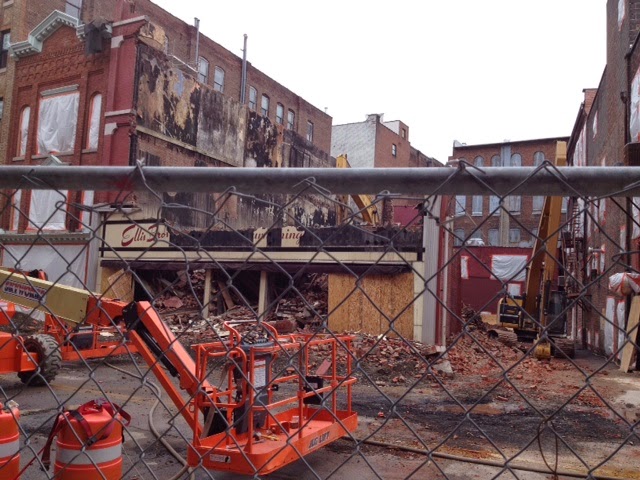
The Lamp in the Window

They thought they could recover after an April 30 fire.

They couldn't.  The building was judged to be in imminant danger of collapse.   The city condemned the historic building.  It had to come down.

It was a sad week in downtown Binghamton, as a 100 plus year old building has been demolished.  A family owned business, Ellis Bros, may leave downtown Binghamton, New York as a result of this fire and demolition. We are a small city in upstate New York, population around 47,000.  We can't afford to lose a long-standing business.
On May 23, the demolition specialists gathered.  The building on the right is the building about to be demolished.  The building directly to the left of it is another historic building, and there was danger that if the demolition wasn't done right, it could be damaged, since the two buildings touch.

There was a lamp barely visible in the window.  My walking companion had had her eyes on that lamp for some time, but now it was too late for her to do anything but view it in the wreckage.
On May 27, demolition started.  By lunchtime, when I came out to look, most of the back was missing, and the workers were at lunch.
Another view, showing windows to nowhere.
Yesterday, the building was more or less down.

A final, farewell view.  I don't know if any parts of that building are salvageable, such as the 100 plus year old bricks, but I do know that the county is waiving part of the "tipping fees" (fees for using the landfill) in an effort to keep Ellis Brothers downtown.

Has something like this happened where you live?

Thursday, May 29, 2014

Best of AM - Mail Order Chickens

This post, with some edits and additions, was first posted in August, 2010.

I never realized that Iowa is the #1 egg producer in the country. 

I lived briefly in Iowa in the 1970's and have been back several times since.  When people think of Iowa, they think of (not necessarily in this order):  Pork, soybeans, corn.  In fact, if you ask my son (who has been to Iowa several times) what he remembers of Iowa, he remembers  miles and miles of boring cornfields.  I don't think I saw many chicken houses there.

When I think of Iowa, I also think of local food, of heritage breeds, of farmers who still care.  Iowa does have at least one heritage breed poultry breeder, who we bought from several times when we lived in Arkansas:  the incomparable Murray McMurray Hatchery.

Iowa also has wonderful, friendly people and a wonderful place we have never been to-the headquarters of the Seed Savers Exchange in Decorah, Iowa and its Heritage Farm..

Exactly the opposite of the current egg scandal farm owners, the folks at Seed Savers work to keep genetic diversity in our seeds, and also seek to keep heritage breeds of certain animals alive.  Their work deserves to be well publicized. 


Too bad Iowa right now is in the news for something totally different-tainted eggs. Half a billion eggs recalled. Thanks to factory farming, shipped to 22 states. It would seem these farms have had many violations-the "same old same old".  I could go into a rant about food safety regulations, but this is not a political blog.  So instead I would like to share some memories of when Iowa farming goes right.

I have fond memories of visiting the Iowa City Farmers Market.  Iowa City is a college town so, as you could expect, they had their share of organic booths.  Of course, everything was locally grown and made.

Yes, in Iowa the small farmer still exists, marketing the most delicious pork and beef (sorry, vegetarian readers), plus all the usual veggies.  In a climate hotter than ours in the northeast, one even saw okra and some other southern favorites for sale.

But I promised to speak about mail order chicken memories. I want to share something about raising chickens and "growing" our own eggs, all from Iowa chickens.

Back in the 1980's, when we lived in rural Arkansas and kept chickens, we would spend the New Year perusing the Murray McMurray catalog, with its brightly colored pictures of what was even then called "rare" chickens.  These are the chickens with names, not numbers:  Barred Rocks, Rhode Island Reds, Black Australorps, Buff Orpingtons, New Hampshire...and on and one-about 130 breeds total.

We would make our selection and place our order (in the mail, of course).  No internet, no fascinating website giving pictures of their operations, no instant update of stock on hand.  Rather, we placed our order and waited for the day we specified.  We did it the "old fashioned" way which, in those days, was the only way.

On the appointed day, there would be a phone call from our local rural post office.  We had to come and get them; they would not deliver.  The box, cheeping away, was rushed home.  In a miracle that we could never get tired of, the living chicks survived the trip.  Just imagine opening a box and being greeted by 25 cheeping 2 day old chicks!  We would take each one out gently, dip its beak in water, and put each precious chick in a little pen under a warm light.  The waterer and feeder were made from mason jars screwed into special "lips".  We fed them commercial but unmedicated chick starter.  After a day or so, they would be ready for supplementation with the occasional June Bug attracted by the light.

This next part is not for the squeamish.  The chicks would get hold of the unfortunate bug and chase each other, trying to snatch what was left of the large bug (it didn't last very long) in a game of chick free-for-all.  The whole while, they would be screaming in delight.

Don't ever say baby chicks are cute.  Not unless you've seen one of those feedings.

You have to love chickens to know them. You have to accept their nature.  Chickens are omnivores, and they lust for blood.  If one of those chicks accidentally got cut, it would have suffered the same fate as that bug.

Then, those chicks would grow, and about 6 months later the female (pullets) would start to lay their small beginner eggs.  The males?  Well, that part isn't for the squeamish either.  (I'll leave the part out about how roosters treat the hens.)  Nothing like a wonderful, thick shelled, fresh egg.  Except if you want to hard boil, in which case you want a slightly aged egg.

We never worried about salmonella.  We ate raw (from scratch) cake batter.  We even made (gasp!) real eggnog!

We moved back to urban life in the mid 1980's, and our chicken life was over. 

But what about Iowa, land of Seed Savers and rare chicken flocks? (At least in 2010 Murray McMurray was still using local farmers to produce their eggs for hatching.)

Moral of story, more important than ever in our brave new world of GMO's:

Support your local farmer.  Know who produces your food.  Know HOW it is produced. Ask questions. Ask lots of questions.

That's one way to protect yourself.

Wednesday, May 28, 2014

Spring Things - Speeding Through May

What a difference a month (give or take a couple of days) makes in upstate New York. 

Forsythia, May 1.
Bradford Pears, May 7.
Lilac, May 16.


Tulip, in my front yard, May 22. Now, almost all the tulips are done.
Azalea, May 22.
Last daffodil in our yard, May 26.
Yellow Mollis Azalea, May 28, West Side of Binghamton, New York.
Spirea May 28.

Is it spring where you live?

Tuesday, May 27, 2014

Best of AM - The Little kitchen of Horrors

This is a true story, first posted in 2011.  I've edited it slightly.  This post is without photos for a reason, as you will soon read.

One day I was cleaning up dishes after breakfast when I saw a little blur to my right, where our stove is.  I know that means a mouse so I turned.  Right next to the stove was a mouse, staring at me.  We started at each other.  I know the mouse must have been startled and would run and hide under the stove.  But no. This mouse stared at me, not sure of what to do, ran across the floor, ran across the floor again back to the beginning and finally (running so close to me that I nearly screamed) ran into the one former bedroom (currently my library) on our ground floor. 

I am not ashamed to admit I ran out of that kitchen and left the dishes half done. I stayed out for about 5 minutes before I would even go back in there.

I left spouse a note, and he bought some mousetraps, put one out that night. Yes, I am not ashamed to say that when it comes to mice, I run for the spouse.

Yesterday morning I saw where the trap had caught a mouse and he disposed of it.

This morning, I went into the kitchen to heat up breakfast and there was a sprung trap by the stove, with a little dead mouse lying underneath the sprung trap.

So I went about my business when suddenly there was a loud clatter and a high pitched squeaking, like an "ee ee ee" but even higher pitched.  THERE WAS ANOTHER MOUSE AND THAT MOUSE WAS ATTEMPTING TO DRAG THE TRAP BEHIND THE STOVE.  But the space was too small.  It kept trying and trying.  I had to eat my breakfast hearing that pathetic "ee ee ee" and the occasional bumping of what I knew was the mouse trying to drag the trap.

The squeaks were so loud. I never went back in to see the final, er, disposition of the matter.
I don't want to speculate if that mouse was trying to save the other mouse, or the relation of the other mouse to him/her.  Or if mice have those types of feelings.  It was creepy.

When my spouse came home from work, he saw the sprung trap and wondered why it was jammed up against the stove.

Now tonight, we have to try to get the other mouse.  How many more are there?

Stephen King would know what to do with this story. 

Do mice take revenge?

And can I ever, even indirectly, kill a mouse again after seeing that sight this morning?

Monday, May 26, 2014

A Scrap of Silk and a Virtual Blood Chit

As the daughter of someone who served in the U.S. Army Air Force during World War II, this story of a scrap of silk was of interest on a  day which has become most interesting, if you hang out on social media on a United States Memorial Day.

The scrap of silk in that blog post is called a "blood chit".  In the instance of the military member whose blood chit is discussed in that post, it was an American Army Air Force man whose plane crashed in China in World War II while flying a mission against the Japanese.  He did not survive.  The local people buried him, kept the chit, and helped recovery workers a year or so later find the grave. This was their way of honoring this man's service.

A blood chit is a document of some sort which is carried by soldiers serving in a place where they can not speak the language.  It gives information about the person carrying the chit so someone who finds the person, injured or worse, can help and knows just to do  They aren't only used in war - for example, a French balloonist who toured the United States in 1793 was given a blood chit by George Washington in case he was lost or injured while ballooning.

Flag placed on curb near Johnson City, New York
 Besides this story from the National Archives, my Facebook timeline seemed to be split between people thanking the military for their service and people who are watching the horror of our VA care scandal with increasing anger.

I think all of our veterans who suffered injury, physical, mental, or both, in their service should be issued a blood chit the minute their service ends. The Veterans Administration (VA) system they manuver speaks a different language and has a different culture.  The vets gave their bodies and minds, and the VA turned its back when they needed help the most.  Records were falsified.  Vets died waiting for treatment, caught in an uncaring bureaucracy.

 But, our country has a long history of not doing right by their veterans - including the disabled veterans of World War II.  I know that because my father was one of them. He never lost his faith in the VA that, at the end, failed him.  My husband is a Cold War veteran, and while he did not serve in combat, he did serve in a dangerous career field.  So, for four years of my life, I was a military wife, and my eyes were opened to a lot of things-including how much of the mission of our military is borne on the back of military dependents.

Parking Space in front of Home Depot, Johnson City, NY
I did not post a "thank you for your service" badge on Facebook.  Instead,  I wish I could give all veterans, past and present, a virtual blood chit.

I want to thank everyone for their service - from the children of the several women I know whose children came back from Iraq and/or Afghanistan with PTSD or other ailments, to the members of the "Silent Generation" who shed their blood to destroy the Nazi threat  If they hadn't done that, I may never have been born.  I want to thank the children I grew up with who served in the Vietnam War, and endured an even worse turning of the American back.

I want to thank the men and women who served with my husband, including the interracial military couple in love who could not find anyone in 1970's Wichita Falls, Texas who would marry them, because that kind of marriage wasn't acceptable in the 1970's. Even if said service members were sworn to give their lives for the freedom of said people, no one would do that one thing for them.

All of you - I DO thank you for your service.  It's amazing, that each generation still sends its members marching off to war, and we still treat our vets with lip service and not much else.

When will our veterans, past, present and future, truly be honored by everyone, including their government?

Sunday, May 25, 2014

Best of AM - Civil War Sunday - Memorial Day and the Civil War

Tomorrow, in the United States, it will be Memorial Day.

This is a portion of a post I wrote for Memorial Day, 2012.  I feel it is appropriate for my Civil War Sunday feature.  I have added some new material for this year.  This will be the last Memorial Day that is held during the 150th anniversary of our United States Civil War.  As such, it is special.
 
This day, sadly, has evolved into a major shopping event for many people, missing the element of what it originally stood for.  I must admit, I will be participating in some of those sales.  It is also thought of as the "unofficial" beginning of summer.  In my area of Binghamton, NY, the area carousels we are famous for open for the season, as do the lakes, and some other recreation areas.

But in memory of my late father, a disabled (non-combat) veteran of World War II, I will also take some time to honor his memory and those of other veterans I know.   Which leads me to a discussion of how this holiday originated here in the United States.

This holiday, in my youth, was celebrated on May 30.  Today, it is the last Monday of May, to allow many to have a three day weekend.

There are several versions of the origin of Memorial Day.  Some of the stories depend on if you were from the Federal side, or the Confederate side, of the United States Civil War (1861-1865.).  What the stories have in common is that Memorial Day, once known as Decoration Day, originated in a desire to honor the sacrifice of those who died in our Civil War.  The Library of Congress lists several stories.  Here are what are perhaps the two main origin stories:

Waterloo, New York, considers itself the birthplace of Memorial Day, and has a federally recognized Memorial Day museum.  According to this story, Henry Wells, a local druggist, suggested a holiday in the fall of 1865 to honor the sacrifice of Civil War dead.  The idea gained traction, and the first Memorial Day was held on May 5, 1866.

But there are other stories. One takes place in Mississippi, a state late a member of the Confederate States of America.  As that story goes, many of the wounded of the bloody battle of Shiloh (1862) were taken to Columbus, Mississippi.  Columbus ended up with its Friendship Cemetery full of Civil War dead of both sides.  Eventually, the Federal dead were relocated to other area cemeteries.

According to Columbus, the first Memorial Day was held on April 5, 1866, as the women of Columbus decorated the graves of both Federal and Confederate soldiers buried in Columbus.

Mental Floss has more interesting perspectives on Memorial Day. 

A North and South Carolina sisters blogging team has still another perspective.

Some states of the former Confederacy also have separate holidays, called Confederate Memorial Day, or Confederate Heroes Day.

While I am speaking of cemeteries where Civil War dead are buried, I would be remiss (building on yesterday's theme of differences in how North and South refer to aspects of the Civil War) if I didn't mention the differences between Federal and Confederate gravestones.

Regardless of what the "true story" of Memorial Day is, I want to leave you with a modern, local story - the story of a family of a soldier from Pennsylvania lost in the Vietnam War. 

May your Memorial Day tomorrow be a meaningful one.

If you do not live in the United States, do you have a holiday to honor war dead?

Saturday, May 24, 2014

Sustainable Saturday - Carolina Gold Rice

A "Best of" post from 2011.  Since I reran some of this trip in April, it's timely.  And, yes, we picked up more.....

Carolina Gold Rice

My recent trip to Charleston, SC held several pleasant surprises for me.  First and foremost, was our proximity (an easy walk down the narrow sidewalks of the historic Ansonborough neighborhood where we stayed, a walk appreciated by my gimpy back) to the Charleston City Market.

 The Market consists of several open buildings in a four block area. These are the entrances to two of the buildings.
The Market (at least, at this time of year) is not primarily a "farmers market" and not all the goods are locally produced, either.  But we had a wonderful time talking and interacting with some of the local artists, and went back several times.  (note, there are no pictures of those artists or their work.  I would not ever do that without permission, and I know many artists do not want pictures taken.)  If I end up posting photos of some work in the future, it will be of work that I purchased and credit will be given.)

One product that is local, and a revival of a historic heirloom food, is Carolina Gold Rice.

What we bought was grown locally and distributed through Charleston Specialty Foods. The distinctive yellow cloth bags packages of this rice are sold by several vendors at the market, and also are for sale at various historical venues throughout the Charleston area.  As the bag explains:

"In 1685, a distressed merchant ship paid for repairs in Charleston with a small quantity of rice seed from Madagascar.  Dr. Henry Woodward planted the seed in South Carolina, beginning the state's 200 year history as the leading rice producer in the United States."


So why should you pay a lot more for an heirloom variety of rice than the plain old (I won't mention any brand names) stuff you find on the supermarket shelves?

For various reasons, the cultivation of rice had slowed in the South Carolina low country, and much "Carolina Rice" is actually grown outside of the Carolinas.  (2014 update - yes, one of those reasons was the freeing of the slaves after the Civil War was over. It's a fascinating story, which deserves its own blog post.) The Carolina Gold Rice Foundation is attempting a comeback for this rice, and as the bag also explains "We are proud to be South Carolina's first product made with Green-e Certified Renewable Energy."

So how can you go wrong?  In one swoop you encourage the production of heritage foodstuffs, and support renewable energy and sustainable agriculture.

The rice can be ordered online or by calling 1-877-RICE-4-YOU. (and please note I am not being paid for this, or any other, endorsement I may make.)

So, how does it taste?  And what is the rice like?

I would judge it as medium grain.

It's definitely distinctive, and delicious.   Spouse (our family cook) made a pilaf with it.  It came out fluffy, and nice.

(2014 update - it also tastes like butter has already been added to it, especially if you try the white rice, which we bought this time around.)

Have you ever eaten an heirloom rice?

Friday, May 23, 2014

Thoughts on Blogging a Book Part 2 anda Blogathon Announcement

Back in January, I wrote a post called "Thoughts on Blogging a Book Part 1". 

(Thank you, those who commented and sent encouraging advice.  I didn't comment back, but it did mean a lot to me.)

Those who know me well will not be surprised that it took me nearly five months to post my "part 2". During that time, there was the tail end of my elderly mother in law's cancer treatment. A wisdom tooth extraction that was complicated (I only got discharged by the oral surgeon on Monday).  A couple of trips.  More care giving stuff (medical bills, my mother in law falling again, and more).  My back problem flaring up (and I'm not done with that yet, either.)

But now, in the next month, my care giving journey with someone with autism may be kicking into higher gear.

There are millions of children with autism in this country.  They are growing up. The first children of the "autism epidemic" in the United States are adults.  More become adults every day.  One day, their parents will be old.  What then?

I've blogged about autism on this blog, and maybe I haven't done it enough.  It is a part of my life that I should be sharing with my readers more.

I have a brother in law (in his 50's) who has autism.  I sometimes feel like a trailblazer - there is a lot of information out there for those who have young children with autism, or even teens, or young adult children.  But siblings in their 50's?

Not so much.

That's where I come in (maybe).

By blogging, I can give the parents and the siblings of these people a glimpse into what happens next.  I can give them a glimpse into my struggles - what my mother in law, and I, were able to accomplish with the help of others and what we failed at. I hope I can help others avoid the mistakes we made.

I've even thought about writing a book about this journey.  Not to be famous, not to have my book made into a movie.  Rather, I want to share what I've learned.  I don't know if I will ever have time, especially now, as my care giving efforts are increasing.  Time passes and my mother in law gets older every day. As do all of us.

Sometime in June, my spouse's guardianship application to become his brother's guardian will be heard in court.  During that time I will be spending even more time with both an aging my mother in law and the brother in law with autism.

Blogging, and looking into turning some of the posts into a book one day, could be a good first step to consolidate some of my thoughts.

I was hoping to use a 2014 WordCount Blogathon to kickstart this book.  The very first WordCount Blogathon I participated in (2011) made my blog what it is today - through it I found the Ultimate Blog Challenge and the rest is history.  I've also been blogging daily since late April of 2011 and I need a different challenge than just blogging daily.

So, my decision is made.  I am going to test the waters and devote a lot (not all) of my June blog to autism.  Maybe not to a book, but to something that may become a book.  This year, the Blogathon is a bit different, and seems to be concentrating on business bloggers, but I am still going to participate.

Right now I plan to keep my Spring Things (which will turn into a "Summer Something" when summer begins in June) but Sustainable Saturday and Civil War Sunday may not be regular features for June. We'll just have to see.

Please don't miss my flower pictures too much. (I can always insert some into the posts "just because".)  And, please, please don't leave me.  Don't let the word "autism" scare you, or think my June blog will bore you enough to click on that mouse or touchpad.

Even if you don't think autism will ever impact your life - it probably will.  One day.  And that one day may be sooner than you think, if you are having children, if you are having grandchildren, if you are an aunt or uncle.  Or if you work with children in any capacity.  Or if you have next door neighbors.  Or if you are living and breathing. (The blog will not debate the causes of the autism epidemic or even if there is one.  I'm focusing on our family situation.)


I value you, my readers, so much, even if I don't say it enough. (I don't).  I am going to ask that you take this journey with me.

See you at the 2014 Blogathon!

Thursday, May 22, 2014

An Innocent Mistake - The Binghamton Salt Babies


In March of 1962,  Binghamton, New York and some of its residents were struck by a tragedy that would make national headlines, and would stick in my nine year old mind.  I never realized that, one day, I would make that community my home.

Back in September of 2009, and then again in September, 2012, I blogged about this tragedy, which led to the death of six babies and changes in the method of infant feedings in hospitals all over the United States. My post centered on speculation concerning if a certain woman seen downtown was the nurse accused of this mistake.  (I now doubt it, based on a conversation I had a couple of years ago with someone who worked at the hospital where this took place, although not at the time of the incident.)

Several people commented on my blog posts.  Some comments are heartbreaking.

An author, Jo Michaels, suggested I might want to write about this.  I wrapped some of my research into a "fictional memoir" I wrote for National Novel Writing Month (NaNoWriMo) in November of 2012.  But as for writing that book - I couldn't bring myself to do it.  Even 50 plus years later, I suspect some of these babies (now grown, of course) still live in this community, as might their elderly parents or other relatives.  Some witnesses still live here.  The last thing I wanted to do is stir up emotions or cause any pain. 

But nothing would prevent me from reading newspapers and other "period" coverage of the event.

I started my research, during NaNoWriMo, by reading articles in the March 23, 1962 issue of Time magazine and the April 27, 1962 issue of Life magazine. The story of the Binghamton Salt babies started out as a normal day at Binghamton General Hospital on March 6, 1962, according to the Life article:

"In the formula room a white-capped practical nurse, licensed by the State of New York and on this day in charge of preparing the babies' bottles, lifted the lid from an aluminum two-pound sugar container and saw that it was only half full. She decided to refill the can.

Following the custom of the hospital, she placed the can on a metal cart, rolled it down the corridor to the elevator, descended to the basement and pushed it along a subterranean tunnel into the hospital's main kitchen. She lifted the two-pound can from the cart and placed it on the floor between her feet in front of two identical, shiny 20 gallon containers standing side by side under a low shelf in dim light. Am small paper tag pasted to the lid of one big container bore the word "Sugar" in plain handwriting Another tag like it was attached to the body of the container.  On the other lid the label was born, but on its fragments the letters "S" and "lt" could be made out. "

How many times was this scene repeated in other hospitals throughout the United States, I wonder. A dimly lit room? A salt container with a worn label?

The Life magazine article continued:

“The practical nurse reached into one of the containers and grasped a scoop. With two scoopfuls she all but filled the small can, enough to supply the formula room for about a week.  She wheeled the cart back upstairs.

By the next night, Wednesday March 7, there was trouble in maternity. Five days later, six babies had died in convulsions." 

 
This was only the beginning of a story with all the elements of a top notch drama - tragedy, mystery, an accused nurse herself a mother, a bomb threat, a race against time to find a way to save the poisoned babies, and much, much more.  And I declined the writing opportunity.

Thank heavens an award winning documentary filmmaker, Brian Frey, decided to make a documentary for our local PBS station, WSKG. Last night, he was going to share his research and archival material, but my back wasn't up to it.  Regretfully, I did not attend his talk.

A promo for the documentary has apparently been on You Tube since 2010, so I wonder when this film will be released.  I suppose I would have found out tonight.

When I do find out more, I plan to blog about it.

Is there a famous or locally famous event that took place in your childhood, which has fascinated you every since?

Wednesday, May 21, 2014

Spring Things - It's....Dare I Say It? Hump Day!

It is - dare I say it - Community Gardens and Home Hump Day.
Time to get out there, and get the seeds and plants planted.  (Although, unlike traditional office workers getting the weekend off, we do some of our gardening work on weekends.)


At home, I've put my hanging baskets together - more on that another time.

My spouse has been busy at our community garden plot. Some of the above plants were started by us; others were purchased, and almost all of these (except for the big pink pot) transplants went out yesterday.  Spouse transplanted winter squash and red Chinese beans, and two lima bean plants.

We used to plant squash directly in the ground, and are experimenting with starting the seeds in peat pots this spring.  We decided to extend the experiment to one type of bean, as we've been having problems with predators eating bean plants.

Swiss chard and carrots are germinating, meantime. The opening of our community garden was delayed this year because of a water pipe problem, and we are trying to make up for lost time.
Meanwhile, our two Earth Boxes have micro greens growing, soon ready for the picking.

Our ginger is planted - yes, you can grow it in upstate New York.

Happy Wednesday, whether you garden or not.

Tuesday, May 20, 2014

These Are Our Colors

Here are the colors of spring in upstate New York.  I bring these to you lying down, as I've re-injured my back. So I am going to take it easy for the next several days. I skipped my exercise/photography walk tonight. These photos were taken in the past two or three days, except the redbud.
A dogwood, taken close up, in shades of pink and white with yellow centers.
Rhododendrons bloom at the same time as dogwoods.  Here, they show off in red and pink on the West Side of Binghamton.

Here, purple as in a weeping redbud (a couple of weeks ago) in majestic purple.
Creeping phlox in purple, white and lavender.
Little lantern columbine in red.
A purple rhododendron.

And, an orange begonia I bought for a hanging basket.

What are the colors of the season you are in?

Monday, May 19, 2014

Grabbing Spring Before It's Gone

Today, some more of the beauty of spring, this time from last week.
A chojuro pear tree (Asian pear) in bloom last week in my neighborhood near Johnson City, New York.
My neighborhood in upstate New York is heavily planted in crabapples. Some years, they are barely in bloom for a couple of days. 

Last week, we enjoyed their fleeting beauty for about four days, as they were finally done in by a combination of heat and thunderstorms.  This picture was taken in late afternoon sun.
Another view.
One more shot of beauty, this time in a different lighting.  This view gives more of the pinkish color.

They are gone now, replaced by lilacs.  Our dogwoods are also approaching the end of their bloom.

Spring is traveling through upstate New York so quickly. We must grab it before it's gone.  Right now it's in the 30's, with a frost advisory.  I hope this is this the last really cold morning until August or September.

What's the weather like for you today?

Sunday, May 18, 2014

Civil War Sunday - Feeling a Battlefield

My interest in Civil War battlefield came quite accidentally.

I've always enjoyed history. I started college with a history major, although I changed my major in my freshman year when the college courses I took didn't have something I was looking for.  I found that "something" in cultural anthropology, but my interest in history remains.

Back in the 1980's, I lived in Arkansas.  My trip to work five days a week took me right past an Arkansas state park that commemorated a Civil War battle, the Battle of Prairie Grove.  One day, my spouse and I visited Prairie Grove State Park just because it was there. We had passed it so many times, we just wanted to see what it was all about.

Each September, they had an excellent crafts show there called the Clothesline Fair.  

But that was the extent of my involvement with Prairie Grove State Park

The second battlefield was near a highway also traveled on to get to my employment - Cane Hill. All I knew of it at the time was a marker along Arkansas Highway 45. I only got to see the actual battlefield last year.  There is no park, but historical plaques are now here and there.

The third battlefield was in Virginia, and was the one that ignited my interest in visiting battlefields - Spotsylvania Court House.  I have no photos - my visit predated digital photography and are in an album somewhere needing to be scanned. But what I do have is my memories, as we commemorate the 150th anniversary of this terrible battle, May 8-21, 1864.  
 
There is an area on the battlefield called the Bloody Angle, where a twenty hour sub-battle at close quarters was fought in pouring rain on May 12-13, 1864.  It was the longest sustained hand to hand combat of the Civil War.  In a Smithsonian museum in Washington, DC, the stump remains of what was once a mighty oak tree that fell as night descended is on display. The tree, felled by artillery and small arms fire in the unrelenting fighting, injured several Confederates as it fell.

At the end of the two week battle, 43 men had won the Medal of Honor.  Five generals were killed or mortally wounded.  One, John Sedgwick, had a major street in the Bronx named after him, near where I went to high school and college.  I also lived for several years in Sedgwick County, Kansas, which is also named after him.  And years later, we visited the battlefield where so many people - some 20,000 plus dead, wounded, missing, captured - fell.

As my spouse and I walked along the Bloody Angle, we felt an...energy, a....something.  Perhaps the spirit of massive death in a small space.  Perhaps, the fortifications that still remain helped us feel something of what happened that day.  We have felt this feeling at other battlefields since.

But Spotsylvania Court House was our first.

Saturday, May 17, 2014

Sustainable Saturday-Aging in Grace

 As some of my readers know, my spouse and I are long distance caregivers for my mother in law, who is in her mid 80's and went through radiation treatment for cancer earlier this year.  We are also advocates for my spouse's youngest brother, who has a developmental disability called autism.  By choice, my mother in law has chosen to keep that son at home, and has refused other housing choices for him.

There is a movement in my country, the United States, called "aging in place".   The hope, for many aging people, is that they can remain in their homes, perhaps with some various modifications. And, part of this movement involves entire neighborhoods. Sometimes, as communities evolve, they become what is called Naturally Occurring Retirement Communities.

For example, this is the biggest Naturally Occuring Retirement Community in the United States.

This is Co-Op City, in the Bronx, one of the five boroughs of New York City.  When it opened in late 1968, many people I knew moved there - people raising families.  Now, those people are retired, and many are still there.  You can say that a Naturally Occurring Retirement Community is an organic expression of a true community, as people of all ages live together, and all of their needs are met.

My mother in law, miles away, has lived in her house for some 50 years.  During that time, it has gone from being in a semi-rural community (she lived near a chicken farm, right off a dirt road) to a suburb of New York City. 

Now she is a widow living on social security in a place where taxes are high, and food and other things are way more expensive than where we live in upstate New York. But, she doesn't have access to many of the services she would be eligible for if she just lived a couple of miles south of where she does live.  She's in a county that is still basically rural, and the services she needs just don't seem to be there. 

Her area is not in a Naturally Occurring Retirement Community.  She's struggled to keep her independence, but the house that seemed good for her and her family when she and her husband were raising several children is now a trap for her.  It is a split level, and her mobility continues to deteriorate.  She has knee issues, and her physical condition rules surgery out.  There are stairs everywhere. 

I certainly didn't take aging into consideration when my spouse and I bought our house.  We were in our 30's. I didn't yet have a bad back and arthritis in one knee.  We are fortunate, because we have everything we need on one floor except our washer and dryer - when we bought our house it was a ranch, and we added a second floor after our son was born.  And, we live in a community with more services for seniors than some other counties in New York State.

It could be better.  But it's a lot better than the community where my mother in law lives.

Yes, we all make decisions that seem right at the time, but times change.  We can all hope that we get the opportunity to Age with Grace. 

Soon, we, and her, are going to have to make some hard decisions.  The one piece of good news is that my spouse's application for guardianship of his brother in law is moving forward, and will be heard in court sometime in June.

As a result of the latest events, I may be rerunning some classic RamblinwithAM posts in the coming weeks.  I hope you enjoy these glimpses of material from the five years of this blog.