Wednesday, May 14, 2014

Spring Things - High Anxiety

No lovely photos tonight, although I have some nice ones to show you.  Please, if you want to see the beautiful part of spring, come back tomorrow for Garden Bloggers Bloom Day.

Spring can sometimes be a time of high anxiety here in the United States.  It's beautiful, but don't be fooled.  It can be deadly.

Early this morning, flash flooding hit upstate New York. This took place less than 100 miles from where I live in the Binghamton, New York area..

Tornadoes in Nebraska.  

I used to live in what is called "tornado alley", so I've had a taste of tornado anxiety. ( I missed this tornado, one of the worst up to that time in the United States, by slightly over two years.)  And now, the city it terrorized and where I used to live, Wichita Falls, Texas, thirsts so for water that they are thinking of treating their waste water for drinking purposes.

And spring isn't over yet.

The neighborhood I live in flooded in 2006 after a weather system stalled and rained, day after day.  It then flooded again in 2011. For us 2011 was a record wet year that climaxed with two tropical storms several days apart.  I've written quite a lot on my blog (check posts after September 8, 2011 if you are interested.) about the aftermath of the 2011 floods.  Only now is the town tearing down some 36 homes in my neighborhood that were less fortunate than my house.

When a book was written about that flood by the local newspaper, an aerial view of my neighborhood was on the cover, although far more neighborhoods than mine suffered - some, I know, even worse.

Since then, it's hard for me to enjoy the sound of rain on the roof, although the terror has faded with time.

But it doesn't take much to get the anxiety going.

Today, we got up to 82 wonderful degrees.  But Friday's forecast is for a high of 66, a low of 44, (I'll let my European friends do their own conversions today-sorry) and a "potential for heavy rain". After the flash flooding of today - well, it may be time for some high anxiety.

But there is nothing I can do about it.

What do I do? Just sit, wait, and enjoy spring while I can.  I'm happy to be alive, and I want to make the most of it.

Are you ever nervous about the weather where you live?

Tuesday, May 13, 2014

Community and Container Gardening Mid May Update

It was the best of times, it was the worst...

After such a harsh winter where we live near Binghamton, New York, my spouse couldn't wait to get his hands dirty at our community garden.   The ground had been plowed.  But it remained closed.

Frustrating!Normally, in our zone 5b climate, it's bad enough that we have to wait until the first week of May to plant, at the normal opening of our community garden at Otsiningo Park, in Binghamton.  Only one lucky year, we were able to start gardening in mid-April.

This year, the first week of May came and went with no opening.

Although we own a house, we have a small plot of land, and not that much of it is in full sun.  We found out the delay was caused by a water pipe problem. We were lucky - we nearly lost our plot for the year.

As it was, as soon as spouse saw the open garden, he immediately planted our onion and leek plants, which had already arrived in the mail.  Onions are one of our, if not our, best crop.

Today, my spouse drove down and spent 4 1/2 hours doing various chores and more planting.  Right now, there isn't much to take pictures of at the community garden.

Meanwhile, we take advantage of whatever sun we have, in the back of our house, with pots and with Earth boxes.  Our major foe here is groundhogs, and I'm sure they will be here any day now.

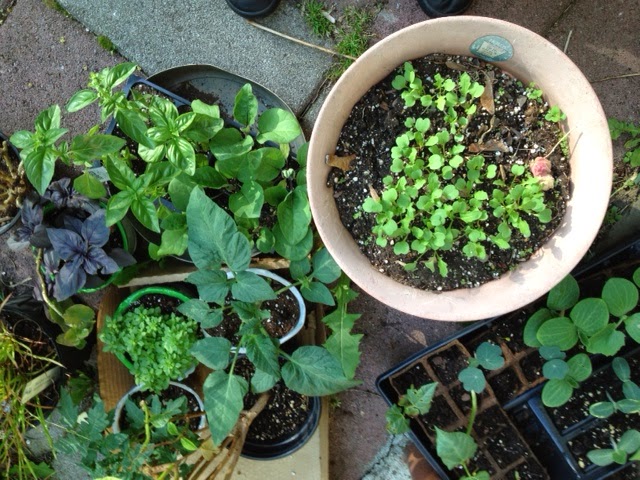
Here's what we have so far:

Italian parsley, elevated to deter said groundhogs.

An earthbox, planted with lettuce, spinach and other assorted greens.

A pot of arugula and some of our transplants (some homegrown, some not).

And a bunch of flowers, some of which I will show you on May 15, Garden Bloggers Bloom Day.

We still plan to grow ginger this year, after our "shocking" ginger success last year. Hopefully, it wasn't a fluke, but we need to plant soon.

Meanwhile, the transplants above await the last frost date.  Technically, for us it's around May 10, but we came close to a frost last week, and my son (who lives about 20 minutes from us) got down to 24 degrees on that same night.  So, a little caution is in order. Our community garden is several miles away and we just can't run down there and start covering things.

I will try to give you an update every two weeks - but you know how I am with my blogging promises.

Are you growing a garden this year?

Monday, May 12, 2014

Barns and Blooms in Upstate New York

This is so not New York City.
Some parts of the country had severe weather yesterday.  But here, spring is continuing. We finally got our first 80 degree day, and should have another one today.

A little tired after Mother's Day, I am letting my "guest photographer" provide some lovely pictures of white trees for today's post.  Later this week, I'll fill you in on some of the gardening my spouse and I have been doing.

My guest photographer lives out in the country, and this will let you see the hilly, rolling countryside of where I live in upstate New York.  So many people think New York State is New York City.  It isn't.

We don't have skyscrapers here.  What we do have is a lot of beautiful hills and rivers.  There are farms just a few miles from my urban home. And, by the way, a lot of New York State is not urban at all. 

Slowly, the trees are leafing out on the hills here in the Binghamton, New York area.  These photos were taken on May 10, incidentally.
Don't you love country roads?  I wonder where this road goes.


Is it time to take a journey?  Where would you want to go on this road?  Let me know in the comments.

Sunday, May 11, 2014

Civil War Sunday - The 100th Mothers Day

In 2012 - two years ago - I wrote this Civil War Sunday post on Mother's Day.  Below is my original post with some minor editing. 

Like so much related to the Civil War, the story of Mother's Day and the Civil War is more complicated than it first appears.  I wanted to expand on this story, as this year is the 100th anniversary of Mothers Day here in the United States.

So, a little update.

It would seem there are two women who are given credit for making Mother's Day possible - Julia Ward Howe (below) but also, a West Virginian by the name of Anna Jarvis.  And, as Mother's Day turns 100 this year in the United States, I've read about a not so well known part of the holiday.

Anna Jarvis' mother, Ann Maria Reeves Jarvis, had lost eight of her twelve children before they reached adulthood.  And, Ann had worked tirelessly to try to reunite Union and Confederate soldiers and their wives after the Civil War (West Virginia, a state that came into being due to the Civil War when part of the Confederate state of Virginia wanted to rejoin the Union, had plenty of both) by creating a "Mother's Friendship Day", complete with picnics.  In 1910, due to the efforts of her daughter, to pay tribute to the effort of her mother Ann,  Mother's Day became a state observance in West Virginia, and, in 1914 it became a nationwide observance.

But, eventually, Anna Jarvis regretted what she did, as the holiday became more commercialized.  She tried to undo what she had done and return Mother's Day to its roots - and, apparently, went insane in the process.

Mother's Day, in other words, is an extreme example of good intentions gone bad.

Although the holiday is way commercialized, it is (in my opnion) a nice time to pay tribute to our mothers - or, have our children pay tribute to us.  Or, for those who did not have a mother present in their lives, to pay tribute to a woman who influenced them.

To mothers everywhere:  Happy Mother's Day.

Civil War Sunday - The Civil War Roots of Mother's Day

So many things in our life here in the United States can be traced to the Civil War.

This will be a short post, as we spend some time with my mother in law. We will have dinner with her, hopefully help her learn to use her iPhone, and then return home to upstate New York.

And it is all because of the Civil War.

True, mothers were honored long before the Civil War, in many cultures and in many ways.

In 1870, a feminist by the name of Julia Ward Howe issued this Mother's Day Proclamation. If this name sounds familiar, she is the same person who wrote the words to what we now know as The Battle Hymn of the Republic.

What was behind this proclamation?

Julia Howe was quite aware that all the people who died or were maimed in the Civil War had mothers. These mothers sent their sons (and sometimes, in disguise, daughters) off to war - and sometimes, these sons fought on opposite sides, brother vs. brother

Her thought was to have an international day of honoring peace and motherhood.

Of course, our modern Mothers Day celebrations aren't exactly that. They are more celebrations of greeting card makers, chocolates, florists and other purveyors of goods suitable for giving.  I hope that my mother in law enjoys the basket of plants we are giving her.

As we like to say in our country, it's the thought that counts.  So, happy Mother's Day to my mother in law.

Saturday, May 10, 2014

Sustainable Saturday - Digging Ramps - or Not

Today, I got an unintended education.

My spouse and I visited the farmers market in Ithaca, New York, home of Ithaca College and Cornell University.

Unlike our farmer's market, in Binghamton (an hour away) which just started its outdoor season last Saturday, the Ithaca market at Steamboat Landing has been outdoors for a good month.  It's much larger than our market, too.

Ithaca has a population of about 30,000, but the three colleges there provide a lot of demand for high quality, organic produce.  It also helps that the Finger Lakes help moderate the climate, and the growing season in the Ithaca area begins sooner than ours does.
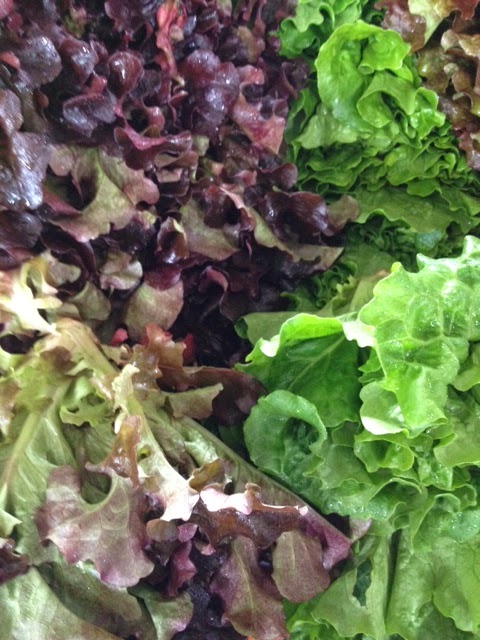
There was the usual lettuce, beautiful in various colors.
And there were a couple of surprises.  The first, fiddleheads, we passed up - I've had them and I'm not too fond of them.

The other surprise was ramps (or wild leeks). Ramps grow wild here in upstate New York, although I don't personally know any place to pick them.  I've tasted food cooked with them, but my spouse (the family cook) has never cooked them. We know a little goes a long way, and are wondering if we can grow these in a shady part of our yard if we plant a couple of the plants we bought today.  We may not want to cook these all.

However, in researching some recipes, I discovered a sobering fact.  It seems that the increasing appetite for ramps may be taking a toll on the wild plants.  In fact, their sale is banned in some places, although, at the present time, it seems New York State has no rules restricting their harvest.

If I had known there might be a problem, I would have asked more questions before buying these.  It could be that these were grown, and not harvested from the wild, or harvested in a sustainable manner.

It's too late to un-buy them, so I will eat them - and I might try to plant a couple of them in a shady part of my yard.

Do you know anything about ramps?

Friday, May 9, 2014

With Clouds of White

Every spring, here in upstate New York, I look forward to the blooming of the white flowers.  Many of them are Bradford pear trees, but there are other all white blooms here in the Binghamton, New York area.

I've also read that Binghamton averages 40 days of 80 plus degree weather (about 26.6 degrees plus, for my non U.S. blog readers) and that the average first date of 80 degree weather is May 5.

We still haven't gotten to 80, although, yesterday, we came close.  Maybe today will be the day.  We last hit 80 degrees here on September 11, 2013.  It's been such a long time.  Such a long, cold, time.

Today, the forecast is 79 degrees.

So let's celebrate with clouds of white.
Near NYSEG Stadium, Binghamton, 5-7-14
Whether or not we reach 80, nature is celebrating spring with clouds of white.
At the middle school where the late Rod Serling of Twilight Zone fame attended in Binghamton, the white trees lining the athletic field are out.
Bookish Bradfords at the Broome County public library garden.
It just isn't the Bradfords that are out.  I love these double flowers.
How about these all white daffodils?

Soon enough, the white will disappear, to be replaced by green.   So let's enjoy the clouds of white while we can.

What is your favorite flower color?

Thursday, May 8, 2014

28 Years Later

It's the things we can't see that scare us the most.

Chernobyl.  Actually, Pripyat (Chernobyl was a power plant, Pripyat was the city the workers lived in.) A city in the Ukraine, now abandoned except for some elderly who insist on living there.   Photos taken in the abandoned city show a rotting landscape of rusting buildings, overgrown yards with broken swing sets, weathered dolls, and even abandoned amusement rides.

You can even tour the area and, believe it or not, I have some interest in doing that.

To my generation, it's hard to believe that some 28 years have passed since we first found out about a nuclear accident in the then Soviet Union.  On April 26, 1986, life changed for thousands and thousands of people in the Ukraine and in Europe, including, possibly, a former tennis star from the Ukraine who passed away earlier this week at the age of 30 from liver cancer.

Since then, scientists have been studying wildlife in what some call the Zone of Exclusion and others the Zone of Alienation, where radiation levels are too high for humans to safely live there - although some people do.

It's even more amazing to me that some people only know Chernobyl from a game called Call of Duty 4.

Last night, I saw a post on my Facebook fall from Mental Floss, linking to a New York Times article about a scientist from the University of South Carolina studying life in the Zone of Exclusion.  His subjects of study include mushrooms, insects, spiders, birds, mice, voles, and bats.

His findings include insects with strange versions of their normal spots, spiders with warped webs, birds with deformed beaks. But they also include certain animals seeming to be adapting to the high radiation levels in ways that include the increased production of antioxidents.

Some animals even seem to be doing better in zones of higher radiation than in zones of lesser radiation.

Now, this scientist is also starting to study the site of the Fukushima nuclear disaster of 2011.
I wonder what scientific finds will be made at Chernobyl (and Fukushima) by the time my son is an old man, and what he will live to see.

Do you live near a nuclear power plant?

Wednesday, May 7, 2014

Spring Things - Spring Things Are Made of This

Spring, spring, glorious spring!  After our harsh winter here in the Binghamton area of upstate New York (not as harsh as some other places, and yet....) we are out celebrating the return of flowers and green - while wishing for some warm weather. Hopefully it won't get too hot too soon.

They say "be careful what you wish for." Years ago, I lived in Wichita, Kansas and over the weekend they hit 102.  (38.8 F for those who use Celsius.)

We haven't had this type of severe winter in several years, and we forget too soon what happens when the trees bloom late.  You get a quick glut of blooms all at once, followed by leaves and summer.

So tempus is fugeting (to mangle a Latin phrase - probably lost some of my blog readers just then, sorry) and it's time to get the iPhone out.
First, a photo taken Friday by my "guest photographer" of a cherry tree against the backdrop of one of Binghamton's landmark buildings.
A forsythia on the West Side of Binghamton, also taken 5-1 - these only bloomed for several days and are now leafing out.
On the other hand, some lilacs are already coming out, like in this picture from yesterday, also on the West Side of Binghamton.  Lilacs and forsythias together? Yikes.
A Bradford Pear from yesterday. Please, let this bloom for more than a couple of days.
And finally, my daffodils are finally in bloom.  My early ones never bloomed but my late ones are making up for it. First, yellow and orange.
And, finally, yellow.

It was so nice to come home from work today, and pot up some hanging baskets.  And, our community garden was finally staked out Monday, so spouse spent some time down there yesterday.  Time for a couple of gardening posts?

What is nature up to where you live?

Tuesday, May 6, 2014

The Ugly Stepsister of Cancer

While I would love to blog about spring today, there is something going on that I need to blog about.
White Hyacinth in my Front Yard

But first, a picture for my blog readers to enjoy.  In the language of flowers, hyacinth can mean consistency.  Or, it can mean "I'm sorry, please forgive me."

And now, the rest of today's story.

Last week, I got an email from someone I had a lunch date with.  She had been in communication with a woman she knew.  That person had "a cold that wouldn't quit." Finally, the person sought medical help.

It wasn't a cold.  It was lung cancer.  And before that woman could blink twice, she was being put into hospice care.  Her family called my friend and told her the woman was asking for her.

It was, needless to say, overwhelming. What do you do when you go to the doctor and find out you have something you never expected?  Well, my friend broke her date with me (good for her!) and went to her other friend - one who is suddenly making the acquaintance of the Ugly Stepsister of Cancer.

I decided to go to the library, now that I was without a lunch date. I found a wonderful book there, written by a local (well, from Ithaca, but Ithaca is only an hour from where I live in upstate New York) breast cancer survivor, called "When Your Life is Touched by Cancer". The author is Bob Riter. 

Yes, the author is male and is a breast cancer survivor.  Yes, men get breast cancer.  And, in fact, my spouse is at risk due to his family history.

There is one cancer that Bob Riter, who has worked with cancer patients as the executive director of The Cancer Resource Center of the Finger Lakes, calls "The Ugly Stepsister of Cancer".  It is lung cancer.

Lung cancer patients bear a burden no other cancer patients bear.  They find themselves required to explain their cancer, over and over.  "Do you smoke?"  "Did you smoke?" they are asked when they tell others of their cancer.

If no (which is the case of someone I know who has been battling lung cancer for over two years),  the patient has to explain that yes, some 15% of people who get lung cancer never smoked.

If yes - well, it's your fault.  No support for you!

Why, ever, would we EVER want to blame someone who has cancer for their cancer?  But my friend has been through this, and now my friend's friend will have go to through this, too.


Also, last Tuesday, I gave four trees to a work friend who lives out in the country to plant in honor of a late neighbor,who died while I was on vacation in April.  I can still remember the day he told me, matter of factly, that he had cancer, and how he was trying to make his peace with it.  (And no, I won't describe "his battle", because that's another thing Bob Riter talks about.)

Finally, last Tuesday, my mother in law found out that her cancerous tumor is dead, but she still needs testing to make sure the cancer didn't spread.  And, meanwhile, she has bills coming in.  She's elderly, she does not have boundless energy, and she asked us to help investigate some of the bills.  She seems to be falling through the cracks of help. Wrong cancer. Wrong place of residence.  Wrong wrong wrong.

Cancer has been on my mind a lot lately.  So what I did was....email Bob Riter.

And he emailed me back! 

What a marvelous person, and the people of Ithaca, New York are so lucky to have him in their lives.

He gave me some starting points with which to help my mother in law.  And, he recommended that I give my friend with lung cancer a copy of the "Ugly Stepsister of Cancer" essay. He's generously posted it online for any of us to read. (To my friend,  I'm sending her the essay.)

If you have cancer, or have a loved one or friend with cancer, I highly recommend this book.  It is a treasure.  It covers so much, in simple language and in easy to read bites.  Bob Riter has thought of everything.  Well, everything but the line of Hallmark cards I'd REALLY like to see, but that's a blog post for another time.


And now, I hope I don't have to talk about cancer again for a long, long time. But, sadly, I know that is not going to happen.

Monday, May 5, 2014

Downtown Buildings and Plants Bloom

Is it possible to have spring beauty in a downtown urban setting?

YES!

We in upstate New York had a cold winter, and now we are having a cold spring.  I work in a small city of about 47,000 with a downtown that is starting to recover from some less than ideal last 20 or so years.  But, it isn't hard to look and find some real beauty in downtown Binghamton, New York.

Part of the beauty of photography is being able to play with natural light.  On Friday, when these pictures were taken, it was mostly cloudy with some breaks of sun. and I took a picture of a magnolia from a couple of angles at around noontime.  Here, everything is dark.
This is when the sun came out.

A small weeping cherry near a monument on the lawn of the Broome County Courthouse.  Don't you love the blue building in the background?  This is the Perry Block, designed by architect Isaac Perry (the architect who designed our Albany state capitol), and construction on this building started in 1876.  This is the only cast iron building in our area

Flowers paired with a historic downtown Binghamton landmark.

Some white blooms in our Broome County library garden. Yes, our downtown library has a garden. I wonder if the library will be "lending" seeds this year, which it has done for the past two years.

To remind us that it is, indeed spring, I will try to bring you some mspring photography for several days this week.  And, if I get any requests, I can feature more of the architecture of downtown Binghamton.

Is it spring where you live? What is the weather like?

Sunday, May 4, 2014

Civil War Sunday - The Wild Battlefield of Fire

One modern newspaper article from a city in the former Confederate States of America called it "the beginning of the end".

And, tomorrow at 4pm, church bells throughout the state of Vermont, a state that stayed with the Union, will toll.

Some of those bells, it is hoped, are bells as old as our Civil War.

Why?

Tomorrow is not just the Cinco de Mayo, a day of celebration in many parts of the United States that, ironically, commemorates an 1862 battle in a different war.  Tomorrow  is also the 150th anniversary of the Battle of the Wilderness, a two day battle that pit some 65,000 Confederates of the Army of Northern Virginia, under the command of General Robert E. Lee, against the approximately 120,000 strong union Army of the Potomac, now under the command of General Ulysses S. Grant.

This two day battle took place in a wilderness of tangled growth, where soldiers could not see each other, and the weapons of war set the thickets on fire.  Medics couldn't reach the wounded because of the limited visibility. Hundreds and hundreds soldiers burned to death and shrouded the entire area in smoke.  This battle became its own special kind of hell.  When people who study the Civil War think of the Wilderness, the first thing they think of is "fire".

This battle was the beginning of the Overland Campaign, which would prove to be the bloodiest campaign of a bloody Civil War.  This battle took place so close to where Stonewall Jackson had been mortally wounded the year before.  In fact, if you visit the area, you can see four famous Civil War battlefields within comparatively short distances to each other.

I remember visiting the Wilderness battlefield many years ago.  At that time I had not studied much about the Civil War, and wondered why what I was looking at was basically a forest.  I was used to seeing battlefields that were nice and open, and had visitors centers.  We wandered around trying to find the visitors center until we gave up, ironically, probably driving on the very roads where combat took place.  (Even today, there is no visitors center).  You can now take a virtual tour, but back then, there was no Internet.

Although stalemated, Grant drove his men south, instead of retreated, as other Union generals had tended to do. 

So, Grant's men marched, towards a place called (using the spelling of the times)....Spottsylvania Court House.

And there..... (to be continued).

Saturday, May 3, 2014

Sustainable Saturday - Behind the Scenes at a Local Grower

These past several years, I've shown you lots and lots of plants.  Herbs, vegetable plants, and lots and lots of flowers.

Have you ever wondered how the bedding plants, herbs and vegetable plants you might buy each spring get grown?  I have, and today, I had the opportunity, with others, to take a "behind the scenes" tour at Nanticoke Gardens, outside of Endicott, New York.

Thank you to Broome County Cooperative Extension for hosting this Farm Tour.  Nanticoke Gardens was one of the stops.  The tours, if you are able to come, continue tomorrow.

Nanticoke Gardens grows almost everything they sell - but how do they do it?  In short - it's a lot of work, and a lot of it, more than you might think, is done by hand.  And, like so much of farming, it's a gamble - a gamble on the weather, a gamble on people's likes and dislikes, and a gamble on changing trends in what people in upstate New York want to grow.

The co owner of Nanticoke Gardens showed us parts of their operation where the public isn't normally allowed, and allowed me to take some pictures.

The plants they sell are propagated in several ways - seeds, unrooted cuttings, and rooted cuttings.
Seeds are planted by hand, and grown in small cells at first.  Meanwhile, the unrooted cuttings (which include the Million Bells I love so much) must be misted and given water in the correct amounts to "bring out" the roots. What you see in the back are rows covered in "reemay" row covers - which we have used ourselves in our gardening.  The co owner demonstrated the automatic sprinklers for us.
These are some of the "unrooted cuttings", more grown up.   Some cuttings, the co owner explained, they can only get rooted, because they don't have the licenses to allow them to grow unrooted cuttings.  Although he didn't get much into the issue of licensing, it is a topic of some interest.

We watched a woman transplanting tiny seedlings, like these, into larger pots.  Part of the work that is done by hand, I don't think I would have the patience to do hundreds of these at one time.

Fungicides must be used in commercial propagation.  Where possible, Nanticoke Gardens uses a biological fungicide called T-22 to reduce their reliance on other fungicides.

Nanticoke Gardens is one of a small number of commercial nurseries still growing their own begonias.  Many are now grown in the Southern United States.  Begonias need a long growing season to get to selling size, and a lot of heat.  These are started in November.
And, in the back, room for expansion.  Nanticoke Gardens grows seedlings for some local small farmers, and also grows poinsettias for the Christmas market.

We were also told that the demand for herbs has been exploding the past four years or so, and they are increasing their supply of herbs. That's the one area I wish they would actually even have more available for sale, especially with scented geraniums and specialty basil.  Maybe one year....

An interesting view "behind the scenes".

Friday, May 2, 2014

Ready to Rise Again?

We've had another fire in downtown Binghamton, New York. It broke out about 7:30 Wednesday morning, and rapidly spread through the below four story building filled with furniture.

Downtown Binghamton was quickly filled with smoke. Wind, fortunately, blew it away from where I work, but our high school and some other businesses had to be evacuated.  The smoke was visible for miles.

Ellis Brothers has been in business since 1900.  The building doesn't look in bad shape in this photo, taken a day after the fire, but, in fact, the building was seriously damaged.  There's a possibility that the building may have to be demolished.


This is the block the building is on, with other turn of the century (the 20th century, that is)  historic buildings on both sides.  Downtown Binghamton has so much promise and so much interesting architecture.
The Ellis family isn't giving up. Today, a restoration company had a truck at the scene.


Downtown Binghamton has seen its share of fires, some of them tragic.  Fortunately, no one was injured in this fire.  Physically, anyway

I have no doubt that the local business community will embrace the Ellis family, because that is what people in small cities throughout our country do - rally at times of tragedy.  Of course, enough of us gathered near the building yesterday to check it out, because that is also human nature.

I hope I don't have to blog about another fire for a long, long time.

Thursday, May 1, 2014

Dancing Around the Maypole

The first day of May, traditionally, has been a celebration of spring.

No maypoles here in upstate New York that I know of.  No sunshine yesterday, either.  Rain and gloom ruled the day.  But we were so much luckier than others - record one day rain to the east and south of us, tremendous flooding in northwest Florida, a street collapse in Baltimore, and the out of whack weather punishes people around the world again and again.

I wish so we could send the rain to Wichita Falls, Texas.

But, somewhere, the sun is shining and people are dancing around maypoles.

I have vague memories of dancing around a maypole. It was probably at my elementary school in the Bronx, in New York City, where I grew up.  It may have even been something called Dance Festival.


In some parts of the world, maypole dancing is an art.

What is dancing around the maypole like? Well, it involves ribbons, dancers and some intricate steps.
Frilly costumes are optional.

What about us in upstate New York? It's foggy right now. The rain is supposed to clear out in the afternoon with temperatures reaching near 70F (21 C).


Is dancing on the first day of May part of your culture?

Wednesday, April 30, 2014

Spring Things - Art Me Up Buttercup

The weather gets more extreme and scarier.  As I write this post, the death toll from the tornadoes of the past several days stand at over 29.

I was in North Carolina barely two weeks ago, before this weather outbreak.  Now, as I write this, parts of North Carolina not that far from where I took these pictures are under a tornado warning.

I'd like to think back to that trip, earlier in April, before the tornadoes came, when we toured the outdoor exhibits at the North Carolina Museum of Art in Raleigh.  Some of the exhibits were intentional, made by man.  Others were there, waiting to be appreciated, brought to us by Mother Nature.

Dogwoods bloomed by a lake.
 Legs in pink sneakers, made by man, and below a dogwood.  Which do you like better?
Can you see it? In the lower right hand corner?
Violets, at the edge of the woods.
And finishing up with a buttercup.

Nature.  Beautiful and deadly. Two sides of the world we live in.  We won't see dogwoods for another few weeks here in upstate New York where I live, so I appreciated the chance to see them in North Carolina.  But, the severe weather, that's something that is not our turn - yet.


This is my last post of the April Ultimate Blog Challenge.  Next month, what do I have in store for you?

You'll just have to come back daily to see.

Tuesday, April 29, 2014

Weeding My Mental Garden

I was not feeling very good about blogging last night.  I was finishing up the Ultimate Blog Challenge, and feeling like I didn't get very far with it.  I couldn't spend a lot of time on it this month, and didn't get the benefits I could have, as a result.  I'm feeling a bit burnt out right now, feeling like I don't have that many readers, and obviously was feeling a bit sorry for myself.

I barely got 5,220 words in my Camp NaNoWriMo manuscript.  Maybe I'll work on it some more in July.  Maybe.

Or, I can be grateful that I'm here, waking up every morning.  It's time to weed my mental garden.

I think I'm feeling this way because my mother in law is going to her oncologist today and, from all indications, she will be told she is in remission.  But several other people I know struggle on. Perhaps it is natural to feel guilty, in a way, although if she continued ill it wouldn't help the other people I know. And, she copes with aftereffects of the treatment she received, including fatigue, and our general long distance caregiving for her continues.

Only two weeks after a neighbor died from cancer, I really need to be reminded of how fortunate we who are not battling for our lives are.  Time to pull some more mental weeds.

This is what I REALLY need to do, instead of feeling sorry for myself.

1.  Support my friends more.  I haven't even contacted my friend down in Brooklyn recently.

2.  Report that, today, I am giving several trees to a work friend, who will plant them in my late neighbor's honor.  Remember I have people in my life who care for me, and, again, thank them all.

3.  Post a beautiful photo. (Here you go.)

Near Charlottesville, VA, April 16, 2014
This is a farm I photographed from our car on our way back from Charleston, SC a couple of weeks ago. Can anyone I know imagine themselves on that picturesque plot of land?

4.  Stop complaining about the cold/windy weather in upstate New York. Hope no one I know is in the path of those terrible tornadoes that have hit Arkansas  and Mississippi (19 dead so far) in the past couple of days.  Spring can be beautiful in the United States, but it can also be deadly.

5.  And finally: Thank you all, my faithful readers, for sticking by me for another month.  Next month, May, is my favorite month of the year, and I am gearing up to bring you more spring beauty, some gardening tips, and updates on my brother in law with autism and my spouse's effort to gain guardianship.

Please join me in weeding your mental garden, and here's to a productive May.

Monday, April 28, 2014

Six Lessons of the Orchid

I am an eternal optimist when it comes to orchids.

I've killed some, and I've made some rebloom.  And, each year, I go to the orchid show at the local mall and end up buying something new.

With orchids, it's all about the journey.  There are so many different kinds of orchids - literally thousands of them, and some even grow wild here in upstate New York.

Next month, I will share with you my latest orchid adventure.  Today I want to treat you to several pictures of the show orchids. It was the perfect day for an orchid show - a gloomy, overcast, windy day with a biting wind.

I can envy people who can grow these orchid beauties, but I know they aren't doing anything I can't do. All I need to do is devote the time to learning the craft of the orchid.

What else can I say but: Beautiful! 

What I loved about this display is the use of various natural materials - moss and wood.
White and lilac - stunning.

What do orchids teach us?

1.  They teach us to pay attention.  Each orchid has its own needs.  You must pay attention to moisture, to the amount and kind of sunshine, to proper orchid nutrition.

2.  They teach us to be patient, because an orchid blooms on its own schedule.  You can not make them bloom. (well, maybe you can, but why would you want to?)

3.  They teach us how thrilling it is when an orchid reblooms.

4.  They teach us that failure is only a stepping stone to success, if we don't give up.

5.  They teach us that spring is not a steady process, here in upstate New York.  Spring advances and retreats. Today was time to retreat indoors, after we completed some yard work, and consider the orchid.

6.  Orchids, and spring, are worth the wait.

Spring will return. One day, it will return for good.

Have you succeeded in doing something hard, which seemed impossible at first?

Sunday, April 27, 2014

Civil War Sunday - A Woman of the Civil War

We are coming up on the anniversary of some major Civil War battles.  With that, I want to take up a suggestion of one of my blog readers, who asked me a couple of years ago (sorry it took so long!) to check into the lives of some lessor known Civil War figures.

One of the most fascinating of them was Sarah Emma Edmonds, a Canadian woman, who participated in the Civil War as both a man (disguised as a man, that is) and a woman.

Several months ago, I saw a book in the Young Adult section of our local public library called "A Soldier’s Story: the Incredible True Story of Sarah Edmonds. A Civil War Hero" by Marissa Moss.  I didn't have a chance to really look at the book due to what else was happening in my life at the time. It's too bad, because the story is one fascinating story.

Initially Sarah ran away to escape an intolerable home situation, disguising herself as a man, and working as a traveling Bible salesman in the United States.  When war broke out, she enlisted in the Union army and worked a number of positions, including in combat, in nursing, and in espionage.  She ended up deserting. Sick with malaria, she was fearful her female identity would be discovered.

Once she recovered, she continued to work in the war, as a woman.  Her memoir, written in 1864, is available online.  

After the war, she married, had three children (all of whom died in childhood) and adopted two other children.

In her fight to be awarded a military pension, many of the men she served with supported her efforts.  I think, of everything, this is what fascinates me the most about her life - given the times, and the attitudes towards women, I admit to a bit of surprise as to how her fellow soldiers rallied around her. In order for her to be awarded a pension, the charges of desertion first had to be dismissed - and, finally, they were.

Even more astonishing, Edmonds is the only woman to have been inducted into the Union veterans group Grand Army of the Republic, although she was far from the only woman who fought in the Civil War.

Is there a "person not widely known in history" (any part of history) who fascinates you?

Saturday, April 26, 2014

Sustainable Saturday - They Didn't Get His Goat

Today, in the Triple Cities of upstate New York, it was time for Earth Day celebrations.  At a local liquor store (whose history is a little controversial, including whether the store can truly be called "local"), they were having tastings of various organic wines from several countries, along with organic cheeses, crackers and almonds to go with the wine.

There were also tastings from a New York State winery, one with a fascinating history.

Anything with a chicken on the label is worth trying, I say!
The story of Bully Hill Vineyards is the story of Walter Taylor, a man who said his birthright and name had been taken from him - but they would never get "his goat".  As a result, some of his wine labels (many of his labels used his own artwork, and his artwork is still used today) featured goats.   (you can find a lot of those labels in an Internet search).

Since he wasn't able, due to legal reasons, to even use his last name on his wine, there would be a "blank" where Taylor's last name would have gone.

Walter (blank) would have been proud to have been called a gadfly.


Today, at the tasting, the sales hook was simple:  Bully Hill was sampling boxed wines, made from native grapes. At one time, boxed wines had a stigma of lack of quality.  That is disappearing in some circles, although there are still questions about whether the plastic liners have BPA. 

But, that little box has as much wine as three 750 ml bottles, and costs a lot less to ship.

I am not a wine connoisseur so don't come to me for advice on whether a wine is good.  I grew up on sweet wine (very sweet wine, if the truth be known), and I still savor (well, drink) sweet wine.

 Many grapes grown in New York State are hybrids.  But these wines are made from native Niagara and Concord grapes.  (the above wine is a concord wine). The wines are sweet.  Bully Hill is not the smallest winery in New York State - far from it, but that also means that people as far away from New York as Indiana and Iowa can sample this wine made from native grapes.

Sweet and good, I think. I enjoyed each of the above wines. (Bully Hill, incidentally, also bottles wine - it isn't just sold in boxes.)

My spouse and I may have met Walter Taylor in 1988, when visiting Bully Hill.  Nowadays, years after Taylor's death (he passed in 2001) I can't be sure, after all these years, but I wondered, because the man I met at the tasting counter was loud, outspoken and, to use a cliche, "larger than life".  We never will know.

My readers who are interested in independent men and women would have loved Walter Taylor.

If you are interested in wines made from native American grapes, you may want to give this wine a try.

Do you have a local "character"?

Friday, April 25, 2014

3711 Photos

See the title?  That's how many photos I have on my iPhone.

No, I'm serious.  I hoard photos.

It's understandable in a way, considering that I am 61 years old.  When I was a child, my most prized possession was a box type camera, with two settings (B&W and Color), a flash (which used - yes, flashbulbs), and which took rolls of 127 film.

You got 12 pictures per roll.  Rolls were expensive.  So was the developing.

You didn't get to see your photos right away, either, so you had no idea if they had come out properly. Or if the roll of film had been loaded correctly, for that matter.   You had to get the film developed first, which took several days.  Especially if you were using color film, which was a luxury reserved for special occasions.

Now, with my iPhone, I point, click, and it's done. Instant photo. I can edit it on the spot with my (simple) photo editing software.  I can post it on Facebook.  I can send it by email and by message.  It's a dream come true.  For example, I took a walk today on the West Side of Binghamton and took these pictures of our sudden spring - it seems flowers are popping out by the minute.

Forsythia

Pieris Japonica (Andromeda)

This massive weeping cherry isn't even totally open yet. What a specimen!
This blue squill wasn't from today but they are still out.

And now, I've just sent these photos all over the world.  Could I have ever dreamed of this back in the film days?

I love modern digital photography.  I was slow to adopt it but I would never go back to film.  And, perhaps like a grown person who knew hunger as a child, I hoard.  But I don't hoard food.  I hoard photos.  That's the only explanation I can come up with.

Anyway, during my recent vacation, I ran out of memory.  I hurridly had to delete, delete, delete. (The pictures are already backed up on my computer). And you know what? I was deleting pictures of family and buildings and keeping pictures of flowers.  And I had all these flowers on my camera already.

But those weren't THIS year's flowers.

I couldn't delete the flowers.  So now I have a phone full of flower photos.  I'm hopeless.

Shhh, don't tell anyone.

Am I the only one who has thousands of photos on their phone?