Sunday, May 20, 2012

Civil War Sunday -Drayton Hall – Guest Writer Christina

Today I feature a guest post on my Civil War Sunday feature.  Please welcome Christina from the blog Lazy Bones Running.

Drayton Hall, located on the Ashley River outside of Charleston, South Carolina is “without question one of the finest of all surviving plantation houses in America” as declared by the South Carolina Department of Archives and History. The southern plantation house was built for John Drayton in 1744, passed through 7 generations and opened to the public in 1977 by the National Trust for Historic Preservation.  


Only three plantations along the Ashley River survived the Union Army after the civil war. Historians believe from reading letters that Drayton Hall survived the post-war destruction because it was used as a hospital most likely for small pox.  There are also 2 other less likely theories on how the house survived.  The first story is about a slave who told the Union troops the house was owned by a Northerner, which could have been Drayton’s cousin. The second theory is Sherman was in love with one of the Drayton women.

Drayton Hall is different than other historic houses in that it is preserved as compared to restored.  As you wander the rooms with a guide, you see the original plasterwork, a back circular stairwell and cracked, faded paint, much of it last painted after the civil war and it wasn’t painted again. You’ll even the see hole for the “toilet”, which fit a bed pan.  Still void of electricity, heat and plumbing, this is a true historic house. Especially after touring restored plantations with luscious gardens in the Charleston area, there is a stark beauty and appreciation experiencing the historic house in its raw state.


If you have an opportunity to visit Drayton Hall, make sure after touring the house to wander the spacious grounds and view the house through the reflection pond. 


Pictures by Christina at Lazy Bones Running 

Christina is a blogger from Phoenix, Arizona with a passion for running and travel.  In June 2011 she vacationed in South Carolina and fell in love with Drayton Hall, especially the reflection pond.  Visit Christina at Lazy Bones Running 

Saturday, May 19, 2012

Sustainable Saturday - Hybrids and Lifts

I had planned to use "Sustainable Saturday" mainly for food and agriculture, but am stepping a little out of my comfort zone for today's post.

Today, as part of the New York Heritage Weekend, venues all across New York State held open houses or festivals.  Since it was Sustainable Saturday, I visited a venue called the Center for Technology and Innovation.

This center is located just outside of downtown Binghamton, New York, in an industrial area.  They hold, I found out, several open houses each year.

One of the missions of this center is to preserve and restore technology that was developed in our local area.  (Did you know, for example, that innovative car companies operated in upstate New York during the early 20th century?) I will feature more about their mission in a future blog post.

Today, as part of Heritage NY, the Center was demonstrating the technology of tomorrow.  This included several types of hybrid or  vehicles and a hybrid lift that uses the downward motion of the lift to generate power back to the unit.

I have talked about BAE Systems, late of my neighborhood, and relocated in nearby Endicott (ironically, on the former IBM campus - IBM having originated in Binghamton, NY as a time machine manufacturer and then moved to Endicott and eventually the world) due to flooding caused by Tropical Storm Lee in September 2011 that destroyed their Westover facility.  This is one of the items that they manufacture - a hybrid truck


Another thing they manufacture is hybrid buses - they used to test these in my neighborhood and I would see them sometimes.


There were several electric cars on display:  a Chevy Volt (not made here but it was a local dealer displaying them) which is not a true hybrid; and an electric car that was once a regular "gas guzzler" 87 Dodge Daytona until modified by its owner, Jason Horak..  He explained the modification cost about $25,000. (not too cost effective, admittedly) but he can go 100 miles on a charge, which currently costs him about $2.00.  Here is an explanatory poster, and a picture of the back batteries.

Jason explained to us that although it appears that the batteries appear to take up most of the hatchback, in reality they are set pretty far down and he carries luggage, groceries, etc. in the back (with a cover, of course) easily.

This is a picture of the Chevy Volt, which, again, is not a true "hybrid" but does have a gasoline engine in addition to being able to run on electricity.


And finally, the lift, which is manufactured by local Raymond Corporation, a manufacturer of forklifts.

( here is a video demonstrating the lift in action).

Do you think a hybrid vehicle is in your future?  Does your home town use hybrid mass transit vehicles?  Or manufacture hybrid equipment?

Friday, May 18, 2012

Welcome Home

This post is a bit personal - and is meant to honor a neighbor, a friend of my son's, a reader of my blog (thank you) and someone fighting a battle with cancer.  You know who you are.

Welcome back home.  I was so glad, coming home from work yesterday, when I saw you sitting outside your house.  The last time I saw you was in mid-March, before something laid you low.

You looked good, sitting there in the spring sunshine.

I missed your posting your music finds from Pandora on my Facebook wall....er, timeline, or whatever they call it nowadays.  I missed your sometimes strange comments on my blog. (you do know what an unusual person you can be, don't you?).

Something tells me you are going to make up for lost time.  One day soon I will see you on your porch, repairing still another bicycle.  This is what you love to do.

You came home on a really beautiful day.  And I don't think you will mind if I share you with my readers and followers.  You deserve your 15 minutes of fame, in the sunshine.  Before you had to go away, you ordered some trees from Arbor Day Foundation for my son.  We intend to plant one of them for you. 

You've been a friend to so many of the boys in the neighborhood.  I'm sure they all missed you.

Here's a little welcome home gift for you.  This is a virtual rose from the garden of my friend in New York City.  It's an old fashioned rose and it smells so sweet.

So once again:  welcome home.  Your garden is waiting for you.


Thursday, May 17, 2012

Spring Things - Westover Purple and Pink

I forgot to tell the fans of my Wednesday Spring Things features that I was posting for a special theme day for the Word Count Blogathon I am participating in.  I owe my readers a big apology - I hope you came back today because I'd like to share some neighborhood flowers with you from my upstate New York area. 

In my garden, I am trying a Cherry Star Superbells in a container.
I also am once again trying a perennial viola.  I've tried a couple of times before, in containers, without success.  This time I have planted this plant in the ground.
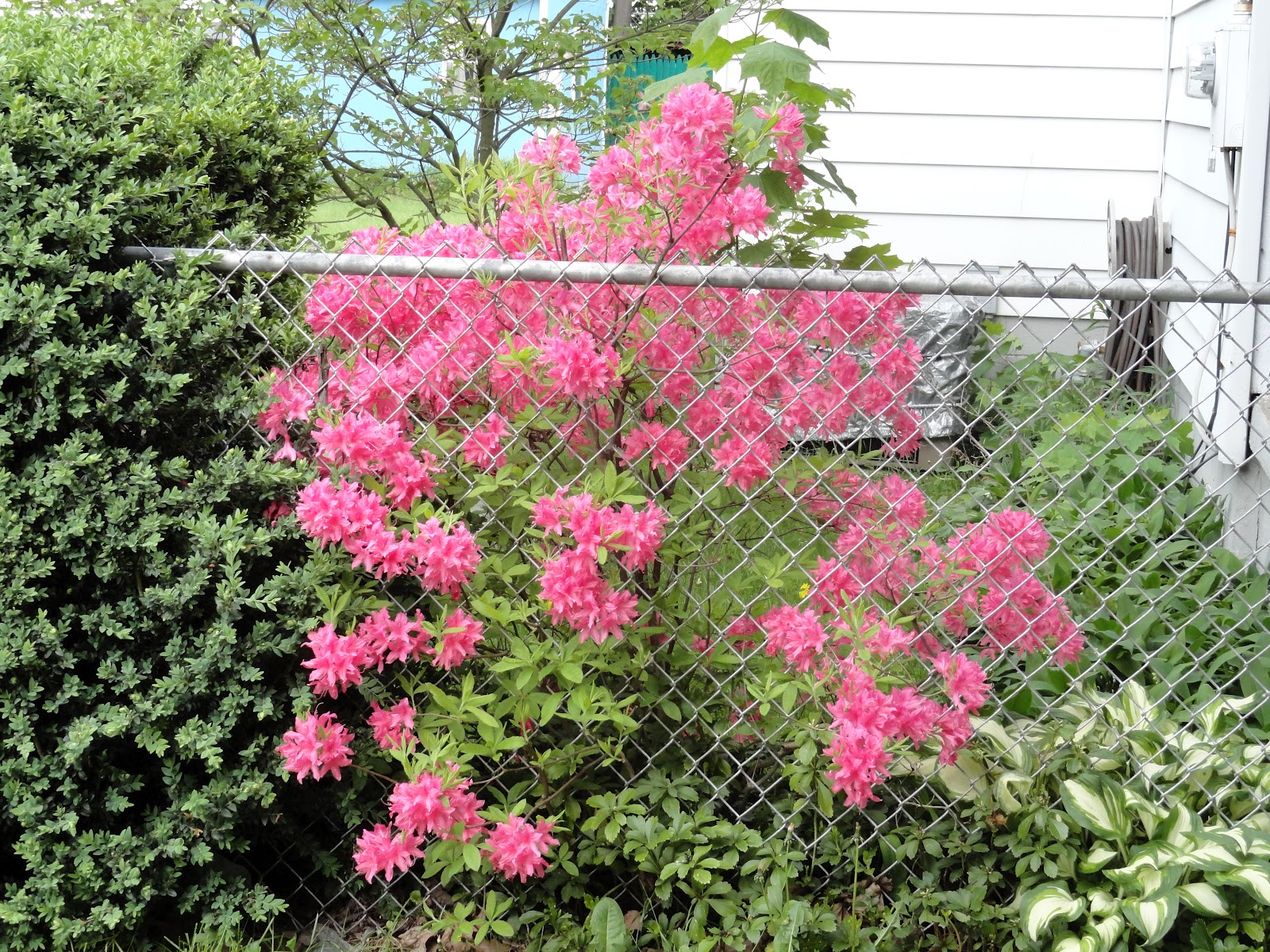
Nearby, a neighbor's pink rhododendron blooms.
Flowers don't have to be ornamental.  I noticed flowers on my chives this morning.  


And finally, here is my mystery flower of the week.  I'm a bit embarassed to admit this, but I see these around town and have no idea what they are.  I've tried looking in a couple of online catalogs but there are so many purple perennials out there that I am just going to be lazy and ask one of my kind readers to help me out.

Every spring, gardening hope blooms that the coming year will be successful. 

Nothing says "hope" like a blooming plant!  Don't you love these shades of pink and purple?  What an artist Mother Nature can be.

What's blooming in your garden?  What are your plans for this year, veggie or flower? (and if you are in the Southern Hemisphere - I'd love to hear from you, too.)


Wednesday, May 16, 2012

A Second Act of Snowbirding

It's time to flee the snow in my native New York for good.  I hope blogging is what will enable my escape.

In my case, I will be turning 60 later this year.   Every winter, here in upstate NY, seems harsher and harsher.  Walking in downtown Binghamton can be downright hazardous.

This past winter, with the grand total of one slippery-slidey morning, was a huge blessing.  I know it won't repeat.  Next winter, we may be back to our normal 80 plus inches of the white stuff.

I don't ever want to see another winter, experience walking in minus degree weather, or shovel ever again.   Yet, I love upstate NY, and want to continue to live here in the summer and fall.

I've been blogging every day for a little over a year now.  A half hour, an hour, of writing practice.  One day, I hope to have enough skills to be able to earn enough money through blogging, or writing, to make my dream come true.

This isn't the first time I've tried to write, though.

When I was in junior high, I wrote a book about a man who was stranded on one of the Canary Islands,   He found a race of civilized canary-men, and had various adventures with them.  By total coincidence, many of these adventures bore a striking similarity to those experienced by one John Carter in the Barsoom books of Edgar Rice Burroughs that I loved so much. 

Then, a month short of my 13th birthday, my mother died suddenly.

The bird-men book was forgotten.  Now, writing became my refuge from a world that felt like an atomic bomb had been dropped on it.  I poured out my pain on page after page of spiral notebooks, staying up sometimes to 1 or 2 in the morning. 

Then, I passed through my teenaged years and those writings were lost and forgotten, too.

Three years ago I discovered blogging and all that pent-up writing started to pour out. Then, in September of last year, my neighborhood, my area, flooded and once again blogging was a lifeline to sanity.

Blogging is so different from how I make my living now.  I have a full time job in an industry I have worked in for 35 years.  I have never been self-employed.

I am still thinking this through, and don't know exactly how I will structure my second act. Will I be able to ever have enough skills to freelance?  Could I write some kind of e-book?  And then what? Become a snowbird?  I know several people who snowbird, and this appeals to me.   I will have to work at least part time after retirement to make it happen.  If I can work from home - well, so much the better.

I will try my best to keep up that 1/2 to 1 hour a day pace.  Day after day.  One day I will be ready.

Will I be able to achieve my snowbirding dreams?  I can't wait to find out.

Tuesday, May 15, 2012

Garden Bloggers Bloom Day - May 2012-Spring Exhausts Itself

Welcome, WordCount Blogathoners and others to my 15th of the month post - Garden Bloggers Bloom Day.  This meme is brought to us by MayDreams Gardens - please visit her site and the other participating blogs after you check out my photos.  You will see plants and blooms from all over the world.

We are still running ahead of schedule here in upstate NY.  The lilacs (which had an off year) have already bloomed.  My irises aren't ready yet and my rhodies are just barely starting to open.


First up are the purple flowers.
Our columbine, purchased last year, is loaded with blooms.

Just in time for GBBD, my first rhodie bloom opens.


Here's a yellow flowered bleeding heart.

This is our yellow spurge (with some violas planted next to it.)

Speaking of violas, these are pansies we planted last fall.  They returned this spring and are blooming furiously, in red, purple and yellow.

I have lily of the valley blooming too, but they didn't come out well.  OK, be shy.


And finally, a little treat.  This is a telephone pole by our house.  A woodpecker loves to stop by and peck but we rarely see him/her. Yesterday evening, there was the woodpecker!  With maximum zoom this was the best I could get but - well, I have a long way to go as a wildlife photographer.  I'm glad plants stand still!

Ahhhh, spring.  Hope you enjoyed my little corner of upstate NY.  What is blooming in your garden?

Monday, May 14, 2012

A Rose Blooms in Brooklyn

Okay, it can happen to anyone.  I had a blog post up for tonight and then managed to accidentally delete it.  So I am going to try to repost it, but it just isn't going to be the same.

I spent this weekend in Brooklyn, one of the five boroughs of New York City.

Tourists congregate in Manhattan, with its skyscrapers, museums, Broadway theaters, and other well known attractions. But most of the population of New York City does not live on Manhattan Island.  They live in the five outer boroughs:  Brooklyn, Queens, The Bronx and Staten Island.  In those boroughs, they will find neighborhoods, restaurants, ethnic markets, and - trees.  Lot of trees. Small backyard gardens.  Flowering plants. Parks.  Birds.

I was born in Queens and grew up in The Bronx.  My Mom grew up in Manhattan.  My Dad grew up (and spent a lot of his life) in Brooklyn.  So, my heritage spans a lot of the great city of New York.

Why not join me in a little excursion out of Manhattan?  Let's hop a subway together - destination, Brooklyn.

 
In a childhood friend's backyard in Brooklyn, a fragrant rose blooms.  (I hope to feature more of her back yard sometime in the near future.)  These were just about done blooming - I was lucky to find this one still opening.

In a nearby front yard, pink and red roses bloom.  I could swear I heard a mockingbird sing.

And finally, in still another nearby yard, a Yellow Rose of Brooklyn.

Not everyone in Brooklyn has a yard.  Many people live in apartment buildings and condos.  But the lucky people who are able to own homes cherish every square inch of their small yards.

Have you visited New York City and ventured out of the familiar tourist areas?  If you did, I'd love to hear your adventures.

Sunday, May 13, 2012

Civil War Sunday - The Civil War Roots of Mother's Day

So many things in our life here in the United States can be traced to the Civil War.

This will be a short post, because I am on the road with my spouse today, traveling from New York City to spend some time with my mother in law. We will have dinner with her, hopefully help her learn to use her iPhone, and then return home to upstate New York.

And it is all because of the Civil War.

True, mothers were honored long before the Civil War, in many cultures and in many ways.

In 1870, a feminist by the name of Julia Ward Howe issued this Mother's Day Proclamation. If this name sounds familiar, she is the same person who wrote the words to what we now know as The Battle Hymn of the Republic.

What was behind this proclamation?

Julia Howe was quite aware that all the people who died or were maimed in the Civil War had mothers. These mothers sent their sons (and sometimes, in disguise, daughters) off to war - and sometimes, these sons fought on opposite sides, brother vs. brother

Her thought was to have an international day of honoring peace and motherhood.

Of course, our modern Mothers Day celebrations aren't exactly that. They are more celebrations of greeting card makers, chocolates, florists and other purveyors of goods suitable for giving.  I hope that my mother in law enjoys the basket of plants we are giving her.

As we like to say in our country, it's the thought that counts.  So, happy Mother's Day to my mother in law. 


Saturday, May 12, 2012

Sustainable Saturday - Say Cheese! Say Dexter!

For several years, the artisan cheese producers in upstate New York have attempted to establish a Cheese Trail.  New York wineries have the Wine Trail.  Why not a Cheese Trail in conjunction with the Wine Trail?  The combination is natural.  I'm not sure any other wine making area has created something like this (if they have, could you let me know?)

This year the cheese makers on the Trail will have four open house weekends.

The next "Cheese Trail" open house will be the Saturday and Sunday of the Memorial Day weekend.

One of the participants in May's Cheese Trail is a cheese maker called the Finger Lakes Dexter Creamery.  This cheese maker is doing something unique in the Western Hemisphere - making Kefir Cheese from Dexter milk. 

The Dexter breed, originating in Ireland, is an ideal breed for the small farmstead.  They are small, friendly, efficient and dual purpose - milk and meat.  The Dexters we saw back in 2009 when visiting the Finger Lakes Dexter Creamery were indeed friendly.

What is kefir?  It is not yogurt, although it is a cultured milk product. Many people attest to its health benefits although I personally do not eat it.  (The Kefir cheese, though, was definitely unique - in a good way.)

There are also a number of goat dairies on the Trail.  I miss the goat milk ice cream one of them, Side Hill Acres, used to have available for sale.  I only had it once, but the memory will live on for years.  Side Hill also sells kefir.


 Part of the spirit of sustainable agriculture is to attempt to buy local whenever possible.  I would ask you to buy from your local farmers whenever possible - at a local farmers market, on the farm (if possible) or even at one of the increasing number of supermarkets who are purchasing from local farmers.

If you do live in upstate New York - please find time to visit these local cheese producers.  You'll be pleasantly surprised at what you find.

Friday, May 11, 2012

To E-Read or Not to E-Read? What a Question

I've been thinking about this for a few months.  Should I join the e-reader movement?  Should I ditch my spare room full of dusty (well, some of them) books - some of which are over 100 years old - and buy a Nook or a Kindle?

This is not as easy a decision as you might think.

I love books, meaning physical books.   I love how they look.  I love how they smell (usually). I love their portability.  You can take a book and read it on the beach.  In the backyard.  In a bubble bath.  On a train.   Anywhere except in the rain. (why do I feel like I'm channeling Dr. Seuss right now?)  No charged batteries required.

You can pack a paperback in your suitcase.  Or even in a large pocketbook, ready for a suitable occasion.  You can read them in the sun.  You can read them in the bath.

And you can get books at the library.  I use the library so much I almost feel guilty about it.  I even pay fines with a smile, knowing I have just contributed to the library.  Ditto with library book sales, which are like chocolate to me.  It's the thrill of the hunt.  What will I find?   I spent time last Saturday at the Ithaca, NY library book sale, and left with a smile (and $27 of merchandise).

And, most of all....at some point in time, will publishers decide to discontinue books?  Will I, in a small way, help the demise of physical books if I get an e-Reader?  The last thing I want is to have on my life's resume is a part responsibility for the death of traditional books.  How could I live with myself?

Books are books.  You don't have to worry if your book is available in the right format for a Kindle, a Nook, or some other format.  You don't need an Internet or phone connection to get one. A well crafted book (no acid paper) will outlive me.  It may outlive my son.  An e-book?  Will the format be around in 20 years?

But, I have to face the fact that more and more of my friends and co-workers are joining the e-reader revolution. These people, mind you, are in their 50's and 60's.  They have lived with books all their lives, but they are choosing to get e-readers.

Why? 
1.  You can buy books that strike your fancy from the comfort of wherever you are.  A wonderful thing for impulsive people-until they get the bill.
2.  Free books or books that are cheaper than the physical editions.
3. Being able to adjust fonts.  Now, this is a big one for the senior reader.  Trust me, younger bloggers, on this one.  When you turn 40, this is suddenly going to get very important as print suddenly shrinks to the size of teeny-tiny ants.

4.  Privacy.  There was a hysterical skit on Saturday Night Live last Saturday (the content of which I can't mention in a family blog) about why a Mom would want a Kindle.
5.  If you travel abroad, you can easily get books in your preferred language.

And finally, one last observation.  I was dragged into digital photography kicking and screaming.  Within a day, I was absolutely hooked.  Why did we ever use film?  Well, film has uses but digital photography has uses, too.

So, maybe I will compromise, get an e reader, and keep my books.

What do you think?  Do you refuse to get an e reader?  Have you made the plunge?  And if so, do you use both your e reader and physical books?


Thursday, May 10, 2012

MacKenzie-Childs and Pinterest

I'd like to rework a blog post I posted back in 2009, when I was a relatively new blogger, to see how I might do the post today..  Because I pinned some of these pictures on Pinterest last month, the original post has suddenly received a lot of interest.  I have a feeling the people clicking through will be a little disappointed because my blog isn't full of fashionable furniture and crafts.

Now I wish I had taken a lot (back in the old days, we would have said "a few rolls") of pictures.  Of course, back then, there was no Pinterest.

If you are ever in the Finger Lakes region of Upstate NY, do visit MacKenzie-Childs.   Much of what they sell are artisan made pieces and the prices are not for the timid.  They do have affordable knobs and some other small items.

The landscaped grounds are free, and if you enjoy the combination of fine crafts and chickens, this is the place for you.  During the growing season, you will see some flower gardens, again free.

If their merchandise hadn't been so far out of reach for a lot of us, I may have featured this on one of my "sustainable Saturdays" - not because of the materials, but because of their support for artisans.  I wish I had the money to buy some of their merchandise.

If you are on Pinterest, feel free to pin these or other pictures on my blog.  Blogger does not have a good "pin" button, but hopefully one day they will.  Also, if you are more interested in this style, do visit the MacKenzie-Childs Pinterest boards.

MacKenzie-Childs: Not for the Timid

Almost three years ago we visted Aurora, NY (in the Finger Lakes) for the annual MacKenzie-Childs barn sale. MacKenzie-Childs is an upscale artisan crafts destination.. Their pottery, furniture, and other decorative items are...shall we say, quite bold. If you love checkerboard patterns, this is your place.


These are examples of some of their furniture.
Unfortunately, photography was not permitted inside their "farmhouse" which was decorated in this style: but this will give you some flavor of the kind of merchandise they offer.


Inside their farmhouse were even more examples of this art.  My favorite room was the bathroom, which was done in checkerboard tile.  Even the sinks were decorated.

Outside, there is a "chicken palace" where normally there is a nice collection of rare chickens - to my disappointment the chickens were removed for the occasion. They did leave some geese, who ran up to everyone who came close, waiting for a handout:


Here is a garden gate.  This shows the detail put into their garden gates plus offers a little peak into one of their gardens:


Finally, here is a view of one of their gardens.

Wednesday, May 9, 2012

Spring Things - Mysteries of the Vestal Rail Trail

A walk this Sunday brought a number of natural mysteries - I hope some of my readers can help me.

For example, this purple plant - there don't seem to be any others in plain view on the trail.  It was perhaps a couple of feet high.  Any guesses?

Next, is a very tall tree.  The green leaves towards the bottom of the photo are from a different tree.


Rather, the mystery is what looks like pick blooms from a really tall tree in back of it.  I took this with a 10x zoom, and this is the best I can show you- sorry, but this was too tall for me to get a good picture.  Some women were looking at this tree when we arrived.  None of us could figure out what this other tree is.


I wish I had smell-o-blog for this next one.  I tried to get a closeup and it didn't work that well.  These are elongated, narrow clusters of small white flowers with yellow stamens.  They smelled very sweet.  Maybe someone can ID these from the shiny leaves in the center of the photo. One of the flowers is just to the right of center.


And finally, butterflies (?) were flittering around a Russian Olive tree.  A few minutes later I found one of the same variety, lying on the ground of the trail. Dying of natural old age?  Or injured and dying?  I don't know.  Does anyone?

Can anyone identify any of these mysteries for me?

Tuesday, May 8, 2012

Put on a Happy Face - The 8 Month Flood Anniversary

Today is the 8 month anniversary of the flooding in the Binghamton, New York area due to torrential rains caused by Tropical Storm Lee. 

I've blogged so much about this that I can write the words in my sleep:  "flood", "Tropical Storm Lee".  But words don't really begin to describe the last eight months here in the neighborhood of Westover, near Johnson  City, NY.  We've seen the best in people (neighbors coming together) and the worst (a drug addict setting a flood-vacated house in my neighborhood on fire).

I was so lucky in comparison to so many.  The flood waters stopped before they got to my house, by a measured distance I still shudder to think about.  We had water in our basement, but we never lost power.  We lost part of our first floor flooring.  Our front and back doors are doing this weird kind of settling thing.  But enough people in my neighborhood lost their homes, either temporarily or permanently, though. Westover also lost a large area employer - 1350 people - when their 800,000. square foot building flooded.  Fortunately they found suitable quarters several miles down the road but those 1350 jobs were touch and go for a while.  They still aren't guaranteed safe, not that any jobs can be nowadays.

How do you measure progress?  By the number of cars reappearing in neighborhood streets, due to people slowly returning to homes?  By stores continuing to reopen?  By trees coming back and blooming this spring?  By our Westover Y, once stripped down to the concrete floors and a desk consisting of a card table and a computer, now carpeted and once again boasting a front desk?


In the very hard hit neighborhood of Twin Orchards, the garage of a house being fixed up sports a happy face


A few hundred feet away, a beautiful Russian Olive tree blooms.  Nature endures.
Ours wasn't even the hardest hit area.  About 15 miles to the west of us is the village of Owego, the "coolest small town in America".  Many businesses have reopened after months of clean up efforts.  I love the mural on this building.


And near our house, a flooded shopping center is again open for business.

Thank you to the businesses who have stayed.  Thank you to the people who fed the stricken of my Westover neighborhood in the days after the waters receded.   Thank you to the employees of Wegmans Supermarket and BAE for going door to door to offer help when your own businesses were closed due to flooding.   Thank you, Maureen McGovern, for honoring a Westover fan with a visit and singing at a flood relief concert.

And thank you, dear reader, for allowing me to tell this story still another time on this, the 8 month anniversary of our flood.


Monday, May 7, 2012

What Disaster Movies Leave Out

Today is a theme day in the 2012 WordCount blogathon.  We are prompted to blog about five movies that have influenced our writing.

I don't watch movies that much, but I would like to approach this prompt from another angle:  Movies of the People.

Hollywood movies don't necessarily tell the true story of disasters.  We found that out on September 7 and 8, 2011.

These You Tube clips are going to look awfully boring to you if you have the time to watch them.  No explosions, no car chases, no high drama of mountains tumbling into rubble or Transformers blasting apart New York City or Hoover Dam.  No aliens, no Earth in danger, no superheroes flying through the sky to push back the asteroid about ready to hit. No, this was a different kind of disaster. 

This disaster started with heavy rains and ended up with rivers pouring into cities, into towns, into peoples' houses.  Roads were literally torn to pieces.  We were lucky here in the Binghamton, NY area because no one died (although my next door neighbor had to be deep water rescued from his SUV).. Some towns in upstate NY look like a giant hand picked them up and dropped them from a few hundred feet.  My good friend's mother still doesn't have her local supermarket.   The closest one is some 20 miles away.  She's 92 years old.

These two You Tube clips are the attempts of two local people with cell phones or video cameras to document what was happening around them.  The first clip, which I watched a number of times in the two months after the flood, features a drive down some streets in Johnson City, NY.  The music is "Mad World" by Gary Jules.  It sets the mood quite well.  The drive starts at a point a bit more than a mile from where I live.  Watching it, in a way, helped me make sense of some of this.

The second clip features some beautiful photography. If you don't have time to see the clip, at least see the beautiful sky a few seconds into the clip.

Disaster movies never show the aftermath, either.  The clean up, the putting back together of buildings, businesses and lives omehow never makes it onto the silver screen.  These clips won't show that part, either.  Because, you've got to admit, the truly dirty work isn't dramatic.  And movies, quite honestly, don't do "boring and everyday" too well.

That's what bloggers are here for.

Tomorrow, I will share some recent photos and let you know how we are doing with the part the movies don't show you on the 8 month anniversary of The Flood.

Sunday, May 6, 2012

Civil War Sunday - Forgotten Helmira

One of the saddest chapters of the United States Civil War history is the story of Civil War prisoner of war camps.

At the start of the war, prisoners were exchanged fairly quickly, many times right on the battlefield.  The exact systems used for this and later "paroles" are beyond the scope of this blog post, but there are a lot of sources online to read more.

Eventually these systems broke down.  By the end of 1862, it was recognized that prisoners, on both sides of the war, needed to be held in a more permanent manner.  And this is where the horror really started.  By the end of the war, over 50,000. prisoners, from both sides combined, had perished.

Mention the word "Andersonville" to any well-educated American adult, and they will immediately recognize the name of what may have been one of the worst, if not the worst, of these prisons.  The site is located in Georgia not that far from Americus (home of Habitat for Humanity) and Plains (home of former President Jimmy Carter). Today, you can visit Andersonville.  I have, and I highly recommend that you do so, no matter what your nationality or ancestry.  There is a Prisoner of War Museum there that you can spend hours in.  Both Andersonville and the Prisoner of War museum are free of charge.

As my host in Americus told me, victors write history.  The North won the Civil War and it is important to note that the North had its share of notorious prisons for its prisoners of war.  The worst, perhaps,was Elmira Prison, located about an hour from where I live, in the City of Elmira, NY.  Its prisoners called it Helmira.

At Helmira, don't look for a developed historical site, with multiple monuments, as you will find at Andersonville.  Don't look for a visitor's center or a museum, either.  In fact, if you don't know exactly where the site is, you may never find it.  Signs in downtown Elmira point out sites related to Mark Twain, who summered in Elmira for 20 years.  You will find no sign pointing you to Elmira Prison.

What you will find, if you persevere, is a residential neighborhood and a vacant lot near a city boat launch, and a building owned by the City of Elmira water department.

There is also a flagpole with an informational plaque.

There is also this monument. 

Please note the monument is dedicated as much to the Northern soldiers who trained at the site before it was a prison, as to the Confederates who died there.  Such a difference from Andersonville, where the Prisoner of War museum aims to make the POW experience universal.


This is part of the boundary between the camp and the neighborhood, something called Foster's Pond.  The pond is about 1/3 the size that it was during the 1864-1865 period when the camp was used as a prison.  It was open for just about a year, and had to remain open after the war ended in April of 1865 as some of the prisoners were too sick to be transported home.


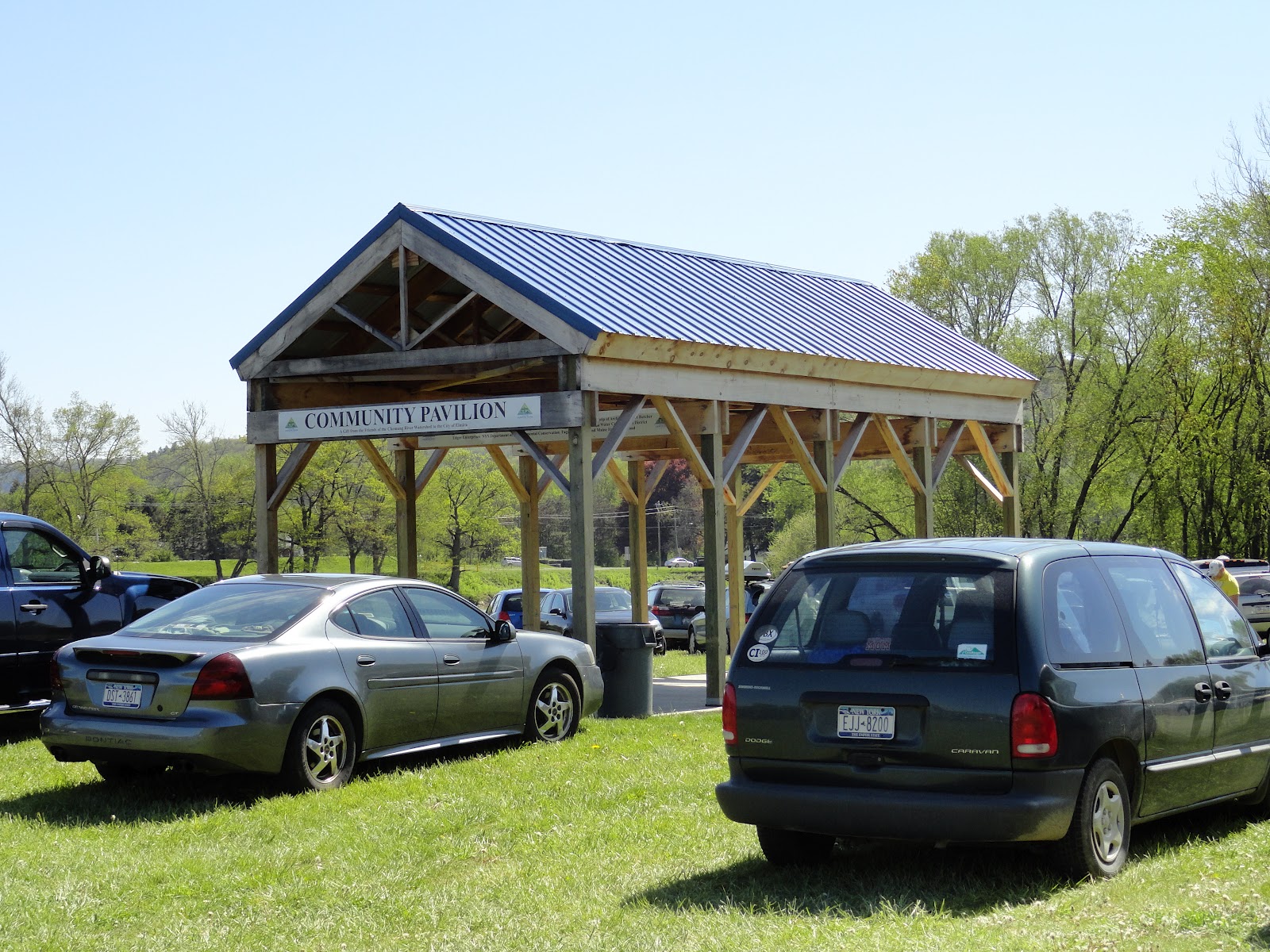
I will leave you with a picture of a community picnic pavilion near the site.  I wonder how many people who rent it know about the history of the site.

If it is true that victors write history - we in the North should be doing a much better job with Helmira.


Saturday, May 5, 2012

Sustainable Saturday - Good King Henry at the Market

I am starting a new feature this Saturday - I may only run it for a month or two.  The outdoor Farmers Market season is upon us, as spring progresses here in upstate New York.  I am more out and about, and I find, enough times, that I am writing about farmers markets, or other sustainability type issues, on enough Saturdays anyway.

So maybe my inner muse is taking a hint.

Today, spouse and I traveled to Elmira (about an hour away) for a Civil War reenactment, so we decided to combine the trip with a trip to Ithaca, New York.  Ithaca is the home of Cornell University and Ithaca College, and their Saturday farmers market is a marvel of organic produce, local cheese, handcrafts, free range meat and eggs, food vendors including a very popular macrobiotic eatery, and practices that are adopted with a keen eye towards environmental impact.

The entrance is so inviting. (Full disclosure- this particular picture and the pansy picture were taken in a previous visit right before Earth Day in April.)

One of the many fine vendors - who can resist this name?

Pansies in April have progressed to....

...a beautiful show of rainbow chard and red and white radishes.

Veggies for sale included everything from the normal spring greens (spinach, mesclun, lettuce) to wild ramps and fiddleheads

One vendor was selling plants of Good-King-Henry, but we were unsure enough about it, despite its historical origins, to buy it.  It sounds like it is only edible in the early spring, so for us it may be more of a curiosity than a real help on our very small urban plot.  We did buy a sorrel plant from the vendor.  Sorrel is gourmet food for Japanese beetles but (knock on wood) it seems we have fewer of those beetles lately than in past years.


Have you grown Good-King-Henry?  I'd love to hear from you.

Join me tomorrow, please, for Civil War Sunday.

Friday, May 4, 2012

Supermoon, Meteors and Life as We Knew It

Saturday is the Cinco de Mayo- time for parties, Mexican food, and, this year, a supermoon.

The supermoon is the full moon when the moon is closest to the Earth.  It normally comes in April or May.

The annual Eta Aquarid meteor shower will be hitting its peak at the same time, Saturday.  Hmmmm.

Does this sound like a plot for a YA series?  For example, what would happen if one of those meteors hit this supermoon?  Things wouldn't go well for the Earth, no doubt.  The moon controls the tides, and a lot of other things, too.  The moon isn't just a pretty ball in the sky that goes through phases every 28 days.

If you are ready to grab onto this theme, too late.  A YA series has already been written on this theme by an upstate New York author, Susan Beth Pfeffer.  And, SPOILER ALERT.  it ain't a pretty story. 

The three books are:
Life As We Knew It
The Dead and the Gone (hints at what happened in book #1, doesn't it?)
this world we live in

Pretty spooky, that this meteor/supermoon thing should come in the middle of me reading this series, which explores What Happens If A Large Meteor Hits the Moon One Night in May.  I'm going to spend a very uneasy Cinco de Mayo evening.

I actually started (without knowing it was part of a series) reading the third and final book, "this world we live in".  What I loved about it is that I was able to immediately plunge into the story although I didn't know a single thing about the first two books.  Within pages, I was hooked so badly I would resent it if I was interrupted.   That's the experience I want from a good read.

This is what I loved the most about the third book:

1.  The characters were people.  They fought (a lot).  The teen heroine had grown through adversity but was far from a saint.  Especially at the end (double spoiler alert)
2.  I felt the natural disasters were plausible as a result of the meteor hit - but since this isn't a "science fiction book" I wasn't expecting hard science.  Nor did I get hard science.
3.  Religion played a part in the book.  In most YA fiction I've read (unless the book is explicitly Christian literature) I normally haven't found much in the way of religion.  Here, characters pray, characters hold church at home, and one main character is a deeply devout Catholic.  I'm glad the book took time to explore what might happen to religious belief in the aftermath of a huge natural disaster.  Not because I'm especially religious (I'm not) but religion is part of the human experience.

This is what I didn't like:
1. The book jacket flaps gave away the entire plot!

Interestingly, in Goodreads reviews,, I found a lot of people were very disappointed with this third book because it didn't continue the growth of the first two books. So perhaps I should be happy that I read the last book first.  Now that I'm reading the first book, I'm sorry, in a way, that I know the fates of some of the main characters.  And I do agree the first book is better than the third.

But I look forward even more to the second book, which takes place in my native New York City. 

Are you looking forward to some moon and meteor shower watching on Cinco de Mayo?

Thursday, May 3, 2012

Will Your Blog Be Obsolete Tomorrow?

We put so much time into our blogs, many of us. 

But will anyone be able to read them in 20 years?  (or, even sooner?)

If you think this is a ridiculous question, answer this question:  Do you have something in your house that can play any of the following, all of which existed as "modern technology" during my lifetime:
-a wire recording (OK, I'm dating myself here);
-an 8 track tape;

-a cassette tape;
-an 8 inch floppy disc;
-a 5 1/4 inch floppy disc or a 3 1/4 inch floppy disk;
-a plastic digital audio tape?
-a VHS tape?

The problem is (except maybe for the cassette and VHS tapes), not many people have these playback devices, either.  So, the history recorded on these devices may well be lost forever.

And what happens when the devices we use today become obsolete?

Consider these facts:
-The Rosetta Stone, recording a decree issued by an Egyptian king in 196 BCE, is still quite readable and the only barrier to reading it was not knowing two of the three scripts the decree was inscribed in;
I can read the Lliad and the Odyssey, although they were first composed (most likely) in the 8th century BCE;
I can admire cave paintings in France first created around 35,000 years ago.

But I can't read floppy discs I created with my first computer, purchased in 1996.

If this doesn't concern you, consider this essay written back in 2002 written about our National Archives called "Are We Losing our Memory?"

So what happens when the Internet evolves, or even becomes obsolete?  What will happen to all the data on it?  True, we have the Wayback Machine, but I have tried to use that on a number of occasions and have found it is not easy, or reliable, to use.

So, short of printing out our blogs periodically (probably killing a forest each time), what can we do?

Will your blog be obsolete tomorrow?  Probably not, but wait 20 years.

We know the Middle Ages but will we know the early 2000's?


Wednesday, May 2, 2012

Spring Things - Lilacs, Tulips and Iris

Here in upstate New York, we have had an unbelievably early spring.  Right now we should be at the beginning but instead we are almost at the end of the spring blooming season..

Perhaps due to some unseasonably cold weather recently (including a couple of freezes), we may be having problems with one of our loveliest spring flowers - the lilac.

At first, I was happy because the lilacs were out so early - in the third week of April we had lilacs opening up, almost a month ahead of "schedule".  But then, a co-worker told me her lilacs were open, but they had no scent.

Then, I looked at my lilac bush. It might be almost 50 years old and is quite wide.  I had one - just one- patch of flowers on the entire plant.  This looks like a lot but that is all there is.  One small patch, and they are about 8 feet off the ground.  No lilac bouquets this year sweetly scenting my dining room?  Looks like it.


On my neighbor's white bush this is all there is going to be. One branch.
I don't know why this is happening.  Could it be last year's super-rainy (ending in floods) weather?  Was it just too much for the lilacs?

Fortunately, other flowers have done a lot better.

Last week I posted a picture of a large tulip patch in front of a senior housing development in downtown Binghamton, where I work. This was in the flood area but it didn't seem to hurt the tulip beds. Yesterday they were still going strong.

And spring held one more surprise for me today.  At my next door neighbor's (same one as the white lilac) his iris were starting to bloom. This normally doesn't happen until late May.


Our amazing spring has been full of surprises.

Are you having an amazing spring, too?  And, if lilacs grow in your area - does it look like it is not going to be a good year for them?


Tuesday, May 1, 2012

The Flooded School That Teaches Us

Welcome, Blogathoners.

I live in an area of upstate NY near the Pennsylvania border.  I am from New York City originally, but have lived in several parts of the United States.  I've lived the past 20 plus years near Johnson City, New York, a handful of miles from Binghamton.  I've been blogging since April of 2009.

On Sundays, I blog about the Civil War. (not as a historian or a reenactor, but as someone who has always loved history. On Wednesdays I blog about Spring Things, which are usually nature or flower related.

In between, I blog about many topics ranging from local food, travel, farmers markets, flowers, vegetable gardening, library book sales, and walking.  But I also blog about area's recovery from devastating floods last September caused by a summer of record rain and then over 10 inches of rain from Tropical Storm Lee.  I live in one of the flood stricken neighborhoods but was fortunate to be spared the majority of what many of my neighbors had to go through.  Blogging has been so important to me through this process.

On the 15th of each month I participate in a Garden Bloggers Bloom Day (which I found out about from another Blogathoner.).  From time to time I will share photos I've taken on my walks.


Today, I wanted to share with you some philosophy brought to us by a sign in front of an elementary school in Binghamton.  The school was severely flooded, and may never reopen.

The school sign, which at one time posted information about school events and holidays, now says "Prosperity is a great teacher.  Adversity a greater."

I thought the quote was so appropriate, sitting as it was in front of a ruined elementary school.  Many of its students were themselves flooded, or had other family members who were.  The building may be ruined, but it still teaches.

So I looked up the quote.  It was written by William Hazlitt (1778-1830) who, I read, was esteemed as possibly the greatest English literary critic after Samuel Johnson.  The entire quote is "Prosperity is a great teacher, adversity is a greater.  Possession pampers the mind; privation trains and strengthens it."


This is so true.  There are a lot of very strong people throughout upstate NY, Vermont, Missouri, Kansas, Japan, Thailand, and a lot of other places.  Adversity brought us here in the Binghamton/Owego area together, and sometimes, as time passes and forces us apart, one can sometimes wish for that community spirit again. But we have to hope that the rebuilding will change all of our lives - for the better. 

Adversity is a great teacher indeed.


Join me in exploring this month of May, and beyond, as we strive to rebuild and enjoy the wonders of our upstate New York area.

Do you have a favorite quote?  Have you been through a natural disaster - if so, what wisdom can you offer us here in the Binghamton area?