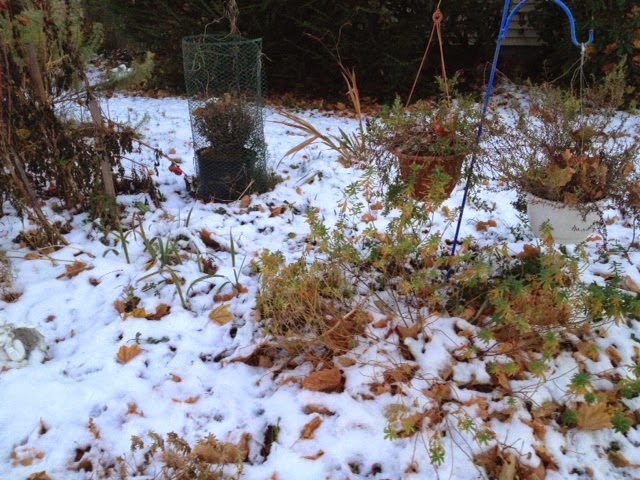
By now, I bet that most everyone in the United States has heard about the terrible snowstorms in the Buffalo, New York area over the past several days. Some areas received over 51 inches of snow in less than 24 hours. Others have had so much snow, that their houses are covered in snow. Many motorists have been stranded. At least eight people (as of this writing) have died. (I also hasten to assure my readers that New York is a large place, and, as I write this the snow on the ground where I live is....a dusting.
Heavy snowfalls are far from unknown in New York State - in fact, we have an annual competition called the Golden Snowball. The city where I work (Binghamton) has even won it a couple of times. But if Buffalo moved its official weather station to Hamburg, for example, they could win it this year without having another flake of snow fall. (I suspect a lot of residents of the area around Lake Erie wish that no more snow would fall this winter. Anyone for a bunch of surplus snow? You must haul yourself)
Something especially fascinating is what you might call the snow door effect.
There is something awe inspiring about the thought of opening your front door and finding - a wall of snow. And, in our modern day and age, you can take a picture and have it all over the Internet in seconds. People take pictures of themselves in front of their snow dog, their toddlers, their dogs.
But there is a different kind of snow door, as I found out about yesterday when some one commented on a blog post I published back in June of 2011.
This house on the edge of property owned (or at least operated) by the Cornell Cooperative Service in Binghamton has a door that is many feet
above the ground. I knew there must be a reason and asked , in June of 2011- did anyone know?
Maybe this once had a second floor outside stairs and porch? Or maybe
Superman rented out the space?
And then there was the low window on the first floor, on the right. Somehow, this seemed so....unbalanced.
Well, I found out yesterday what this second floor door is.
It is a snow door, put there for cases when the snow got so high, you need to get out through the second story of your house.
So clever and yet - I never guessed.
A door to nowhere - unless you live in snow country, in which case you may be more than happy to have this door in your house.
Does your area have a special invention that helps live life where you are?
Welcome! I hope I bring a spot of calm and happiness into these uncertain times. I blog about my photography adventures, flowers, gardening, the importance of chocolate in a well lived life, or anything else on my mind.
Friday, November 21, 2014
Thursday, November 20, 2014
Penmanship and History
Recently, someone left a comment on my blog about the dying art of penmanship. That inspired me to repeat a post from one of my Civil War Sunday blog series.
It would be a terrible thing, in my opinion, if we lost the ability to read historic documents. However,, fewer and fewer schools are teaching cursive writing. And, what about "penmanship" - something that is also a dying art in our age of texting and typing?
I had to practice penmanship in school. It was a hated part of my education and my handwriting is a mix of print and cursive today. But, I read cursive fluently. My son, who is in his mid 20's, never learned cursive, but he was exposed to it. If he has children? My understanding is, they won't learn cursive at all.
With some minor edits, I present:
This past week, some exciting news was announced - the report of the first doctor to reach Abraham Lincoln after he was shot was found. The doctor was Dr. Charles Leale,a doctor who had seen Lincoln speak several days before. For some reason, Lincoln's face fascinated him and he decided to go to Ford Theatre that fateful night of April 14, 1865, to study Lincoln further. Accounts say he was only about 40 feet away from Mr. Lincoln when he witnessed the assassination.
Of course, it is always exciting for historians to have a source document found. But, to me, what is more exciting is the availability online of the document itself.
For example, doctors have wondered if Lincoln's life could have been saved by modern medicine. As of 2007, the answer would have been "yes but with a lot of brain damage". Now, we have an exact account of the medical measures taken.
From my point of view, though, what fascinated me the most was the document itself. If you look at it, you will see it is beautifully written. Not only is the writing that of an educated man, but the quality of penmanship is breathtaking to the modern reader. For example, I would never win an award for my penmanship.
Handwriting was a common form of communication during the Civil War, 150 years ago. Those fortunate enough to be schooled spent countless hours practicing penmanship. There were no typewriters commercially available (to the best of my knowledge) until right after the Civil War, although typewriters had been invented. Many documents were handwritten. Part of judging how educated a person was consisted of judging that person's penmanship.
Each side, Federal and Confederate, wrote countless letters, battle orders, and the like. Some kept diaries. Most all of these were handwritten.
What I found is that there were two main styles of writing during the Civil War era, "Copperplate script" and "Spencerian script." I am not a graphic designer, but it seems from the small amount of research I did that both scripts, in one form or another, are still quite alive and well.
Even the instructions provided for Spencerian script sing to me.
With penmanship an instinctive skill, the writer was free to express his thoughts - and I could imagine the thoughts of Dr. Charles Leale flowing as he wrote about the fateful night of April 14 and morning of April 15, 1865. He did not talk about that night, the night he spent holding the dying President's hand, for years. He made his observations public in 1909, the 100th anniversary of Lincoln's birth, in a speech called "Lincoln's Last Hours".
Dr. Charles Leale died in 1932, one of the last living witnesses to the assassination.
Have you learned calligraphy? Do you mourn the removal of cursive handwriting from elementary school curriculum?
It would be a terrible thing, in my opinion, if we lost the ability to read historic documents. However,, fewer and fewer schools are teaching cursive writing. And, what about "penmanship" - something that is also a dying art in our age of texting and typing?
I had to practice penmanship in school. It was a hated part of my education and my handwriting is a mix of print and cursive today. But, I read cursive fluently. My son, who is in his mid 20's, never learned cursive, but he was exposed to it. If he has children? My understanding is, they won't learn cursive at all.
With some minor edits, I present:
Civil War Sunday - Civil War Penmanship and Dr. Charles Leale
This past week, some exciting news was announced - the report of the first doctor to reach Abraham Lincoln after he was shot was found. The doctor was Dr. Charles Leale,a doctor who had seen Lincoln speak several days before. For some reason, Lincoln's face fascinated him and he decided to go to Ford Theatre that fateful night of April 14, 1865, to study Lincoln further. Accounts say he was only about 40 feet away from Mr. Lincoln when he witnessed the assassination.
Of course, it is always exciting for historians to have a source document found. But, to me, what is more exciting is the availability online of the document itself.
For example, doctors have wondered if Lincoln's life could have been saved by modern medicine. As of 2007, the answer would have been "yes but with a lot of brain damage". Now, we have an exact account of the medical measures taken.
From my point of view, though, what fascinated me the most was the document itself. If you look at it, you will see it is beautifully written. Not only is the writing that of an educated man, but the quality of penmanship is breathtaking to the modern reader. For example, I would never win an award for my penmanship.
Handwriting was a common form of communication during the Civil War, 150 years ago. Those fortunate enough to be schooled spent countless hours practicing penmanship. There were no typewriters commercially available (to the best of my knowledge) until right after the Civil War, although typewriters had been invented. Many documents were handwritten. Part of judging how educated a person was consisted of judging that person's penmanship.
Each side, Federal and Confederate, wrote countless letters, battle orders, and the like. Some kept diaries. Most all of these were handwritten.
What I found is that there were two main styles of writing during the Civil War era, "Copperplate script" and "Spencerian script." I am not a graphic designer, but it seems from the small amount of research I did that both scripts, in one form or another, are still quite alive and well.
Even the instructions provided for Spencerian script sing to me.
With penmanship an instinctive skill, the writer was free to express his thoughts - and I could imagine the thoughts of Dr. Charles Leale flowing as he wrote about the fateful night of April 14 and morning of April 15, 1865. He did not talk about that night, the night he spent holding the dying President's hand, for years. He made his observations public in 1909, the 100th anniversary of Lincoln's birth, in a speech called "Lincoln's Last Hours".
Dr. Charles Leale died in 1932, one of the last living witnesses to the assassination.
Have you learned calligraphy? Do you mourn the removal of cursive handwriting from elementary school curriculum?
Wednesday, November 19, 2014
Fall Fancies - November Rain
The last few days, people in my part of upstate New York have been fortunate. Some two hours from us is an epic snowstorm. We've escaped the worst of the "polar vortex" blast of ice cold November weather.
Before I settle into my post, I want to thank everyone who has commented on my blog this month. I haven't responded too many times to the comments that much (NaNoWriMo is a great excuse) but know that I appreciate each and every one of you. Thank you!
My guest photographer friend, who lives out in the countryside near Binghamton, New York, was taken by her dog on a walk earlier this week. I wanted to share with you what they found.
My friend is fascinated by the hollies on her land, which are glowing a beautiful red.
In the snow, her dog plays hide and go seek, sort of. Can you see the dog?
Hollies from a distance, as a nearby pond starts to ice over. The foggy, sleety, rainy conditions mute the colors. This is so like November around here.
So unlike the same pond, a different angle, in late September and early October, but the November picture has its own kind of beauty.
Thinking of "November Rain" makes me think of a song from 1991. Its music just seems so...Novemberish.
The cold has settled in where I live. What's the weather like where you live?
Before I settle into my post, I want to thank everyone who has commented on my blog this month. I haven't responded too many times to the comments that much (NaNoWriMo is a great excuse) but know that I appreciate each and every one of you. Thank you!
My guest photographer friend, who lives out in the countryside near Binghamton, New York, was taken by her dog on a walk earlier this week. I wanted to share with you what they found.
My friend is fascinated by the hollies on her land, which are glowing a beautiful red.
In the snow, her dog plays hide and go seek, sort of. Can you see the dog?
Hollies from a distance, as a nearby pond starts to ice over. The foggy, sleety, rainy conditions mute the colors. This is so like November around here.
So unlike the same pond, a different angle, in late September and early October, but the November picture has its own kind of beauty.
Thinking of "November Rain" makes me think of a song from 1991. Its music just seems so...Novemberish.
The cold has settled in where I live. What's the weather like where you live?
Monday, November 17, 2014
A Random Act of Kindness to Remember
Yesterday, shopping for a card for a friend who is about to undergo surgery on Wednesday, I received a random act of kindness that was so special, that both of us ended up hugging and crying right in the middle of the store. I don't know the name of this woman, but I am tearing up again just thinking of her.
I don't know if I will ever meet her again (I only shop in this local store, a gift shop, several times a year) but if not, I hope she finds out, somehow, how much what she did meant to me. And, may she receive much goodness in her life. (It's too soon, but one day I'd like to blog about it.)
In November of 2010, I also experienced a random act of kindness. I've experienced some since but this one, in a way, also was special. Maybe, I shouldn't say this one was special - all of them are special. But, I wonder how the man in this story is doing. Is he better off? Despite what must have been hard times for him, he had such an upbeat attitude.
I don't know if I will ever meet her again (I only shop in this local store, a gift shop, several times a year) but if not, I hope she finds out, somehow, how much what she did meant to me. And, may she receive much goodness in her life. (It's too soon, but one day I'd like to blog about it.)
In November of 2010, I also experienced a random act of kindness. I've experienced some since but this one, in a way, also was special. Maybe, I shouldn't say this one was special - all of them are special. But, I wonder how the man in this story is doing. Is he better off? Despite what must have been hard times for him, he had such an upbeat attitude.
As we approach the Thanksgiving season here in the United States, , I need to remind myself that I have a lot to be grateful for.
Since this post was written, so much has happened in my life, and in the lives of those I love.
Have you ever experienced a random act of kindness? I'd love to hear about it in the comments.
******
I had gotten out of work early for a couple of appointments. After the appointments, spouse decided we should get our Thanksgiving turkey. We did so, and then remembered that a nearby Aldi had good sales on fresh cranberries and also celery.
I don't know if you have an Aldi's where you live. If you do, it is an interesting concept. Aldi is actually a huge chain in Germany, with stores in various stores on the Continent and also in Great Britain. In the United States, for some reason, they initially came in as a "bargain" store, with (in my opinion) dirty, ill lit stores. I would not shop there for years. You couldn't get a shopping cart without paying a deposit. You had to bag things yourself (and if you didn't bring bags, they would gladly sell them to you.) The employees "did it all", the same people doing store cleanup, stocking, and cash register.
When my son took German in school, his teacher came in one day with an Aldi ad from Germany. What a difference! Aldi in Germany is almost like a combination grocery/department store. But meanwhile, back in upstate NY...
Due to that ad, we gave them another shot. 'They had seriously upgraded the stores in the meantime, with better lighting and edible produce. So we do shop there on and off, depending on the sales. You can't beat their prices, although I don't think I would ever buy fresh meat there. But they do have a number of really decent store brands (they sell very little national brands, if you care about that-I don't) and when they have specials on German food....well, they are German.
At one time, their target clientele, to be blunt, was lower income people. But now with the economy, you find a lot of middle class people in there too. Times are hard. I'm grateful for the Johnson City Aldi. (they've even opened a second store just to the north of Binghamton).
Anyway, there we were getting ready to check out. We only had three items. The line was long, although the lines there tend to move quickly. The person at the back of the line had an overflowing cart. "Here, go ahead of me." The next person also let us in, and also let go ahead of him a person right behind us who had two items. His clothes were a little dirty and he walked like he had a stiff leg, with a limp.
We struck up a conversation with the man with the limp. He had some extra money because he had sold two cars at auction today. He had been up since 5 am. It was a good day for him, because he was able to buy another car to fix up and sell. Best of all, it was his birthday. He couldn't see why he should spend $30. at Texas Roadhouse [a steakhouse chain in the U.S.] when he could buy some frozen steaks and cook him at home (we don't know if he had a loved one waiting for him. I hope so). He was so glad to be spared a few extra minutes on line, so he could get home and rest.
I hope this gentleman had a wonderful rest of the day, due to this random act of kindness.
Sunday, November 16, 2014
Civil War Sunday- War is Hell
Since many of my readers are not from the United States, here are some fast facts about Atlanta, Georgia.
1. It is the cosmopolitan capital city of the state of Georgia.
2. Population of the city proper is about 448,000 but its metropolitan area's population is around 6.1 million - and the major traffic jams there bear testimony to that.
3. Among many other things, it is known as the home city of The Weather Channel, CNN, Home Depot, Delta Air Lines, Turner Broadcasting, Coca-Cola, and many other corporations. You may have heard of some of these.
4. 150 years ago yesterday, a Civil War event, the thought of which still brings pain to so many, began in Atlanta, Georgia.
If you don't think Sherman's March to the Sea isn't well remembered in the former Confederate states (which include Georgia), I will tell you a true story.
I am a native of New York State. I lived some years in the South (Florida, Arkansas), but most of my life has been spent between New York City and upstate New York.
Several years ago, my husband and I visited Charleston, South Carolina (the first state to secede from the Union, in late 1860), where the Civil War began in April of 1861. A fellow blogger recommended we go to a Civil War reenactment being held near Charleston during our visit, and asked us to look up a reenactor she knew. We did this, and found the man, who was giving a talk to a number of people attending the reenactment, which had not yet begun.
The reenactment wasn't for one particular battle, but combined several battles fought in the Charleston area.
This knowledgeable man was talking about aspects of the Civil War and answering questions. We asked some questions, and it must have been obvious to the other people in the group that we were from the North - our heavy New York accents gave that away. (You never do lose the accent of the New York City area). All was going well - until the reenactor started to talk about Sherman's March.
The temperature suddenly dropped about 20 degrees and, at least to me, it was like everyone was looking at my spouse and me. The looks were not friendly.
We left the discussion and walked elsewhere.
It doesn't matter how educated you are about the Civil War. If you only know four things about the Civil War, they might just be the bombardment of Ft. Sumter that started the war, the Emancipation Proclamation, the Gettysburg Address and....Sherman's March to the Sea, which started in Atlanta on November 15, 1864 and concluded in Savannah, Georgia on December 21, 1864.
If you've never heard of the Battle of Atlanta - well, chances are you have heard of it (at least in fiction). It is part of the famed movie Gone with the Wind.
Prior to the March starting, Union troops had captured Atlanta in September, 1864. Sherman ordered the city burned.
When Sherman gave the order that the city be evacuated and burned, the Mayor of Atlanta appealed to Sherman to reverse his decision. This was Sherman's response.
This is not easy reading. But war is not easy for anyone.
After spending some time in Tennessee and Alabama, Sherman split his troops into two parts. With 60,000 men under his command, the March began.
In the March, (known as the Savannah Campaign by historians), Union Major General William Sherman's aim was to destroy the capacity of the Confederate South for waging war. He succeeded in that aim by marching across Georgia, destroying much in his path. As far as the innocent civilians that got in the way, their livestock and food was stolen and (if they resisted) their houses were burned. And, 150 years later, the after effects of that campaign still linger psychologically.
Ironically, if you ever hear the expression "War is Hell", try this quote from General Sherman:
“It is only those who have neither fired a shot nor heard the shrieks and groans of the wounded who cry aloud for blood, more vengeance, more desolation. War is hell.”
Sherman died on February 14, 1891. His funeral, in St. Louis, was attended by thousands. Flags flew at half staff. One of his pallbearers was former Confederate General Joseph E. Johnston.
Johnston had surrendered his troops to Sherman near Durham, North Carolina, not long before the war ended.
Johnston contracted pneumonia at the funeral and died a little more than a month later.
1. It is the cosmopolitan capital city of the state of Georgia.
2. Population of the city proper is about 448,000 but its metropolitan area's population is around 6.1 million - and the major traffic jams there bear testimony to that.
3. Among many other things, it is known as the home city of The Weather Channel, CNN, Home Depot, Delta Air Lines, Turner Broadcasting, Coca-Cola, and many other corporations. You may have heard of some of these.
4. 150 years ago yesterday, a Civil War event, the thought of which still brings pain to so many, began in Atlanta, Georgia.
If you don't think Sherman's March to the Sea isn't well remembered in the former Confederate states (which include Georgia), I will tell you a true story.
I am a native of New York State. I lived some years in the South (Florida, Arkansas), but most of my life has been spent between New York City and upstate New York.
Several years ago, my husband and I visited Charleston, South Carolina (the first state to secede from the Union, in late 1860), where the Civil War began in April of 1861. A fellow blogger recommended we go to a Civil War reenactment being held near Charleston during our visit, and asked us to look up a reenactor she knew. We did this, and found the man, who was giving a talk to a number of people attending the reenactment, which had not yet begun.
The reenactment wasn't for one particular battle, but combined several battles fought in the Charleston area.
This knowledgeable man was talking about aspects of the Civil War and answering questions. We asked some questions, and it must have been obvious to the other people in the group that we were from the North - our heavy New York accents gave that away. (You never do lose the accent of the New York City area). All was going well - until the reenactor started to talk about Sherman's March.
The temperature suddenly dropped about 20 degrees and, at least to me, it was like everyone was looking at my spouse and me. The looks were not friendly.
We left the discussion and walked elsewhere.
It doesn't matter how educated you are about the Civil War. If you only know four things about the Civil War, they might just be the bombardment of Ft. Sumter that started the war, the Emancipation Proclamation, the Gettysburg Address and....Sherman's March to the Sea, which started in Atlanta on November 15, 1864 and concluded in Savannah, Georgia on December 21, 1864.
If you've never heard of the Battle of Atlanta - well, chances are you have heard of it (at least in fiction). It is part of the famed movie Gone with the Wind.
Prior to the March starting, Union troops had captured Atlanta in September, 1864. Sherman ordered the city burned.
When Sherman gave the order that the city be evacuated and burned, the Mayor of Atlanta appealed to Sherman to reverse his decision. This was Sherman's response.
This is not easy reading. But war is not easy for anyone.
After spending some time in Tennessee and Alabama, Sherman split his troops into two parts. With 60,000 men under his command, the March began.
In the March, (known as the Savannah Campaign by historians), Union Major General William Sherman's aim was to destroy the capacity of the Confederate South for waging war. He succeeded in that aim by marching across Georgia, destroying much in his path. As far as the innocent civilians that got in the way, their livestock and food was stolen and (if they resisted) their houses were burned. And, 150 years later, the after effects of that campaign still linger psychologically.
Ironically, if you ever hear the expression "War is Hell", try this quote from General Sherman:
“It is only those who have neither fired a shot nor heard the shrieks and groans of the wounded who cry aloud for blood, more vengeance, more desolation. War is hell.”
Sherman died on February 14, 1891. His funeral, in St. Louis, was attended by thousands. Flags flew at half staff. One of his pallbearers was former Confederate General Joseph E. Johnston.
Johnston had surrendered his troops to Sherman near Durham, North Carolina, not long before the war ended.
Johnston contracted pneumonia at the funeral and died a little more than a month later.
Saturday, November 15, 2014
Garden Bloggers Bloom Day - November 2014 - Cactus Surprise
If Garden Bloggers Bloom Day had been on November 13, I still could have shown you some flowers in my zone 5b garden in the Johnson City area of upstate New York.
But yesterday, with the first snow that stuck (we had sleet and snow last Friday, but it didn't - here, anyway) and a hard freeze, I had to let go.
Now starts the season of hoping some indoor flowers bloom each 15th of the month, so I am not totally embarrassed in front of the world. Gulp.
Welcome to Garden Bloggers Bloom Day, where gardeners from all over the world show what is blooming.
For example, my Thanksgiving (more on that later) cactus are blooming. Even this little cutting in a tiny pot is blooming for me. (Did you know that grammar geeks say that cactus, cactuses and cacti are all correct to use as the word to describe two or more cactus plants? So please do not leave a comment about "cactus" as a plural.)
But before I show you more flowers, I want to show you that, as of about 7am this morning, I still had a couple of flowers left outside, in a hanging basket.
A petunia still bravely bloomed, a spot of pink in the brown all around it. This plant has survived, twice, down to 25 degrees F (-3.8 C.) I don't expect it to bloom much longer.
So, what else do I have? Well, first, a confession. Last Saturday I went to an open house at a local nursery/florist, Tioga Gardens, and replenished my supply of flowering plants.
I bought this African Violet while the African Violets I already own, roots trimmed and put back in pots with fresh soil, show their displeasure.
And, I could not resist a white Christmas cactus in bud, or so I thought. Now that it's opening up, lovely light pink blossom are emerging. (sorry, no name tag in the plant). But I had a big surprise, reading today's post on the host blog for the GBBD meme. I do not own any Christmas cactus - every last one of my Christmas cactus are actually Thanksgiving cactus - same genus, but different species. The secret is in the leaves - if they have points on them, you have Thanksgiving cactus.
And maybe that explains why my plants bloom in November...
Finally, back to my flowers from this summer, here is a geranium I brought inside (one of several). I have no idea why the picture looks like this - this is a reddish geranium. But I loved my iPhone 4S's interpretation of this flower so much, I decided to post it anyway.
And now, I must start a hunt for a true Christmas cactus - maybe I'll have one to show you next GBBD.
Did you like what you saw? Please comment, and then please visit May Dreams Gardens, which hosts this meme every 15th of the month, and click on other links to see what is blooming all over the world.
But yesterday, with the first snow that stuck (we had sleet and snow last Friday, but it didn't - here, anyway) and a hard freeze, I had to let go.
Now starts the season of hoping some indoor flowers bloom each 15th of the month, so I am not totally embarrassed in front of the world. Gulp.
Welcome to Garden Bloggers Bloom Day, where gardeners from all over the world show what is blooming.
For example, my Thanksgiving (more on that later) cactus are blooming. Even this little cutting in a tiny pot is blooming for me. (Did you know that grammar geeks say that cactus, cactuses and cacti are all correct to use as the word to describe two or more cactus plants? So please do not leave a comment about "cactus" as a plural.)
But before I show you more flowers, I want to show you that, as of about 7am this morning, I still had a couple of flowers left outside, in a hanging basket.
A petunia still bravely bloomed, a spot of pink in the brown all around it. This plant has survived, twice, down to 25 degrees F (-3.8 C.) I don't expect it to bloom much longer.
So, what else do I have? Well, first, a confession. Last Saturday I went to an open house at a local nursery/florist, Tioga Gardens, and replenished my supply of flowering plants.
I bought this African Violet while the African Violets I already own, roots trimmed and put back in pots with fresh soil, show their displeasure.
And maybe that explains why my plants bloom in November...
Finally, back to my flowers from this summer, here is a geranium I brought inside (one of several). I have no idea why the picture looks like this - this is a reddish geranium. But I loved my iPhone 4S's interpretation of this flower so much, I decided to post it anyway.
And now, I must start a hunt for a true Christmas cactus - maybe I'll have one to show you next GBBD.
Did you like what you saw? Please comment, and then please visit May Dreams Gardens, which hosts this meme every 15th of the month, and click on other links to see what is blooming all over the world.
Friday, November 14, 2014
In the Still of the Morning
All is still.
The first snow has fallen and powders the ground. Our first freeze has come
It is time to let go, here in the stillness of the early morning, in the 25 degree weather. It is time to enjoy the stillness of winter.
Every year, I go through this ritual. I cling to summer, screaming. When the first frosts threaten, I cover plants. I bring in my hanging baskets (and I have a lot of them.). Then, as the frosts get closer and closer, I take cuttings.
I can't let go of summer.
I can't let go of the flowers, the herbs, the veggies.
But one day I wake up and it's 25 degrees, and there is a thin layer of snow on the ground.
The forecast is for sub freezing temperatures every day.
Still.
There no longer isn't any point. Still, perhaps, I try one last time.
I have to give up the effort. I must give in.
I tell myself winter is not that bad. I will have my indoor plants. I will have the remains of what I harvested. I will have the season of rest, of hot soup.
Still. I will count the days until the first crocuses peek out of the ground, and snow no longer blankets the ground.
(End of five minutes worth of free writing - no editing, no overthinking. Just like NaNoWriMo, which I am way behind in. Oh well, there's the rest of the month....)
I am linking today to Five Minute Friday.
Five minutes of free writing. Today's prompt was "still".
Join me again tomorrow for "Garden Bloggers Bloom Day."
![]() |
| Begonias just before sunrise 11-14. At this point they had already passed away. |
The first snow has fallen and powders the ground. Our first freeze has come
It is time to let go, here in the stillness of the early morning, in the 25 degree weather. It is time to enjoy the stillness of winter.
Every year, I go through this ritual. I cling to summer, screaming. When the first frosts threaten, I cover plants. I bring in my hanging baskets (and I have a lot of them.). Then, as the frosts get closer and closer, I take cuttings.
I can't let go of summer.
I can't let go of the flowers, the herbs, the veggies.
But one day I wake up and it's 25 degrees, and there is a thin layer of snow on the ground.
The forecast is for sub freezing temperatures every day.
Still.
There no longer isn't any point. Still, perhaps, I try one last time.
I have to give up the effort. I must give in.
I tell myself winter is not that bad. I will have my indoor plants. I will have the remains of what I harvested. I will have the season of rest, of hot soup.
Still. I will count the days until the first crocuses peek out of the ground, and snow no longer blankets the ground.
(End of five minutes worth of free writing - no editing, no overthinking. Just like NaNoWriMo, which I am way behind in. Oh well, there's the rest of the month....)
I am linking today to Five Minute Friday.
Five minutes of free writing. Today's prompt was "still".
Join me again tomorrow for "Garden Bloggers Bloom Day."
Thursday, November 13, 2014
"B" and The Rokerthon
Today, in the United States (for those of us who have cable TV) we may have the chance to watch history being made - live.
Al Roker, a TV weather presenter, is going to attempt to break a Guinness world record for most consecutive hours presenting a weather forecast. He plans to present for 34 straight hours. The current confirmed record is 24 hours. The unofficial record was set in September by a Norwegian woman who did some of the broadcast in her bathrobe.
This is being done, incidentally, to benefit a charity related to the USO, a serviceperson support organization with a long, distinguished history. And fans will be able to interact with Al on social media during this weather report to beat all weather reports.
People are already calling it a "Rokerthon". Let's just say that Al Roker is a showman. He can be quite funny, and he can also skate along the edge of - shall we say - being a bit outrageous. Or even risque.
These are the terms and conditions of this weather reporting marathon, which is already in progress (it started 10pm Eastern time last night).
Al gets a 5 minute break each hour. He can save them up (in other words, by not taking them) to have a longer break.
He can't talk about weather taking place more than seven days in the past.
He can't talk about weather predicted more than seven days into the future.
He can only talk about the weather. (Sorry, Al, no BBQ!)
And, there will be an official from the Guinness organization on site at all times to ensure that everything is the way it should be, so that the record can be official.
I was disappointed that the Weather Channel wasn't livecasting it on Al's own Weather Channel show this morning, Today.com will live stream all 34 hours. I am watching him right now - and you can send him some encouragement on Twitter, or drink some green tea and eat some jerky with him.
So what does this have to do with "B", my brother in law with autism?
Well, many people with autism have what is called a special interest - something they are obsessed about. "B"'s special interest is the weather. In fact, my spouse is an amateur metereologist, and has already shared how HE would do this Rokerthon if he was called to do it and not Al Roker. But his love of weather is nothing like the love of weather that "B" has.
"B" isn't much of a conversationalist so he could never do his own "B"athon, but one of his topics of conversation, when he chooses to converse, is the weather. Especially the weather in the city where the brother he loves lives.
I hope that Al Roker talks about Binghamton and Johnson City, and "B" gets to see it.
Knowing Al, he might even do it in a bathrobe.
Do you plan to watch any of the Rokerthon?
Al Roker, a TV weather presenter, is going to attempt to break a Guinness world record for most consecutive hours presenting a weather forecast. He plans to present for 34 straight hours. The current confirmed record is 24 hours. The unofficial record was set in September by a Norwegian woman who did some of the broadcast in her bathrobe.
This is being done, incidentally, to benefit a charity related to the USO, a serviceperson support organization with a long, distinguished history. And fans will be able to interact with Al on social media during this weather report to beat all weather reports.
People are already calling it a "Rokerthon". Let's just say that Al Roker is a showman. He can be quite funny, and he can also skate along the edge of - shall we say - being a bit outrageous. Or even risque.
These are the terms and conditions of this weather reporting marathon, which is already in progress (it started 10pm Eastern time last night).
Al gets a 5 minute break each hour. He can save them up (in other words, by not taking them) to have a longer break.
He can't talk about weather taking place more than seven days in the past.
He can't talk about weather predicted more than seven days into the future.
He can only talk about the weather. (Sorry, Al, no BBQ!)
And, there will be an official from the Guinness organization on site at all times to ensure that everything is the way it should be, so that the record can be official.
I was disappointed that the Weather Channel wasn't livecasting it on Al's own Weather Channel show this morning, Today.com will live stream all 34 hours. I am watching him right now - and you can send him some encouragement on Twitter, or drink some green tea and eat some jerky with him.
So what does this have to do with "B", my brother in law with autism?
Well, many people with autism have what is called a special interest - something they are obsessed about. "B"'s special interest is the weather. In fact, my spouse is an amateur metereologist, and has already shared how HE would do this Rokerthon if he was called to do it and not Al Roker. But his love of weather is nothing like the love of weather that "B" has.
"B" isn't much of a conversationalist so he could never do his own "B"athon, but one of his topics of conversation, when he chooses to converse, is the weather. Especially the weather in the city where the brother he loves lives.
I hope that Al Roker talks about Binghamton and Johnson City, and "B" gets to see it.
Knowing Al, he might even do it in a bathrobe.
Do you plan to watch any of the Rokerthon?
Wednesday, November 12, 2014
Fall Fancies - We'll Always Have Yesterday
These photos of the gorgeous color in the Binghamton/Owego area of New York State should speak for themselves. Sometimes, words only take away from a story.
That's one of the beautiful things about blogging - it is visual, and you have these posts to look at when the seasons have moved on and fall is a distant memory.
For a lot of the United States, fall is a distant memory, with ice and snow already settled in. But, for us, we had a day yesterday of blue skies and temperatures near 60 F (15 C). This kind of day almost never happens here in November. I admired it from a chair in a dentist's office.
Fall color has lasted longer this fall than any fall I can remember in the nearly 30 years I've lived in upstate New York. I took these pictures over the last several days. Soon this will be a memory.
The glow comes partially from bright yellow trees, including this massive gingko tree in a historic neighborhood in Owego, New York.
Another gingko stands near the Susquehanna River in Owego.
And, last but not least, the glow of a fall sunset as seen through a maple tree on the West Side of Binghamton.
Today it rains. And tomorrow, our colder weather starts. It will be another season - the season of Letting Go.
More on that topic another time.
That's one of the beautiful things about blogging - it is visual, and you have these posts to look at when the seasons have moved on and fall is a distant memory.
For a lot of the United States, fall is a distant memory, with ice and snow already settled in. But, for us, we had a day yesterday of blue skies and temperatures near 60 F (15 C). This kind of day almost never happens here in November. I admired it from a chair in a dentist's office.
Fall color has lasted longer this fall than any fall I can remember in the nearly 30 years I've lived in upstate New York. I took these pictures over the last several days. Soon this will be a memory.
The glow comes partially from bright yellow trees, including this massive gingko tree in a historic neighborhood in Owego, New York.
Another gingko stands near the Susquehanna River in Owego.
And, last but not least, the glow of a fall sunset as seen through a maple tree on the West Side of Binghamton.
Today it rains. And tomorrow, our colder weather starts. It will be another season - the season of Letting Go.
More on that topic another time.
Tuesday, November 11, 2014
Blood Swept Lands and Seas of Red
On November 11, 1918, on the 11th hour of the 11th day of the 11th month, World War I ended, but not before eight million plus people died.
Of that total 888,246 were British.
The British and Canadians call today, November 11, Remembrance Day. We in the United States call it Veterans Day.
This is a breakdown of the total death toll worldwide.
Just for one country - the number 888,246. It is impossible to visualize this, or the total World War casualties, but the British found a way to help us.
In the dry moat of the Tower of London, 888,246 ceramic poppies were planted starting this summer, a sea of red, there since August but I (an American) did not see this on television until just recently.
My ancestry is not British but one of my uncles was a civilian casualty of World War I.
Although in this country we don't use the imagery of poppies in the same way as the inhabitants of the former British Empire do, I can appreciate the imagery. It is so different than the way we in the States tend to commemorate the holiday. We have parades, but so much (everything from "Veterans Day sales" to the more recent practice of retail stores giving vets discounts on Veterans day) seems to revolve around retail sales and not really honoring our veterans.
Lest we forgot, a poem that still gives me chills, years after I read it for the first time, written by a Canadian doctor, Lt. Colonel John McCrae, in 1915.
Some feel the poem glorifies war but there is the first part of the poem to consider.
Of that total 888,246 were British.
The British and Canadians call today, November 11, Remembrance Day. We in the United States call it Veterans Day.
This is a breakdown of the total death toll worldwide.
Just for one country - the number 888,246. It is impossible to visualize this, or the total World War casualties, but the British found a way to help us.
In the dry moat of the Tower of London, 888,246 ceramic poppies were planted starting this summer, a sea of red, there since August but I (an American) did not see this on television until just recently.
My ancestry is not British but one of my uncles was a civilian casualty of World War I.
Although in this country we don't use the imagery of poppies in the same way as the inhabitants of the former British Empire do, I can appreciate the imagery. It is so different than the way we in the States tend to commemorate the holiday. We have parades, but so much (everything from "Veterans Day sales" to the more recent practice of retail stores giving vets discounts on Veterans day) seems to revolve around retail sales and not really honoring our veterans.
Lest we forgot, a poem that still gives me chills, years after I read it for the first time, written by a Canadian doctor, Lt. Colonel John McCrae, in 1915.
Some feel the poem glorifies war but there is the first part of the poem to consider.
In Flanders fields the poppies blow
Between the crosses, row on row,
That mark our place; and in the sky
The larks, still bravely singing, fly
Scarce heard amid the guns below.
Between the crosses, row on row,
That mark our place; and in the sky
The larks, still bravely singing, fly
Scarce heard amid the guns below.
We are the Dead. Short days ago
We lived, felt dawn, saw sunset glow,
Loved and were loved, and now we lie
In Flanders fields.
We lived, felt dawn, saw sunset glow,
Loved and were loved, and now we lie
In Flanders fields.
Take up our quarrel with the foe:
To you from failing hands we throw
The torch; be yours to hold it high.
If ye break faith with us who die
We shall not sleep, though poppies grow
In Flanders fields.
To you from failing hands we throw
The torch; be yours to hold it high.
If ye break faith with us who die
We shall not sleep, though poppies grow
In Flanders fields.
And Lt. Colonel McCrae? He died, in military service, before World War I ended, from complications of pneumonia. But before he died, he had seen too much death.
Perhaps that is how we must visualize war - the story of human suffering, one person at a time.
Monday, November 10, 2014
The Fall of The Wall
August 13, 1961-November 9, 1989.
This is one gravestone I am happy to see.
It's been 25 years since the Berlin Wall fell.
By the time my son was born, in upstate New York, the Wall had already fallen. But, since the day it literally rose overnight in my childhood, that Wall became part of the Cold War that I grew up in.
The wall separated neighborhoods. It separated families. People risked their lives trying to flee to freedom in West Berlin. At least 136 people died in connection with the Wall (including at least one guard shot by an escapee.)
Ceremonies were held this weekend in Berlin to commemorate the end of the Wall. Mikhail Gorbachev and Lech Walesa joined German Chancellor Merkel in celebrating. It is noteworthy that Chancellor Merkel grew up in East Germany (she was born in West Germany) and was in a crowd that headed to West Berlin that incredible day.
East Berlin. East Germany. West Berlin. West Germany. Even 25 years later, the names sound so natural to me. Germany was divided up by the victorious allies after World War II ended, seven years before I was born, and Berlin, located in East Germany, was similarly divided. After all, those names were a part of most of my life. I am grateful that my son never had to learn those names except in a history class.
My son ended up taking two years of German in high school, and would play online games with German teenagers. Theirs was a generation that didn't have to live through what my generation did and what the Greatest Generation that suffered so in World War II went through before then.
Last night, in Berlin, eight thousand white balloons were released into the air, followed by fireworks over the Brandenburg Gate.
The Berlin Wall now exists in pieces spread all over the world. But parts still stand in Berlin. Look at them, and ponder the depths of what mankind can do to itself.
This is one gravestone I am happy to see.
It's been 25 years since the Berlin Wall fell.
(A haunting whistle and a song about the ending of the Cold War)
The wall separated neighborhoods. It separated families. People risked their lives trying to flee to freedom in West Berlin. At least 136 people died in connection with the Wall (including at least one guard shot by an escapee.)
Ceremonies were held this weekend in Berlin to commemorate the end of the Wall. Mikhail Gorbachev and Lech Walesa joined German Chancellor Merkel in celebrating. It is noteworthy that Chancellor Merkel grew up in East Germany (she was born in West Germany) and was in a crowd that headed to West Berlin that incredible day.
East Berlin. East Germany. West Berlin. West Germany. Even 25 years later, the names sound so natural to me. Germany was divided up by the victorious allies after World War II ended, seven years before I was born, and Berlin, located in East Germany, was similarly divided. After all, those names were a part of most of my life. I am grateful that my son never had to learn those names except in a history class.
My son ended up taking two years of German in high school, and would play online games with German teenagers. Theirs was a generation that didn't have to live through what my generation did and what the Greatest Generation that suffered so in World War II went through before then.
Last night, in Berlin, eight thousand white balloons were released into the air, followed by fireworks over the Brandenburg Gate.
The Berlin Wall now exists in pieces spread all over the world. But parts still stand in Berlin. Look at them, and ponder the depths of what mankind can do to itself.
Sunday, November 9, 2014
Civil War Sunday - The 144 Bottles of Terror
"Sooner or later, everything old is new again." - Stephen King
We in the United States fear a terrorist attack on New York City. It's already happened in the lifetime of most of us now alive - on September 11, 2001. It's actually happened before that, for example, on September 16, 1920.
Now, think of this scenerio.
People at war with the United States plot in Toronto, aiming to disrupt a Presidential election. Several cities in the United States are targeted: Boston, Chicago, Cincinnati and New York City. Their plans are to set fires, using a modern inflammatory chemical, as a distraction and to spread fear. The election would be disrupted.
The conspirators are homegrown men, not from overseas, the type of attack we fear most.
This is, as the saying goes, "ripped from today's headlines".
New York City, November, 2014?
No, November of 1864, as rebel Confederates plotted to spread terror and get the Union to the negotiation table.
The fascinating story is told here, but to summarize:
As I had blogged about last week, President Abraham Lincoln was up for reelection on November 8, 1864. Things were not looking bright for his reelection. No President had been reelected since 1832. His own former commanding general was running against him. Many in the United States were weary of war, and the Confederates were hoping for a general uprising. Many in New York City, in particular, would join the uprising - or so the plotters hoped.
The original plot was to set distraction fires, seize treasuries in the cities and raid prison camps to set Confederate prisoners free. But then Colonel Robert Martin, in charge of the conspirators charged with seting fires in New York City, decided he wanted to burn New York City to the ground.
A retired druggist was hired to concoct an incendiary called Greek Fire - a chemical that had been developed around 672 and was used as a weapon - especially useful in naval warfare as Greek Fire would float on water and burn.
This video shows the power of Greek Fire. Imagine if this plot had been carried out exactly as planned.
The Greek Fire was packed into 144 bottles and distributed to a network of conspirators.
The fires would be timed in such a time as to cause minimal death - but a lot of destruction.
Some conspirators lost their nerve, And, the plot was found out and Union troops guarded the cities during the election. The election went on as scheduled and Lincoln won. So, the Confederates decided to try again, setting fires in a series of New York hotels on November 25, 1864 in closed off hotel rooms.
They forgot one crucial fact about Greek Fire - it needs oxygen to burn. Most of the fires smoldered, and some fires went out on their own, but the New York City fire department had one busy night. One fire, at the Barnum Museum, was set by a drunk conspirator and was more successful. Some 2,500 people were in the building, attending a play. The fire did burn in the open air and, fortunately, no one was killed.
New York City stood unburned. No one was killed.
If the Confederates had decided to target a local gas works, which contained pressurized tanks full of gas, the result may have been far different.
Would the course of the war have changed if New York City had burned? We will never know. As it was, only one conspirator was caught (and subsequently was executed). And, the attempted firing of New York City was condemned by the public.
And the war ended, on its own, several months later.
We in the United States fear a terrorist attack on New York City. It's already happened in the lifetime of most of us now alive - on September 11, 2001. It's actually happened before that, for example, on September 16, 1920.
Now, think of this scenerio.
People at war with the United States plot in Toronto, aiming to disrupt a Presidential election. Several cities in the United States are targeted: Boston, Chicago, Cincinnati and New York City. Their plans are to set fires, using a modern inflammatory chemical, as a distraction and to spread fear. The election would be disrupted.
The conspirators are homegrown men, not from overseas, the type of attack we fear most.
This is, as the saying goes, "ripped from today's headlines".
New York City, November, 2014?
No, November of 1864, as rebel Confederates plotted to spread terror and get the Union to the negotiation table.
The fascinating story is told here, but to summarize:
As I had blogged about last week, President Abraham Lincoln was up for reelection on November 8, 1864. Things were not looking bright for his reelection. No President had been reelected since 1832. His own former commanding general was running against him. Many in the United States were weary of war, and the Confederates were hoping for a general uprising. Many in New York City, in particular, would join the uprising - or so the plotters hoped.
The original plot was to set distraction fires, seize treasuries in the cities and raid prison camps to set Confederate prisoners free. But then Colonel Robert Martin, in charge of the conspirators charged with seting fires in New York City, decided he wanted to burn New York City to the ground.
A retired druggist was hired to concoct an incendiary called Greek Fire - a chemical that had been developed around 672 and was used as a weapon - especially useful in naval warfare as Greek Fire would float on water and burn.
This video shows the power of Greek Fire. Imagine if this plot had been carried out exactly as planned.
The Greek Fire was packed into 144 bottles and distributed to a network of conspirators.
The fires would be timed in such a time as to cause minimal death - but a lot of destruction.
Some conspirators lost their nerve, And, the plot was found out and Union troops guarded the cities during the election. The election went on as scheduled and Lincoln won. So, the Confederates decided to try again, setting fires in a series of New York hotels on November 25, 1864 in closed off hotel rooms.
They forgot one crucial fact about Greek Fire - it needs oxygen to burn. Most of the fires smoldered, and some fires went out on their own, but the New York City fire department had one busy night. One fire, at the Barnum Museum, was set by a drunk conspirator and was more successful. Some 2,500 people were in the building, attending a play. The fire did burn in the open air and, fortunately, no one was killed.
New York City stood unburned. No one was killed.
If the Confederates had decided to target a local gas works, which contained pressurized tanks full of gas, the result may have been far different.
Would the course of the war have changed if New York City had burned? We will never know. As it was, only one conspirator was caught (and subsequently was executed). And, the attempted firing of New York City was condemned by the public.
And the war ended, on its own, several months later.
Saturday, November 8, 2014
Sustainable Saturday - A Fictional Future Grows in Brooklyn?
Can I write a novel about a future sustainable Brooklyn forced into a sustainable lifestyle by climate change by a girl growing up in that future?
I am participating in a writing self-challenge called NaNoWriMo, which requires its participants to write 50,000 original words (a rough draft, no editing) during the month of November. Just writing anything fictional is a challenge for me - 50,000 words in 30 days is a huge challenge, especially when I've already encountered writer's block on days six and seven.
For my NaNoWriMo novel, I decided to write a young adult novel called Gravesend, named after a neighborhood in Brooklyn I have a little familiarity with. Set approximately 40 years in the future, I intended it to be a dystopian novel - my favorite form of young adult literature.
But a funny thing happened on the way to the novel.
My protagonist has taken charge (yes, this is the kind of thing that happens when you write fiction) and has started to write it herself. And, therein lies the problem.
She isn't living in a dystopian Gravesend. And she isn't the character I expected her to be.
Ahem.
Oh, it isn't a fun Gravesend to grow up in, it faces some big problems, and my girl, whose name is Alex (short for Alexandria), has seen her share of weather related tragedy. In fact, she's an orphan due to a superstorm, and those storms have become more and more frequent. But I am starting to get lost in her daily life. And you know what?
Inspired by an article I read the other day on people attempting to grow rice on an island off the coast of Manhattan, I actually am writing about a future Gravesend full of conflict, but also full of hope. And farming.
I'm really curious to see where Alex is taking my novel, now that she's taken over.
I'm still behind where I should be, but let's see if I can catch up. Watch my progress on my right sidebar. And, if you are participating in NaNoWriMo, come be my buddy - you will find me at RamblinWritr.
I am participating in a writing self-challenge called NaNoWriMo, which requires its participants to write 50,000 original words (a rough draft, no editing) during the month of November. Just writing anything fictional is a challenge for me - 50,000 words in 30 days is a huge challenge, especially when I've already encountered writer's block on days six and seven.
For my NaNoWriMo novel, I decided to write a young adult novel called Gravesend, named after a neighborhood in Brooklyn I have a little familiarity with. Set approximately 40 years in the future, I intended it to be a dystopian novel - my favorite form of young adult literature.
But a funny thing happened on the way to the novel.
![]() |
| Not the fictional Gravesend |
My protagonist has taken charge (yes, this is the kind of thing that happens when you write fiction) and has started to write it herself. And, therein lies the problem.
She isn't living in a dystopian Gravesend. And she isn't the character I expected her to be.
Ahem.
Oh, it isn't a fun Gravesend to grow up in, it faces some big problems, and my girl, whose name is Alex (short for Alexandria), has seen her share of weather related tragedy. In fact, she's an orphan due to a superstorm, and those storms have become more and more frequent. But I am starting to get lost in her daily life. And you know what?
Inspired by an article I read the other day on people attempting to grow rice on an island off the coast of Manhattan, I actually am writing about a future Gravesend full of conflict, but also full of hope. And farming.
I'm really curious to see where Alex is taking my novel, now that she's taken over.
I'm still behind where I should be, but let's see if I can catch up. Watch my progress on my right sidebar. And, if you are participating in NaNoWriMo, come be my buddy - you will find me at RamblinWritr.
Friday, November 7, 2014
Fallen Leaves - Who Can Say Where They're Blowing?
Please fall, I beg. Don't leave us.
We had our first snow and sleet today, in the Binghamton area of upstate New York.
Fall, I will cling to your leg and scream if you leave me, just like I did with summer. How can I be jilted twice in two months by two seasons?
How can I not, with the beauty you have showered me with? The honeynut squashes? The apples? The laughing pears? The beautiful sunsets?
It's coming soon. The polar vortex that made last February an absolute misery is on its way.
Have you not forgotten what you showed me earlier this week?
Or this? Fall, don't you remember?
You are breaking my heart.
On the banks of the Chenango River, trees are finally turning.
At the abandoned BAE building in Westover, the Bradford Pears have barely started to turn.
You can't do this. You can't snow on my parade. Just a week ago, things looked like this, in downtown Binghamton.
And even tonight, in the dark 5:30 front yard, I found a nasturtium, covered by leaves, and spared by frost. I know you will get this plant tonight, and I accept it.
I have no choice. I must accept the howling winds to come. I must accept the freezing temperatures that will envelop my area as the sun turns its back on us. That is the way of upstate New York.
I will need to accept the change of seasons, and the long winter to follow. More than this, I can't expect. And so, I will rerun a fall song I put on my blog last year.
"I could feel at the time/there was no way of knowing/Fallen leaves in the night/Who can say where they're blowing?"
I will try to expect the best.
We had our first snow and sleet today, in the Binghamton area of upstate New York.
Fall, I will cling to your leg and scream if you leave me, just like I did with summer. How can I be jilted twice in two months by two seasons?
How can I not, with the beauty you have showered me with? The honeynut squashes? The apples? The laughing pears? The beautiful sunsets?
It's coming soon. The polar vortex that made last February an absolute misery is on its way.
Have you not forgotten what you showed me earlier this week?
![]() |
| Japanese maple, Front Street, Binghamton, NY |
You are breaking my heart.
On the banks of the Chenango River, trees are finally turning.
![]() |
| Taken early morning 11-7-14 |
You can't do this. You can't snow on my parade. Just a week ago, things looked like this, in downtown Binghamton.
And even tonight, in the dark 5:30 front yard, I found a nasturtium, covered by leaves, and spared by frost. I know you will get this plant tonight, and I accept it.
I have no choice. I must accept the howling winds to come. I must accept the freezing temperatures that will envelop my area as the sun turns its back on us. That is the way of upstate New York.
"I could feel at the time/there was no way of knowing/Fallen leaves in the night/Who can say where they're blowing?"
I will try to expect the best.
Thursday, November 6, 2014
The Pears are Again Laughing at Me
Today is the sixth day of November, and the sixth day of a writing self-competition called NaNoWriMo. 50,000 words in 30 days is the goal, and we are getting to the long haul part. The part of frozen creativity, writers block, panic and worse.
I am going to devote today to NaNoWriMo and a research project I hope to blog about later this month.
I have a feeling that, today, pears - and everything else - are laughing at me, as I drip sweat and blood, and wonder what I have gotten myself into - for the third year in a row.
And maybe, if I have time, I'll even publish another Apple Crisp recipe next week - one with Asian pears and an unusual apple called the Thornberry. Here's a sneak preview:
Yes, that's a real mixture of raw apples and pears (the pears are the white slices). I left some of the apple skin on so you can see the true beauty of the Thornberry (and because I had cut my finger and wasn't that inclined to do a complete peeling job).
Doing NaNoWriMo? I would love to be your writing buddy - My "pen" name is ramblinwritr.
And here's a post on pears - and writing, from November of 2012, for your enjoyment.
I hope an author I admire greatly, Scott Westerfeld, won't mind me using a point he made in a "pep talk" to NaNoWriMo participants, as the topic of today's post.
Years ago, when my spouse and I moved to rural Arkansas to pursue the "simple life", we found out that the "simple life" did not exist. Life is a lot more complex than any of us can dream of.
We found out that (back in the 1980's anyway), the city life was the simple life. You didn't have to make a whole lot of decisions. In the rural "simple life", on the other hand, there was a decision wherever you turned.
We were trying to be what was called "ecological" in those days (I think the closest term today would be "green") and that made decisions even more difficult.
One example: how to heat? In the city life your landlord provided the heat. In the countryside you had to choose rhe fuel of choice: Wood? Propane? Electric? Wood was renewable but if you burned wood in a homemade wood stove made from a 55 gallon drum, it was very polluting. Hmmm, hadn't thought of that....Solar panels? Nice thought, but they were terribly expensive, way beyond our budget.
City life - you bought a refrigerator and plugged it in. Country life - was a refrigerator "ecological?" Should we own one, and if so: would we use electric or propane? What were the advantages and disadvantages of each?
Food: local but not organic? Shipped in but organic?
(I've blogged about a similar choice many of us make today when we shop: local small merchant but merchandise made in China? Or big box store selling goods made in the U.S.A.?)
Each element of our lives needed a decision, and we quickly learned that what we thought was the most polluting choice was sometimes, overall, the best choice. In other words, there were no simple choices, and we had to make the best choice for us, even if it wasn't "politically correct".
What Scott Westerfeld told us in yesterday's pep talk is a lesson we all should learn, not just people aspiring to be authors of a novel. "Here's a funny thing about human beings: we always think too simply. The universe is always bigger, messier, and more complicated than we expect it to be."
As for the title of today's post, it is a paraphrase of something else Scott Westerfeld said, pointing out that even something as simple as a pear isn't simple at all - there are over 3,000. varieties of pears.
Broaden your horizons. Learn as much as you can about this world. Wisdom isn't always in the places you expect it to be. I'm guilty of being close-minded sometimes, and I can probably say, truthfully, that even the most broad minded of us are.
The "sustainable" life involves thoughtfully considering the options and making a good decision that is right for you at that one point of time.
List all your options. Think of all the possibilities. When you exhaust your list, try to think of a few more. If you can't come up with too many, then you may find that
"THE PEARS ARE LAUGHING AT YOU, MY FRIEND."
Thank you, Scott. As far as my writing I will try to remember that "Sometimes getting to the end of a novel simply takes remembering that the world is more complicated than we know, and then sticking some of those complications into the story."
I sure don't want those pears laughing at me.
I am going to devote today to NaNoWriMo and a research project I hope to blog about later this month.
I have a feeling that, today, pears - and everything else - are laughing at me, as I drip sweat and blood, and wonder what I have gotten myself into - for the third year in a row.
And maybe, if I have time, I'll even publish another Apple Crisp recipe next week - one with Asian pears and an unusual apple called the Thornberry. Here's a sneak preview:
Yes, that's a real mixture of raw apples and pears (the pears are the white slices). I left some of the apple skin on so you can see the true beauty of the Thornberry (and because I had cut my finger and wasn't that inclined to do a complete peeling job).
Doing NaNoWriMo? I would love to be your writing buddy - My "pen" name is ramblinwritr.
And here's a post on pears - and writing, from November of 2012, for your enjoyment.
Sustainable Saturday - The Pears are Laughing at You
Years ago, when my spouse and I moved to rural Arkansas to pursue the "simple life", we found out that the "simple life" did not exist. Life is a lot more complex than any of us can dream of.
We found out that (back in the 1980's anyway), the city life was the simple life. You didn't have to make a whole lot of decisions. In the rural "simple life", on the other hand, there was a decision wherever you turned.
We were trying to be what was called "ecological" in those days (I think the closest term today would be "green") and that made decisions even more difficult.
One example: how to heat? In the city life your landlord provided the heat. In the countryside you had to choose rhe fuel of choice: Wood? Propane? Electric? Wood was renewable but if you burned wood in a homemade wood stove made from a 55 gallon drum, it was very polluting. Hmmm, hadn't thought of that....Solar panels? Nice thought, but they were terribly expensive, way beyond our budget.
City life - you bought a refrigerator and plugged it in. Country life - was a refrigerator "ecological?" Should we own one, and if so: would we use electric or propane? What were the advantages and disadvantages of each?
Food: local but not organic? Shipped in but organic?
(I've blogged about a similar choice many of us make today when we shop: local small merchant but merchandise made in China? Or big box store selling goods made in the U.S.A.?)
Each element of our lives needed a decision, and we quickly learned that what we thought was the most polluting choice was sometimes, overall, the best choice. In other words, there were no simple choices, and we had to make the best choice for us, even if it wasn't "politically correct".
What Scott Westerfeld told us in yesterday's pep talk is a lesson we all should learn, not just people aspiring to be authors of a novel. "Here's a funny thing about human beings: we always think too simply. The universe is always bigger, messier, and more complicated than we expect it to be."
As for the title of today's post, it is a paraphrase of something else Scott Westerfeld said, pointing out that even something as simple as a pear isn't simple at all - there are over 3,000. varieties of pears.
Broaden your horizons. Learn as much as you can about this world. Wisdom isn't always in the places you expect it to be. I'm guilty of being close-minded sometimes, and I can probably say, truthfully, that even the most broad minded of us are.
The "sustainable" life involves thoughtfully considering the options and making a good decision that is right for you at that one point of time.
List all your options. Think of all the possibilities. When you exhaust your list, try to think of a few more. If you can't come up with too many, then you may find that
"THE PEARS ARE LAUGHING AT YOU, MY FRIEND."
Thank you, Scott. As far as my writing I will try to remember that "Sometimes getting to the end of a novel simply takes remembering that the world is more complicated than we know, and then sticking some of those complications into the story."
I sure don't want those pears laughing at me.
Wednesday, November 5, 2014
Fall Fancies - 50 Shades of Color
There have been years when there was snow on the ground on November 5 in upstate New York.
And then, there are years when flowers are still in bloom.
Yesterday, in Binghamton, New York, it got up to 66 degrees (almost 19 Celsius) - speaking of crisp fall days, this wasn't one of them.
The trees are giving us their final show of color, before weather later this week sweeps the last of the leaves off the trees.
There are bright red trees.
Maroon trees.
Yellow trees.
And even trees in bloom. (OK, a shrub - a fall blooming forsythia that blooms every fall.)
Alas, all too soon, the green will be replaced by what some of us call the "S" word. And, at this time of year, we actually risk a lot of trouble if leaves stay on the trees too long. The early snow will stick to any leaves still on the trees and down come branches - and, sometimes, even trees.
The snow will be here any day.
In the meantime, I'm grateful for the last days of fall weather. Maybe I didn't show you 50 shades today, but I hope I showed you a good sample.
Did you have a day filled with color?
![]() |
| November 3, 2014 |
Yesterday, in Binghamton, New York, it got up to 66 degrees (almost 19 Celsius) - speaking of crisp fall days, this wasn't one of them.
The trees are giving us their final show of color, before weather later this week sweeps the last of the leaves off the trees.
There are bright red trees.
Maroon trees.
Yellow trees.
And even trees in bloom. (OK, a shrub - a fall blooming forsythia that blooms every fall.)
![]() |
| November 13, 2013 |
The snow will be here any day.
In the meantime, I'm grateful for the last days of fall weather. Maybe I didn't show you 50 shades today, but I hope I showed you a good sample.
Did you have a day filled with color?
Tuesday, November 4, 2014
Did You Vote Today?
For those of my readers who are in the United States, I have a question for you.
Did you vote today?
If not, and if your polls are still open, I implore you to run out there and get on line.
I don't care what your politics are. I don't care if you think "they are all corrupt and it doesn't make a difference who gets in."
Well, it does make a difference, and not just for your particular races, but for the country as a whole.
Think about turnout in other countries, such as countries where people risk their lives, literally, in order to vote. And, yet, they turn out. To them, the vote is that important.
All many of us have to do is endure some discomfort.
If you don't vote, you don't get to complain afterwards. How's that?
So go out and fill out that ballot before it is too late.
Speaking of discomfort, I was reminded of an election day in 2010 when I voted....
I had a chance today to test out handicapped voting. Unintentionally.
On the way to work this morning, I managed to sprain my ankle. At this hour of blogging my ankle is taped up and I am icing it. I'm using a clamshell support and walking with crutches. The last time I had to walk with crutches, I was 10 years old. Lucky me. At least I can put some weight on the foot. Thank heavens, I can't complain.
So getting to the polling place, usually a pleasant walk from my house, suddenly turned into a logistical planning session.
Now, in saying this, I am well aware there are people who do this kind of thing each and every day, some of them doing it every day of my lives. So I don't want to make a big deal out of this (as in "pity me!"-DON'T) but I wanted to tell you about my experience. It's sobering in a way, because the tiny bit of trouble I went to due to my sprain is nothing compared to what people in some countries have to go through, including putting their lives at risk.
Spouse drove me, crutches in the back seat.
First obstacle: the curb. I haven't quite gotten the hang of going up stairs with my crutches, so I had to remember the mantra: Good leg up, bad leg down. In other words you lead with the good leg going up, and the bad leg going down. I got up the curb and slowly made my way to the front door. So far, so good, except that my formerly fast walk has turned into a slow, deliberate crawl.
Spouse was good enough to hold the door. At least in this point of my life I'm not as self conscious so I didn't expect, or care, if people stared at me.
I was fortunate that I only had to wait a couple of minutes. I balanced on the crutches to sign the book you have to sign in New York State before you are allowed to vote.
Until last year, we had lever voting machines. Now, we've joined the electronic age, but with paper ballots. So I somehow, while grasping my crutches, transported a long paper ballot, the special marking pen, and the privacy screen, to the corral where you do your marking.
The poll worker asked "would it be easier for you to sit?" I told him, yes.
So I got to see how the "handicapped" corral function worked. A part of the corral swings up and locks, and you can push a wheelchair under the table part. The worker then got a chair for me. I sat, marked my ballot, inserted it into the privacy sleeve, then got up, then carried (grasping my crutches at the same time) the ballot and the pen to the scanning machine. Thankfully, the scanning worked the first time. Then, reversing the process, spouse held the door, I went out to the parking lot, hurt my foot stepping off the curb because I haven't mastered "down" yet, hobbled into the car, and from there, home.
The neat part was yet to come.
When I signed onto Facebook there was a large "I voted" button Facebook asked members to click if they had voted. I did so and I got to see which of my Facebook friends had already voted. Some of them live in early voting states and at least one had voted early. If I could have seen into the future, and if NY permitted, I would have voted early too. But it was a good effort. And I am glad to report that I had a good number of voting friends.
And, I hope you voted too.
Did you vote today?
If not, and if your polls are still open, I implore you to run out there and get on line.
I don't care what your politics are. I don't care if you think "they are all corrupt and it doesn't make a difference who gets in."
Well, it does make a difference, and not just for your particular races, but for the country as a whole.
Think about turnout in other countries, such as countries where people risk their lives, literally, in order to vote. And, yet, they turn out. To them, the vote is that important.
All many of us have to do is endure some discomfort.
If you don't vote, you don't get to complain afterwards. How's that?
So go out and fill out that ballot before it is too late.
Speaking of discomfort, I was reminded of an election day in 2010 when I voted....
On Crutches and on Facebook
Here's my post from Election Day, 2010.
On the way to work this morning, I managed to sprain my ankle. At this hour of blogging my ankle is taped up and I am icing it. I'm using a clamshell support and walking with crutches. The last time I had to walk with crutches, I was 10 years old. Lucky me. At least I can put some weight on the foot. Thank heavens, I can't complain.
So getting to the polling place, usually a pleasant walk from my house, suddenly turned into a logistical planning session.
Now, in saying this, I am well aware there are people who do this kind of thing each and every day, some of them doing it every day of my lives. So I don't want to make a big deal out of this (as in "pity me!"-DON'T) but I wanted to tell you about my experience. It's sobering in a way, because the tiny bit of trouble I went to due to my sprain is nothing compared to what people in some countries have to go through, including putting their lives at risk.
Spouse drove me, crutches in the back seat.
First obstacle: the curb. I haven't quite gotten the hang of going up stairs with my crutches, so I had to remember the mantra: Good leg up, bad leg down. In other words you lead with the good leg going up, and the bad leg going down. I got up the curb and slowly made my way to the front door. So far, so good, except that my formerly fast walk has turned into a slow, deliberate crawl.
Spouse was good enough to hold the door. At least in this point of my life I'm not as self conscious so I didn't expect, or care, if people stared at me.
I was fortunate that I only had to wait a couple of minutes. I balanced on the crutches to sign the book you have to sign in New York State before you are allowed to vote.
Until last year, we had lever voting machines. Now, we've joined the electronic age, but with paper ballots. So I somehow, while grasping my crutches, transported a long paper ballot, the special marking pen, and the privacy screen, to the corral where you do your marking.
The poll worker asked "would it be easier for you to sit?" I told him, yes.
So I got to see how the "handicapped" corral function worked. A part of the corral swings up and locks, and you can push a wheelchair under the table part. The worker then got a chair for me. I sat, marked my ballot, inserted it into the privacy sleeve, then got up, then carried (grasping my crutches at the same time) the ballot and the pen to the scanning machine. Thankfully, the scanning worked the first time. Then, reversing the process, spouse held the door, I went out to the parking lot, hurt my foot stepping off the curb because I haven't mastered "down" yet, hobbled into the car, and from there, home.
The neat part was yet to come.
When I signed onto Facebook there was a large "I voted" button Facebook asked members to click if they had voted. I did so and I got to see which of my Facebook friends had already voted. Some of them live in early voting states and at least one had voted early. If I could have seen into the future, and if NY permitted, I would have voted early too. But it was a good effort. And I am glad to report that I had a good number of voting friends.
And, I hope you voted too.
Monday, November 3, 2014
Easy Peasey Honeynut Squash Soup
Last year, I blogged about a new butternut squash variety developed by Cornell called the honeynut.
This year, we grew them for the first time. The results were a bit small, but the squash are as sweet as sugar. They are the sweetest winter squash I've ever tasted.
They never got big, and we didn't get too many, but the experiment was successful enough that we will try it again next year. And, we were able to find some more in a farmers market about an hour from where we live in upstate New York.
Today, I want to give you a quick and easy recipe for low calorie (but high taste) winter squash soup. Made with the honeynut squash, this doesn't need any sweetening. You can also use regular butternut squash. You can thank my dear spouse for this recipe because my cooking skills don't extend too far.
1. Don't split squash. Just poke some holes in it with a knife. The squash will be hard, and you don't want to injure yourself.
2. Cook whole squash in microwave until soft. For a squash the size of the above, about five minutes. Length of time will vary according to size. Two squash, to make soup for 2-3 people, will take 10 or so minutes. Then, split and remove seeds, let rest. (If you don't have a microwave, you can do this in a conventional oven, and you can still roast it whole. It will take a lot longer.)
3. Then, scoop out the flesh and put into blender with some chicken stock or veggie stock. Puree.
4. You can season with nutmeg, ground ginger, or sage - if you do, it is recommended that you cook it for a few minutes to allow seasonings to blend. If desired, cool to room temperature, or eat hot.
This wasn't one of my better photos and you can blame NaNoWriMo for that.
This makes a wonderful late fall soup, and it is so versatile.
You can add some caramelized onion in the last stage of cooking (after you puree). Or, you can add chopped up cooked carrots, or, really, whatever you want. I would think some applesauce would work for a sweeter soup. Or, you can make it thin and use as a sauce for ravioli or other pasta.
Would you like to see more recipes like this? Would you like me to devote a particular day, perhaps Mondays, for a recipe? (It wouldn't be every Monday). Let me know, dear readers, what you think.
This year, we grew them for the first time. The results were a bit small, but the squash are as sweet as sugar. They are the sweetest winter squash I've ever tasted.
They never got big, and we didn't get too many, but the experiment was successful enough that we will try it again next year. And, we were able to find some more in a farmers market about an hour from where we live in upstate New York.
1. Don't split squash. Just poke some holes in it with a knife. The squash will be hard, and you don't want to injure yourself.
2. Cook whole squash in microwave until soft. For a squash the size of the above, about five minutes. Length of time will vary according to size. Two squash, to make soup for 2-3 people, will take 10 or so minutes. Then, split and remove seeds, let rest. (If you don't have a microwave, you can do this in a conventional oven, and you can still roast it whole. It will take a lot longer.)
3. Then, scoop out the flesh and put into blender with some chicken stock or veggie stock. Puree.
4. You can season with nutmeg, ground ginger, or sage - if you do, it is recommended that you cook it for a few minutes to allow seasonings to blend. If desired, cool to room temperature, or eat hot.
This wasn't one of my better photos and you can blame NaNoWriMo for that.
This makes a wonderful late fall soup, and it is so versatile.
You can add some caramelized onion in the last stage of cooking (after you puree). Or, you can add chopped up cooked carrots, or, really, whatever you want. I would think some applesauce would work for a sweeter soup. Or, you can make it thin and use as a sauce for ravioli or other pasta.
Would you like to see more recipes like this? Would you like me to devote a particular day, perhaps Mondays, for a recipe? (It wouldn't be every Monday). Let me know, dear readers, what you think.
Sunday, November 2, 2014
Civil War Sunday- Moments That Changed History
Consider this statue in front of the Broome County Courthouse in Binghamton, New York. I pass it several times a week.
You are looking at someone who could have been President of the United States if only he had been chosen to run with Abraham Lincoln in 1864. Yet, chances are, you've never heard of him. His name was Daniel Dickinson, and he was a minor player in this incredible story.
To tell this story, I must tell a story about the United States Presidency.
In the United States, our Constitution (through the 22nd Amendment) currently limits a President to two full elected four year terms. That amendment did not exist in 1864, but tradition worked to similarly limit Presidential terms.
War between our States threatened as soon as Abraham Lincoln was elected in 1860. Barely was Lincoln inaugurated with his Vice-President Hannibal Hamlin (March 4, 1861) than war broke out in Charleston, South Carolina (a state that had seceded the previous December 20th). Lincoln was a peacetime President for just a tiny bit more than a month, as the Civil War formally began on April 12, 1861. The saying "brother against brother" was no cliche. Families were torn apart.
Now, in the summer of 1864, it was time for a Presidential election. And the beauty of our system is, such an election has never, before or since been delayed or called off for any reason.
Would Lincoln run for reelection in 1864? And, would he have a different running mate for Vice-President? (In our system, the President and Vice-President run on one ticket). And would Lincoln even be able to run as the candidate of his own party, the Republican Party?
There were so many reasons for Lincoln not to run. Many people were not happy with his handling of the war, including some in his own political party. In fact, his political party, the Republicans, were a third party in 1860 (the main two parties being the Whigs, and the Democrats). Yes, Lincoln was the last third party candidate ever to win our Presidency, thanks in part to a splintering of the Democratic Party.
(The 1860 election was actually quite complex, and its complexity is beyond the scope of this blog.)
But now it was 1864.
The Union and the seceded Confederate States of America had been at war for three weary years. A Union victory seemed so far away in the fall of 1864.
The last President prior to 1864 to be reelected was Andrew Jackson - in 1832. No President had been reelected to a second term since then.
But run Lincoln did. His party split. One wing called the Radical Republicans nominated not Lincoln, but explorer of the West John C. Fremont, a man who grew up in what had become the Confederacy. Other Republicans who supported Lincoln united with "War Democrats" and Lincoln ran under a combined "National Union" banner. Meanwhile, the "Peace" Democrats ran a man by the name of [General] George McClellan - a man who once commanded the Union's Army of the Potomac. Yes, McClellan ran against his Commander in Chief.
I am far from a political junkie, but I know a good story when I read one. (And if I got any of my facts wrong, I'm sure I will hear from my politically inclined readers.)
But now, back to the Vice-President. It was decided not to have Hannibal Hamlin as his Vice-President again if he won a second term. Various candidates were considered, including the former U.S. Senator from New York, and War Democrat, the very Daniel Dickinson whose statue stands in front of the Broome County Courthouse. But he wasn't chosen.
Instead, Lincoln's running mate became someone born in one Confederate State (North Carolina) who was currently the Union military governor of a Confederate state under Union control (Tennessee) - Andrew Johnson.
The Confederacy itself did not participate in the election.
The election was close.
But Lincoln won, taking all but three participating states.. To this day, there is speculation that, if the Confederate states had been allowed to vote, if McClellan would have won. As the peace candidate,what would have McClellan done as President? We'll never know for sure.
When Lincoln was assassinated in April of 1865, mere days after the Civil War ended, Johnson became President.
But it just as easily could have been Daniel Dickinson, and if it had, history, again, may have been quite different.
We'll never know how different, though.
Politics are not my main interest but there are many resources online if you want to learn more about this election.
![]() |
| Statue of Daniel Dickinson, Binghamton, NY |
You are looking at someone who could have been President of the United States if only he had been chosen to run with Abraham Lincoln in 1864. Yet, chances are, you've never heard of him. His name was Daniel Dickinson, and he was a minor player in this incredible story.
To tell this story, I must tell a story about the United States Presidency.
In the United States, our Constitution (through the 22nd Amendment) currently limits a President to two full elected four year terms. That amendment did not exist in 1864, but tradition worked to similarly limit Presidential terms.
War between our States threatened as soon as Abraham Lincoln was elected in 1860. Barely was Lincoln inaugurated with his Vice-President Hannibal Hamlin (March 4, 1861) than war broke out in Charleston, South Carolina (a state that had seceded the previous December 20th). Lincoln was a peacetime President for just a tiny bit more than a month, as the Civil War formally began on April 12, 1861. The saying "brother against brother" was no cliche. Families were torn apart.
Now, in the summer of 1864, it was time for a Presidential election. And the beauty of our system is, such an election has never, before or since been delayed or called off for any reason.
Would Lincoln run for reelection in 1864? And, would he have a different running mate for Vice-President? (In our system, the President and Vice-President run on one ticket). And would Lincoln even be able to run as the candidate of his own party, the Republican Party?
There were so many reasons for Lincoln not to run. Many people were not happy with his handling of the war, including some in his own political party. In fact, his political party, the Republicans, were a third party in 1860 (the main two parties being the Whigs, and the Democrats). Yes, Lincoln was the last third party candidate ever to win our Presidency, thanks in part to a splintering of the Democratic Party.
(The 1860 election was actually quite complex, and its complexity is beyond the scope of this blog.)
But now it was 1864.
The Union and the seceded Confederate States of America had been at war for three weary years. A Union victory seemed so far away in the fall of 1864.
The last President prior to 1864 to be reelected was Andrew Jackson - in 1832. No President had been reelected to a second term since then.
But run Lincoln did. His party split. One wing called the Radical Republicans nominated not Lincoln, but explorer of the West John C. Fremont, a man who grew up in what had become the Confederacy. Other Republicans who supported Lincoln united with "War Democrats" and Lincoln ran under a combined "National Union" banner. Meanwhile, the "Peace" Democrats ran a man by the name of [General] George McClellan - a man who once commanded the Union's Army of the Potomac. Yes, McClellan ran against his Commander in Chief.
I am far from a political junkie, but I know a good story when I read one. (And if I got any of my facts wrong, I'm sure I will hear from my politically inclined readers.)
But now, back to the Vice-President. It was decided not to have Hannibal Hamlin as his Vice-President again if he won a second term. Various candidates were considered, including the former U.S. Senator from New York, and War Democrat, the very Daniel Dickinson whose statue stands in front of the Broome County Courthouse. But he wasn't chosen.
Instead, Lincoln's running mate became someone born in one Confederate State (North Carolina) who was currently the Union military governor of a Confederate state under Union control (Tennessee) - Andrew Johnson.
The Confederacy itself did not participate in the election.
The election was close.
But Lincoln won, taking all but three participating states.. To this day, there is speculation that, if the Confederate states had been allowed to vote, if McClellan would have won. As the peace candidate,what would have McClellan done as President? We'll never know for sure.
When Lincoln was assassinated in April of 1865, mere days after the Civil War ended, Johnson became President.
But it just as easily could have been Daniel Dickinson, and if it had, history, again, may have been quite different.
We'll never know how different, though.
Politics are not my main interest but there are many resources online if you want to learn more about this election.
Saturday, November 1, 2014
Sustainable Saturday - November Browns
It is November 1.
Yesterday, downtown Binghamton, New York was filled with office workers. But change was in the air.
The last farmers market for downtown Binghamton was yesterday. Few people showed up at noon, as the vendors bundled up against the cold.
Our community garden is closed until next year (and, happily, it looks like there will be one next year.)
The growing season is over. Brown is the color of the day. Brown leaves fall from trees. Brown foliage lies where green was just a few days ago.
The farm stands are closed, their once overflowing wooden bins empty. Just last week, they overflowed with apples, cabbages, and cauliflower.
The pumpkins and gourds are gone, all hopefully going to good homes.
This morning, the realities of winter bear down on us as our farmers markets move indoors. This is the last day of daylight savings time. Why do we do this, anyway?
It's time to hunker down and make some late fall dishes. This week, I might just share one of those recipes with you.
What are you doing today?
Yesterday, downtown Binghamton, New York was filled with office workers. But change was in the air.
The last farmers market for downtown Binghamton was yesterday. Few people showed up at noon, as the vendors bundled up against the cold.
Our community garden is closed until next year (and, happily, it looks like there will be one next year.)
The growing season is over. Brown is the color of the day. Brown leaves fall from trees. Brown foliage lies where green was just a few days ago.
The farm stands are closed, their once overflowing wooden bins empty. Just last week, they overflowed with apples, cabbages, and cauliflower.
The pumpkins and gourds are gone, all hopefully going to good homes.
This morning, the realities of winter bear down on us as our farmers markets move indoors. This is the last day of daylight savings time. Why do we do this, anyway?
It's time to hunker down and make some late fall dishes. This week, I might just share one of those recipes with you.
What are you doing today?
Subscribe to:
Posts (Atom)